September 26, 1851

PICT0150

*

Friday 26th  Mrs S Ames & Mrs Mitchell went into Boston & Cambridge

Wednesday & returned last night  Julia is to work

for Helen to day  they talk of sending her to Boston

to school  I have been to work on my dresses some

to day and have varnished my desk & beaureau

& some other things, taken up some plants 

from the garden  It is very cold and we had 

some frost last night

It had been a week ago today that Evelina, Oakes, and other Ameses had stood in Boston for hours watching a grand parade celebrating the railroad.  Since that time, Evelina had returned home, rearranged furniture and nursed her daughter through an uncomfortable spell of sickness.  She must have finally felt that her life was getting back to normal.

Evelina sewed a bit today, of course, and continued to redecorate, varnishing two pieces of furniture. Even more pressing, however, was her garden. She brought some plants into the house in hopes that they would winter over and, most likely, pulled out other annuals that she had planted months earlier.  She was feeling the cold and noted the frost, although her father-in-law, Old Oliver, contradicted her in his assessment of today’s weather as “cloudy most of the day but not cold.”

Old Oliver also noted that “Horatio was here to day, ” something that Evelina neglected to mention. Horatio and Oakes Ames didn’t get along, so the men would have avoided one another if possible. Perhaps Evelina didn’t see Horatio, although, given his great size and odd voice, he would have been hard to miss. As described by Winthrop Ames, Horatio “was an enormous man, so large that when he walked beside his father he made the latter appear of almost ordinary stature; but with a piping voice which seemed especially incongruous with his great frame.”**

Evelina did quickly see sisters-in-law Sarah Lothrop Ames and Harriett Ames Mitchell who returned from an overnight in the city. Sarah may have been scouting boarding schools for her daughter, Helen.


* Courtesy of cherrycroft.blogspot.com

** Winthrop Ames, The Ames Family of Easton, Massachusetts, 1937, p.107
September 24, 1851

imgres

Wedns Sept 24th  Susan has had another night of

suffering and has not slept but little if any but this

morning she appeared better and has had a more

comfortable day than I expected she would have  Helen

brought in her doll for her to play with and she

has had three to play with which has taken […] her

mind from her sickness in a great measure.

Francis dined here carried home Mr & Mrs Whitwell


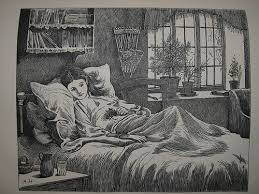
The nettle rash, or hives, that had attacked Susie Ames began to subside this morning, surely bringing relief not only to the little girl, but to her mother and everyone else interested in her welfare. As Susie began to feel better, she became agreeably occupied with an extra doll brought in for her to play with by her older cousin from next door, Helen Angier Ames.

Helen’s mother, Sarah Lothrop Ames, and Harriett Ames Mitchell left Easton today to go into Boston and Cambridge for a night. Perhaps they visited Sarah’s sixteen-year-old son Fred Ames at Harvard, where he was a new sophomore. Fifteen-year-old Francis E. Gilmore, the youngest son of Evelina’s brother Alson Gilmore, came to the Ames’s for midday dinner.  Was he visiting the construction site of his older brother, Edwin Williams Gilmore, who was building a home close to Ames compound? Francis lived down on the family farm, and was able to give a ride south to William and Eliza Whitwell, who had been visiting Sarah Witherell.

Meanwhile, focused and persistent, Old Oliver continued to supervise construction of a new flume from Great Pond near Stoughton south to the waterflow in North Easton. He noted in his daily journal that “this was a fair day with a strong wind from the north west and pritty cold. we got on the top stone to our floom to day.”


September 21, 1851

1525-105430-a-flumere

*

Sunday Sept 21st  Have been to meeting  Mr Ames & self came

home at noon and Horace Pool came with us

and they rode up to the great pond where they are

building a new floom.  Brought Abby Torrey from

meeting & carried her back  She & Malvina are spending 

a week at Alsons  Miss Latham & her brother Edward

came to our meeting this morning and to the other 

part of the house after  I called into see them

The new flume going in at Great Pond was attracting local attention. After church, Oakes Ames and Horace Pool rode up to see it. Oakes had been in Boston when his father, Old Oliver, had begun the work, and no doubt he was curious to see the progress.  No one would have been working on it today, as it was Sunday.

The flume was intended to harness water power for the shovel factory. It was basically an inclined ditch lined with stones and boulders to shunt the water along. Some flumes – such as those used in lumbering – are lined with wood, but that wasn’t likely to be the case here, given the scarcity of wood, the availability of stones, and the expectation of longevity. Old Oliver’s oxen must have been used to haul the many stones, and man-power used to put each one in place.  The channel itself would have been dug with Ames shovels, naturally.

Evelina, perhaps moving about slowly on sore feet, went to church and caught up with various friends and family members, including nieces Abby and Malvina Torrey. She popped into the other part of the house – the section lived in by Old Oliver and his daughter Sarah Witherell – to greet some visitors there.  She was settling back into her routine after the Boston holiday.

Photograph of an old flume, blogoteca.com/afonsoxavier, courtesy of Hadrian


September 20, 1851

Train

Sat Sept 20th  Was out shopping all day purchased a number

of articles among the rest a Cashmere & french print

dress paper for my parlour brought home two chairs

from Bigelowes  We all returned home this evening

Frank came to Stoughton after us & rode back

on the stage.  Went into Olivers awhile this evening.

Have had a great deal of trouble with my feet while

I have bee[n] gone & to night they are very sore.

The Boston spree continued for most of the day as Evelina walked and shopped for everything from fabric to wallpaper to furniture.  She and Oakes brought their purchases home on the train (or “in the cars” as they might have said) to Stoughton. It was, finally, time to return to North Easton.  Son Frank Morton Ames met them at the depot with a carriage – or wagon –  but rode home by himself on the local stagecoach. The conveyance he brought to the group getting off the train was, perhaps, too crowded with goods from town to fit everyone in.

Perhaps not wanting to let go of the many sensations that three exciting days in the city had produced, Evelina went next door to Oliver Jr and Sarah Lothrop Ames’s house. They had returned the day before, and so missed the fireworks. Surely they compared notes on their experiences at various events at the Railroad and Steamship Jubilee.  They may have compared blisters and sore shanks, too.  They did much walking and standing during their junket, and Evelina at least was feeling the effects. Her feet hurt.

Meanwhile, never having bothered to go into town for the celebration, Old Oliver was moving ahead on improvements for the shovel shop.  In his journal he noted that “this was a fair day wind south west and quite warm we put in the bottom stone for the floom at the great pond to day and the 5 foot one on the east side of it.” A flume for the factory was going in at Great Pond.

September 19, 1851

5209548721_5943a65d99_z

Friday Sept 19  Mr Ames went into Boston also Frank

We went to Mr Daniels store to see the procession

They were an hour and a quarter passing and we

were very much fatigued we were in the store about

four hours  We returned to Mr Orrs and dined

In the evening Mr Ames & self Mr Norris Emily & Helen

Mr Wm Harris & sister walked to see the illuminations

Oliver & wife returned home & Frank

The Railroad and Steamship Jubilee concluded today in Boston with a huge parade around the city that moved from School Street through Haymarket Square, down Merchants Row, State and Washington Streets toward Tremont, Park, and the Boston Common. There the procession traveled between a line of schoolchildren, then went along Beacon Street and turned toward Boylston, where they finished. The “civic procession” featured not just the requisite brass bands, waving pennants, dignitaries on horseback, carriages of officials, and marching men. It also offered something new: one whole marching division of selected representatives of industry, intended to showcase the thriving manufacturing of the greater Boston area. Were the Ames shovels included?

Evelina and various family members saw the parade from a shop on Washington Street. They stood for hours, first waiting, then watching as the parade rumbled by. The store owner, Mr. Daniels, was certainly kind to let the group stay for four hours. Perhaps he sold Ames shovels?

An afternoon banquet followed on the Boston Common under a special pavilion. This the Ameses did not attend (nor were they likely to have been invited – their railroad days were yet ahead of them.) The featured after-dinner speaker was Edward Everett, a minister, past president of Harvard, former U. S. Representative and one-time Governor of Massachusetts.  With all those qualifications, he was nonetheless best known for his oratory. In 1863, he would be the featured speaker at the dedication of the Gettysburg Battlefield. On this occasion in Boston, Everett spoke about ” The Beneficial Influence of Railroads.” His fitting summation to the three day celebration of the modern railroad was topped only by the evening display of illuminated buildings around the city and fireworks over Boston Harbor.

Evelina, Oakes, and a group of relatives and friends saw those “illuminations.” How memorable the whole day must have been, and how “fatigued” Evelina must have felt by the time her head hit the pillow.

September 17, 1851

Ruth_Morrill_wife_of_Justin_S._Morrill


*

Wednesday Sept 17th  Mrs Stevens left for Boston

this morning & sorry I am to have her go

Miss Eddy dined with Mrs Mitchell &

took tea at Olivers  I went in to tea but

went in but a few moments before as I have

been very busy all day.  Made about a dozen

Lbs of peach preserve & some grape jelly

Ruth Swan married to night Oakes A & Mrs H Mitchell

gone to the wedding

The Great Railroad and Steamship Jubilee kicked off in Boston today with the arrival of President Millard Fillmore and other dignitaries from the United States and Canada, all ready to express mutual congratulations over the new railroad and steamboat connection between their countries.

Evelina knew about the events in Boston but stayed focused on domestic responsibilities in North Easton. From fruit she had recently obtained, she made preserves and jelly, a day-long task that kept her “very busy”.

In the evening, her son Oakes Angier Ames and sister-in-law Harriett Ames Mitchell went to the wedding of Ruth Barrell Swan and Justin Smith Morrill of Vermont.  Ruth, a daughter of Dr. Caleb Swan and his first, late wife, was 28 years old and, in the culture of the day, was marrying late. Independent of the affection she must have felt for him, she may also have thought that he was worth the wait. Three years later, Justin Morrill was elected to the U.S. House of Representatives where he served until 1867, when he became a U.S. Senator. He served the state of Vermont until his death in 1898. A founder of the Republican party, he was a leader in establishing the land-grant colleges with his Morrill Land Grant bill in 1862. That same year, he authored the Anti-Polygamy Act which was aimed at the Church of the Latter Day Saints. He was clearly a one-woman man, and that woman was from Easton.

Ruth Ballard Swan of Easton who married Justin Smith Morrill.

September 16, 1851

Cake


Tuesday Sept 16th  Mrs Witherell Emily & Cousin H Mitchell

went into Boston this morning and are going to stop the

remainder of the week  I made some cake

this morning & had to be away from Miss Eddy

more than I could wish  Mrs S Ames & Helen &

Oliver here to tea  Harriet came in but did not stop

long  Miss Eddy will stop the night here

A visit from Miss Eddy, a woman who has been staying with various friends – or relatives – in Easton, may have been the impetus for Evelina to bake a cake this morning to serve at tea.  It’s worth noting that despite having collected peaches and grapes during the last few days, Evelina didn’t make a fruit pie or tarts to serve. She was saving that fruit to put up for the winter, and wouldn’t have wanted to waste any of it on a tiny social occasion. Cake it was.

The Ames family from next door, Oliver Jr., Sarah Lothrop Ames, and their daughter Helen came for tea, ate some cake and presumably chatted with Miss Eddy.  Sister-in-law Harriett Ames Mitchell stopped by briefly, too. Not making an appearance in the front parlour, however, was Sarah Witherell and her daughter from the other part of the house. They had departed that morning for a planned week in Boston, traveling with a Mitchell cousin.

Sarah Witherell had headed to Boston in anticipation of a special event, The Great Railroad and Steamship Jubilee. The Jubilee was to be a “celebration commemorative of the opening of railroad communication” to Canada.”*  It recognized the creation of a railroad line from Boston to Burlington, Vermont that connected with a steamship to Canada via Lake Champlain. Travel in the United States had become international. The celebration would go on for three days, and many members of the Ames family would strive to attend some part of it.


*The Railroad Jubilee: an account of the celebration commemorative of the opening of railroad communication between Boston and Canada, Sept. 17th, 18th and 19th, 1851.


September 8, 1851

1856_tea_BostonAlmanac


Monday Sept 8th  Mother Mrs Stevens & self sat down

to work in my chamber  The weather is very

hot  After dinner we went into the other

part of the house awhile it being so much

cooler  Abby came here to tea. Oakes A

Frank & Mrs Mitchell went to a party to Mr

Cushing Mitchells this Evening & are to spend the night

Tea had been on the serving tray very much of late, with or without short biscuits. Evelina served tea to her niece, Abby Torrey, today while yesterday she took tea at the parsonage during intermission. Three days ago, she hosted a small tea party for a guest, Mrs. Latham, her sister-in-law, Sarah Ames Witherell, and others. Evelina’s grandson, Winthrop Ames, described the importance of tea time some eighty years later:

“Supper, always called Tea, at seven was the sociable occasion.  It was usually consisted of cold meats, hot biscuits, preserves and cakes – an easy menu to expand for unexpected guests. Every week at least, and usually oftener, one household would invite the others and their visitors to tea; and the whole Ames family might assemble…”*

Although the Ameses grew and raised much of their own food, tea was a commodity that had to be purchased. Coffee and sugar, too.  As the above advertisement from 1856 indicates, tea and coffee could be purchased in bulk in Boston (not surprisingly, given Boston’s long history of importing tea into its harbor!) Black tea was the general favorite and, as the ad suggests, could be obtained in different grades of excellence.  Did the Ameses order in bulk?  Did they acquire a chest of tea at the family rate? Their careful use of money would imply that whichever Ames did the purchasing got the best product for the lowest price possible.

The weather, meanwhile, continued to be very hot. It didn’t prevent brothers Oakes Angier and Frank Morton and their youngest aunt, Harriett Ames Mitchell, from traveling to Bridgewater for a party and an overnight. Social goings-on continued.  No doubt, tea was served.

*Winthrop Ames, The Ames Family of Easton, Massachusetts, 1938, p. 128

September 7, 1851


Ames Home and Office, North Easton, Massachusetts ca. 1852 - 1862

Ames Home and Office, North Easton, Massachusetts
ca. 1852 – 1862

*

Sunday 7th  Have been to meeting all day  Mother

Mrs Stevens & I went to Mr Whitwells at

intermission Mrs Whitwell made a cup of tea

for us, brought mother home with us from meeting

at night  Mr Ames & I called at Mr Swains

Mr & Mrs Peckham are to leave tomorrow for

Taunton & the children & Mrs Metcalf  Thursday

The weather is very warm  Gave Mrs Stevens

some cuff pins it being her birth day.

Despite today’s heat, Evelina and her guest Mrs Stevens, and others of the Ames family, presumably, attended both morning and afternoon sessions of church. When the last service was over, they carried Evelina’s 79-year-old mother, Hannah Lothrop Gilmore, to North Easton to stay for a few days.

An important transition was taking place this week at the shovel works.  John Peckham, former clerk, and his family were leaving for Taunton.  His place in the Counting Office was being taken by John Swain, whom Oakes and Evelina went to visit late in the day.  Swain and his wife, Ann Meader Swain, probably hailed from Nantucket.  They had connections in North Easton, but the move to a new abode was still a big change for the young couple. Oakes, with his wide-armed jocularity and Evelina with her easy, approachable manners, must have made the Swains feel welcome.  Over the years, their friendship would solidify.

Many decades later, when Ann Swain was the only one of the foursome still alive, she told historian and minister William Chaffin about the special relationship between John Swain and Oakes Ames:

“…[H]er husband had his regular salary supplemented by an addition from Mr. Ames. Mr. Swain did more or less work for him, besides the regular office work when he was head clerk. Mr. Ames was not very methodical and his transactions for the day in Boston, jotted down in a notebook rather hastily, would sometimes be in a tangle when he came to the office in the evening (office work in those days always going on in the evening), and he would say to Mr. Swain, ‘Come, John, you help me straighten out these things.’ In common with all the persons who served him Mr. Swain had a strong affection for Mr. Ames.”**


*Ames Homestead with Counting Office on far left.  Residence demolished in 1951.

**William Chaffin, Oakes Ames, private publication                                   


September 6, 1851

shopping

Sat Sept 6th  Alson brought Mrs Stevens before we

were up this morning left his carriage here

while he went to Boston.  We went into Olivers

& passed the afternoon with Mrs Latham & Mrs W & Mrs

Mitchell I called on Mrs Peckham while the others

went to Mr Manly’s garden  Mr Ames brought home

some cuff pins for Alsons wife & Mrs Stevens

Evelina was probably pleased today to lapse back into a sociable, summer agenda.  Family friend Mrs. Stevens arrived at dawn, it would seem, delivered by Evelina’s brother Alson Gilmore on his way into Boston. The two women later went next door to call on Sarah Lothrop Ames and were joined by sisters-in-law Sarah Ames Witherell and Harriett Ames Mitchell and the former’s houseguest, Mrs. Latham.  Chat, chat, chat.

As they had done occasionally throughout the summer, many of the women went up to look at the flowers in Edwin Manley’s garden. The blooms they saw would be among the last for this year.  Evelina eschewed that walk (or ride) and went instead to call on Susan Peckham, wife of John Peckham, clerk for the shovel company.  The Peckhams were about to move, so perhaps Evelina went to see what help she could be, or to say goodbye. Susan Peckham must have been packing things up, a chore that would have made Evelina, who was lately familiar with the bustle of departure, feel right at home.

Oakes Ames spent the day in Boston, as he did almost every Saturday.  He went on business for the shovel company, often returning with orders or payments.  Just as often, he carried out particular errands for his wife.  Yet it’s not clear whether she or he or both, perhaps, suggested the purchase of cuff pins (perhaps what we call cuff links) for Mrs. Stevens and Henrietta Williams Gilmore.  Both women had birthdays around this time.