November 15, 1851


SUGARLOF

1851

Sat Nov 15th  Another day I have been about house all

day, this morning helped the gardener weigh out

a box of sugar that we bought in Boston

got my bags of cloth of different kinds

in order in the shed chamber  It has been

very stormy all day Mr Ames and Oliver Jr

in Boston Oliver went yesterday He looked 

at carriages but did not purchase one

Bridget gone to housekeeping

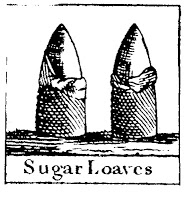
At the rate Evelina used sugar in her fruit preserves, she needed many loaves of it. Unable to purchase it at the family store in the village, she bought what they needed in Boston at Faneuil Hall.  On this day, she appeared to be breaking at least part of a sugar loaf into usable bits for her kitchen.  The family gardener helped her, perhaps because the sugar loaf was so heavy to hold.

Sugar wasn’t the only commodity that Boston had to offer.  Evelina’s husband, Oakes, and his brother, Oliver Ames Jr., had gone to the city, the latter in search of a new carriage. He – or they – didn’t purchase anything, just looked.  Oliver Jr. would have been very careful about the cost and quality of such a big item.  Both men would have admired the various coaches, chaises, gigs and traps they must have seen.

It’s worth noting that Evelina reveals today where she kept her “bags of cloth,” when not working on them: in the shed. As she organized them today, folding cloth and perhaps tossing any textiles that couldn’t be used, she would have heard steady rain on the roof.


November 13, 1851

Drum


Thursday Nov 13th  Have been cleaning the draws in

the beaureaus and have papered the closet beside

the fire place and painted some boxes &c

Ellen Meader […] has been making Susan a visit

this afternoon  The Stoughton band have been

in the neighborhood this evening. They marched 

and played up as far as the house and back to the

school house.  Went to Mr Swains and had coffee &c &c

Mr Ames has been to Boston

Stoughton, Massachusetts, has a wonderful musical legacy, most famously the Old Stoughton Musical Society, a choral group that has been active since 1786. Known in its first hundred-twenty years simply as the Stoughton Musical Society, some of its members referred to it as the “Grand Club”*. When it celebrated its centennial in 1886, Lt. Governor Oliver Ames and Governor George D. Robinson were two notable attendees at a celebratory concert. Oliver (3) was very fond of music; he even took singing lessons in his youth. He must have enjoyed the musical evening.

The long and revered history of the Old Stoughton Musical Society sheds no light on the existence of a Stoughton marching band, however. Evelina’s entry may be the only known mention – at least to date – of such a band.  On this day in 1851 it marched and played instruments through the village of North Easton, presumably after the factory had closed for the day. Why did it stop at the Ames’s house? What was the occasion? Surely the music it played was a welcome change from the usual clanging and hammering that emanated from the shovel shop.

Other than this pleasant interlude, Evelina’s day was ordinary.  While her daughter Susie had a friend over, Evelina cleaned, papered and painted.  Later in the day – perhaps as she accompanied little Ellen Meader home – she had “coffee &c &c” at the home of Ann and John H. Swain.  Oakes Ames spent the day in Boston.


Mary Swan Jones, The One Hundredth Anniversary Celebration, 1886


October 28, 1851

fig7

*

Tuesday Oct 28.  Have been assisting Mr Scott about papering

again to day and have painted over some things

and places about the house. Finished papering the

sitting room and little entry just after dinner

Hannah called with Eddy a few moments

Mr Ames is still in Boston passed last

night there.  I spent the evening in the other

part of the house.


Yesterday’s unseasonable snow storm departed and left behind “a fair day**”  Evelina seemed not to notice the difference, focused as she was on the repapering and repainting of the downstairs of her part of the house. She was helping with the actual papering. Her husband, Oakes, was away in Boston, so her only responsibility was making sure that meals were on the table for sons Oakes Angier and Frank Morton and daughter Susan Eveline, a task she typically delegated to her servants.

Hannah Lincoln Gilmore, who was married to Evelina’s nephew, Alson “Augustus” Gilmore, paid a call with her older son Eddy. Edward Alger Gilmore was a toddler who had fidgeted more than once in his great-aunt’s parlor. He was only two years old, and probably couldn’t yet pronounce his name.

Eddy’s middle name came from his maternal grandmother, Rachel Howard Alger (1802-1823), the first wife of Alson Gilmore and mother of Hannah’s husband, Augustus.  Rachel died less than a year after Augustus was born; Augustus couldn’t have remembered her, but he clearly wished to honor her by naming his own first-born after her. The Alger family was settled in Bridgewater, Taunton, and Easton, all descendants of a Thomas Alger in the 17th century. Both Evelina and Sarah Lothrop Ames were among the hundreds of descendants in the Thomas Alger line.


* Illustration in “Scientific American”, ca. 1880, of machine production of wallpaper, New York, Courtesy of National Park Service, http://www.cr.nps.gov/history/online_books/tpsd/wallpaper.

** Oliver Ames Journal, courtesy of Stonehill College Archives


October 27, 1851

winter_snowfall-t2

Monday Oct 27th  Mr Scott came this morning about nine

It being very stormy he could not get here before

Mr Smiley came just before and worked about

three hours.  After dinner went to Mansfield.

I have been helping Mr Scott paper the sitting

room  Have been busy all day about the 

papering.  Mr Ames went to Boston this afternoon

was also gone Thurs & Friday of last week


Snow! At least that’s what Old Oliver reported in his journal: “this morning the ground was coverd with snow and it snowd about all the forenoon, and was cold. wind north west + blowd hard, at night the fields are coverd with snow 2 or 3 inches deep – there has bin 1 ¼ inches of rain this time”  Evelina only reported that the weather was “stormy.”

Not only did the weather interfere with the travel of the workmen; it also surely challenged servant Jane McHanna as she attempted to wash and dry the weekly laundry. Yet it didn’t seem to prevent Oakes Ames from heading to Boston in the afternoon.  He had been there often of late.  Indoors, Mr. Scott continued to put up new wallpaper in the downstairs.  The redecorating and attendant removal of much of the furniture had been going for a week.

It was the 300th day of the year.

October 25, 1851

WHEATLAN-h

*

1851

Sat Oct 25th  Mr Scott & Holbrook have been to work

all day papering the parlour and they have got

it papered only from the little entry door

around to that corner of the mantlepiece.

Mr Smiley worked here about two hours to day

put on the border in the parlour as far as it [was]

papered and some paint on top of the closet

shelves.  I have trimmed the paper and &c.


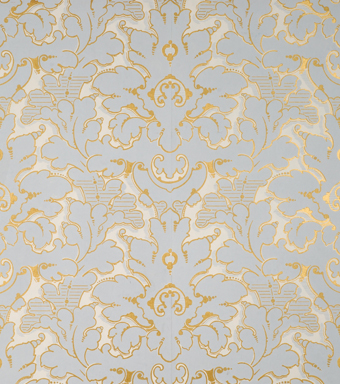
The wallpaper in the illustration above is an example of a mid-19th century pattern that might have been available in Boston, where Evelina purchased her new paper for the parlor. Two men, Mr. Scott and Mr. Holbrook, did some papering today, but not fast enough to suit Evelina. She was so eager to have the paper up that she helped by trimming some of it herself.  What did the workmen think about that? Mr. Smiley, who only seemed to work a few hours at a time, applied a border to what paper had been put up and painted a few shelves.

Oakes Ames was probably absent today, as Saturday was his usual day to be in Boston taking orders for shovels. Sons Oakes Angier and Frank Morton would have been at the factory across the street, honing their skills in the manufacture of shovels. Little Susie was probably at school.


*Example of mid-19th century wallpaper, courtesy of adelphiapaperhanging.com

October 18, 1851


Herman_Melville_1860Herman Melville

Sat Oct 18  Have been to Boston with Mr Ames to day &

have bought Paper for the sitting room &c &c

went into all the stores where there were ribbons

to match my dress could not find a good one

Did not get near all the things I wanted

Lavinia came here to night.  Mrs S Witherell

& Miss S Orr called a few moments

It was a full Saturday for Evelina. She accompanied her husband into Boston and while he probably visited customers and took orders for shovels, or collected payments from various vendors, Evelina went shopping. She purchased new wallpaper for the sitting room and more. She was on a tear to refurbish the old homestead – or at least her half of it – yet wasn’t able to “get near all the things” she wanted.  She searched for ribbon, too, maybe to go with the new cashmere dress that she and Julia Mahoney only recently finished.

Evelina and Oakes returned to Easton in time to welcome niece Lavinia Gilmore for the night. As they traveled back from the city, they may have noticed the sky beginning to cloud up, pushed along by winds from the south. After their return, Sarah Witherell and her houseguest, spinster Susan Orr, popped in from the other part of the house, perhaps to ask what wallpaper Evelina had selected.

Far away, in London, 500 copies of a new novel called “The Whale” were published today in three small volumes. In a month, the same book, written by young American author Herman Melville, who dedicated it to his friend Nathaniel Hawthorne, would be published in New York with an added title: “Moby-Dick.”  Evelina never mentioned it, but might she have read it?

October 14, 1851


Corpse


Tues Oct 14th  Expected Julia here to work this 

morning but she sent word that she would not come

untill afternoon and it has put me back about my work.

Went to the store and got muslin for Mrs Willis robe,

and linings for dresses.  Helped Mrs Witherell & Mrs S

Ames make the robe  Julia came this afternoon & cut

the waist to my dress  Mr Ames has been to Boston &

Braintree

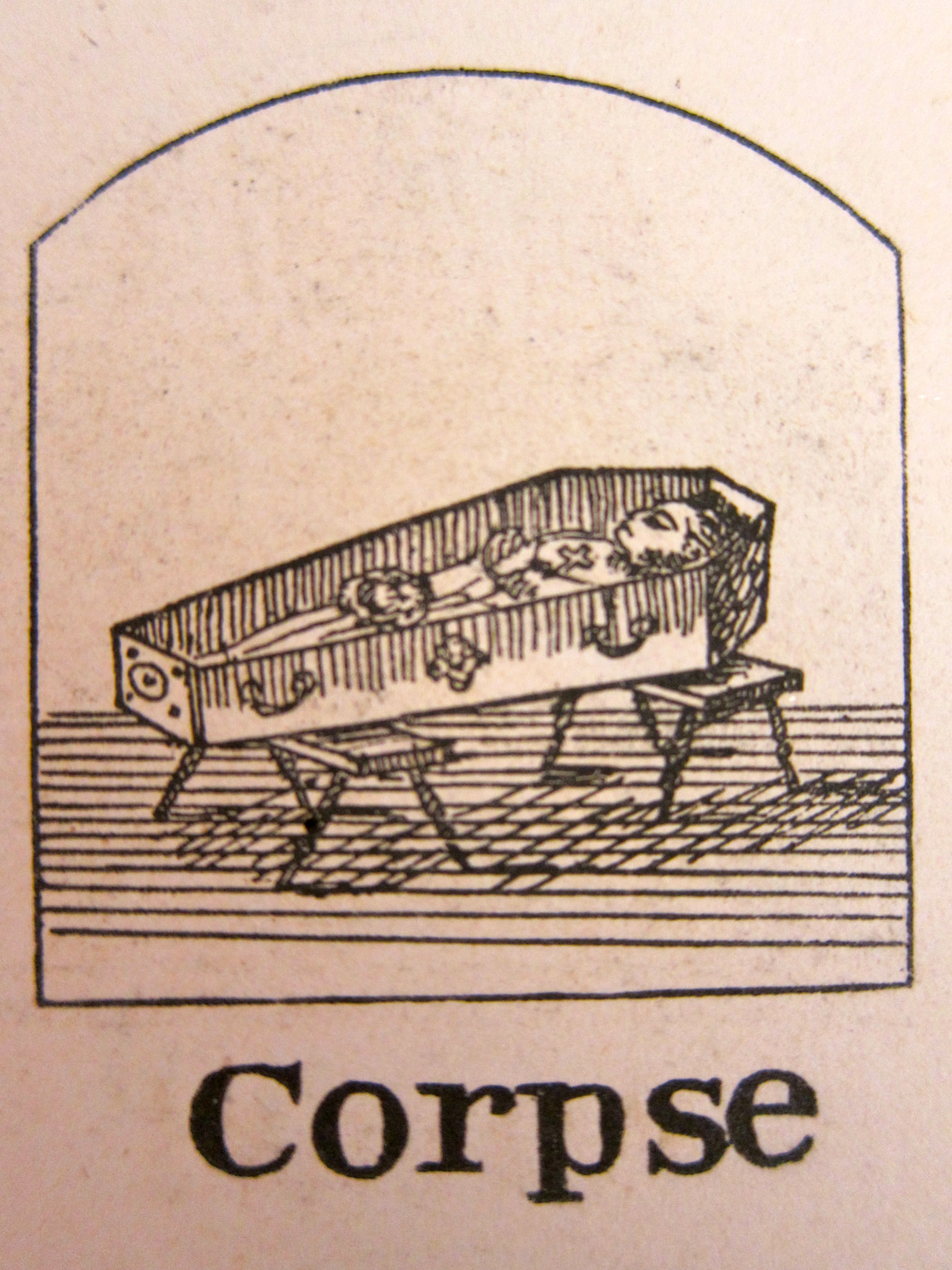
The sad business of sewing a robe, which is what the Ameses called a shroud, fell to Evelina and her sisters-in-law. The Ames women often were called on to make robes for the deceased, as they did today for a neighbor, Mrs. Willis. Mrs. Willis, who had died the day before, presumably had no family members who could otherwise sew the robe. Evelina herself picked up the muslin, the traditional material for a burial sheet, from the Ames store. The process of preparing the dead for burial tended to follow the existing customs:

“Before the Civil War, the care of the dead was largely the domain of the deceased’s family and neighbors. The corpse was customarily laid out on a board that was draped with a sheet and supported by chairs at either end. The body was washed, almost always by a female member of the household, and wrapped in a sheet for burial. A local carpenter or furniture maker […] supplied a coffin, a simple pine box with a lid. The undertaker, often the same carpenter or furniture maker […] took the coffin to the house and placed the body inside. With the family and friends gathered around, the minister performed the appropriate religious rituals, and then the undertaker conveyed the coffin to the graveyard.”*

Other sewing went on today as well. Evelina had spent the past several days piecing together a dress made of cashmere, and was waiting for the dressmaker of choice, Julia Mahoney, to work on the waist.  Julia was late, however, which threw a wrench into Evelina’s plans for the day. Evelina didn’t like tardiness, and was unhappy to have to rearrange her day. Eventually, however, Julia arrived and “cut the waist.”

Oakes Ames, meanwhile, went into Boston and Braintree, presumably on shovel business.  Saturday was his usual day to go into Boston; it being Tuesday, perhaps something beyond Oakes’s usual job of taking orders for shovels was called for.

*http://www.memorialhall.mass.edu/classroom/curriculum , “Death and Dying in the 18th and 19th Centuries”


October 2, 1851

9904548_1_l


*


Oct 2d Thursday  Helped Ellen quilt some this forenoon 

She seems to do pretty well at it

Mrs Elijah & Ellen Howard & Mrs Abba Leach

spend the day and evening in the other part

of the house  I was there at tea.  Oliver &

wife have been to her fathers  Mr Ames has been

to Boston   Lavinia Williams came in the stage

with him but he did not speak to her

Evelina and her servant, Ellen, worked on the new quilt this morning .  Evelina had set the quilt up in the sitting room using a frame that could be dismantled and stored. The frame would have had four wooden legs at the corners, such as those in the illustration above.  Long boards around which the quilt edge was wrapped would have been fastened into the corners, creating an adjustable rectangle on which the women could work.  When finished the pieces of wood would be stowed away until needed again.

In the other part of the house, Sarah Witherell welcomed Nancy Howard, her daughter Ellen Howard, and Mrs. Abba Leach for the day. The women made a social visit that lasted all day and into the evening. Did they bring any needlework or sewing with them, or was conversation the only occupation? Evelina dropped in for tea, but Sarah Lothrop Ames from next door didn’t join them. She and her husband Oliver Jr were calling on her parents, the Hon. Howard Lothrop and his wife Sally. The Lothrop family may still have been wrestling over how to manage the family farm since the death of Clinton Lothrop, Sarah’s younger brother.

From Boston, where he was probably collecting orders for shovels, Oakes Ames returned home on the stagecoach where he sat with an acquaintance of Evelina, Lavinia Williams.  Mrs. Williams was the wife of Cyrus Williams, a local farmer of some means. Evelina seemed surprised that Oakes and Lavinia didn’t converse en route.

Even as Evelina was looking back at the day’s small social exchanges, she was beginning to feel unwell, something she wouldn’t report for another few entries.


September 30, 1851

IMG_0004

21st century view of apartment building owned by Col. John Torrey, which Augustus Gilmore and his young family moved into in 1851

Sept Tuesday 30  Augustus family left this afternoon for

their new place  his wife went this forenoon

and put down two ca[r]pets and put up two beds

I went about four Oclock and helped her

untill night   passed part of the evening in

the other part of the house  I have been to 

work a very little on my dresses and so

has Ellen  Helen left this morning for school in Boston

It was “a fair day + pritty warm”*, so folks who had stayed inside yesterday because of the rain were able to be out and about today. Evelina must have felt better, too, as she helped her nephew’s wife, Hannah Lothrop Gilmore, set up housekeeping in their new quarters in the village. Practiced mothers, they probably kept their eyes on Hannah’s small sons as they worked.

Helen Angier Ames, fourteen-year-old daughter of Sarah Lothrop and Oliver Ames Jr., left for Boston this morning.  She was going to a new school, the third one this year. Clearly she, or her parents, had had difficulty settling on the right situation. Perhaps this one would be the charm. We don’t know which academy or seminary she was headed to; there were probably several schools to chose from. The Auburndale Female Seminary was one that was established about this time (today is exists as Lasell College) though we have no indication that this was the one, among many, that the Oliver Ameses would have settled on for their daughter.

The Girls High and Normal School started up around the mid-19th century as well.  It was focused on training young women to become teachers, and thus was unlikely to be the institution that Helen Ames went to.  Helen didn’t need to be trained to make a living.  A smaller, private outfit was likely to have been the place for her.

* Oliver Ames, Journal

September 27, 1851

333_EOA_484_-_1850_20_H1a

 $20 Gold Piece, 1850

Sat Sept 27  Have been very busy to day but can

scarcely tell what I have done have been working

about house most of the time  Have bought

Mrs Mitchells beaureau and to night it has

come and it looks better than I expected  agreed

to pay her 18 dollars but shall give her 20 for it

Mr Ames carried back the chairs to Bigelows

and bought me one at Courrier & Trouts for […] 25 Dols

William Chaffin, Unitarian minister and town historian, once described Evelina as “very economical.”* He claimed that she mended her husband’s pants so that he wouldn’t have to spend money on new ones. Some Ames descendants and others knowledgeable about the family history also consider Evelina to be the personification of Yankee frugality. She sewed tucks into dresses, reused old pieces of carpet, made her own soap and kept careful household accounts. She mended coats, upholstered a lounge for the parlor and roped relatives and friends into helping her make shirts for all the men in her house. She did work that she could have paid others to do for her. Was she being cheap or was work a habit with her? Or both?

Evelina could and did spend money, as last week’s flurry of shopping in Boston demonstrates. She bought dress fabric, chairs for the parlor and new wallpaper. And today, only one week later, she paid her sister-in-law, Harriett, $2 more for a chest of drawers than the price they had agreed upon. The gesture was generous, and underscores the possibility that Evelina was not quite the cheapskate that family tradition has allowed.

As the acquisition of the used “beaureau” shows, Evelina was having a burst of redecorating. What had set this off? The shovel shop was doing well, obviously, so they could afford to buy new things. Beyond having the means, what encouraged her to make these alterations? Was she being encouraged by her husband? He seemed to be right there with her at the store.  Was Oakes’s participation prompted by an easy complacency about his wife’s spending or a shared enthusiasm for the new purchases? Was an influx of wealth changing the way they lived?

* William Chaffin, Oakes Ames, private publication, Courtesy of Easton Historical Society