April 24, 1852

7841216_6_l

Sat 1852

April 24  Mrs Ames returned last night I came

from Boston to night.  Like my things pretty well

have bought me some bronze candelabras

drugget a lot of gentlemans hose &c &c

Got through with my shopping about three

and went to Mr Orrs.  Lucia Harris is

there Mrs Witherell & Ames came to see my

things in the evening

The bronze candleabras that Evelina bought in Boston today were purchased, in all likelihood, for the parlor. They were a formal throwback to the time when candles were used for lighting, which was the period that began when the Pilgrims first arrived and lasted to the early part of the 19th century.  By 1852, however, oil lamps and very soon, kerosene lamps, were becoming standard fare for lighting. They were more economical than candles.

Burning candles, then, was something of a “retro” effort that honored the grace and warmth of the familiar candlestick, and suggested that the homeowner had enough money to burn candles if he so chose. No smudgy little whale oil lamp for the parlor or the dinner table, though oil lamps of varying styles and efficiency might operate in the rest of the house. In the room in which company was entertained, the candleabras would glow, and brag.

Both sisters-in-law came over at the end of the day to see what Evelina had bought, and it’s hard to imagine they were interested in the “gentlemans hose &c.” They came over to check out the new candleabras.
April 23, 1852

Boston, early 1850s, partial panoramic view

 Partial view of Boston and Cambridge from the Bunker Hill Monument, early 1850s*

1852

Friday April 23d  Went to Boston with Mrs S Ames

Called on Mrs Stevens did not stop with

her more than 15 minutes. Went to Mr Orrs

at night  Julia is there with her babe she

grows nicely and Julia is quite smart

I was about a great deal and was very

much fatigued but had a good […]

comfortable day

Evelina had not been out of Easton for more than two months.  Her last trip to Boston had been in the middle of February, when she’d traveled in with her son Oliver (3) and shopped for prints for the parlor.  That was before the fire at the shovel shop. With so much time having elapsed, she must have been eager to get to the city again.

She traveled into town with her sister-in-law, Sarah Lothrop Ames. They may have called together on family friend Mrs. Stevens, but they likely went their own ways afterwards. As usual, Evelina stayed with the family of Robert and Melinda Orr, where she visited their daughter Julianne Orr Harris (Mrs. Benjamin Winslow Harris) and her new baby, Mary, at whose birth Evelina had been present. Both mother and daughter seemed healthy.

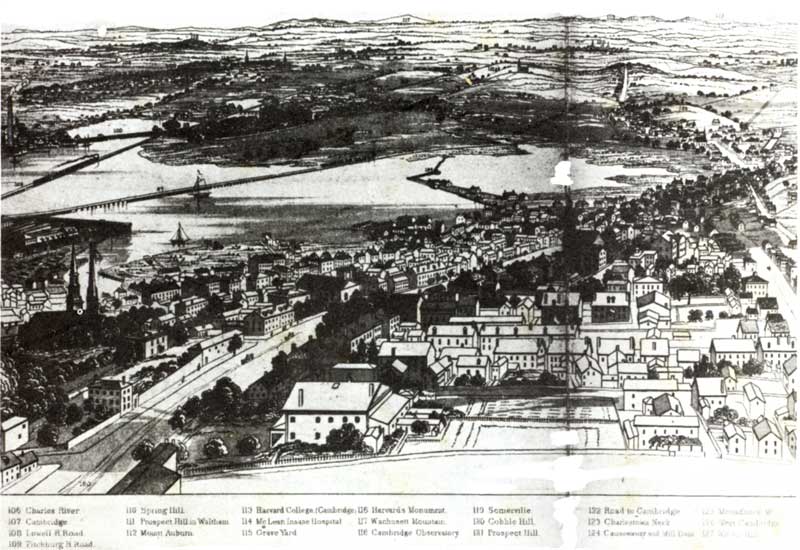
Boston was probably bustling at this time of year, trees at the bud and the air cold but promising. The partial view of the city in the illustration above, made about this time, shows a city that was growing west and south. Between 1840 and 1850, its population had grown from 93,383 people to 136,881. By 1860, the count had reached 177,840. In this vista, railroads are visible, and a Back Bay sits ready to be completely filled..

The view was captured from the top of the Bunker Hill Monument, itself a recent feature of the landscape. Replacing an earlier monument also dedicated to the Revolutionary War battle in Charlestown, it was completed in 1842 and dedicated in 1843. Antiquarian Samuel Gardner Drake (and one of the founders of the New England Geneaological Society) published the panorama in his The History and Antiquities of Boston  in 1856 .


*Partial image of Panorama of Boston and Cambridge from top of Bunker Hill Monument, from The History and Antiquities of Boston, published in 1856 by Samuel Gardner Drake

April 17, 1852

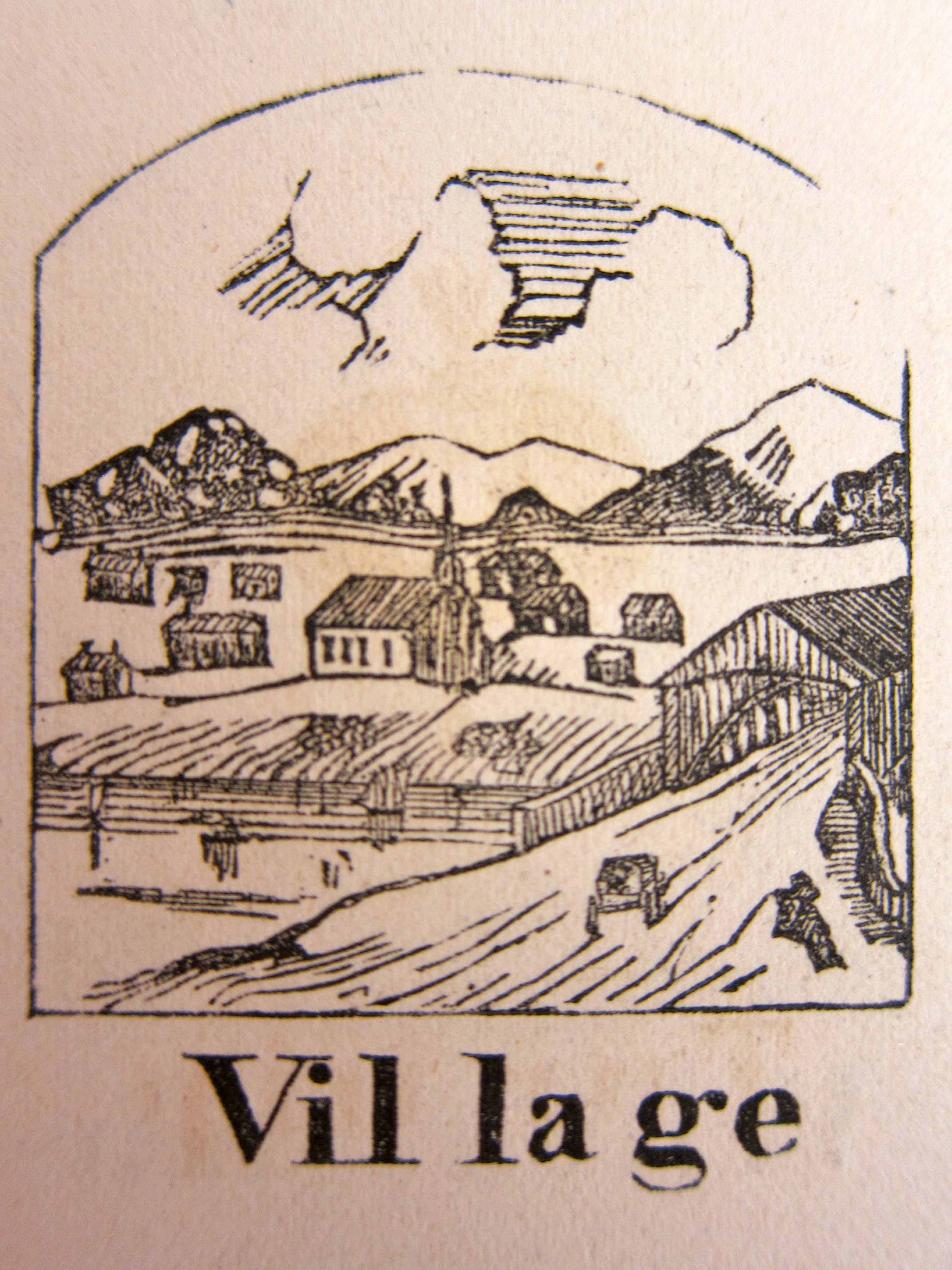
Village

1852

April 17  Saturday  Julia was at work here a year ago to day

has improved very much in dress making since then

I have my black silk nearly finished.  The Delaine

all done except the sleeves & buttons, am waiting

to go to Boston to get the trimmings.  This afternoon 

have been altering some old dresses for Susan

Hannah called to get me to go up by the school

house and select a place for a house for them

Mrs Witherell went with me  A beautiful pleasant day

Sewing continued today, with Julia Mahoney again on hand to assist with Evelina’s new dresses, one of black silk, the other of a light wool they called delaine. The finished projects would have to wait for trimmings to be fetched from Boston. Evelina meanwhile refashioned some old dresses for her daughter, for “[e]very season there was a great remaking of old garments to bring them up to date.”*

The bad weather of the past two days disappeared and was replaced by fair skies. Despite continued cold temperatures, Evelina was finally drawn outside on a fun errand. Invited by her niece, Hannah Lincoln Gilmore, and accompanied by her sister-in-law, Sarah Ames Witherell, she went to the local school house to look at some property that her nephew, Alson Augustus Gilmore, and Hannah, his wife, were considering.  They had been renting rooms from Col. John Torrey, but now were planning to build a house.

Everyone in North Easton lately seemed to be wielding a hammer. It was spring.


*Winthrop Ames, The Ames Family of Easton, Massachusetts, p. 127


March 26, 1852

imgres


1852.

Friday March 26  Mrs S Ames returned from Boston last

night, had unpleasant weather for two days.  She called

at Mr Orrs found them all well. Julia is there

yet with her little one  Mrs S Ames & Witherell

called on Mrs Elizabeth Lothrop and invited me

to go with them but I felt it more my duty to call

on Mrs Swain, did so, and was prevailed upon to 

spend the afternoon & evening.  She has weaned her

babe, has been quite unwell but is now better

Two young women closely connected to Evelina recently weaned their babies. Hannah Lincoln Gilmore, wife of Evelina’s nephew Augustus, had just weaned her seven month old son, Willie. Ann Swain, wife of the head clerk of the shovel works, John Swain, had done the same with her five month old boy, John.

Weaning was an anxious time for both babies and mothers, although in this circumstance it appears the babies came through the ordeal better than their mothers, at least at first. Both Hannah and Ann had been unwell during the process. Evelina, in her attentive way, had spent time with the two young mothers while they ailed. As a practiced mother who had nursed and weaned five babies of her own, she may have offered advice and provided significant comfort to the younger women.

In Boston on this day in 1852, far from the concerns of the nursery, a new house of worship, the Temple Ohabei Shalom, the first synagogue in Boston, was consecrated. Although the temple, built on Warren Street, is no longer standing, we know that was architecturally handsome and well-appointed. It could seat 400 worshipers and also offered an area for a Hebrew School, a meeting room, and a bath, known as a mikveh.* A temple by the same names exists today on Beacon Street in Brookline.

Although Easton now has a synagogue, the Temple Chayai Shalom, it did not have one, nor did it have a visible Jewish community, in 1852.


* Jim Vrabel, When in Boston, Boston, 2004, p. 160

February 23, 1852

Looking glass

Monday 23d Feb 1852  Worked about the house this forenoon

dusted the chambers and washed around the

windows &  doors.  Susan washed the dishes. Am

trying to have her learn to knit, improves some

but rather slowly  This afternoon have been mending

some and have put one new sleeve into my

blue & orange Delaine  The looking glass came

out from Boston to night

We might call it a mirror, but Evelina and most of her contemporaries called her new purchase a looking glass. (Think of “Through the Looking Glass and What Alice Found There,” Lewis Carroll’s 1871 sequel to his 1865 “Alice’s Adventures in Wonderland.”) Like the framed prints Evelina had recently bought for her walls, the looking glass was a fashionable piece of decor. She must have been tickled to have one hanging in her parlor.

New “methods of mass-producing large, flat panes of glass had been perfected and, by combining them with heatless, chemical-coating technologies,”* mirrors had become easy to manufacture – and affordable.  At mid-century they became stylish and ubiquitous, symbolic of the new taste and purchasing power of the middle class. In a home like Evelina’s which, 50 years earlier, might have boasted no more than a small, courting-type mirror, a big, new looking glass, hung on braided silk roping from molding above it, had become de rigeur.

Other than this exciting upgrade in the parlor, today was a Monday like any other. Jane McHanna did the laundry, Susie Ames washed the breakfast dishes, and Evelina took to her needlework.  She was teaching her daughter to knit.


*Wikipedia, Mirrors, accessed February 19, 2015.

February 13, 1852


Fire engine

1852

Feb 13th  Friday  Have been to work on Olivers shirt

that I was intending to finish last week and have not

got it done yet  have scarcely got over my

Boston jaunt.  Carried my sewing into the other

half of the house awhile  Brother Oliver returned

from Boston to night & says the large machine

shop just back of Mr Orrs was burned last night

Mrs Witherell here about two hours this evening

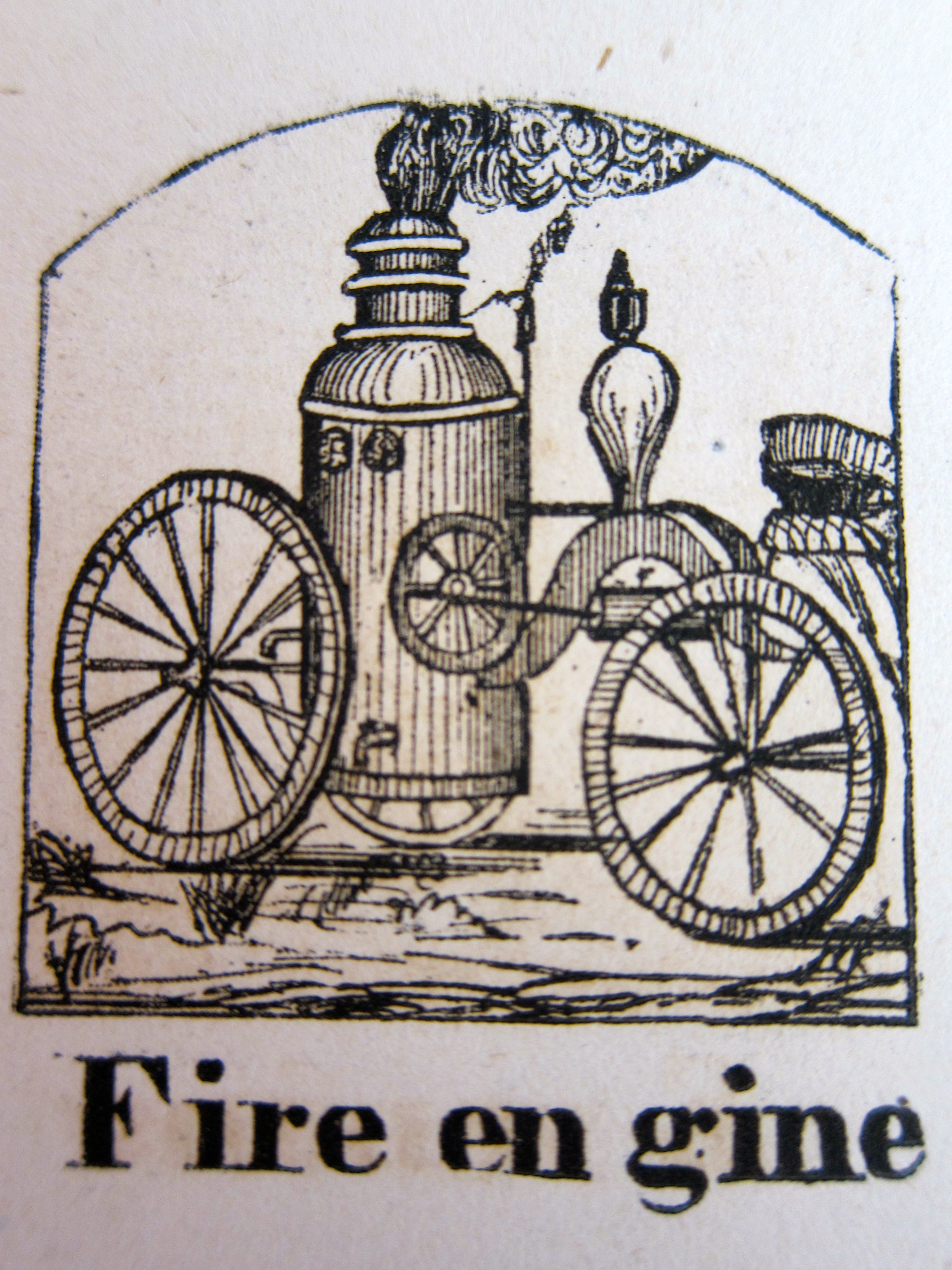
A serious fire happened in Boston, as Oliver Ames Jr. reported when he got home. The family probably read about it in the city newspapers, including The Boston Atlas:

“FIRE. – Firemen Injured. – About 10 o’clock last night a fire was discovered in the upper part of a five story brick building, in the rear of No. 24 Kingston street. The fire broke out upon the upper floor, used for chair painting. The flames spread rapidly, and in a few minutes the roof fell in, pressing portions of the walls over the sides, the falling bricks injuring five firemen who were upon ladders directing the streams upon the fire, two of them very badly indeed. The third story was improved by the “Boston Laundry,” and was burnt out. The second story, occupied as Fox’s machine shop, and the first by Horace Jenkins, mason, were thoroughly drenched with water. The building, a sham built concern, is owned by Willard Sears. The wind was quite high and the weather freezing cold at the time, and the firemen deserve great credit for their well directed and energetic efforts in subduing the devouring elements, – and it is with pain and regret that we have to record injury to so many of their number: – John Smith, of Hydrant No. 2, very severely in the back and shoulders; Christian Karcher, Engine C. No. 1, badly bruised; Abraham Ross and James McCullis, of Hydrant Co. No. 3, bruised. Charles Ricker, of same company, received a severe injury in the back. It was reported that Smith’s and Ricker’s injuries are of a very serious nature. They were all carried into houses nearby, and medical aid procured.”

Then as now, fire was deadly serious.  John Smith died of his injuries three days later, Boston’s first modern fireman to suffer a Line of Duty Death.**

*The Boston Atlas, February 12, 1852

**http://www.bostonfirehistory.org, accessed Feb. 11, 2015

February 11, 1852

Rain

Feb 11th Wednesday  Returned from Boston to night very

much fatigued  It has rained poringly all

day and I was out shopping and most horrible

walking in the streets  Went to Doe & Hazleton

and bargained for a looking glass  bought an

all wool Delaine of Mr Norris  Mrs Witherell

was here some time this morning

Boston in February is subject to terrible weather, as Beantown residents in 2015 know all too well from recent record-breaking snow.  In 1852, heavy precipitation was also the rule, although on this particular day it didn’t snow, but “rained poringly.” Shopping suddenly wasn’t as much fun as it had been the past two days. Evelina found the going “most horrible,” but still managed to chase down some good buys.

She treked to an area of the city known as Cornhill – not Cornhill Street, or Lane, or Road, but just plain Cornhill.  This area of the city is now irrevocably altered, having been turned into Government Center, a modernistic architectural complex, in the 1970s.  Only a small portion of the original Cornhill known as Sears Crescent now remains. In the 1840s and 1850s, Cornhill was known as a center for Boston’s intelligentsia. Writers, poets, and book publishers gathered there.

In 1852, at number 42 to 48 Cornhill, there were also several retail shops, including one called Doe & Hazleton. Owned by Joseph Doe and J. M. Hazleton, the store specialized in “Decorative Furniture.” It was there that Evelina went and “bargained for” a mirror, to be delivered to North Easton in the near future.  She also bought some wool cloth from another Orr son-in-law, Caleb Norris, and probably had that delivered, as well.

By day’s end, Evelina was back in North Easton, “much fatigued” from her shopping.

February 10, 1852


thetouc2

Physician-assisted childbirth, mid-19th century

Feb 10th, Tuesday

1852  Went out shopping about 11 Oclock staid untill

that time with Mrs Harris who was confined with

a daughter born about two Oclock.  looked at engraving

again today purchased Allhalloween  Oliver returned 

home to night but I did not get through with my

shopping and concluded to stop another night

Mr Harris came in the cars this afternoon heard of her

sickness just in time to take them  Oliver Jr called at Mr Orrs

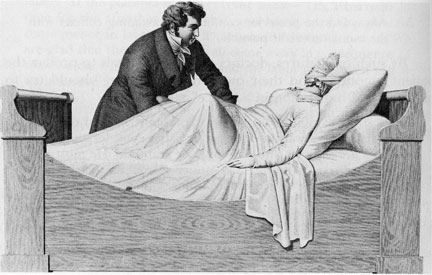
While shopping for art in Boston with her son Oliver (3), Evelina had another memorable day. Per usual, she stayed with the Robert Orr family in the city. While there, one of the Orr daughters, Julianne Orr Harris, went into labor and gave birth to a girl.  Evelina stayed with Julianne for a time, which would have been normal in the older tradition of a “circle of women” being present at childbirth. Evelina’s timetable is a bit confusing, but it sounds as though she was there for much of the labor – or “sickness” –  if not at the actual delivery.

It’s likely that a male doctor presided at the birth, because by this period, especially in urban areas, physician-assisted births had become the rule rather than the exception. Midwives were phased out, although they never entirely disappeared. One result of this change was that strict propriety in the birthing room prevailed over medical accuracy, at least in the 19th century. Modern historian Jack Larkin notes:

“Embarrassment and constraint became part of the birth process; physicians were greatly hindered, as midwives had never been, by firmly established canons of female modesty. Men could not look directly at their patients’ genitals, but had to examine them only by touch while they remained fully clothed.Often deeply uncomfortable with a bedchamber full of women looking on – sometimes critically – doctors tried to persuade expectant mothers to clear them out of the birthing room.”

Julianne’s husband, Benjamin Winslow Harris, was away when his wife went into labor, but got a message, somehow, and just made the train home. He would not have participated in the birth itself, but he may have had a hand in the naming of his first child: Mary Harris, after his own mother.


*Jack Larkin, The Reshaping of Everyday Life,New York, 1988, p.97.


February 9, 1852


Boston_art_club_design_wm_emerson

Architectural Rendering of Boston Art Club, ca. 1882

Feb 9th  Monday  Went to Boston with Oliver  spent

the forenoon in looking at pictures.  dined at

Mr Orrs.  Afternoon Mrs Stevens & Mrs Morse

went with us to look at pictures.  purchased 

two engravings one of them painted  returned to

Mr Orrs and spent the evening in playing 

cards  Very fine weather

Evelina’s boring Sunday in North Easton gave way to a few fun days of shopping in Boston. Leaving Jane McHanna to manage the house in her absence, she traveled into the city accompanied by her middle son, Oliver (3), the only son who wasn’t working. The two of them spent the day looking at “pictures” – prints and paintings, probably – and ended up buying two engravings. That one was “painted” meant that it had been hand-colored.

Where did they shop? At a gallery? At an artist’s studio? Amory Hall on Washington Street was one facility that accommodated artists at the time.Who was selling engravings in 1852? Readers, do you know?

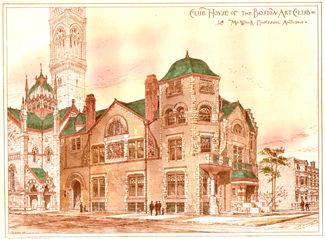
It’s hardly arbitrary that Oliver (3) was the son who shopped for art with his mother. Besides being the only male in the family at liberty to take his mother into town, Oliver (3) loved art. He would collect paintings, prints and sculpture all through his life, in fact, especially after he and Anna C. Ray had married and built their large homes in North Easton and Boston. Before becoming governor, Oliver (3) traveled a great deal as a salesman for O. Ames and Sons and, in the process, bought art for himself at galleries in New York City and elsewhere. In the 1880s, he was also president of the Boston Art Club, an artists’ consortium begun in 1854 – 1855 that expanded to include wealthy patrons such as Oliver Ames.

February 5, 1852

imgres

Jenny Lind 

(1820- 1887)

Thursday  Feb 5th  Have not been very well to day after being

out last evening.  Have put a new bosom into

an old shirt of Olivers  Passed part of the

afternoon at Edwins and part of the evening in

Olivers was also there about two hours this forenoon

It is a delightful evening and fine sleighing


A celebrity wedding took place in Boston on this date. Opera singer Jenny Lind married her accompanist, Otto Goldschmidt, at the home of banker Samuel Gray Ward in Louisburg Square.* There was no People Magazine, Entertainment Tonight or The Daily Beast to herald the occasion, but the newspapers of the day carried the story.  “The Swedish Nightingale” was big news.

Originally from Sweden, Jenny Lind was discovered at the age of nine when the maid of a dancer at the Royal Opera overheard her singing. Though untrained, Lind soon rose to prominence on the strength of her beautiful soprano voice and became court singer to the King of Sweden and Norway. She almost damaged her vocal cords in the process, but rest and proper training set her to rights. She became world-famous in operas such as Der Freischutz  and Lucia di Lammermoor.  

In 1850, showman P. T. Barnum brought Jenny Lind to the United States, where she gave 93 performances over two years. When she married in Boston, she was nearing the end of her American tour and would soon to return to Europe. At 32, she would retire from touring and become the mother of three, yet she would continue to perform occasionally and teach for the remainder of her life. Many of us in the 21st century know of Jenny Lind as much for a style of spool bed that carries her name as for her acclaim as an early international opera star.


* Jim Vrabel, It Happened in Boston, p. 61