May 12, 1851

ServiceBerry1

Monday May 12th  Was about house all the forenoon but

cannot tell what doing  Jane has done the washing.

Orinthia washed the dishes for her. This afternoon

Orinthia and I have been out to plant the flower seeds

and I got some Shad berry & Burgundy Rose bushes

from Olivers & flowering Almonds from Alsons We 

were at work in the garden three or four hours

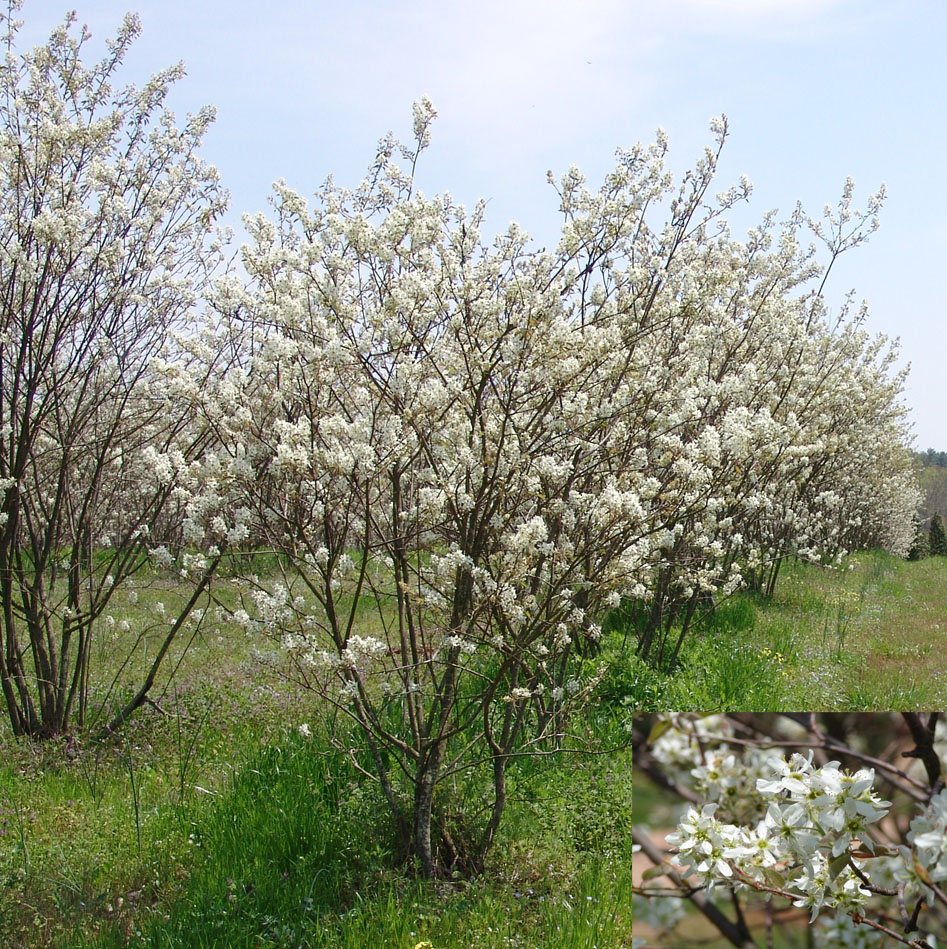
A sure sign of spring in New England is the blooming of the shadbush.  Because its little white flowers are among the earliest to be seen, its blossoms were often used at springtime funerals in the seventeenth, eighteenth and nineteenth centuries. Thus shadbush is also called the “serviceberry” bush for its appearance at funeral services; in some other locations it’s known as the “Juneberry” bush.  Wherever and whenever it grew, its presentation of blossoms was as welcome as the first robin.  The red berries it produced could be used in pies or, if not harvested, would be consumed by those same robins and other birds like cedar waxwings.

The shadberry bushes at Evelina’s were most likely planted out back behind the house near the Queset Brook, where they would tolerate the partial shade and indifferent soil.  However, the Burgundy Rose bushes that Evelina also obtained from her obliging brother-in-law, Oliver Jr., would have required a more selective location in the sun.  Were those roses planted right in Evelina’s flower beds?  Were they as red as their name sounds?

Her brother, Alson Gilmore, provided Evelina with flowering Almond bushes (Latin name is Prunus triloba.)  In contrast to the white serviceberry and the red roses, the flowering almonds produced pink blossoms.  Evelina was evidently aiming for a rosy spectrum in her yard. The flowering almonds like sun, so where might she have planted them?

The work of planting the various bushes took Evelina and Orinthia several hours to complete, and must have given them a real sense of accomplishment – not to mention sore backs.

April 9, 1851

Wagon

1851

April 9th Wednesday  This day has been a busy one but I can

scarcely tell what I have done but have been about

many things.  Lavinia came this afternoon with her

father He was going to North Bridgewater and

came this way to bring her.  They were here […]

to tea They have all gone to the assembly to

night at Lothrops Hall I believe it is the last

dance for the present A[u]gustus gone to Boston. Pleasant

We all have days that zoom by unaccountably; we get to the end of them and wonder what we did.  Evelina had one of those days today; she could “scarcely tell” how she passed the time.  She probably dealt with various household chores: mending, sweeping, overseeing Jane McHanna, perhaps stirring something on the stove or straightening up a clutter of periodicals in the sitting room.  With three sons and a daughter under her roof, she certainly passed part of the day tending to their needs and conversing with them over small matters. She saw her husband out the door and perhaps urged him not to forget to come home for tea. She may have popped next door to check on Sarah Lothrop Ames, who remained ill in bed.

Her niece Lavinia Gilmore stopped over, having been carried from the Gilmore farm to the village by her father, Alson Gilmore. Did they travel in a farm wagon or a carriage? After tea, Lavinia and her male cousins went to the dance at Lothrop Hall, the last of the season.  Formal socializing for the young set would have to wait until next fall.


March 13, 1851

mens_fashion_1856

1851  March 13  Thursday  This forenoon worked on an old pair of 

pants for Oliver  They needed a great deal of 

repairing and I worked on them untill two Oclock

This afternoon & evening spent at Alsons with Oliver 

& wife, Wm Reed & wife, Mrs Whitwell, A[u]gustus & J. Pool

& wife passed a very pleasant afternoon.  I knit on

Susans Angola yarn stocking.  It has stormed

quite hard all the afternoon, got there about five Oclock

Did the Ames men dress like the gentlemen in this 1850’s illustration?  Oakes Ames, as we know from stories his appalled friends told, did not dress so well. But his sons might have aspired to be fashionable. Certainly Oliver (3), whose old pants Evelina mended today, might have wished for such an outfit, one that befitted a man with his eye on college.

It’s doubtful that the pants Evelina sewed today came out looking like those in the fashion plate.  As accomplished a seamstress as she was, the men’s pants she was most familiar with were working pants, the ones her sons wore to the shovel shop everyday. It took her several hours to repair this pair. Then, not willing to let her hands be idle, she carried a knitting project to her brother Alson’s, perhaps traveling there with her brother-in-law, Oliver Jr. and his wife Sarah Lothrop Ames. The Gilmores were having a little gathering.

Alson and Henrietta Gilmore seemed to be socializing a great deal this month.  Last week they held a dance that the Ames sons attended, this week they had friends in for tea, and sometime before that they had sent their nineteen-year-old daughter, Lavinia, into town to stay with the Ames family for a week. What was going on? Did this increased social activity stem from cabin fever or was it mere coincidence? Were the Gilmores working to find a husband for Lavinia?

The Angola yarn that Evelina knitted into a stocking for little Susie is something of a mystery ingredient. Does any reader know about this yarn?

February 19, 1851

Farm

Feb 19  Wednesday  A[u]gustus & wife came this morning in

the stage  We had our breakfast about six Oclock

and I had my morning work most done

We went to Mr Torreys to make a call met Alson

and Lavinia coming.  Alson went back to the poor

farm & Lavinia went with us to Mr Ts  Alson came

here to tea.  Augustus has engaged Mr Torreys

tenement if he concludes to take it   Beautiful weather.

Breakfast at six a.m., at work by seven.  That was the way it was done in the small industrial town of North Easton. By the time Augustus and Hannah Lincoln Gilmore arrived, the men of the house were at the factory and Evelina had washed the dishes, dusted the parlor and instructed Jane McHanna on the menu for dinner and  tea, probably adding additional directions on finishing up the ironing or some other piece of housework.

Off she went, then, to the home of her old brother-in-law, Col. John Torrey, with their mutual nephew, Augustus, only to meet her brother (and Augustus’s father,) Alson Gilmore, en route.  Alson had brought one of his daughters, Lavinia Eveline Gilmore, into town for a visit with the Ameses.  Evelina was fond of her niece, so the visit promised to be pleasant.

Alson soon drove off.  Evelina said he was headed to the “poor farm,” which may have been a jest expressing her opinion of the old family place or perhaps an expression of concern over the economics of the Gilmore homestead.  Or Alson may actually have been on an errand to an Almshouse located in the center of Easton*, near the church that the family attended.  Perhaps Alson was in search of temporary laborers for his farm, although why he would need help in the middle of winter is questionable.  Maybe he had an official role in its oversight.

Many towns had poor houses where the indigent lived; Worcester, Massachusetts established one in the late 1830s in alarmed response to a rising influx of immigrants.  Some citizens were afraid of the diseases that immigrants might be bringing with them, so part of the impetus for setting up a poor farm or poor house or Almshouse, as they were also known, was to establish a discrete site for new arrivals, pending further inspection.

Incidentally, today was an anniversary that probably went unnoticed in the Ames family.  On this date in 1810, a baby named Angier Ames was born.  He was the fourth son of Old Oliver and Susanna Angier Ames, coming along after Oliver Jr. and before William Leonard.  He only lived to be fifteen months old, dying in the summer of 1811 of an unrecorded cause.  Old Oliver wrote no record of this child; did he think of him on this day, some forty years later?

*A shout-out to Frank Mennino, Curator of the Easton Historical Society, for his capable sleuthing about the “poor farm.”  As he pointed out to me, the Almshouse can be identified on an 1855 map of the town. Thank you, Frank!

January 26, 1851

Gravestone of Hannah Gilmore

Gravestone of Hannah Gilmore

Jan 26  Sunday  Have been to meeting all day and heard two

excellent sermons from Mr Whitwell  Came home

between meetings.  Alson rode home with Mr Ames

Mother came with us from the afternoon meeting will

stop a few days.  Mr Whitwell walked up this morning

expecting to exchange with Mr Lovell but he (Mr Lovell)

was not prepared.  Mr W says a minister ought always to

be prepared.  Edwin called this evening.  It is a beautiful day.

A scheduling mix-up at church today caused consternation.  Most congregations had a practice of exchanging ministers.  On a regular basis, a minister from one church would swap one Sunday with a minister from another, allowing the congregations to listen to other voices and sermons.   On this Sunday, the scheduled switch between Reverend Whitwell of the Unitarian Church and Reverend Lovell of the soon-to-disband Protestant-Methodist assembly failed to take place.  Mr. Whitwell wasn’t pleased, but he seemed to recover just fine.  He delivered two more “excellent sermons.”

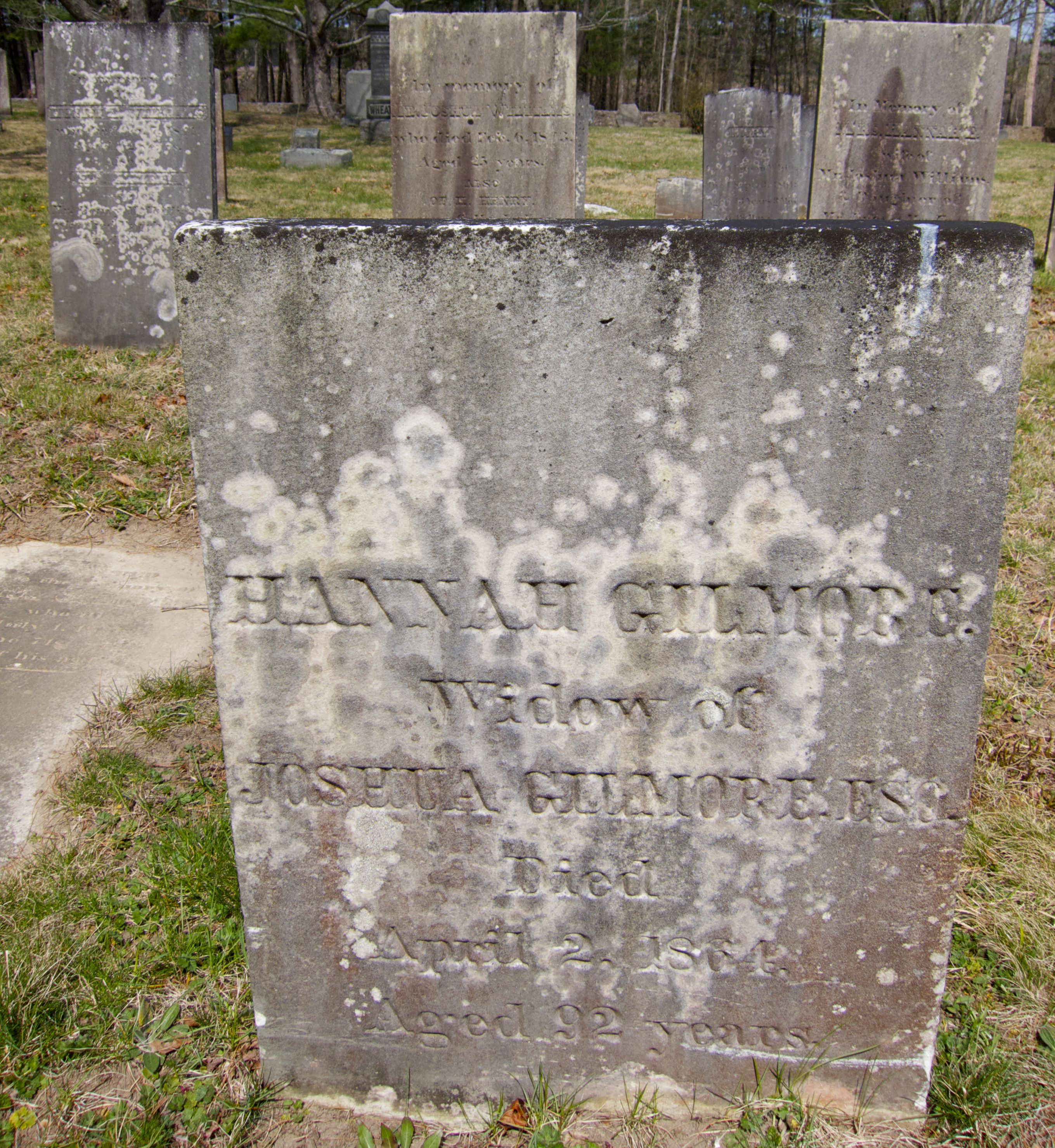
“Mother” was Hannah Lothrop Gilmore, or Mrs. Joshua Gilmore, as she would have been known, or perhaps  The Widow Gilmore, her husband having passed away in 1836.  One year shy of eighty, she was the mother of eight children, of whom only three were still alive.  Evelina was her only living daughter.

Mrs. Gilmore lived most of the time with her middle son, Alson, his wife, Henrietta, and their children at the family farm in the southeastern corner of Easton.  Just north of the town line with Raynham, the Gilmore property lay on what was known as the Turnpike Road.  In the distant past, Joshua Gilmore had maintained a tavern at that site, and had collected the fees from travelers on that road.  In 1851, the family still got income from the Turnpike, but the tavern was gone.  The land was all farm.

Occasionally, Mrs. Gilmore would visit with her daughter in North Easton.  Alson would carry her to church and after the service was over, Hannah would leave with Oakes and Evelina to stay at their home for the week.   While in North Easton, she’d be able to visit not only with her Ames grandchldren, but also with other grandchildren in the area, like Abby and Malvina Torrey.  And on this Sunday, her grandson Edwin Williams Gilmore, a grown son of Alson who no longer lived at the farm, paid a visit.  He would soon be building a home close to the Ameses.

January 21, 1851

Potato

Jan 21  Tuesday.  This morning commenced working on

Susans sack but had some things to do about house so

that I could not accomplish much.  Mrs. Holmes called

to get some potatoes for Miss Eaton  says she (Miss E) is

failing and the Dr had told her that he could not help

her  Mr Robinson came this afternoon to varnish the

chimney pieces & spilled the varnish over my carpet

which prevented me from going to have Susans doll

dressed

Harriet Holmes, a neighbor, came to the Ames house to fetch potatoes for the ailing Miss Eaton, the same Miss Eaton on whom Evelina and Sarah Ames called during the cold spell earlier in the month. The spinster lived with Harriet and Bradford Holmes, their children, Harriet’s mother and a shovel worker named Oliver Eaton – a relative, possibly.  Mr. Holmes was a teamster who probably worked with Old Oliver’s oxen. Many folks who lived in North Easton were connected to the shovel works in some way.

The potatoes that Evelina gave away would have been grown either by Old Oliver or by Alson Gilmore, Evelina’s brother, who owned the Gilmore family farm.  Potatoes were common fare at the dinner table, and particularly a favorite for winter use.  The Irish called them “pratties.” The challenge for a housewife lay in how to serve potatoes: mashed, roasted, and boiled were familiar variations, then and today.  Sarah Josepha Hale underscored the dietary importance of potatoes in her book, The Good Housekeeper.  “To boil Potatoes in the best manner, is a very great perfection in cookery,” she said.

In the Ames sitting room, hapless Mr. Robinson had to contend with a displeased housewife after he spilled varnish on the carpet.  He was already in Evelina’s bad graces from having taken too long to paint around the fireplaces. How do you suppose Evelina got the varnish cleaned up?

January 16, 1851

Muff & Tippet B & W

1851

Jan 16 Thursday  Went to Boston with S Ames.  Oakes A carried 

us over to the stage.  We found it very bad walking 

could scarcely cross the street without going over

shoe in snow & water but otherwise a delightful day

We bought some druggett & Sarah a muff & tippet

for herself & cuff & tippet for Helen.  We got us some

oysters at Vintons.  Called at Mr Orrs about four thirty

that we should have time to reach the cars but we were left.

Boys went to an assembly at Canton

Alson & Augustus dined here.

O, joy, a trip to Boston, an event that Evelina typically finds “delightful” no matter what the weather.  After two days of sadness about the death of Lewis Carr, Evelina and Sarah Lothrop Ames headed into the city via stage coach on a shopping excursion.  The railroad, which they called “the cars,” did not yet reach North Easton, but did stop in Stoughton.  The women intended to return by train at nightfall, and be carried home from Stoughton by one son or other, but missed the train and had to stay overnight.  They may not have been disappointed to have to stay in town.

Sloppy weather didn’t prevent the successful acquisition of goods.  Evelina bought some drugget, or carpeting, while Sarah found accessories for herself and her daughter.  Muffs and tippets, naturally, were very much in fashion for winter wear.  Dining on oysters was another highlight, as was a visit to an old family connection, Mr. Orr.

The homefront in Easton was busy, too.  Evelina’s brother, Alson, and his oldest son, Augustus, took midday dinner with Oakes and his children.  Little Susie would have been the only girl at the table.  In the evening, Oakes Angier, Oliver (3) and Frank Morton headed to Canton to a dance.  Everyone’s spirits seemed brighter today.

Photo of muff and tippet, ca. 1840,  from Minnesota Historical Society

January 13, 1851

Washing

/51 Jan 13  Washing day of course, and I have been

about house in the morning as usual.  A Augustus dined

with us, come up in the stage.  Made a hair cloth back to

another rocking chair  Went to Mr Whitwells with Mr

Ames this evening, met with Alson & wife.  It is a

beautiful moonshiny evening and we have had a

pleasant ride and have enjoyed myself very much.  Mr &

Mrs Whitwell I like very much  Father killed another

yoke of oxen to day and we have a quarter & the tripe.

Boiled that we had last week to day.

Monday is Wash Day.  This might be a Yankee commandment, were there a written code.  History has it that the first day the Pilgrims got off the Mayflower was a Monday, and the first thing the women did after all those weeks at sea was to wash their clothes.  The timing stuck, and remained a custom for centuries.  On Mondays at the Ames house, Jane McHanna washed the family clothes and linens while Evelina did almost everything else in terms of housework and cooking.  Evelina was not fond of putting her hands into soapy water.

The roads around town must have improved.  This evening, Evelina and Oakes finally got over to the Whitwells’ house, presumbly for a delayed acknowledgment of Mr. Ames and Mr. Whitwell’s shared birthday.  Evelina clearly enjoyed herself.  Another couple was there: Alson and Henrietta Gilmore. Alson is Evelina’s older brother.  He owns the old family farm in the southeast corner of Easton, just north of the town of Raynham.  He and his wife have six children together, as well as a son from Alson’s first marriage.  This is Alson “Augustus” Gilmore, who had midday dinner at the Ames house today.  Augustus lives in Boston as the year opens but will soon move back to North Easton.  He does courier work for the Ames brothers.

Evelina is close to her nieces and nephews; their presence in her life, and her affection for them, is evident throughout the diary.  Less certain is the regard that other members of the Ames family held for the Gilmores; family lore has it that the two families moved in different social circles and that even into the 20th century, the Gilmore clan was looked down on by members of the Ames clan. From Evelina’s happy description of the day, however, we can surmise that she was unaware, on this lovely, “moonshiny” night, anyway, of any discrimination.