November 29, 1851

frontcover_500

Nov 29th  Sat.  This forenoon have been mending

Olivers (3) clothes and putting them in order to 

carry back Monday.  Have been with Oliver

to spend the afternoon at Mothers. Came

home by Mr Lothrops to bring Sarah Lothrop

Fred & Helen home  Alson has been quite 

unwell a week or more & is not able to work

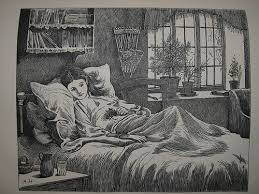
Evelina was enjoying the company of her middle son, Oliver (3), today. Like many a modern child, he had brought his clothes home from college to be put “in order” (but not washed – it wasn’t laundry day.) Evelina mended what she could and then the two of them rode south to visit old Mrs. Gilmore and the family on the farm. They found that Alson Gilmore, Evelina’s brother, had been “quite unwell.” He was evidently bed-ridden, which suggests that their Thanksgiving had been less celebratory than the Ames’s.

Unlike the shovel laborers in the village, Alson did work that didn’t follow a schedule set by a bell.  He labored according to the demands of the season, weather and livestock. How had he managed to run his farm this past week when he was too ill to work? Most likely his fifteen-year-old son, Francis, took over responsibility for any livestock. And if the Gilmores had any dairy cows, it was typically the women of the house – in this case, daughter Lavinia or wife Henrietta – who would typically have done the milking. Because it was November, and after the harvest, there was otherwise not much work that demanded attention.

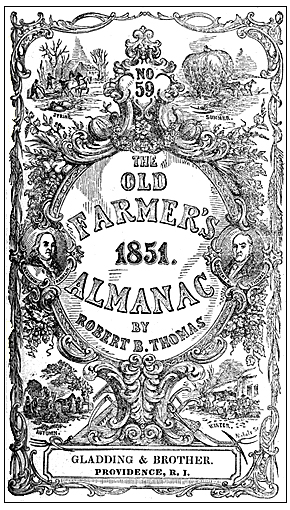
The Old Farmer’s Almanac, seen above, would have been full of advice for Alson and other farmers. We don’t know if Alson consulted it. (Like Old Oliver Ames, he might have consulted instead an agricultural newspaper called The Massachusetts Ploughman.)  The almanac was just featuring its new “Four Seasons” cover, first used in October of 1851 and still in use in 2014. It was designed by Hammatt Billings, a Boston architect and artist who also did the original illustrations for Uncle Tom’s Cabin, and engraved by Henry Nichols of Cambridge, who name appears on the lower right.  The editor was Robert B. Thomas, whose portrait is featured on the right side of the cover, opposite Benjamin Franklin.
November 8, 1851

Vegetables

Sat Nov 8th  Jane is still in Mansfield and Bridget

sick consequently I have to do the housework and

I have scarcely sat down for one moment  Alson

came up with a load of vegitables and Hannah

called and I left my work while they stopped

Mrs Witherell came home this evening and I have been

in there  Mr Ames went to Boston stopt at Canton to a

whig meeting.  Oakes & Frank brought him home.

Not only was the dependable Jane McHanna away, but the Ames’s second servant, Bridget O’Neil, was sick.  Dr. Ephraim Wales had checked in on Bridget the previous evening but she was still laying low.  Evelina, capable if disinclined, was faced with doing her own housework. She spent most of the day choring, as she called it.

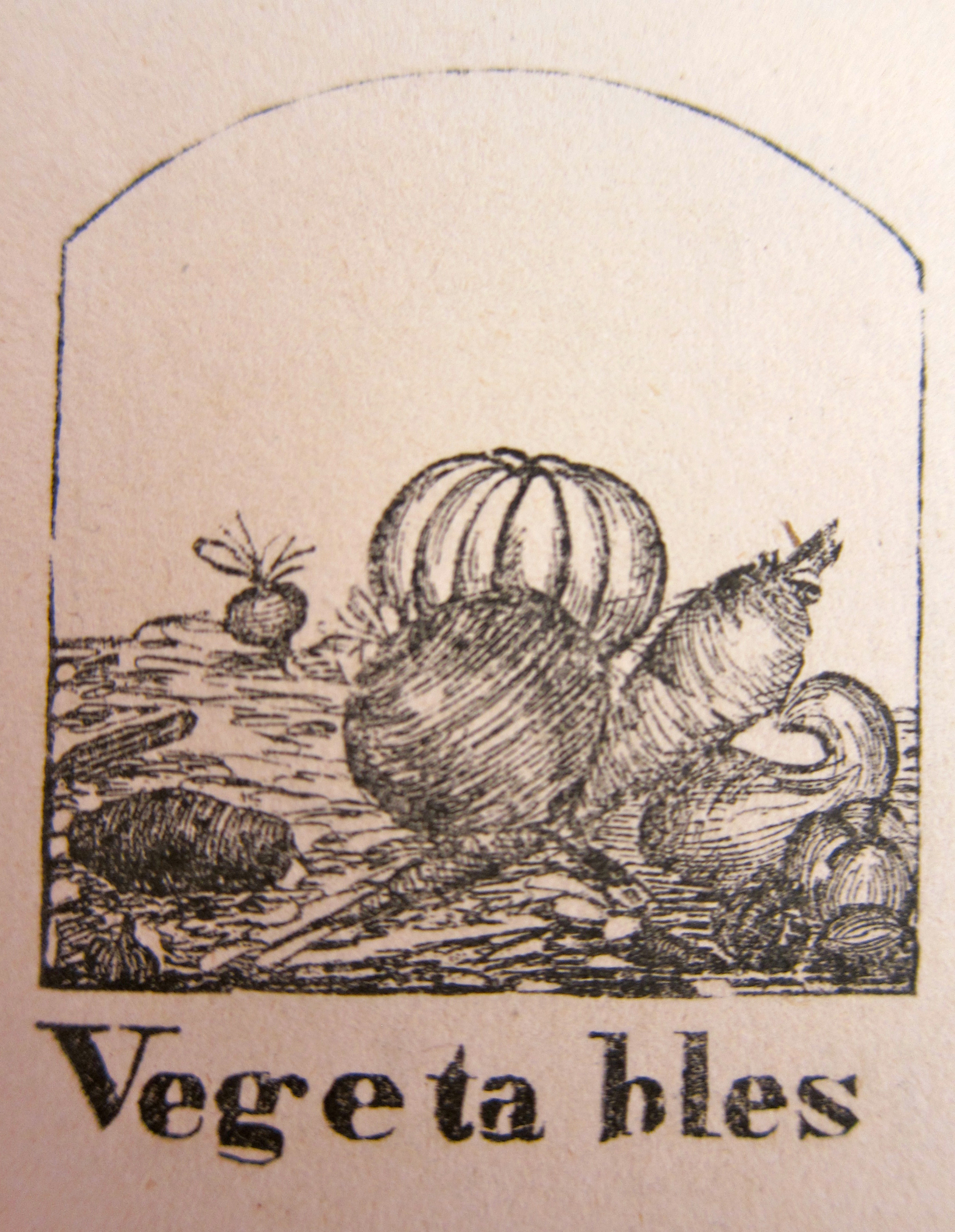
Her brother, Alson Gilmore, drove a wagon up from the Gilmore family farm to deliver a “load of vegitables” to the Ameses. His daughter-in-law, Hannah Lincoln Gilmore, who lived right in the village, came to call and for those visits, Evelina paused to chat.  Once they left, however, she must have plunged into sorting and storing the vegetables that Alson had brought. By this time of year, they would most likely have been root vegetables such as turnips, parsnips, carrots and potatoes. She would have stored them somewhere cool, dry and varmint-free: the cellar, if it wasn’t too wet, or the buttery or even the shed. Sharp-eyed housewife that she was, Evelina would have made sure everything was put away safely.

Oakes Ames, meanwhile, went to Boston as usual on this Saturday, but also “stopt at Canton to a whig meeting.”  The following Monday was Election Day and the party faithfuls were gathering in anticipation. This is the first mention in Evelina’s diary of Oakes’s participation in local politics. Their son, Oakes Angier, had shown interest earlier in the year, running unsuccessfully for the Easton school superintending committee, and attending the Whig convention in Springfield.  But her husband’s interest, although it had probably existed prior to this moment, had not drawn comment. Evelina mentions the meeting most likely because of the impending vote, but the statement coming so close on the heels of an undisclosed agreement she and Oakes had made only one week earlier gives creedence to the possibility that their agreement had something to do with Oakes’s waxing interest in politics.

November 1, 1851

OLYMPUS DIGITAL CAMERA

*

1851

Sat Nov 1st  This morning I patched the paper in the

bedroom that Mr Robinson papered last spring

Henrietta came about ten Oclock and left mother 

and her little girls at Augustus.  I went there this P.M.

and staid a couple of hours.  Mr & Mrs Peckham came

to the other part of the house  Mr Scott has finished

painting the parlour and has done here for the present

I paid him 12 dols, 25 cts for graining


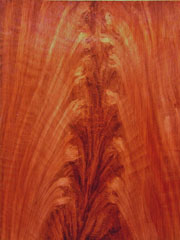
The graining of the woodwork and doors in the downstairs of the house was completed today. As noted earlier, graining is the painting of a surface to resemble wood.  In 1851, popular taste dictated that wood trim from simple pine or ash or other tree be grained to resemble a dressier wood such as mahogany, or curly maple. The illustration above, from a modern decorating company that offers “faux bois,” as graining is also known, shows a hand-painted example of flame mahogany.

The talented Mr. Scott finished his work today, for which Evelina paid him $12.25.  In today’s dollars, the “labor value” of that compensation is $2,680, according to one economic source.** That value is computed using a wage index for unskilled labor; the computation for a production worker compensation would be even higher. That Evelina made note of the expenditure in her personal journal suggests that she thought it was noteworthy – in her own opinion, she either paid too much or she got a good deal.  I suspect the former!

Social life went on as usual today. John and Susan Peckham were back in town and stopped in to see Old Oliver and Sarah Witherell. Evelina’s sister-in-law, Henrietta Williams Gilmore, came into the village from the farm and brought old Mrs. Gilmore to Mr. Torrey’s to visit Alson “Augustus” and Hannah Gilmore.  Henrietta also brought along her two youngest children, eight-year-old Henrietta Hall Gilmore and six-year-old Helen Jane Gilmore.  The two girls were actually half-sisters of 29-year-old Augustus. Their mutual parent, Alson Gilmore, had a spread of seven children from two wives.


Image of mahogany-style graining, Courtesy of http://www.statusfaux.com, Great Neck, New York.

** http://www.measuringworth.com/uscompare/relativevalue.php


October 31, 1851

apple_barrel

*

Friday 31st  Have taken up the bedroom and stair carpets

and Bridget has cleaned the front entry

I have been very busy all day about the house

Mrs Hubbell, Ames, and Mrs S Ames have been

to Sharon  Mrs Witherell called at Mrs Swains

this afternoon but I was so busy that I could 

not accompany her.  Passed the evening in

the other part of the house.  Mr Scott painting

Mr Hawkins lectured at the methodist meeting house


Evelina’s autumn version of spring cleaning continued today as she tackled the upstairs carpets. Mr. Scott was still in the house, painting, and servant Bridget O’Neill cleaned the front entry which had also undergone repainting. “Very busy all day about the house,” Evelina evidently didn’t even venture out of doors.

Others did go outside. Sarah Ames Witherell paid a call on new mother Ann Swain, while Sarah Ames, Almira Ames and Mrs. Hubbel rode to nearby Sharon. Old Oliver noted in his journal that “this was a fair day + some cooler wind north west +considerable of it.”

Some miles northward, in Concord, Henry David Thoreau noted in his journal that “The wild apples are now getting palatable. I find a few left on distant trees, that the farmer thinks it not worth his while to gather. He thinks that he has better in his barrels, but he is mistaken, unless he has a walker’s appetite and imagination, neither of which can he have.”**  Two farmers in Evelina’s life, her father-in-law, Old Oliver, and her brother, Alson Gilmore, might take exception to Thoreau’s characterization of them as men without imagination.

In the evening, a Mr. Hawkins gave a lecture at the Methodist meeting house, right in the village.

* Barrel of apples, http://nbarnett2.wordpress.com/2010/02/15/the-importance-of-good-packing/

**Henry David Thoreau, Journal, http://hdt.typepad.com/henrys_blog/2004/10/october_31_1851.ht

September 24, 1851

imgres

Wedns Sept 24th  Susan has had another night of

suffering and has not slept but little if any but this

morning she appeared better and has had a more

comfortable day than I expected she would have  Helen

brought in her doll for her to play with and she

has had three to play with which has taken […] her

mind from her sickness in a great measure.

Francis dined here carried home Mr & Mrs Whitwell


The nettle rash, or hives, that had attacked Susie Ames began to subside this morning, surely bringing relief not only to the little girl, but to her mother and everyone else interested in her welfare. As Susie began to feel better, she became agreeably occupied with an extra doll brought in for her to play with by her older cousin from next door, Helen Angier Ames.

Helen’s mother, Sarah Lothrop Ames, and Harriett Ames Mitchell left Easton today to go into Boston and Cambridge for a night. Perhaps they visited Sarah’s sixteen-year-old son Fred Ames at Harvard, where he was a new sophomore. Fifteen-year-old Francis E. Gilmore, the youngest son of Evelina’s brother Alson Gilmore, came to the Ames’s for midday dinner.  Was he visiting the construction site of his older brother, Edwin Williams Gilmore, who was building a home close to Ames compound? Francis lived down on the family farm, and was able to give a ride south to William and Eliza Whitwell, who had been visiting Sarah Witherell.

Meanwhile, focused and persistent, Old Oliver continued to supervise construction of a new flume from Great Pond near Stoughton south to the waterflow in North Easton. He noted in his daily journal that “this was a fair day with a strong wind from the north west and pritty cold. we got on the top stone to our floom to day.”


September 11, 1851

Plum


Thursday  Was very busy this forenoon

fixing work for Ellen cut out a corded skirt for her

to make for Susan  Have been this after 

noon to Alsons with Mr Ames & Mrs Stevens

met Augustus & wife & Miss Eddy had quite

a treat of peaches plumbs &c  came home quite

early in the evening  The weather still

continues to be hot

Ah, harvest.  This time of year brought a short-lived abundance of fresh fruit, “peaches, plumbs &c.”  “[Q]uite a treat” Evelina sighed, perhaps with the scent of peaches still on her fingers as she wrote. She, Oakes and guest Mrs. Stevens had met up with nephew Augustus, his wife Henrietta and another visitor, Miss Eddy, at the family farm south of the village. Now run by her brother Alson Gilmore, it was the farm where she grew up. Perhaps the annual harvest from the family orchard reminded her of her childhood.

While the fruit was delightful, the hot weather was not.  It’s difficult to imagine how hot Evelina must have been when she spent much of her morning cutting out corduroy. “Corded” cloth was heavy, and not easy to cut, either. She wanted one of the servant girls, Ellen, to sew the skirt for daughter Susie.  She was already thinking ahead to the fall and winter, perhaps; maybe she thought of winter as she cut along and stayed cool that way.

Evelina’s entry on this date was written exactly 150 years before our modern catastrophe, 9/11/2001. Unimaginable then and still.

September 6, 1851

shopping

Sat Sept 6th  Alson brought Mrs Stevens before we

were up this morning left his carriage here

while he went to Boston.  We went into Olivers

& passed the afternoon with Mrs Latham & Mrs W & Mrs

Mitchell I called on Mrs Peckham while the others

went to Mr Manly’s garden  Mr Ames brought home

some cuff pins for Alsons wife & Mrs Stevens

Evelina was probably pleased today to lapse back into a sociable, summer agenda.  Family friend Mrs. Stevens arrived at dawn, it would seem, delivered by Evelina’s brother Alson Gilmore on his way into Boston. The two women later went next door to call on Sarah Lothrop Ames and were joined by sisters-in-law Sarah Ames Witherell and Harriett Ames Mitchell and the former’s houseguest, Mrs. Latham.  Chat, chat, chat.

As they had done occasionally throughout the summer, many of the women went up to look at the flowers in Edwin Manley’s garden. The blooms they saw would be among the last for this year.  Evelina eschewed that walk (or ride) and went instead to call on Susan Peckham, wife of John Peckham, clerk for the shovel company.  The Peckhams were about to move, so perhaps Evelina went to see what help she could be, or to say goodbye. Susan Peckham must have been packing things up, a chore that would have made Evelina, who was lately familiar with the bustle of departure, feel right at home.

Oakes Ames spent the day in Boston, as he did almost every Saturday.  He went on business for the shovel company, often returning with orders or payments.  Just as often, he carried out particular errands for his wife.  Yet it’s not clear whether she or he or both, perhaps, suggested the purchase of cuff pins (perhaps what we call cuff links) for Mrs. Stevens and Henrietta Williams Gilmore.  Both women had birthdays around this time.

September 3, 1851

Trunk

Wednes Sept 3d  Alson came this morning & brought

Orinthia and staid to dinner and carried Mrs Stevens

home with him  Orinthia has been packing her clothes

Mrs Stevens stiched three more collars for me & Mrs

Witherell two that are for Frank.  Abby Torrey called

this afternoon &c and on her return Orinthia & I went

to the store  Pauline passed the afternoon with Helen

Orinthia Foss was packing her clothes, getting ready to return home to Maine. What prompted the departure isn’t clear. Did she lose her job, or was she called home on family matters? She would return to North Easton eventually, but did she know that when she left?  How did she feel about leaving this town where she had lived for six months? How did Evelina feel about the loss of her young friend, even temporarily?

Orinthia wasn’t the only one with a trunk to be packed. Oliver Ames (3), too, was a day away from departure and had a trunk into which his mother – and others, perhaps – were placing his new collars and mended shirts. Last minute sewing was still going on, but by this time the trunk would have been nearly full of the clothes that Oliver would need for a term at college.

That Oliver was going away to study at Brown was just shy of miraculous.  At 20, he was old to be going, for one thing; in the nineteenth century, the average students were teenaged, like Fred Ames at Harvard. But more than that, his father Oakes had not wanted him to go. According to one 19th century acquaintance of Oliver, Oakes “had inherited some measure of that Puritanical contempt for the liberal arts.” After completing prep school, Oliver had been directed to work at the factory, “to learn the trade of shovel-making. But the desire for a higher education remained strong, and when at the end of his five years apprenticeship he had mastered the trade, his father yielded to his solicitations, and allowed him to enter Brown University.” * Oliver had earned his ticket out.

* Hon. Hosea M. Knowlton, “Address,” Oliver Ames Memorial, 1898, pp. 98-99


August 30, 1851

OLYMPUS DIGITAL CAMERA

*

Sat Aug 30th Have been marking Olivers clothes and fixing

them.  Called to Mr Whitwells Major Seba Howards

Mr Samuel Dunbars and at Alsons with Pauline

Took tea at Alsons brought Orinthia home with us

All of Mr John Pools family were there or rather

Rachel Augusta & Elisabeth.  Mrs Stevens came

there yesterday  Alson & Mr N Hall here to

dinner & tea

Another sociable Saturday was enjoyed by many throughout Easton, as friends and neighbors rode here and there calling on one another. As one modern historian has noted, “formal and informal forms of socializing were the most common amusements throughout the period. Then, as now, folks liked to visit one another, usually after supper and on weekends. The middle class gathered in their parlors, talked, sang, played games, and so on.”**

Evelina certainly did her part. With her friend Pauline Dean, she paid calls on various friends, including the Howards, the Dunbars, and the dependable Reverend Whitwell and his wife Eliza. At her brother Alson’s farm, where they took tea and visited with old Mrs. Gilmore, they chatted with three daughters of the John Pool family, including Rachel, Augusta and Elizabeth.  Rachel and Augusta had visited Evelina earlier in the month and accompanied her to the company store and the shovel shop.  Evelina was a friend to young women – especially to Orinthia Foss, the schoolteacher, whom they scooped up and took back to North Easton.

On their way home, as they likely rode past fields of Queen Anne’s Lace and Goldenrod, did they acknowledge that summer was coming to an end?


Photograph by John S. Ames III

** Marc McCutcheon, Everyday Life in the 1800s, Cincinnati, 1993, p. 200.


August 29, 1851

WhiteAster

Friday Aug 29th  Alson & Mr Hall came early this

morning and were here to dinner & tea, brought Pauline

with them  Have been mending for Oliver getting his

clothes ready for school  Went with Pauline to Edwins

garden he has not many pretty flowers in blossom has

some fine Dahlias  got 5 lbs of butter at Mr Marshalls

after we came back went into Olivers to hear Pauline

play.  George & wife & Sarah gone to her fathers

The day after Clinton Lothrop’s funeral, Sarah Lothrop Ames, her brother George Van Ness Lothrop and his wife Almira spent the day, at least, at the Lothrop farm with their parents, Howard and Sally Lothrop. They would have had to make long-term plans for the property, now that Clinton wouldn’t be there to tend the family farm.

Alson Gilmore, Evelina’s brother, took his meals at the Ames’s today.  He was working nearby, perhaps with Mr. Hall, helping his son, Edwin Williams Gilmore, build a house. They were putting in the cellar.  Pauline Dean, who must have been staying with or near the Gilmores, returned for a visit. She probably got roped into helping Evelina with the mending.

Evelina had a lot of mending to do, as Oliver (3) was preparing to go off to school.  Like his cousin Fred Ames, he was going to attend an Ivy League college, but in Providence, not Cambridge.  Oliver (3) would be going to Brown, and his mother had to get his clothes ready. Shirt fronts, collars and hose weren’t her only business today, however.  She and Pauline took a break from domesticity and went to Edwin Manley’s to see his garden. There they saw “some fine dahlias.”

Dahlias, which had been introduced in the United States early in the 1800s, had quickly became popular, although not yet listed in Joseph Breck’s Book of Flowers. So successful were they that over the course of the century more than 10,000 varieties were developed or identified and sold. Today, dahlias are still much admired by flower gardeners, yet less than a dozen of those 19th century heirloom examples still exist in cultivation.* The earliest known, White Aster (above) dates from 1879.

*oldhousegardens.com