February 4, 1851

Governor Oliver Ames (Feb. 4, 1831 - Oct. 22, 1895)

Governor Oliver Ames

Tues Feb 4  Had my morning work done about nine Oclock just

as A A Gilmore & wife came to pass the day.  About eleven

we called to see Simeon Randalls house.  This afternoon

called at Mr Torreys and at Mr Peckhams.  While

we were at tea Mr Torrey called to talk about letting his

house to Augustus.  Received a letter from O Foss.

Passed this evening with Sarah W in the other part

of the house finished another pair pantletts  Pleasant

Evelina’s nephew, Alson “Augustus” Gilmore, and his wife, Hannah Lincoln Gilmore, came to North Easton today to search for a house to rent.  A young couple with one child, Eddie, they were expecting a second child in July, although they may not have shared that information with their aunt.  Even if they had, she would never have spoken of it.  The increasingly prim culture of the day forbid it, but the high rate of infant mortality, too, caused many expectant parents and their relatives to downplay “the blessed event.”  Evelina carried Augustus and Hannah around to look at available properties.

Although Evelina doesn’t mention it, today is the birthday of her middle son.  Oliver Ames (3) turned 20 today.  Like his older brother, Oakes Angier, and his younger brother, Frank Morton, Oliver worked at the shovel shop, learning the business in the expectation that he would one day help run the company.  He had attended school at Leicester Academy and had hoped to go on to college, as his cousin Fred Ames was planning to do, but his father had insisted that he return home to work. Oakes Ames was no fan of formal education, having despised learning in his own youth.

The eldest son, Oakes Angier, naturally stood first in line to superintend the shovel business, but Oliver (3), would be a partner. Like his father, he was ultimately slated to travel as the company’s salesman.  Third son Frank, on the other hand, would be given an auxiliary administrative position in a related family-owned business, the Kinsley Iron Works Company in Canton.

But on this day, those occupations were in the future, as was Oliver (3)’s more memorable service as Governor of Massachusetts from 1886 to 1889. On this birthday, he was a brand-new twenty year old who worked hard all day, read alot, and enjoyed attending “sings”.


January 31, 1851

photo

Jan 31st Friday  This morning sat down with mother quite early

mended several articles. & altered the waist of Delaine Dress

Augustus came in the stage & dined here & carried mother

to Mr Torreys.  I went about two & passed the afternoon

Called on Mrs Lothrop at Dr Wales, Engaged the

school house for O Foss to keep a private school.

Came home quite early & wrote her a letter.  Sewed

on Susans panteletts.  Very cold but not quite as cold as yesterday

Evelina and her mother, Hannah Lothrop Gilmore, sat together and sewed this morning.  After mending several items – there was always mending to be done – Evelina reworked the waist on a delaine dress, “delaine” meaning “of wool” in French.  It was a popular and durable fabric in this era.  But altering the waist begs the question, did she have to take it in or let it out?  And had she begun to wear her sleeves in the new “pagoda” style?

Augustus Gilmore, Evelina’s nephew and Hannah’s grandson, soon arrived and, once Oakes and his sons came home from the factory at noon, they all dined together. Augustus was close to his Ames cousins, and worked for the company from time to time.  After dinner,  Augustus accompanied his grandmother to the Torrey house in the village, where Hannah’s granddaughters, Abby and Malvina, lived.  Evelina joined them there a bit later, and paid another call as well, on Mrs. Lothrop.  There were many Lothrops in Easton, so we can’t know just which one Evelina visited.

We can know that Evelina was somehow involved in the setting up of a private classroom.  A young woman named Orinthia Foss, with whom Evelina corresponded, was due to arrive in North Easton to teach.  The genesis of this arrangement is a mystery. Was Evelina doing this because of concerns about Susies’ schooling?  Who else was involved? And who was Orinthia Foss? How was she hired?

Whatever the back story was on this new little school, Evelina took a bold step today when she committed to renting a schoolhouse.  She promptly returned home to write Orinthia with the good news.

January 16, 1851

Muff & Tippet B & W

1851

Jan 16 Thursday  Went to Boston with S Ames.  Oakes A carried 

us over to the stage.  We found it very bad walking 

could scarcely cross the street without going over

shoe in snow & water but otherwise a delightful day

We bought some druggett & Sarah a muff & tippet

for herself & cuff & tippet for Helen.  We got us some

oysters at Vintons.  Called at Mr Orrs about four thirty

that we should have time to reach the cars but we were left.

Boys went to an assembly at Canton

Alson & Augustus dined here.

O, joy, a trip to Boston, an event that Evelina typically finds “delightful” no matter what the weather.  After two days of sadness about the death of Lewis Carr, Evelina and Sarah Lothrop Ames headed into the city via stage coach on a shopping excursion.  The railroad, which they called “the cars,” did not yet reach North Easton, but did stop in Stoughton.  The women intended to return by train at nightfall, and be carried home from Stoughton by one son or other, but missed the train and had to stay overnight.  They may not have been disappointed to have to stay in town.

Sloppy weather didn’t prevent the successful acquisition of goods.  Evelina bought some drugget, or carpeting, while Sarah found accessories for herself and her daughter.  Muffs and tippets, naturally, were very much in fashion for winter wear.  Dining on oysters was another highlight, as was a visit to an old family connection, Mr. Orr.

The homefront in Easton was busy, too.  Evelina’s brother, Alson, and his oldest son, Augustus, took midday dinner with Oakes and his children.  Little Susie would have been the only girl at the table.  In the evening, Oakes Angier, Oliver (3) and Frank Morton headed to Canton to a dance.  Everyone’s spirits seemed brighter today.

Photo of muff and tippet, ca. 1840,  from Minnesota Historical Society

January 14, 1851

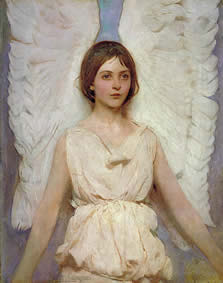
Abbott H. Thayer, Angel, 1887, oil Smithsonian American Art Museum Gift of John Gellatly

Abbott H. Thayer, Angel, 1887, oil
Smithsonian American Art Museum
Gift of John Gellatly

/51

Jan 14  Tuesday.  This morning after taking care of my room went

to the store and into Mr Carrs to offer my assistance there.

Lewis Carr died last night very suddenly bleeding at the 

lungs.  Has been in a decline since last July but was about

the house as usual yesterday and conversed with O A and 

his friends in the evening & told what he was going to do when

he got well.  about ten or eleven Oclock called to his mother

to come quick which was the last word & died almost instantly

This afternoon carried Mr & Mrs Whitwell to A A Gilmores.

The “white plague,” consumption, was a killer; today we know it as tuberculosis and, in parts of the world, it’s still killing.  In 19th century America, it was a leading cause of death, the scourge of young lives, particularly.  Its contagious properties were unknown, which helped it spread.  Although different treatments, such as prolonged rest in warm climates, were tried (when possible), no cure for the disease would be found until the middle of the 20th century.  Some people did recover from TB; most did not.

Lewis Carr, a friend of Oakes Angier Ames, was barely 20 years old. He was the son of Caleb and Chloe Carr of North Easton where the family had lived for generations.  His father, known as “Uncle Caleb” in his later years, was a life-long employee of the shovel works and close to the Ames family.  So close, in fact, that two decades later, Caleb would serve as a pall-bearer at Oakes Ames’s funeral.

It is typical that Evelina would help the Carr family at this time.  She and her sisters-in-law were often called upon to sew the shrouds that corpses were wrapped in, which is what she did on this day for the family.

January 13, 1851

Washing

/51 Jan 13  Washing day of course, and I have been

about house in the morning as usual.  A Augustus dined

with us, come up in the stage.  Made a hair cloth back to

another rocking chair  Went to Mr Whitwells with Mr

Ames this evening, met with Alson & wife.  It is a

beautiful moonshiny evening and we have had a

pleasant ride and have enjoyed myself very much.  Mr &

Mrs Whitwell I like very much  Father killed another

yoke of oxen to day and we have a quarter & the tripe.

Boiled that we had last week to day.

Monday is Wash Day.  This might be a Yankee commandment, were there a written code.  History has it that the first day the Pilgrims got off the Mayflower was a Monday, and the first thing the women did after all those weeks at sea was to wash their clothes.  The timing stuck, and remained a custom for centuries.  On Mondays at the Ames house, Jane McHanna washed the family clothes and linens while Evelina did almost everything else in terms of housework and cooking.  Evelina was not fond of putting her hands into soapy water.

The roads around town must have improved.  This evening, Evelina and Oakes finally got over to the Whitwells’ house, presumbly for a delayed acknowledgment of Mr. Ames and Mr. Whitwell’s shared birthday.  Evelina clearly enjoyed herself.  Another couple was there: Alson and Henrietta Gilmore. Alson is Evelina’s older brother.  He owns the old family farm in the southeast corner of Easton, just north of the town of Raynham.  He and his wife have six children together, as well as a son from Alson’s first marriage.  This is Alson “Augustus” Gilmore, who had midday dinner at the Ames house today.  Augustus lives in Boston as the year opens but will soon move back to North Easton.  He does courier work for the Ames brothers.

Evelina is close to her nieces and nephews; their presence in her life, and her affection for them, is evident throughout the diary.  Less certain is the regard that other members of the Ames family held for the Gilmores; family lore has it that the two families moved in different social circles and that even into the 20th century, the Gilmore clan was looked down on by members of the Ames clan. From Evelina’s happy description of the day, however, we can surmise that she was unaware, on this lovely, “moonshiny” night, anyway, of any discrimination.

January 6, 1851

Ox

/51 Monday Jan 6

Jane commenced washing this morning but was taken sick

and had to leave it.  And I had to do the housework again

Father killed two oxen & gave us the tripe  Went to North

Bridgewater this afternoon in a sleigh with S A, Helen 

and E Quinn.  A A Gilmore here to tea had business in

the office  Bought patch for a quilt for Susans bed   run

it together this evening  Received a letter from 

O Foss  She says Roland A has come from California

Jane McHanna was under the weather this Monday morning – perhaps from yesterday’s drive in the frigid air – and unable to manage the laundry and housework.  In the kitchen, something had to be done with the fresh tripe that arrived from Evelina’s father-in-law. Considered a delicacy, the tripe would soon be served at the midday dinner table.

As was typical for this time of year, Old Oliver slaughtered a yoke of oxen and distributed the meat and offal among the family. As he described it, “we kilt a yoke of oxen to day I had of Charles Gurney the off one weighed 1475 and the other 1330.”  Now 71 and retired from the shovel business, Old Oliver spent much of his time raising oxen. (Farming, too, as we’ll see later.)  He was evidently quite fond of them, and they were extremely useful in the family business for transporting raw material and finished shovels.  Oxen were a common sight in North Easton in 1851; anyone inside the Ames house would have heard ox carts rumbling by on the road.

The weather had improved and  housework couldn’t keep Evelina at home this afternoon.  Off in a sleigh to North Bridgewater she went with Sarah Ames, Sarah’s daughter Helen and a neighborhood dressmaker, Elisa Quinn.  The women were most likely on the hunt for fabric.  Evelina found quilting material, and after tea was over that night, began to put together a quilt for her daughter, Susan.