March 28, 1852

Ames-Shovel-Handle-2

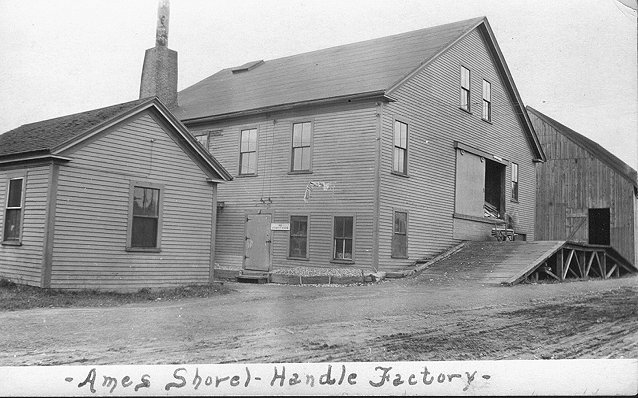
Ames Shovel Handle Factory, Oakland, Maine*


March 28 Sunday  Went to church this morning and

at noon called at Mrs Wm Reeds with Henrietta

Hannah came at noon but was faint and

I carried her home and got back to church about

the time the services were over  After went down

to the new shops with Mrs W, S Ames Augusta Orinthia

found Mr. Ames, Oliver & Cyrus L there returned by Edwins

and all called there  Mr Ames & self went to Augustus’ this evening

The new shops were up, and various family members rode by to see them after church. No more “dismal ruin”, as reported by Evelina only three weeks earlier. Risen like a phoenix from the ashes of the old shops, the shovel works were about to begin operations in new, if temporary, quarters.

It was a large group that gathered to consider the new buildings. Evelina, who had missed the afternoon service in attending to her ailing niece, Hannah Lincoln Gilmore, nonetheless rode back from church to the site. Accompanying her were her sisters-in-law, Sarah Witherell and Sarah Ames; another niece, Augusta Pool Gilmore; and sometime boarder and frequent companion, Orinthia Foss.  At the site, by accident or design, they found Oakes Ames and his brother, Oliver Ames Jr., and Cyrus Lothrop, a brother of Sarah Lothrop Ames who often resided with his sister. The group must have marveled at the swift reincarnation of the shovel works.

Perhaps a celebratory spirit inspired the crowd to assemble en masse at the nearby home of newlyweds Augusta and Edwin Gilmore.

*Image of Ames Shovel Handle Factory, Oakland, Maine courtesy of the Oakland Maine Area Historical Society. Included to illustrate what the rebuilt shovel factory could have resembled.

March 20, 1852

faces


from The Philosophy of Laughter and Smiling , 1877

1852

March 20th Saturday  Have cut and basted a purple print

apron for Susan of a pattern that Lavinia

brought from Mary  Abby & Edwin & wife were

here to tea  Orinthia dressed in Franks clothes

and paraded around here awhile.  Send for Mrs

Witherell & Mrs S Ames to see her  We have had

a pretty lively time  Orinthia brought over

Edwin & wife.

The ladies laughed today.  After sewing for hours, breaking only for midday dinner, Evelina and her young friend Orinthia Foss laid down their needles to have tea. Orinthia got it into her head to put on nineteen-year-old Frank Morton Ames’s clothes “and paraded around.” She donned his shop pants, perhaps, and shop coat over one of his white muslin shirts. Evelina and her guests were so amused at the sight that they called in Sarah Ames and Sarah Witherell to see the fun. Cross-dressing was a novelty for these women, and Orinthia’s daring act generated hilarity.

All things considered, these women were probably due for some laughter.  It was the first day of spring, and everyone had been pretty well cooped up for months, excepting the occasional trip into town. More recently, they had suffered through a major fire. Some innocent amusement was a good release.

Evelina’s favorite author, Charles Dickens, knew all about laughter: “It is a fair, even-handed adjustment of things, that while there is infection in disease and sorrow, there is nothing in the world so irresistibly contagious as laughter and good humor.”**

While the women amused themselves at home,  the best-selling novel of the 19th century was published in book form today, in Boston.  We’ll soon find Evelina reading Uncle Tom’s Cabin.


* Clockwise: “The Giggling Laugh, excited by Boisterous Fun and Nonsense.” “The Obstreperous Laugh, instigated by Practical Jokes or Extreme Absurdities.” “The Hearty Laugh of the Gentler Sex.” “The Stentorian Laugh of the Stronger Sex.” “The Superlative Laugh, or Highest Degree of Laughter.“ From The Philosophy of Laughter and Smiling, George Vesey, 1877. Courtesy New York Historical Society, courtesy of CABINET: The Art of Laughter, Issue 17, Spring 2005

**Charles Dickens, A Christmas Carol

March 3, 1852

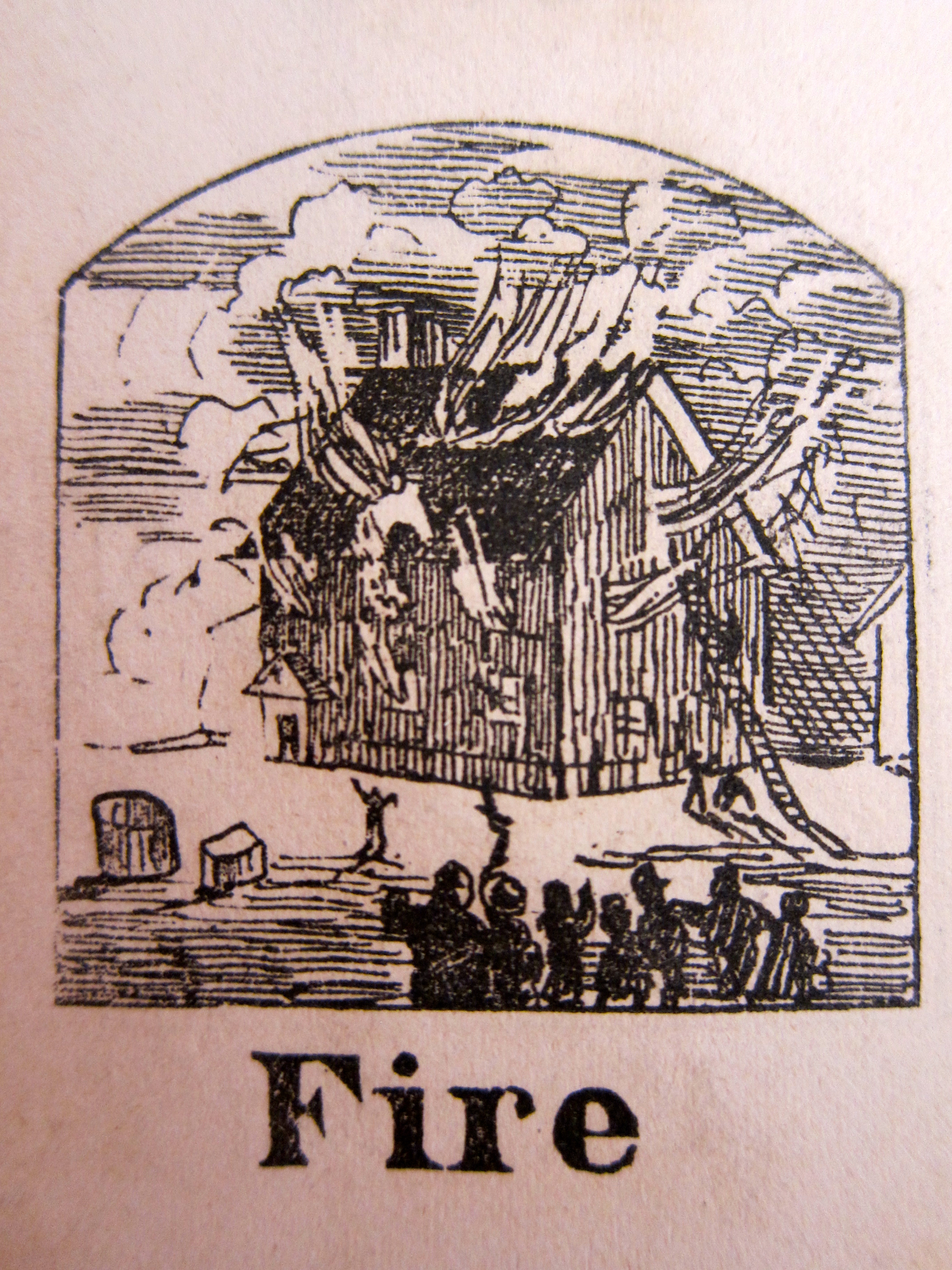
Fire


1852

March 3  Wednesday  Last night the finishing shops

were burned to the ground by Quinns letting 

his lantern fall into the varnish  Oakes came

home from the fire about 4 Oclock much

more cheerful than I expected to see him and 

went to bed  OA and Frank came home to put

on dry clothes & went back and staid untill morning

Lavinia & Augusta were here awhile this afternoon


Fire! Most of the shovel company’s buildings, situated in”the most centralized areas of Ames production, ‘the island’ at the outfall of Shovel Shop Pond,”* caught fire and burned to the ground. On his nightly round, Patric Quinn, the watchman, dropped his lantern into the varnish. The subsequent explosion must have been quick and, given the nature of the combustibles, uncontainable from the outset.

Naturally, Old Oliver recorded the event as well: “last night about eleven O clock the finishing shop took fire and the shops adjoining it were burned down – Bisbes shop and the small one made out of the cole hous that was mooved from the hoe shop was saved – the fire took from the varnish …”**

O. Ames & Sons had caught fire before, once in 1844 and again in 1849.  After the 1844 fire, the family “had bought a used fire engine,”** which was brought to bear on the 1849 fire. In that case, Old Oliver credited the engine with saving the day, noting that “if we had have had no engoin I think it would have burnt up.” **

This latest conflagration was different. As modern historian Gregory Galer points out, “luck was not on their side…[the used fire] engine was no match for the blaze, fueled in part by 12,000 well-dried, ash shovel handles; oil and varnish used to protect completed shovels; and the wooden building itself.”*  The shovel shop was in ruins.

Evelina didn’t attend the fire, but she would have been able to see the flames from their front windows. The fire went on all night, her husband, sons and other townspeople present for most of it. There is no record of any injuries.


Gregory Galer, Forging Ahead, MIT, pp. 248-249

** Oliver Ames, Journal, Stonehill College Archives, Arnold Tofias Collection


February 29, 1852

Ink

Feb 29

1852 Sunday  It was quite windy and mother

was unable to attend meeting all day so

I staid at home with her this morning.

This afternoon have been with mother & Augusta

& mother returned home. Since meeting

have written a letter to cousin Harriet Ames

but feel rather doubtful about sending it

1852 happened to be a leap year, which, as most of us know, is so named because the addition of the extra day of February 29 causes days of the week, which normally advance by a single weekday from one year to the next, to “leap” ahead by two.

Leap year is known in more scientific circles as a bissextile or intercalary year. Charles Dickens knew that.  He also knew about a tradition that allowed ladies to propose marriage during Leap Year, a custom otherwise accorded to the male of the species. In 1840, when Queen Victoria announced her “intention” to marry Prince Albert , he commented – tongue-in-very-British-cheek – accordingly:

“That the present is Bissextile, or Leap Year, in which it is held and considered lawful for any lady to offer and submit proposals of marriage to any gentleman, and to enforce and insist upon acceptance of the same, under pain of a certain fine or penalty; to wit, one silk or satin dress of the first quality, to be chosen by the lady and paid (or owed) for, by the gentleman.

“That these and other horrors and dangers with which the said Bissextile, or Leap Year, threatens the gentlemen of England on every occasion of its periodical return, have been greatly aggravated and augmented by the terms of Her Majesty’s said Most Gracious communication, which have filled the heads of divers young ladies in this Realm with certain new ideas destructive to the peace of mankind, that never entered their imagination before.

“That a case has occurred in Camberwell, in which a young lady informed her Papa that ’she intended to ally herself in marriage’ with Mr. Smith of Stepney; and that another, and a very distressing case, has occurred at Tottenham, in which a young lady not only stated her intention of allying herself in marriage with her cousin John, but, taking violent possession of her said cousin, actually married him.

That similar outrages are of constant occurrence, not only in the capital and its neighbourhood, but throughout the kingdom, and that unless the excited female populace be speedily checked and restrained in their lawless proceedings, most deplorable results must ensue therefrom; among which may be anticipated a most alarming increase in the population of the country, with which no efforts of the agricultural or manufacturing interest can possibly keep pace…”

Evelina may have read Dickens’ playful screed on the dangers of Leap Year, probably without taking offense.  She had her own letter to write today to a cousin, one that seemed to trouble her.


* Charles Dickens, Sketches of Young Couples, courtesy of http://www.authorama.com


February 15, 1852

 lilliam_wald2

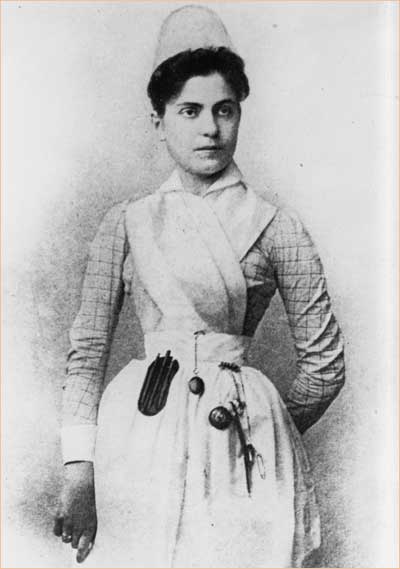
Nursing uniform from the late 19th c.*

1852

Sunday Feb 15th  Have been to church and at

noon went to Mr Baileys to see sister Amelia

who is nursing there  Mother went with me

Have been reading since meeting  Edwin & wife came

in to spend the evening but Mr Ames & self were

just going to Mr Swains and they would not let 

us stop for them so they went to Augustus  Had a 

pleasant call or rather visit at Mr Swains  came away

about nine Oclock  Very pleasant

The sun came out today, so despite it being “pritty cold,”** the Ames family went to church. During the intermission between morning and afternoon services, Evelina and her elderly mother, Hannah Lothrop Gilmore, rode out to visit Amelia Gilmore.  Amelia was the widow of Evelina’s brother, Joshua Gilmore, Jr. Joshua had died three years earlier, at age 35, leaving Amelia with two sons to raise.

In order to support herself and her boys, Amelia hired out as a nurse.  In this instance, she was looking after a Mr. Bailey, who must have lived near the Unitarian church. He may have lived alone, been ill and needed paid help; otherwise the convention of the day would have meant his female relatives looked after him. When Amelia wasn’t working, she and her youngest son, Samuel, lived with the Alger family near the Gilmore farm. The older son, Charles, had hired out somewhere but would soon come to reside with his uncle Alson Gilmore.

In 1852, nursing was not a formal profession.  Women (nursing was considered the exclusive province of women at the time) undertook nursing because they needed to work and this was one of very few avenues open to them. They based their protocol on personal experience in caring for ill members of their own families. There were no training programs or certification venues available, in no small part because there were so few hospitals. People were cared for at home. It would take the Crimean War in Europe and the Civil War in the U.S. to change attitudes and formalize medical care.

*Courtesy of http://www.nursinglink.monster.com

**Oliver Ames, Journal, Stonehill College Archives, Arnold Tofias Collection


February 11, 1852

Rain

Feb 11th Wednesday  Returned from Boston to night very

much fatigued  It has rained poringly all

day and I was out shopping and most horrible

walking in the streets  Went to Doe & Hazleton

and bargained for a looking glass  bought an

all wool Delaine of Mr Norris  Mrs Witherell

was here some time this morning

Boston in February is subject to terrible weather, as Beantown residents in 2015 know all too well from recent record-breaking snow.  In 1852, heavy precipitation was also the rule, although on this particular day it didn’t snow, but “rained poringly.” Shopping suddenly wasn’t as much fun as it had been the past two days. Evelina found the going “most horrible,” but still managed to chase down some good buys.

She treked to an area of the city known as Cornhill – not Cornhill Street, or Lane, or Road, but just plain Cornhill.  This area of the city is now irrevocably altered, having been turned into Government Center, a modernistic architectural complex, in the 1970s.  Only a small portion of the original Cornhill known as Sears Crescent now remains. In the 1840s and 1850s, Cornhill was known as a center for Boston’s intelligentsia. Writers, poets, and book publishers gathered there.

In 1852, at number 42 to 48 Cornhill, there were also several retail shops, including one called Doe & Hazleton. Owned by Joseph Doe and J. M. Hazleton, the store specialized in “Decorative Furniture.” It was there that Evelina went and “bargained for” a mirror, to be delivered to North Easton in the near future.  She also bought some wool cloth from another Orr son-in-law, Caleb Norris, and probably had that delivered, as well.

By day’s end, Evelina was back in North Easton, “much fatigued” from her shopping.

February 7, 1852

dickens12_2084187b


Charles Dickens, ca. 1852

(1812 – 1870)


1852  Sat  Feb 7th  Orinthia Miss Burill Susan & self called this

morning on Mrs J Howard, Whitwell & E Howards

left Susan at Mr Howards, came home with Frank

from a sing this evening.  Abby Augusta & Helen were

here awhile this afternoon  Helen went out to Bridgewater

last night and came up with Mr & Mrs James Mitchell this

forenoon  Orinthia went home about five and this

evening we have been into Olivers.  Mr Mitchell returned at nine.


This was a non-stop sociable Saturday for Evelina; she, her daughter Susan, dear companion Orinthia Foss, and another young schoolteacher, Miss Burrell, made calls all morning long. In the afternoon, she entertained three of her nieces and in the evening, visited next door at Oliver Jr and Sarah Lothrop Ames’s house. Chat, chat, chat.

In the larger world of letters, Charles Dickens turned 40 years old today. Even at mid-career, he was known as “The Inimitable,” so great was his talent, so voracious his readers. Evelina loved his work and benefited from his prolificacy.

By this point in Dickens’ life, among the books he had already published were The Pickwick Papers, Nicholas Nickleby, various Christmas novellas including A Christmas Carol, Dombey and Son, and David Copperfield, which Evelina had read the previous year. At this time he was composing Bleak House which, like most of his novels, was published in serial form over many months. Its first episode would come out in March, 1852, and run through September, 1853.

Still waiting to be born were future classics such as Hard Times (which targeted Unitarianism, among other entities), Great Expectations, A Tale of Two Cities, Our Mutual Friend – and more. Dickens wrote articles, made speeches, toured, and even acted. He was a high-profile tour de force with a fertile imagination and a thirst for success. Ralph Waldo Emerson, who heard Dickens speak in Boston, compared the author’s ability to “a fearful locomotive to which he is bound and can never be free from it nor set to rest.”*

*Ralph Waldo Emerson, quoted in Annie Field’s diary, 1868.


February 5, 1852

imgres

Jenny Lind 

(1820- 1887)

Thursday  Feb 5th  Have not been very well to day after being

out last evening.  Have put a new bosom into

an old shirt of Olivers  Passed part of the

afternoon at Edwins and part of the evening in

Olivers was also there about two hours this forenoon

It is a delightful evening and fine sleighing


A celebrity wedding took place in Boston on this date. Opera singer Jenny Lind married her accompanist, Otto Goldschmidt, at the home of banker Samuel Gray Ward in Louisburg Square.* There was no People Magazine, Entertainment Tonight or The Daily Beast to herald the occasion, but the newspapers of the day carried the story.  “The Swedish Nightingale” was big news.

Originally from Sweden, Jenny Lind was discovered at the age of nine when the maid of a dancer at the Royal Opera overheard her singing. Though untrained, Lind soon rose to prominence on the strength of her beautiful soprano voice and became court singer to the King of Sweden and Norway. She almost damaged her vocal cords in the process, but rest and proper training set her to rights. She became world-famous in operas such as Der Freischutz  and Lucia di Lammermoor.  

In 1850, showman P. T. Barnum brought Jenny Lind to the United States, where she gave 93 performances over two years. When she married in Boston, she was nearing the end of her American tour and would soon to return to Europe. At 32, she would retire from touring and become the mother of three, yet she would continue to perform occasionally and teach for the remainder of her life. Many of us in the 21st century know of Jenny Lind as much for a style of spool bed that carries her name as for her acclaim as an early international opera star.


* Jim Vrabel, It Happened in Boston, p. 61

January 1, 1852

OLYMPUS DIGITAL CAMERA

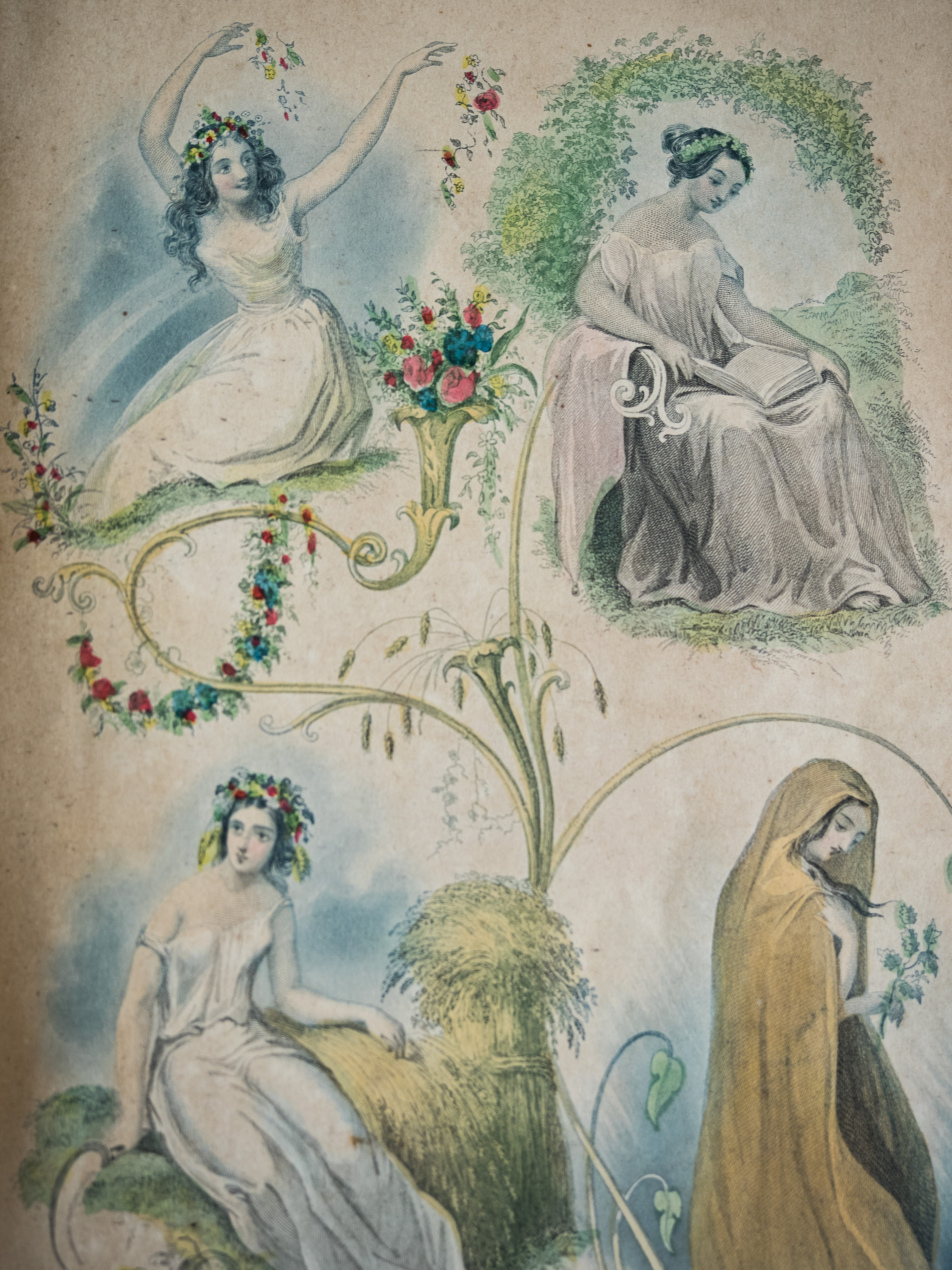
The Four Seasons, from Godey’s Lady’s Book, 1851

1852

Jan 1st Thursday.  It being very stormy last night Alson &

wife came home with us from Olivers & spent the night

and forenoon.  Cooked a turkey for dinner.

Went with them to Augustus this afternoon and 

evening called on Mrs J C Williams, found her

making some shop shirts for Oakes Angier.  The weather

is very warm & unpleasant


The new year began with rain and high water in the ponds, pleasing Old Oliver Ames.  He may have been retired from the shovel shop, but he kept close watch on how the business was doing, and how the business was doing depended heavily on how the water power was running. Evelina herself found the rain “unpleasant.”

Evelina and her family marked the day with a turkey dinner, making it an occasion. Evelina’s brother, Alson Gilmore, and his wife, Henrietta, had stayed the night, unable to get back to their farm in the driving rain. They were rewarded with a feast. After the midday meal ended, Evelina went with them to see Alson’s eldest son, Alson Augustus Gilmore, and his young family.

Back in the village, Evelina visited a seamstress about making shirts for her son, Oakes Angier Ames. Mrs. Williams, who was probably a widow, would sew a number of work or shop shirts for the Ames men over the course of the year.  Evelina herself had sewn multiple shirts the previous spring, a task that took her weeks to finish. Much as she enjoyed sewing, she must have been thrilled to pass the chore on to someone else. This would free her up to concentrate on dresses and accessories, as well as tend to the mending basket that always had work in it.

The New Year

What is a diary as a rule? A document useful to the person who keeps it. Dull to the

contemporary who reads it and invaluable to the student, centuries afterwards, who treasures it.

Sir Walter Scott


January 1, 2015

Dear Readers,

If you’re like me, you have treasured the 1851 diary of Evelina Gilmore Ames. Some of you have even participated with comments that have added depth to the consideration of a time gone by. Your additions have enhanced the small tale of a Yankee housewife who marked her modest days with regular notations of dresses sewn, flowers planted and fruits preserved, who wrote of short trips into Boston, visits to the family farm, and errands of mercy into the homes of sick neighbors.

Without meaning to, Evelina preserved a picture of life from antebellum New England, a life that has disappeared and evolved into a world she’d be hard-put to recognize. Her children, grand-children, and great-grandchildren have lived and died. Her house itself is gone, though the grander dwelling of her in-laws, Oliver, Jr. and Sarah Lothrop Ames, still stands proudly next door. Automobiles drive where oxen carts and horse carriages moved, and the significant architecture of certain stone buildings in the center of the village memorializes relatives she loved. The very factory whose noisy production of world-famous shovels led the local economy for decades moved away more than sixty years ago. She couldn’t have imagined it.

Yet some things remain the same. People are still people, solicitous or mean, content or down-hearted, eager or indifferent. The true characters we read about in the pages of her diary are recognizable and familiar to us in their essential humanity. We can find ourselves and our own families somewhere in these pages; we all behave so similarly. In Easton, Massachusetts, many descendants of the people Evelina wrote about still live. Last names like Ames, Gilmore, Randall, Tisdale and others can be found in the local telephone book (which itself is in danger of becoming as obsolete as Evelina’s tin stove.)

Evelina continued to keep a diary after 1851, but only the 1852 diary is extant. Her journals from the Civil War period have been lost. We’ll just have to treasure the one that remains. And so, ahead of us is the last available year of Evelina’s tiny aperture on the Ames family of old.

Thank you for reading!


Sarah Lowry Ames

(wife of John S. Ames III, great-great-great-grandson of Oliver and Susanna Angier Ames)