February 3, 1851

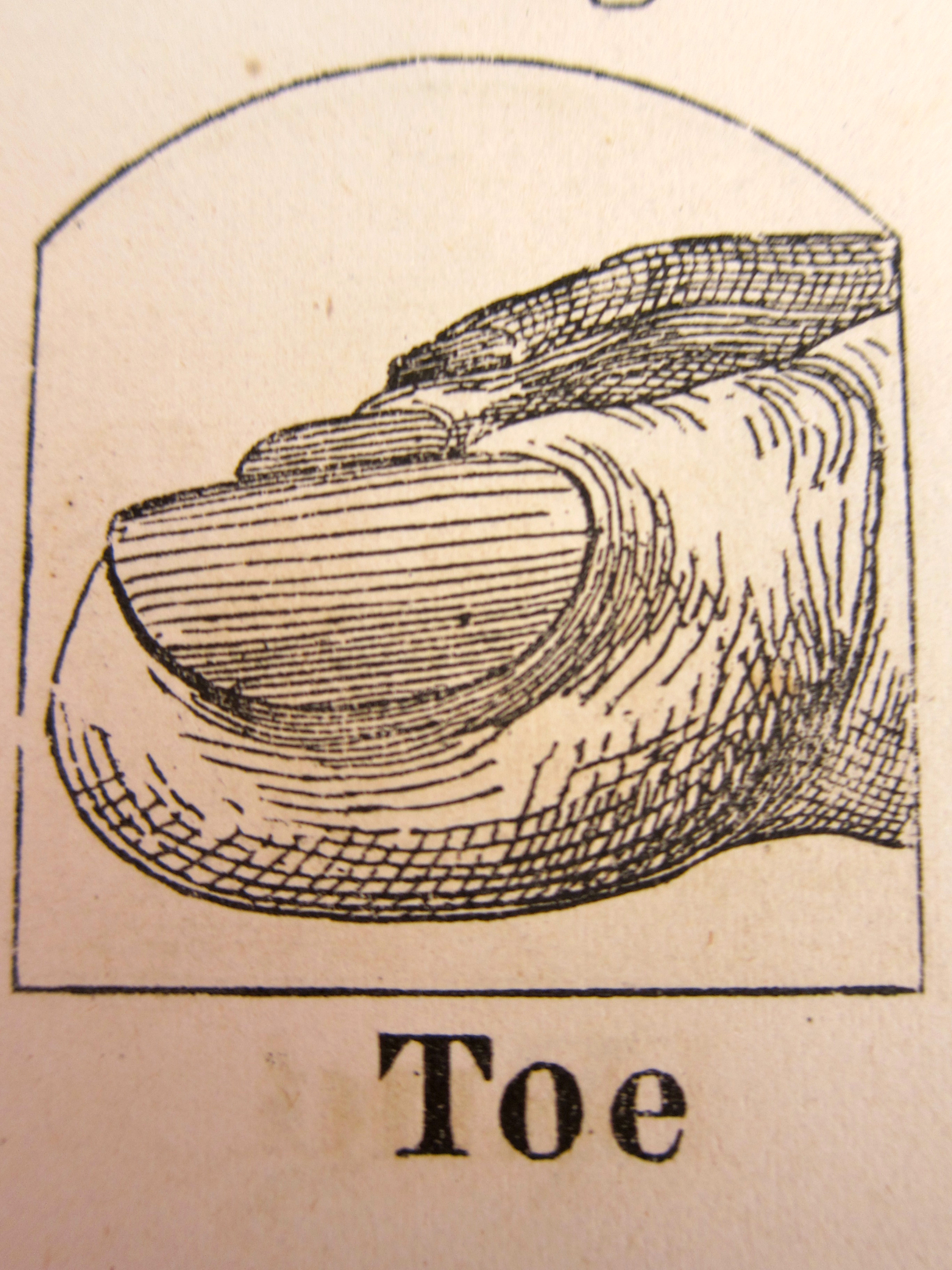
Toe

1851

Monday Feb 3 have not been about house much on

account of my foot.  It pains me a great deal & has

turned black under the nail.  Could not sleep last night.

Have been most of the day mending Oakes A shop coat.

work awhile mending Mr Ames shop coat

Susan has a bad cold & cough so that she did not

go to school.  This afternoon wrote a letter for Jane

to her nephew.  This is a remarkably pleasant day.

Evelina had to sit down today on account of having dropped a flatiron on her foot and injured her toe.  She wasn’t idle, however.  It was Monday, after all, and no one was ever idle on a Monday. She took up her mending, working on the shop coats of her husband, Oakes, and her eldest son, Oakes Angier.  The shop coats were used by the men for work, and only work, and had to be plenty sturdy enough to do physical labor in.

Little Susan (known as Susie  by her brothers) stayed home from school today and rested. At age eight, Susan was beginning to learn how to sew, but her skills at this stage were too elementary to help her mother with the mending.  Instead, she may have sat with her mother and read aloud, as sometimes happened, or perhaps her cough kept her in bed.

Jane McHanna, the servant who was busy today washing clothes, wanted to write a letter to a nephew.  Like many of the other Irish immigrants, Jane was probably illiterate and so asked Evelina to write the letter for her.  Evelina obliged.  But would the nephew have been able to read the letter once he got it?  And where was he?  Back in Ireland or had he, too, made his way to America?
February 2, 1851

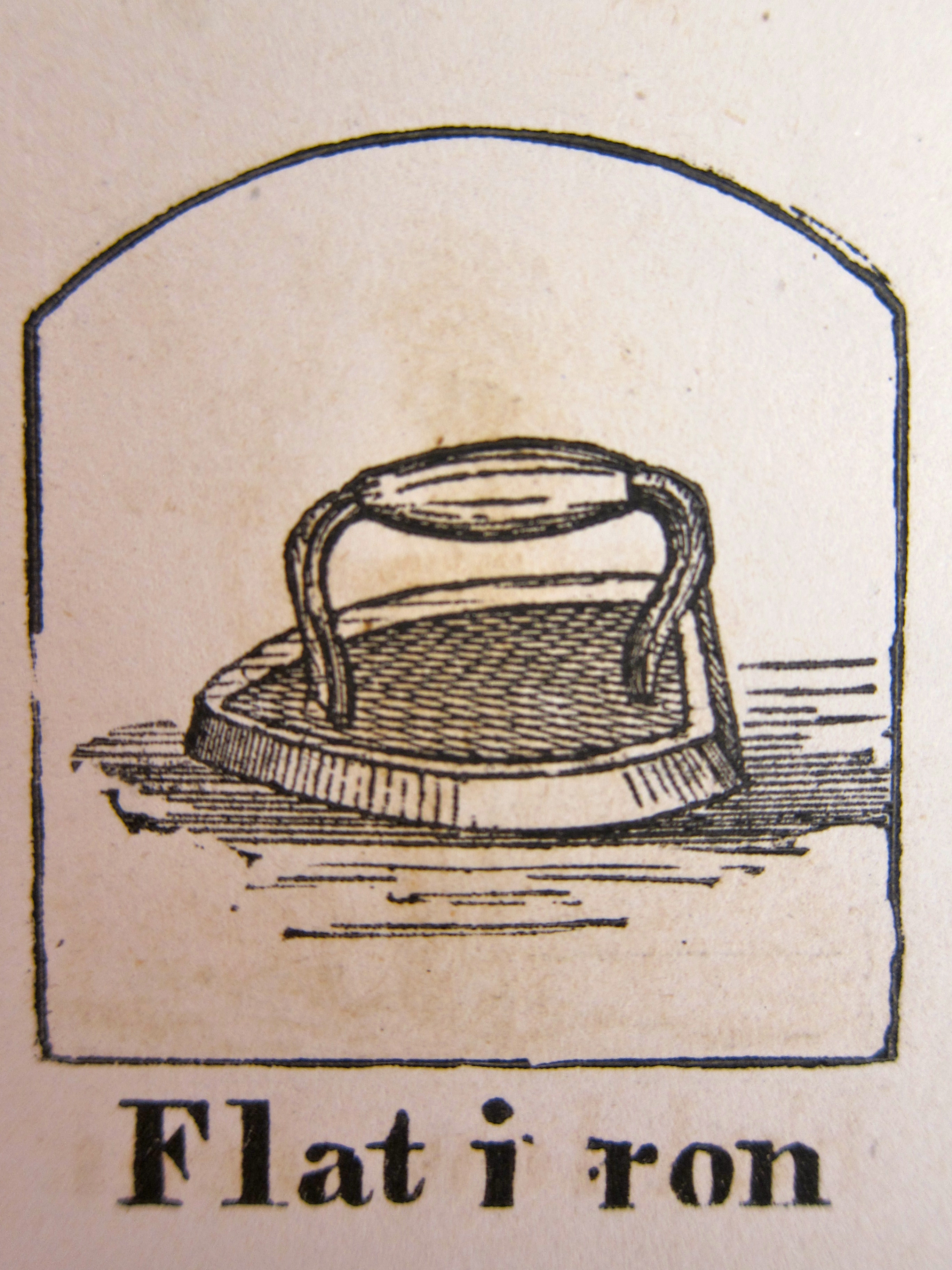
Flatiron

Sunday Feb 2d  It snowed very hard this morning but we

all went to meeting to hear Mr Brigham of Taunton

He gave us two very good sermons  he is very quick in his motions

& very independent in his manner  Mother went to meeting & home.

Since meeting have been reading in David Copperfield

Sarah A & Helen came in and stoped an hour or two.

This evening have hurt my foot quite badly by letting a

flatiron fall on it  It has cleared of[f] quite pleasant.

Snowy weather didn’t prevent attendance at meeting, and the Ames family stayed for both morning and afternoon service.  A visiting minister, Reverend C. H. Brigham, replaced Reverend Whitwell in the pulpit.  Mr. Whitwell, meanwhile, presumably officiated in Taunton.  This kind of swap was accomplished every month or so when ministers in the area switched places.  A Congregational practice that had been in place for years, the swap gave ministers the test of different congregations while, with fresh voice, it reiterated church dogma among a broad population.  Both congregations and ministers benefited however “quick in his motions” a visiting parson might be.

After church, Evelina’s brother Alson Gilmore carried their mother, Hannah, back to the farm in southeastern Easton.  Evelina had a little more time to herself, which she spent with Charles Dickens, at least until her sister-in-law Sarah Ames and daughter Helen stopped by.  Evelina has been reading David Copperfield – an 800 page book – for a week now.  But somehow in the course of the afternoon or evening – perhaps getting prepared for laundry day tomorrow? – Evelina dropped a flatiron on her foot.  Ow.  That took her out of commission for the rest of the day, perhaps allowing even more reading.

February 1, 1851

Ames Home and Office, North Easton, Massachusetts ca. 1852 - 1862

Ames Home and Office, North Easton, Massachusetts
ca. 1852 – 1862

Feb 1st  Saturday  Sit down to mending again this morning

Mended a pr of kid gloves and a number of other things

Went into the other part of the house with mother

to tea  worked on panteletts finished two prs.  Mrs Packard

and Mrs Rhoda Fuller called there  Mr Ames has been 

to Boston & brought home Ladys Books Grahams & Harpers

& International Magazines & 1/4 lb Angola yarn.  Have been

reading in the magazines this evening.  Cloudy & warmer

Evelina often mentions going into “the other part of the house,” which was a section of the house on the southern side in which Old Oliver, a widower, lived with his widowed daughter Sarah Witherell and her children.  This section was created when Old Oliver turned the original (ca. 1812) dwelling into a duplex in 1827 on the occasion of the marriage of Oakes and Evelina.

In 18th century New England, family custom often dictated that the eldest son inherit the family homestead and, in order to effect that, houses were sometimes renovated to allow two families to live side by side until the transfer of property came to pass.  That this practice was becoming less prevalent in the 19th century meant nothing to Old Oliver who, independent and conservative, still had his feet in the 18th century in certain ways.  His home would go to his eldest son, and he would eventually provide homes for his other children as well.

In the above photograph of the Ames House on Main Street, we can see the original home in the center, a building that is divided in two on the inside, with Old Oliver’s doorway facing toward the camera (behind the middle tree).  The entryway for Oakes and Evelina faces the street.  To the left of the house is the attached office, where Oakes and Oliver Jr and others kept track of business matters.  It was known as the Counting House.

In the background to the right is the house Old Oliver built for Oliver Jr and wife Sarah Lothrop Ames on the occasion of their marriage in 1833.  In 1863, they would tear this down and rebuild a more modern and formal abode, one that still stands today. The old homestead, which housed generations of Ameses in its time, was torn down in 1951, approximately 100 years after this photograph was taken.

January 31, 1851

photo

Jan 31st Friday  This morning sat down with mother quite early

mended several articles. & altered the waist of Delaine Dress

Augustus came in the stage & dined here & carried mother

to Mr Torreys.  I went about two & passed the afternoon

Called on Mrs Lothrop at Dr Wales, Engaged the

school house for O Foss to keep a private school.

Came home quite early & wrote her a letter.  Sewed

on Susans panteletts.  Very cold but not quite as cold as yesterday

Evelina and her mother, Hannah Lothrop Gilmore, sat together and sewed this morning.  After mending several items – there was always mending to be done – Evelina reworked the waist on a delaine dress, “delaine” meaning “of wool” in French.  It was a popular and durable fabric in this era.  But altering the waist begs the question, did she have to take it in or let it out?  And had she begun to wear her sleeves in the new “pagoda” style?

Augustus Gilmore, Evelina’s nephew and Hannah’s grandson, soon arrived and, once Oakes and his sons came home from the factory at noon, they all dined together. Augustus was close to his Ames cousins, and worked for the company from time to time.  After dinner,  Augustus accompanied his grandmother to the Torrey house in the village, where Hannah’s granddaughters, Abby and Malvina, lived.  Evelina joined them there a bit later, and paid another call as well, on Mrs. Lothrop.  There were many Lothrops in Easton, so we can’t know just which one Evelina visited.

We can know that Evelina was somehow involved in the setting up of a private classroom.  A young woman named Orinthia Foss, with whom Evelina corresponded, was due to arrive in North Easton to teach.  The genesis of this arrangement is a mystery. Was Evelina doing this because of concerns about Susies’ schooling?  Who else was involved? And who was Orinthia Foss? How was she hired?

Whatever the back story was on this new little school, Evelina took a bold step today when she committed to renting a schoolhouse.  She promptly returned home to write Orinthia with the good news.

January 30, 1851

Flames

Jan 30th  Thursday  Mended Mr Ames pants which

took me most of the forenoon, read some to Mother.

Spent this afternoon at Olivers with mother & Mr

Whitwell.  They sent the carriage for Mrs Whitwell

but it was so cold that she did not come.  Mr Ames

took tea with us & Mr Ames Oliver Jr C Lothrop & 

Helen played cards I commenced a stocking of the yarn

Mrs Foss gave me.  A bitter cold day & quite windy.

A great fire in Taunton

“A verry bad day to go out in,” noted Old Oliver in his journal today.  Eliza Whitwell refused to leave her home several miles away to join the Ames ladies in the afternoon, even though her husband was there.  The carriage – did it belong to Old Oliver, or Oliver Jr, or to the family in general?  Whoever owned it, its likely driver was Michael Burns, an employee of Old Oliver who looked after the horses and carriages.

While Michael drove to and from the parsonage in the howling cold, various family members gathered next door at Oliver and Sarah Lothrop Ames’s house for tea. Oakes and his son Oliver (or possibly his brother Oliver – unclear) played cards – probably whist – with Cyrus Lothrop and Helen Ames.  Cyrus was an unmarried brother of Sarah Lothrop Ames who lived with Sarah and Oliver, Jr. for many years. Helen was their only daughter; their son, Fred, was probably away at Phillips Exeter Academy on this occasion.  Evelina knitted and kept her mother company.

In nearby Taunton, Massachusetts, Evelina reported, the furious wind contributed to a “great fire.”  The histories of that period don’t mention this fire, so perhaps it was not as great as Evelina thought.  That, or it paled in comparison to the larger fires that Taunton suffered in 1838 and 1859.*  Fire, naturally, was the dread of every homeowner and municipality; towns and cities in the 19th century (and before) were pock-marked by periodic burnings, its citizens haunted by the loss of life and property that fires engendered. The fire on this day in Taunton would have been made especially difficult by the frigid air and icy wind.

*Information obtained from Old Colony Historical Society, Taunton, Massachusetts

January 29, 1851

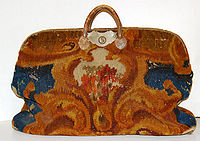
Carpetbag

Carpetbag

Jan 29th  Finished my carpet bag this morning and afterwards made

a long call on S Witherell and then she came here and sit awhile

with Mother.  This afternoon cut Susan 4 prs of pantletts

and finished a pr that was cut out a long time since.

S Witherell passed an hour with us this afternoon and 

then again this evening  The boys went to the shop awhile

Mr Ames came home at 1/2 past seven (wonderful to relate)

and has been reading in Mr Lovells paper  Very heavy rainfall

Pleasant tonight but very windy

Sewing the carpet bag was speedy work for Evelina, given her skill with a needle.   Carpetbags were fashionable travel bags from as early as the 1820s, in America and England.  They gained notoriety after the Civil War when they became symbolic of certain ruthless opportunists – “carpetbaggers” – from the North who flooded into the South to take advantage of the post-war confusion and economic disarray.  The negative symbolism of this small piece of luggage was unknowable in 1851, obviously, so we can imagine that Evelina carried her new carpetbag with pride.  Perhaps she used it on her next trip to Boston.

Oakes Ames didn’t linger in the office tonight as usual but came home for a quiet evening of reading the Olive Branch.  Evelina was pleased to have his company, which must have provided some variety for her elderly mother, too.  Sarah Witherell’s company would have added to the ease and sociability of the evening.  More often, Sarah stayed in her part of the house in the evening in order to be company to her father. And the boys – Oakes Angier, Oliver (3) and Frank Morton – went back to the shop, although the nine o’clock curfew was nigh.

The Ames house was divided into two living areas, with Old Oliver, Sarah Witherell and her two children on the southern side and  Oakes and Evelina’s family on the northern.  Old Oliver made this division back in 1827 when Oakes and Evelina first married, indicating then that Oakes, as his eldest son, would inherit the family  homestead.  The two families had lived side by side ever since, the house expanding and contracting as children grew up, occupants died or moved out, and grandchildren came into the world.

Some Ames family members of today who can remember the old homestead (it was torn down in 1951) shake their heads in wonder at this living arrangement, curious as to how everyone fit in.

January 28, 1851

Pray

1851

Jan 29th Tuesday  This morning sit down quite early to 

making a carpet bag of pieces that were left of the parlour

carpet.  This afternoon cut a place in the drugget for

the parlour register  Abby & Malvina passed the afternoon

here and this evening.  Mother Abby & myself have been

to a prayer meeting at Mr Bucks.  Mr Buck, wife &

their children all spoke & prayed  Charley best of all.

Abby made a few remarks & a number of others.  Cloudy.

It appears that the recent domestic mishap of spilled varnish on the parlor carpet was solved by the installation of new “drugget” or carpeting. The change of carpeting must have been in the works before Evelina’s purchase of drugget in Boston two weeks back.  After the rug was installed (by whom?,) Evelina scavenged enough scraps from the cutting to begin to assemble a carpetbag for herself.  Waste not, want not.

The mention of cutting the rug to fit around a register helps confirm the existence of a central furnace in the old house.  In fact, Old Oliver had installed coal furnaces only recently on his property, in the counting house or office as well as in the residence.  Coal as fuel was a marked change from earlier days when the family had relied on wood-burning fireplaces for heat.  Oakes Angier must have been pleased with the change.  According to his grandson Winthrop, Oakes Angier detested the old fireplaces, remembering that they  “broiled you on one side while you froze on the other.” *

Tonight Evelina took her mother and niece Abby Torrey to a prayer meeting at the Bucks’ house where they heard all the Buck family members pray.  Evelina’s take on young Charley Buck was prescient, for he would grow up to be the Reverend Dr. Charles Henry Buck, well-respected Methodist minister in a succession of churches in Connecticut, New York and, eventually, Easton.

*Winthrop Ames, The Ames Family, 1937, p. 125.

January 27, 1851

Read

Jan 27th Monday.  As usual this morning have been washing dishes

and working about house all the forenoon.  could not sit

with mother at all.  It was cloudy and looked like rain

but Jane ventured to put her clothes out to night  They

are nearly dry.  This afternoon & evening have finished

Susans gingham apron.  Sarah W came in awhile this

evening and the boys have been reading.  After school

Susan went to see Mary Ann Randall.  Cloudy

Another Monday, meaning that Evelina did the housework while Jane McHanna tackled the laundry.  Evelina was too busy “choring,” as she often called it, to sit down in the morning and sew or read with her mother, Hannah Gilmore, who was visiting for the week.  The women sewed together in the afternoon, however, after the midday meal, and in the evening, they enjoyed a visit from Sarah Witherell.  Oakes was most likely over in the office; he and his brother Oliver Jr. often worked there in the evenings after tea.

The boys were around, of course.  The shovel factory closed at 6 P. M. whereupon Oakes Angier, Oliver (3) and Frank Morton walked home. There were no dances on a Monday night, so after tea, they amused themselves by reading.  All three boys read, yet Oliver (3) was reckoned to be the most scholarly.  Even as a child he enjoyed reading and, with Oakes Angier, began to collect books. Years later, a colleague would say of Oliver that “in the company of books he found an absorbing pleasure.”*

On this winter night, everyone indulged in the papers or books, reading by the light of various oil lamps.  Evelina was no doubt eagerly turning the pages of David Copperfield, perhaps reading aloud to her mother whose aging eyesight may have precluded the pastime.  Hannah Gilmore loved to read.   In fact, she had named Evelina after the heroine of a book popular in her youth: Evelina; Or the History of a Young Lady’s  Entrance into the World.  This comic novel by British author Fanny Burney came out in 1778, and continued to find an appreciative audience in both Britain and America.   Evelina had probably read it at some point, if only to see how Evelina Anville captivated Lord Orville.

*Memorial Volume for Governor Oliver Ames, ca. 1896

January 26, 1851

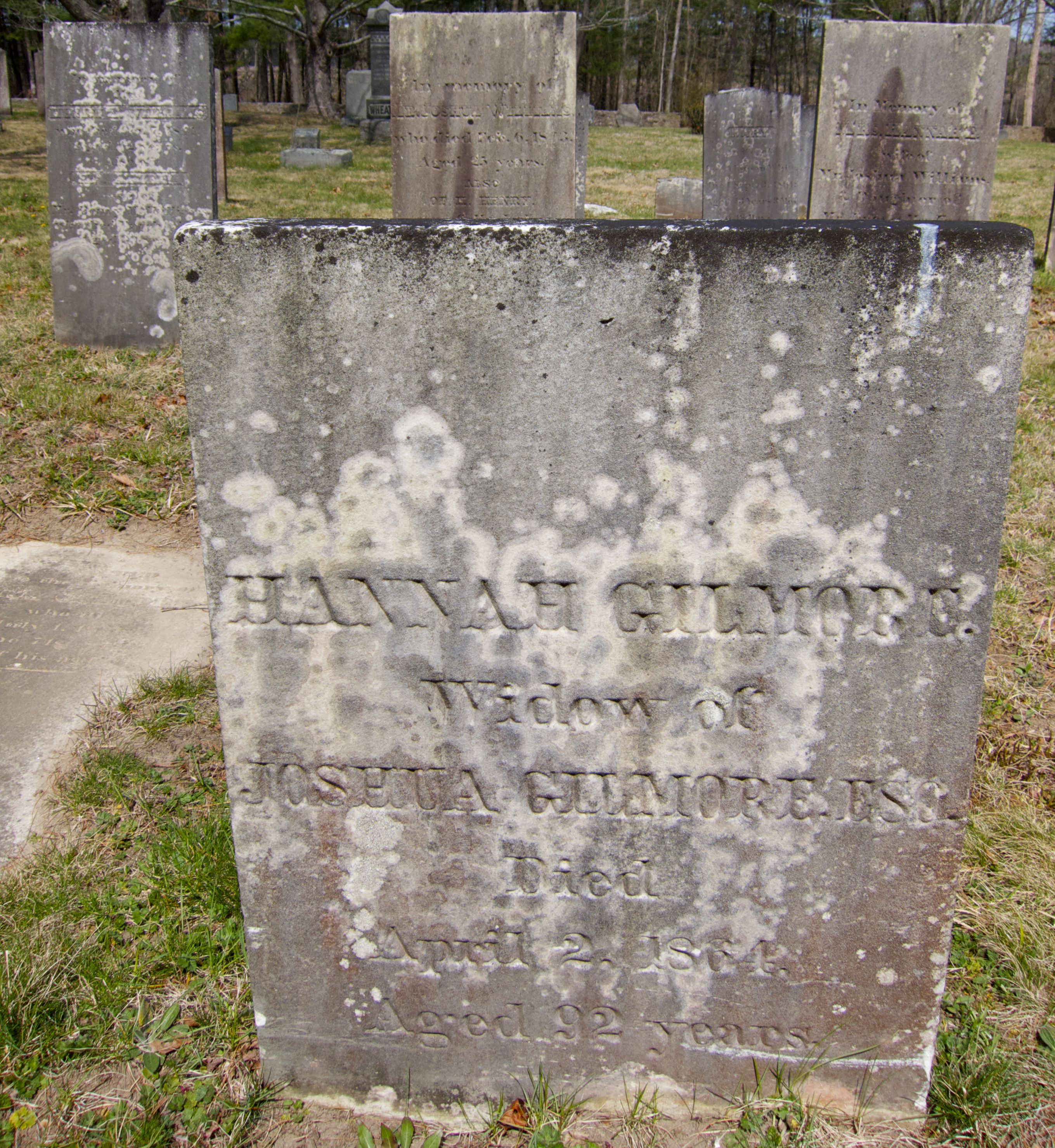
Gravestone of Hannah Gilmore

Gravestone of Hannah Gilmore

Jan 26  Sunday  Have been to meeting all day and heard two

excellent sermons from Mr Whitwell  Came home

between meetings.  Alson rode home with Mr Ames

Mother came with us from the afternoon meeting will

stop a few days.  Mr Whitwell walked up this morning

expecting to exchange with Mr Lovell but he (Mr Lovell)

was not prepared.  Mr W says a minister ought always to

be prepared.  Edwin called this evening.  It is a beautiful day.

A scheduling mix-up at church today caused consternation.  Most congregations had a practice of exchanging ministers.  On a regular basis, a minister from one church would swap one Sunday with a minister from another, allowing the congregations to listen to other voices and sermons.   On this Sunday, the scheduled switch between Reverend Whitwell of the Unitarian Church and Reverend Lovell of the soon-to-disband Protestant-Methodist assembly failed to take place.  Mr. Whitwell wasn’t pleased, but he seemed to recover just fine.  He delivered two more “excellent sermons.”

“Mother” was Hannah Lothrop Gilmore, or Mrs. Joshua Gilmore, as she would have been known, or perhaps  The Widow Gilmore, her husband having passed away in 1836.  One year shy of eighty, she was the mother of eight children, of whom only three were still alive.  Evelina was her only living daughter.

Mrs. Gilmore lived most of the time with her middle son, Alson, his wife, Henrietta, and their children at the family farm in the southeastern corner of Easton.  Just north of the town line with Raynham, the Gilmore property lay on what was known as the Turnpike Road.  In the distant past, Joshua Gilmore had maintained a tavern at that site, and had collected the fees from travelers on that road.  In 1851, the family still got income from the Turnpike, but the tavern was gone.  The land was all farm.

Occasionally, Mrs. Gilmore would visit with her daughter in North Easton.  Alson would carry her to church and after the service was over, Hannah would leave with Oakes and Evelina to stay at their home for the week.   While in North Easton, she’d be able to visit not only with her Ames grandchldren, but also with other grandchildren in the area, like Abby and Malvina Torrey.  And on this Sunday, her grandson Edwin Williams Gilmore, a grown son of Alson who no longer lived at the farm, paid a visit.  He would soon be building a home close to the Ameses.

January 25, 1851

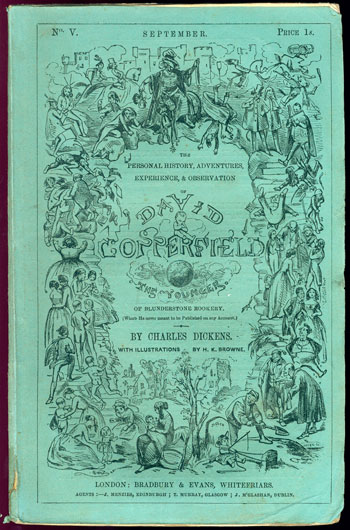
Charles Dickens, David Copperfield

1851

Jan 25 Saturday.  Have been sweeping and dusting the house and 

have done a little of everything and not much of anything.  Have got

the chambers in pretty good order for once in my life.  Have

mended Mr Ames coat & vest.  Took the time when he was 

from home because he has but one suit beside his go to meeting

poor man!  Called at Mr Torreys just at night.  This eve

have been mending & have had no time to read.  Commenced

reading David Copperfield.  Mr Ames at Boston.  Very warm & fine

Evelina could be critical of others, but she was most critical of herself.  Her self-deprecation often took a humorous tone, as in having done “a little of everything and not much of anything.”  She really tried to get things organized at home today, tackling perhaps one of her biggest challenges: keeping her husband Oakes in decent clothes.

Family lore would have it that Evelina was miserly, lore that is reinforced by Reverend William Chaffin.  Chaffin blamed Evelina for Oakes’ shabby “pantaloons,” believing that Evelina  “being economical kept them well mended instead of encouraging him to buy new ones.”  Yet Chaffin also acknowledged Oakes’s indifference to outfit, telling us that while on a trip into Boston with a friend, Reuben Meader, Oakes responded to Meader’s suggestion that he should wear better clothes by saying: “Oh, I can wear poor clothes if I want to, but some men can’t.”

Oakes spent money on gifts; he was well-known and well-liked for his charitable instincts.  However, unlike his brother, Oliver Jr., who shopped for bespoke outfits in Boston, Oakes didn’t spend a dime on his apparel; he simply didn’t care, so  Chaffin was unjustified to blame Oakes’s appearance on Evelina.  She tried to keep him mended, and we know that she was willing to spend money on clothes; certainly she kept the dressmakers in Easton occupied.  But she must have met resistance if and when she tried to improve her husband’s wardrobe.

Today’s hard work had a reward: opening the pages of David Copperfield, the newest book by Charles Dickens.