April 4, 1851

fc63da74a7d83ab723f4be9af9db4c70

1851

April 4th

Friday  Have been working about house this forenoon

Gave my parlour a thorough sweeping & bedroom

& stairs &c  Have not been at all well and had

hard work to sweep.  Jane finished the ironing

We have had a hard weeks work  This afternoon

I mended the stockings  Called at Olivers awhile

Mrs Peckham called here.  Very Pleasant

Evelina was feeling the effects of a laborious week of domestic duties. Over the past several days, she and Jane McHanna had really turned to in the kitchen, preserving a pig, trying lard, making sausage and doing the bi-weekly baking. On top of that the women had seen to their regular chores, which included ironing and sweeping the rooms free of the spring dust. Evelina managed all this while recovering from the cold of the weekend before. Sitting down to do some mending must have felt good.

She found some compensation by briefly visiting her sister-in-law, Sarah Ames, next door. And at home, Susan Peckham came to call. Mrs. Peckham was the wife of John Peckham, the Ames’s head clerk and bookkeeper. What was the purpose of her call? Susan may simply have desired to be sociable, or she may have had something she needed to communicate. At a time when today’s instantaneous ability to telephone or text someone was unimagined, even the simplest request or slightest inclination to talk to a friend, a relative, or, in this case, the boss’s wife took time and effort. Susan Peckham, whatever her purpose was, had only two options open to her: writing Evelina a note, or calling on her.  She chose the latter.

What might the women have discussed?  Evelina didn’t say.
 

April 3, 1851

pork-pie_2180207b

1851

April 3  This morning went quite early to baking in the brick

oven made mince & dried apple pies two custards brown

bread three large pork pies & ginger snaps. Alson here

to dine.  Henrietta & the two little girls dined at Mr Torreys

& were all here to tea  This Evening we all went to the 

dancing school.  Mr Whitwell called a few minutes

this afternoon & Mrs S Ames  Quite Pleasant

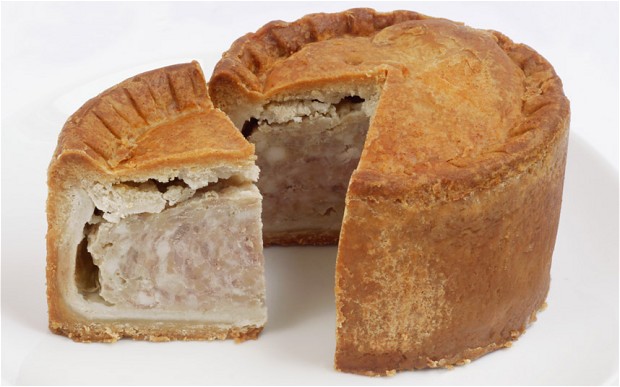
Small wonder that pork pies were on the menu, after Evelina and Jane McHanna spent all of yesterday processing a freshly-“kild” pig. Once again in the kitchen with her apron on, Evelina turned today to baking. As usual, she baked a large quantity of goods in the brick oven that she shared with her sister-in-law, Sarah Witherell. About every ten days or two weeks – or every fortnight, as they might describe it – one or both women would bake up a storm of pies, cakes, bread and cookies, enough to last until the next big baking.

Mince meat pies, brown bread and ginger snaps regularly featured in Evelina’s baking. These are the first pork pies to appear, however.  New, too, are the dried apple pies. Gone by now are the apples in the barrel that was delivered in January from the Gilmore farm, the one that was kept locked in the cellar so that the sons of the house wouldn’t eat up the fruit. Any apples that remained were from a group that must have been dried the previous fall for just this purpose, to provide a little fruit in an otherwise barren season.  By this time of year, housewives had to rely on preserves and dried fruit for variety in the family diet.

The Ames had company for tea: another sister-in-law, Henrietta Gilmore, and her two youngest children, little Henrietta and little Helen, made a rare visit from the Gilmore farm. These two youngest nieces of Evelina are about the same age as little Susie, yet they don’t get much mention in the diary.  They probably lived too far away for regular play time. Mr. Whitwell, the highly-regarded Unitarian minister, paid a call today, too.  Pleasant spring weather was bringing people out of the houses to visit.


April 2, 1851

Ham

1851 Wednesday

April 2nd  Jane & myself have been taking care of a hog

that was killed yesterday.  Have the lard tried

sausages made  fat back & hams salted and the whole

hog already for cooking.  This afternoon Jane ironed

seven fine bosom shirts.  This evening have been reading

being to[o] much fatigued to work.  Augustus went to 

Boston

It was a busy day in the Ames kitchen as Evelina and her servant, Jane McHanna, set about preserving one of the pigs that Evelina’s father-in-law, Old Oliver, had slaughtered the day before.  He sold some of the pork, but held back at least one of the animals for his own household.  Evelina and Jane had a long day’s work processing the animal, which had weighed about 300 pounds when slaughtered.

As the women broke the animal down into workable pieces, they “tried the lard,” which meant that they boiled much of the pork fat in water on the top of the stove, taking care to avoid the spattering as the fat popped and the water drew down. The resulting lard was cooled and stored, probably in stoneware jars, for future household use.

Also to be cooked in the future were the big hams, ribs, hocks and more.  The large hams were salted and hung in a safe place like the cellar or a smokehouse until ready to be baked or boiled and eaten, while smaller pieces like the ham hocks would have gone into glass jars or stoneware. Everything got prepared, even sausages, which was a process unto itself, what with grinding the meat, mixing in the herbs and spices, and packing the mixture into the intestinal casing.

In addition to all this, Jane found both time and energy to iron “seven fine bosom shirts.” The cookstove, which had been heated for trying the lard, must have been hot enough to heat up the flatirons.  Perhaps not wanting to waste that good energy, Jane set up the table to iron.

Those two women must have slept well this night.


April 1, 1851

Swine

1851

April fool day  Have had some sport this morning

with Mrs Witherell, Mrs Ames & Orinthia, making

April fool of them,  Jane heard something at

Mr Bartletts yesterday, which has made her cry

& about sick so that she had to go to bed.  Susan has

begun to work on card board that Mrs S Ames got at

N Bridgewater yesterday  Orinthia, Susan & self passed the 

afternoon at Mr Torreys  Weather Pleasant

April Fool’s Day is a holiday of uncertain parentage, in part because the very nature of the day has generated multiple false versions of its origin. The most credible genesis dates back to Roman times and the festival, Hilaria, which, in simplest terms, honored the vernal equinox. The departure of winter and the arrival of spring was cause for celebration and spirited fun.

Although Evelina may have had little interest in the history of April Fool’s Day, she loved the practice of it.  After a winter of icy weather, muddy roads, illness and sewing, sewing, sewing, the innocent levity of a practical joke or two delighted her. She did have a sense of humor. Whether the relatives and friends she played tricks on enjoyed the day with equal humor remains unknown. Her sisters-in-law, Sarah Witherell and Sarah Ames, may have known her well enough to expect a joke from her on this day.

No April Fool’s nonsense for Old Oliver, however. Ever the farmer, he practiced his own rite of spring with the slaughter of pigs:

“4 shoats kild to day and the 4 weighd 1205 pound  I sold them for 7 1/2 cents a pound.”

No laughing today for Jane McHanna, either. She was distressed and “about sick” over something she heard the previous evening. She took to her bed, most likely leaving Evelina to prepare evening tea.

What was the card board project that little Susie Ames began today?  Any idea, readers?

March 31, 1851

Shears

1851

March 31st Monday  This morning after doing my chores about

house, cut out a shirt of rather coarse unbleached

cloth for Mr Ames, am going to put a linen

bosom into it.  Also cut a coarse shirt for 

Oliver, have been mending some, but have not

sewed any on the shirts.  Called this afternoon

on Mr Holmes & at Bridgets to see the dress

maker, Worked awhile on my scrap book.  Orinthia

& I spent the evening at Olivers, Jane at G. Bartletts P.M.

After her morning chores on this last day of March, Evelina cut out more shirt parts. Any reader who has been following this blog on a daily basis has seen Evelina’s prodigious production of shirts for her husband and three sons. This particular project is soon to end. After one or two more mentions, Evelina will leave behind the cuffs, bosoms, and coarse and fine cloth of men’s shirtmaking and move into dressmaking for herself and her daughter, Susan.  And when fair weather truly arrives, she will head for her flower garden.  She will never completely stop sewing – there was always mending to be done – but she will relax her grip on needle and thread.

Today being Monday, Jane McHanna was busy with the weekly laundry, washing the family linens and clothes and hanging them out to dry.  In the evening – after preparing tea for the family, no doubt – Jane left to go to a Mr. Bartlett’s.  The call was probably a social one, but we don’t know whom she visited.  Because so many of the servants in the village had recently immigrated from Ireland, they tended to know one another and often visited each other when they had time off.  Meanwhile, Evelina and the young boarder, Orinthia Foss, headed next door to visit Sarah Lothrop Ames.  It was a sociable evening for all the women in the Ames household.


March 30, 1851

headache1

*

March 30 Sunday  Have not been to meeting at all to day.  My

cold is very troublesome have a very bad head ache.

could not read much.  Mr Cyrus Lothrop 3d called this 

evening & Frederick, Oakes Angier & Orinthia rode

down to Mr E Howards this evening.  Mrs Howard

has gone to Nashua to make a visit.  Mother returned

home from meeting  A very fine day

I commenced making fire in the furnace

Evelina continued feeling poorly today. After yesterday’s helping of the commercial elixir, Wistar’s Balsam of Wild Cherry, one can’t help but wonder if her headache was, in fact, a symptom of hangover from the alcohol she unknowingly ingested.

The consumption of alcohol was absolutely forbidden at the Ames’s house.  Both Oakes and his brother Oliver Jr took a temperance pledge early on, and kept it. They hoped their workmen would follow their example. In this they differed from their father who, in his heyday of running the shovel works, had allowed his workers a ration of rum as part of their regular routine.  Old Oliver’s habits had been learned in the 18th century, which had a more lenient attitude about liquor.  In the 19th century, however, tolerance of alcohol disappeared. Temperance became the banner of the day, its support increasing yearly and culminating, ultimately, in the Prohibition amendment in the 20th.

In the Ames dining room, even something as mild as cider was frowned upon.  Cider was considered by some at a “gateway” beverage to liquor and hard spirits; others found it innocuous. Evelina kept some in the pantry to put in her mince pies but never served it at table.  Once, however, she offered a tumbler of cider to her future son-in-law, Henry French when he turned down a cup of coffee. Oakes admonished them both by stating flatly that, “No cider shall be drunk at my table.”

Alcohol was a controversial issue.  If Evelina had known that the medicine she was taking was laced with alcohol, she might not have indulged.  If Oakes had known, he wouldn’t have allowed her.

*Advertisement from ca. 1900.  


March 29, 1851

483a

1851

March 29 Sat  Have a very bad cold and cough some

but it has not increased with my cold which is unusual

Have taken Wisters Balsam  This afternoon mother

Orinthia & self called awhile in the other part of the 

house  Abby came here about four & stoped one

hour or two, but did not stay to tea  I finished Mr

Ames bleached shirt and Orinthia finished a

coarse shirt for him  Pleasant and fine traveling

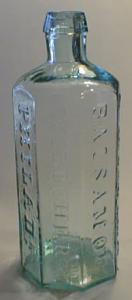
Evelina caught a “very bad cold,” her second one since the start of the year.  The first cold she treated by concocting a time-honored home remedy of which her Puritan ancestors would have approved. It included honey, a little horehound from her own garden, and more. The new cold, however, she dosed with a commercial product, Wistar’s Balsam. This bottle of patent medicine was something she purchased “over-the-counter,” as we would say today, with the expectation that a commercial product offered an improvement over what she might have made for herself.  Such a transition from home-made to manufactured goods was very much part of the mid-19th century world in which she lived.

Dr. Wistar’s Balsam of Wild Cherry was the most popular of many patent medicines available in the marketplace for the self-treatment of various ailments. With its “heady melange of cherry bark, alcohol and opiates,” it claimed to have “‘effected some of the most astonishing cures ever recorded in the History of Medicine!'”* With no regulatory oversight or standards to adhere to, it and other nostrums could and did claim curative powers over everything from colds to consumption. A consumer like Evelina could be completely taken in.

How Wistar’s Balsam helped Evelina’s cold is uncertain, but she temporarily felt better for the drugs she imbibed. She was able to sit up with her mother, Orinthia and Sarah Witherell, visit with her niece Abby Torrey, and finish sewing a fine shirt for her husband.


*footnotessincethewilderness.wordpress.com/2010/07/13/henry-wister-and-the-nations-leading-patent-medicine-dr-wistars-balsam-of-wild-cherry

March 28, 1851

Egg

1851

March 28 Friday  After making my bed &c went to

mending Mr Ames coat which kept me busy till past

nine Oclock.  A[u]gustus brought me 50 eggs

for which I paid 50 cts  Mother returned from 

Mr Torreys about ten Oclock.  Mrs Witherell

came in at 4 Oclock and staid untill 5 Oclock and 

finished stiching the ninth bosom  Mrs Buck

and Sarah called the Evening  Weather very pleasant

A penny an egg, or 12 cents a dozen.  Not so today.

That Evelina bought her eggs tells us right away that the Ameses didn’t keep chickens.  If they had, Evelina would never have paid for something she could get for free.  These eggs came by way of the Gilmores, either from Augustus who may have been living on a property that had chickens or, possibly, from Augustus’s father, Alson, out on the family farm.

Poultry seldom appeared at the Ames’s dinner table, or at least Evelina didn’t mention it if and when it was served. Beef and pork were the mainstays of their diet, not chicken. Turkey and goose was served, but only on special occasions. The larger animals, once slaughtered, could be preserved in multiple ways, and could stretch to feed more people. Chicken didn’t offer as much variability, although it was acknowledged to be “generally healthful” and for the sick, “a most agreeable and nutritious diet.”*

In the winter, particularly, chicken as a meal was in short supply all over New England. Chickens were vulnerable to the harsh winter of Massachusetts and many people simply didn’t keep any. Come spring, however, they were a welcome change. A “spring chicken” was something young and fresh. An old laying hen, on the other hand, once past her prime, was something to be put in a pot and stewed.

It follows that eggs, which were important in cooking and baking, were in demand. Thus we find Evelina procuring several dozen for her kitchen.

*Sarah Josepha Hale, The Good Housekeeper, 1841.


March 27, 1851

0380042t

1851

March 27 Thursday.  Spent the day with Mother at A[u]gustus,

got home just before six Oclock and went

in the evening to the dancing school with Mrs S. Ames

Cut out and commenced a bleached shirt for

Mr Ames but have not done so much as to finish 

the sleeves.  Mrs. S. Ames has been to Boston from 

Sharon.  A fine day and very good travelling

the roads are quite dry.  Mother stopt at Mr Torreys.

After Evelina and her mother spent the day with, respectively, nephew and grandson Augustus, Hannah Gilmore left to spend the night at her son-in-law, John Torrey’s, house in the village, leaving Evelina briefly unencumbered from looking after the elderly woman. Evelina seized the opportunity to go out with her sister-in-law, Sarah Ames, to help chaperone a dance for the young people.

No doubt the Ames sons, Oakes Angier, Oliver (3) and Frank Morton were at the dancing school, as they had been for most of the previous Thursday evening assemblies. So, probably, was Fred Ames, making a rare appearance while home from school.  While adults from their parents’ generation were always present at these occasions, one wonders how the young men felt having their mothers among the group standing guard.

These assemblies were important social occasions that provided innocent pleasure and animation. They fostered acquaintances among the young people of the town who had few other opportunities to mingle.  Dance steps were learned, exercise was taken, manners were polished, courtships were sparked, hearts were engaged or disappointed, and perpetuation of the species forwarded in this important small town gathering. Surely both Evelina and Sarah Ames watched the proceedings with interest.

March 26, 1851

Sweep

1851 March 26 This morning Orinthia & myself gave a thorough

sweeping & dusting to sitting room entry & then I 

went to mending stockings  Mother & myself passed

the afternoon at Olivers with Mr & Mrs Whitwell.

Mrs S Ames & Mrs Witherell spent the evening

here  I finished the shirt that I commenced 

for Oliver on Monday.  It has been a delightful day

Mud season, as they call it in New England, had arrived and thus a daily sweeping of the floor and carpet was essential. Dust and mud entered the house on the bottoms of boots and shoes when anyone came in the door.  Once this messy passage from winter to spring had safely passed, it would be time for spring cleaning.

Meanwhile, the ladies in the Ames compound on Main Street were socializing among themselves. Evelina took her mother next door to Sarah Lothrop Ames’s house in the afternoon and visited with William and Eliza Whitwell, who were calling.  In the evening, both sisters-in-law came over to visit with her.  The ladies sewed – Evelina still working on shirts, this one for her middle son – and chatted.

The men were not present for this girls’ night in.  Oliver Jr. was in New Jersey on business and, if Oakes were in town, he would have been over in the office, as was his wont.  Years later, Winthrop Ames, grandson to Oakes and Evelina, would note in his description of family life in Easton in 1861:

“Usually […] Oakes, Oliver junior and their sons went to the office in the evening to catch up with their correspondence (all letters were written and copied by hand), discuss business together and go over accounts with the head bookkeeper.”

Whether working or playing, the Ames family members spent this quiet evening en famille.