March 26, 1852

imgres


1852.

Friday March 26  Mrs S Ames returned from Boston last

night, had unpleasant weather for two days.  She called

at Mr Orrs found them all well. Julia is there

yet with her little one  Mrs S Ames & Witherell

called on Mrs Elizabeth Lothrop and invited me

to go with them but I felt it more my duty to call

on Mrs Swain, did so, and was prevailed upon to 

spend the afternoon & evening.  She has weaned her

babe, has been quite unwell but is now better

Two young women closely connected to Evelina recently weaned their babies. Hannah Lincoln Gilmore, wife of Evelina’s nephew Augustus, had just weaned her seven month old son, Willie. Ann Swain, wife of the head clerk of the shovel works, John Swain, had done the same with her five month old boy, John.

Weaning was an anxious time for both babies and mothers, although in this circumstance it appears the babies came through the ordeal better than their mothers, at least at first. Both Hannah and Ann had been unwell during the process. Evelina, in her attentive way, had spent time with the two young mothers while they ailed. As a practiced mother who had nursed and weaned five babies of her own, she may have offered advice and provided significant comfort to the younger women.

In Boston on this day in 1852, far from the concerns of the nursery, a new house of worship, the Temple Ohabei Shalom, the first synagogue in Boston, was consecrated. Although the temple, built on Warren Street, is no longer standing, we know that was architecturally handsome and well-appointed. It could seat 400 worshipers and also offered an area for a Hebrew School, a meeting room, and a bath, known as a mikveh.* A temple by the same names exists today on Beacon Street in Brookline.

Although Easton now has a synagogue, the Temple Chayai Shalom, it did not have one, nor did it have a visible Jewish community, in 1852.


* Jim Vrabel, When in Boston, Boston, 2004, p. 160

March 25, 1852

OLYMPUS DIGITAL CAMERA

1852

March 25  Thursday  Quite a heavy snowstorm this 

morning but it soon cleared and the sun came out

bright and for a short time the trees were clothed

with snow and were realy beautiful to behold

Have been mending quite a number of 

garments that were laid by from time to time

thinking I would mend them at a more convenient 

opportunity but that time seldom comes especialy

if it is what I dislike to do

Evelina had a quiet day, within and without. The snowstorm and its immediate aftermath produced a beautiful hush over the village. The trees in her backyard, along the Queset, were “clothed in snow,” and “beautiful to behold.”  This would be one of the last snowstorms of the season.

It was a lack of activity, perhaps, that made Evelina introspective today. She was more apt to describe her days in external terms, as in what she did and where she did it; but on this day she looked inward and faulted herself for not doing her duty. Because mending was so disagreeable to her, she was apt to procrastinate in tending to it. On this quiet day, she had no excuse not to do it.


*Photograph by John S Ames III

March 24, 1852

1024px-Robert_Koch_BeW

Robert Heinrich Herman Koch

(1843 – 1910)

1852

March 24th  Wednesday  This morning made a call in the other

part of the house, while there I was sent for  Augusta came here

and staid untill half past eleven.  this afternoon

she came again and we went into Mrs Witherells for

an hour or two.  We went into the office when Mr Swain

went to his tea, brought some Ploughmans from the office

chamber to look over  Spent the evening at Mr Joel Randalls

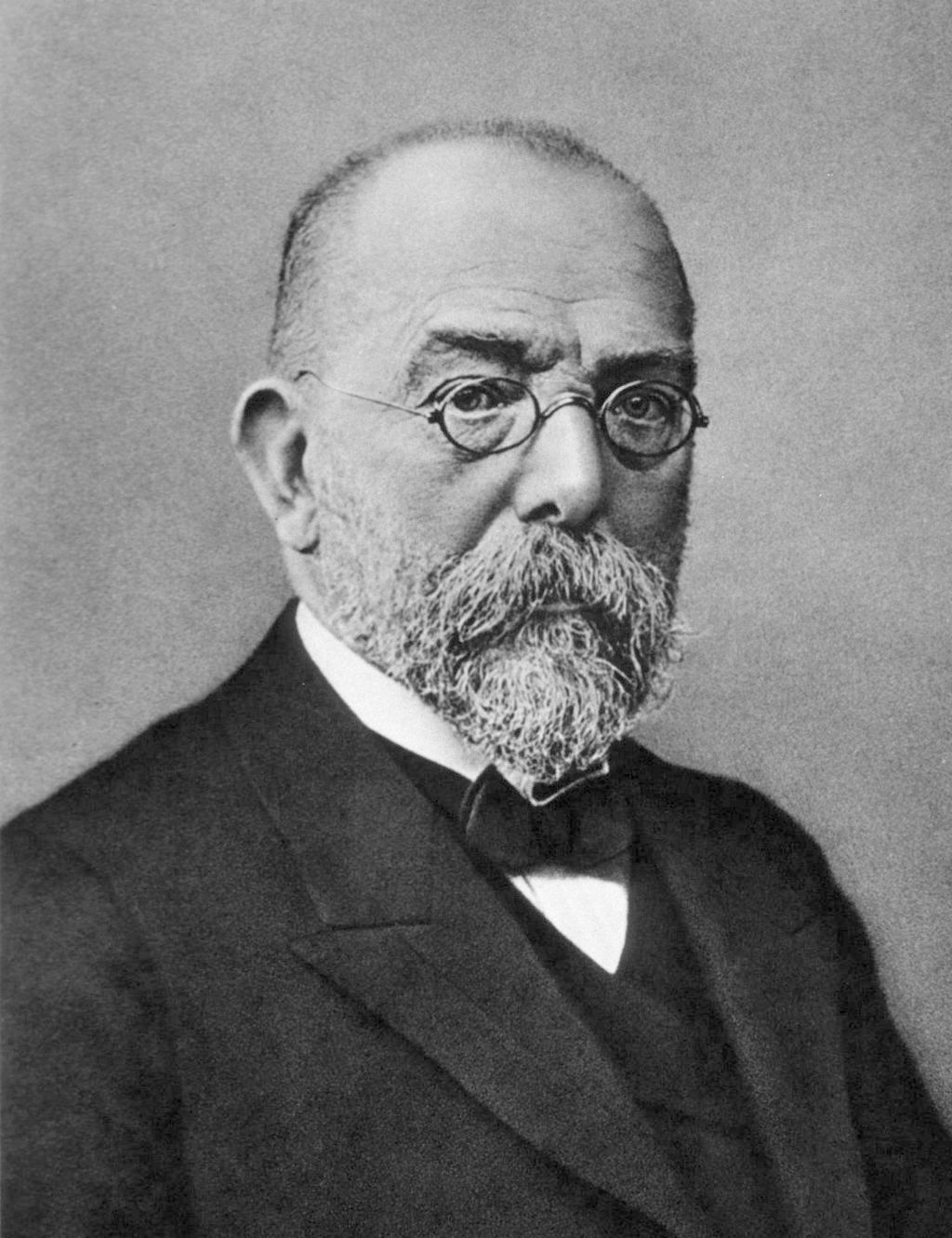
Since 1992, March 24 has been commemorated around the globe as World Tuberculosis Day. The date commemorates the discovery of the cause of a disease that has scourged the world since ancient times. On March 24, 1882, thirty years after Evelina wrote about her day in her diary, the brilliant German microbiologist Dr. Robert Koch presented to the medical community his finding that tuberculosis – also known as “consumption,” the “white plague,” and phythsis – was caused by the Mycobacterium tuberculosis. His discovery changed the world, and earned him a Nobel Prize.

In 1852, no one knew what caused consumption.  If anything, people believed that it was a hereditary disease that attacked those with weak constitutions. No one realized that it was contagious, an ignorance that lead to its spread everywhere, especially in urban areas with crowded living conditions. The disease was often, but not invariably, fatal.

Easton may have been a country town, but it was just as vulnerable to tuberculosis as any urban area. In fact, in Easton, just the day before Evelina’s diary entry, a 55 year-old housewife named Silence Macomber died of the disease. Of 47 deaths in Easton in 1852, consumption led the list; Mrs. Macomber was one of eight residents that year to die from it. All but one of the eight were women.

Tuberculosis has not been eradicated. Third World countries, especially, are still vulnerable despite great advances in prevention and treatment. In the 21st century, it’s still a disease to fear, just as Evelina and her contemporaries did.


March 23, 1852

SurvChain

 Gunter’s Chain**

March 23

1852 Tuesday. Alson and wife dined here and spent

the afternoon at Edwins  He has been running

out lines for Edwin & Melvin Randall  Orinthia

went home with them.  Was at tea in Edwins

& this evening with Augusta at Augustus’

Augustus has gone to New York.  Susan is staying

there to night went just after dinner.  Oliver & wife

went to Boston this morning   Rained untill early night.

The Gilmore clan was moving around today. Evelina’s nephew, Alson “Augustus” Gilmore, was headed for New York City on business for his boot company or the Ames shovels, or both. Evelina’s brother (and Augustus’s father), Alson Gilmore, and his wife, Henrietta Williams Gilmore, had midday dinner at the Ames house. Alson was in the village helping another son, Edwin Williams Gilmore, and an Easton man, Melvin Randall, run out lines.

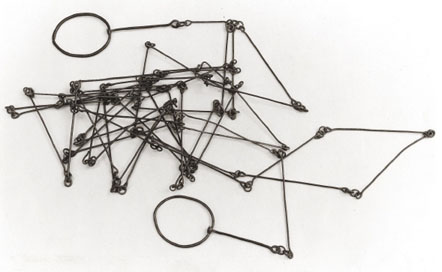
The phrase “running out lines” is open to interpretation (ice fishing is a possibility!), but the most likely meaning is that ground was being measured, perhaps for the new factory buildings soon to be built. A running measure is the cumulative distance in a straight line from a fixed point. The standard instrument used to get a running measure, at least in the 18th and 19th centuries, was a Gunter’s chain. It was used in conjunction with a compass and a transit (for establishing straight lines) to measure ground.

Invented by an English clergyman and mathematician, Edmund Gunter, around 1620, the Gunter’s chain “played a primary role in mapping out America.”** The Army Corps of Engineers would have owned such chains in bulk. The chain’s 100 lines measure 4 poles, or 66 feet, or 22 yards, depending on how you care to count it. Eighty chains equal one mile.

The Gunter’s chain, however, helpful as it was, was apt to be hand-made and thus subject to variation. It was eventually replaced by the more accurate surveyor’s tape.

By the way, for those readers who follow the game (or watch Downton Abbey), the length of a cricket pitch is exactly one chain.

*Thank you, Frank Mennino, for your assistance on today’s blog.

**Image from Colonial Williamsburg, courtesy of http://www.history.org

March 22, 1852

Sweep


1852

March 22  Monday  Have been sweeping dusting &

cleaning all day  Have put in order parlour

entries, parlour & sitting room chambers and back

& shed chamber, nearly dusk before I got through

Orinthia & Susan washed the dishes in the 

morning  Orinthia has written another two or three 

letters has not done much  beside  Ain’t she lazy?

It was Monday. Evelina spent her day “sweeping dusting & cleaning,” and Jane McHanna washed tubs of clothes and hung them out to dry, but “lazy” Orinthia only helped wash the breakfast dishes and wrote a couple of letters. In comparison to quiet, helpful Amelia Gilmore, whose visit Evelina had enjoyed, Orinthia Foss and her spirited but indolent company was a come-down.  We should remember that Orinthia was single and only in her early twenties (although in that era, some would have said she was already a spinster) while Amelia, a widow, was in her early thirties and Evelina, a matron, in her early forties. The age gap between Evelina and Orinthia was beginning to wear thin on Evelina’s part, and perhaps on Orinthia’s as well.

Spring had officially arrived two days earlier on March 20. No buds or blossoms were yet in evidence, however, and more snow had yet to fall. The industry that Evelina demonstrated today with her broom and dust rag suggests that she was rehearsing for spring cleaning, perhaps wanting to get it out of the way so that the moment anything came up in her flower beds, she’d be free to go outside and garden. Perhaps she looked at the still-frozen ground and imagined her flowers in full bloom. It was getting to be that time.


March 21, 1852

9291031-apples-are-stored-in-the-cellar-to-keep-fresh

1852

March 21 Sunday  Have all been to meeting except

Susan who is not very well  George carried

Amelia home at noon  I had a very pleasant

visit from her of nearly two weeks.  Orinthia

called with me into Edwins after church & we

helped ourselves to apples from the cellar.  Augusta

sent us one filled with sand and cheese.

Called at Mr Whitwells at noon & at Mrs J Howard a moment

Spring had arrived; Amelia Gilmore left the Ames’s home and hospitality and headed back to her own quarters in southeastern Easton. George Oliver Witherell, 14-year old son of Sarah Ames Witherell, obligingly carried her home in a carriage during the intermission at church. Evelina, meanwhile, visited with the Whitwells and the Howards.

After church Evelina and Orinthia went to the home of Edwin and Augusta Gilmore and helped themselves to “apples from the cellar.” That the young couple still had apples from the previous fall suggests that the harvest had been good and the storage arrangements even better. We presume that Evelina and Orinthia took the apples with the permission of the Gilmores; Augusta sending over a barrel “filled with sand and cheese,” corroborates that. But why is a barrel with cheese also filled with sand? Any thoughts, readers?


March 20, 1852

faces


from The Philosophy of Laughter and Smiling , 1877

1852

March 20th Saturday  Have cut and basted a purple print

apron for Susan of a pattern that Lavinia

brought from Mary  Abby & Edwin & wife were

here to tea  Orinthia dressed in Franks clothes

and paraded around here awhile.  Send for Mrs

Witherell & Mrs S Ames to see her  We have had

a pretty lively time  Orinthia brought over

Edwin & wife.

The ladies laughed today.  After sewing for hours, breaking only for midday dinner, Evelina and her young friend Orinthia Foss laid down their needles to have tea. Orinthia got it into her head to put on nineteen-year-old Frank Morton Ames’s clothes “and paraded around.” She donned his shop pants, perhaps, and shop coat over one of his white muslin shirts. Evelina and her guests were so amused at the sight that they called in Sarah Ames and Sarah Witherell to see the fun. Cross-dressing was a novelty for these women, and Orinthia’s daring act generated hilarity.

All things considered, these women were probably due for some laughter.  It was the first day of spring, and everyone had been pretty well cooped up for months, excepting the occasional trip into town. More recently, they had suffered through a major fire. Some innocent amusement was a good release.

Evelina’s favorite author, Charles Dickens, knew all about laughter: “It is a fair, even-handed adjustment of things, that while there is infection in disease and sorrow, there is nothing in the world so irresistibly contagious as laughter and good humor.”**

While the women amused themselves at home,  the best-selling novel of the 19th century was published in book form today, in Boston.  We’ll soon find Evelina reading Uncle Tom’s Cabin.


* Clockwise: “The Giggling Laugh, excited by Boisterous Fun and Nonsense.” “The Obstreperous Laugh, instigated by Practical Jokes or Extreme Absurdities.” “The Hearty Laugh of the Gentler Sex.” “The Stentorian Laugh of the Stronger Sex.” “The Superlative Laugh, or Highest Degree of Laughter.“ From The Philosophy of Laughter and Smiling, George Vesey, 1877. Courtesy New York Historical Society, courtesy of CABINET: The Art of Laughter, Issue 17, Spring 2005

**Charles Dickens, A Christmas Carol

March 19, 1852

moms_white_cake_2

March 19th Friday  Have heat the brick oven baked

mince & dried apple pies & Jenny Lind cake  Amelia

went to Mr Torreys this morning and Orinthia

afternoon & self this evening, when we returned

found Edwin & wife here.  Mr Whitwell called

had called at Edwins for the first time

Jenny Lind, international opera star, was so famous at mid-century that many things were named in her honor: A street in North Easton, for one, and more. The “Swedish Nightingale,” young, pretty and gifted, was promoted to the hilt by master showman P. T. Barnum. Happy fans and clever merchandisers attached her name to a bed, a bonnet, a steamer trunk, a pudding, a saloon in Brooklyn and a gold-rush town on the Calaveras River in California. She also had a cake named after her.

Evelina baked a Jenny Lind cake today.  Perhaps she took the “receipt” from a popular cookbook by Mrs. A. L. Webster titled The Improved Housewife. The result was a real departure from the usual fruitcake:

Stir together 2 cups white sugar and 1 butter.  Add 10 egg-whites, well beaten. Just before setting in , add half a teaspoonful soda dissolved in cup of cold milk and 1 and half cream tartar mixed with 4 cups flour.  Flavor with vanilla, or to taste. Line pans with buttered paper, and bake in moderate oven fifteen or twenty minutes.  Frost it. – Or: the 10 yolks with the other ingredients as above, and the grated rind of 2 lemons for the flavoring, make a nice cake.”


March 18, 1852

images-2

1852

March 18th  Thursday  A very heavy rain storm to day

Amelia Orinthia & self have had a quiet day

but mine has not been pleasant work, have

mended Mr Ames old shop coat have put new

cloth in the under part of the sleeves, mended

button holes so, think it will last some time.

Also mend Franks pants  Orinthia has been 

to work on her delaine dress

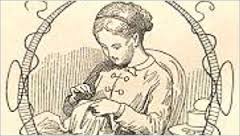
The women at the Ames residence stayed indoors today, held inside by “a cold driving rain storm.”* They sewed, naturally, but Evelina didn’t particularly enjoy herself. Orinthia got to work on a new dress, but Evelina had to mend her husband’s shop coat and her son Frank’s pants. Mending was never as much fun as sewing, but it was essential. As we have noticed before, Evelina was devoted to making things last. Like other Yankee housewives, she had been brought up to: “Eat it up, wear it out, make it do or do without.”**

Yet as the family grew more wealthy, Evelina began to enjoy the luxury of not doing without. She shopped in Boston for fashion accessories and household items that she would never have had in her youth. As modern historian Jack Larkin has pointed out, a “household’s furnishings constituted a material world that defined the limits of comfort, heating and lighting, and filled functional needs for sitting, sleeping and eating, but they also spoke of Americans’ economic status and aspirations.”***

Old habits die hard, as we know. The Ameses had money, and Evelina didn’t have to mend her husband’s shop coat; she could have insisted that he buy a new one, or she could have sewn one for him, perhaps. Her ingrained sense of economy, however tempted by the changing world around her, wouldn’t allow it. William L. Chaffin, the town historian who knew the Ames family, described Evelina as “economical” in his late-life remembrance of Oakes Ames, and shared the tale that Oakes joked about Evelina at the dinner table, suggesting to guests that his wife wanted them to help themselves to preserves that were going bad so she could use them up.

On this day, rather than demand that her husband purchase a new work coat – which we can surmise he had no interest in doing – Evelina fixed up the old one, and sighed that she wasn’t sewing a new dress instead.

*Oliver Ames, Journal, Stonehill College Archives, Arnold Tofias Collection

** A 20th century, World War II-era version of this maxim was “Use it up, wear it out, make it do or do without.”

***Jack Larkin, The Reshaping of Everyday Life, 1988, p. 264


March 17, 1852

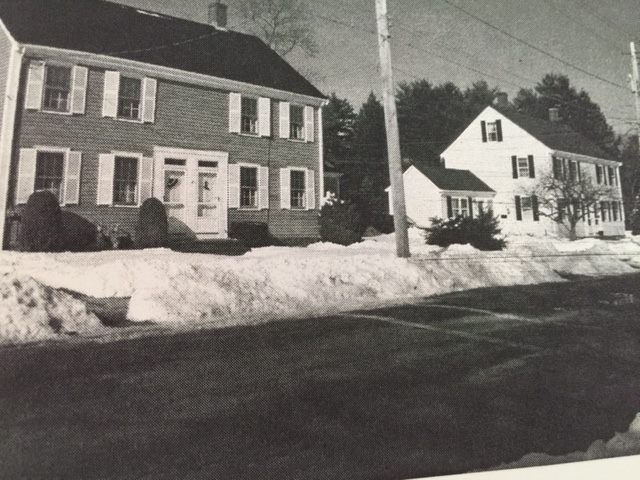
 IMG_0085Modern photograph of two private homes on Oliver Street in Easton, originally built in 1852 as part of the temporary structure for the shovel factory.*

March 17

1852  Wednesday.  Passed the day at Mothers with Amelia

and Susan   Carried Augusta to her fathers

and afternoon she and Rachel came down

to see us  Miss Foss closed her school Sat.

Came to Mothers this morning and to

night came home with us.  Carried cloth

and cut out a bleached shirt  Amelia worked

on the sleeves.

Evelina spent a pleasant day with her mother and several relatives. Her friend Orinthia Foss came to stay for a time. Evelina’s father-in-law, Old Oliver Ames, was completely focused on the rebuilding of the shovel shops. He seemed pleased to report:

“this was a cloudy day wind northeast. + in the afternoon it was cold + chilly. the roof is on the stone shop + the windows are in + the down stream end finisht- + the piece from that to the water shop is up + the roof shingled + the walls are boarded – one hundred + eight feet of the handeling shop is up and part of it clapboarded. the polishing shop is up and the roof shingled and the sides boarded + partly clapboarded the hammer shop is up + the sides + ends boarded and the roof and two thirds sleighted”**

This is one of the longest entries that Old Oliver ever wrote in his journal. He was clearly proud of the progress that had been made in the two weeks since the fire that destroyed almost all. The factory would soon be back on its feet, and planning for more permanent stone buildings could move forward. The wooden buildings that went up so fast would have another use after the stone buildings were erected, that of housing for some of the shovel workers. They would be moved from the original site by the pond and become residences. As you can see from the illustration, some of them are still used today.


* Image taken by Gregory Galer, Forging Ahead, MIT, 2001, Figure 50

** Oliver Ames, Journal, Stonehill College Archives, Arnold Tofias Collection