September 10, 1851

Thread

Wednes Sept 10th  Cousin Harriet spent the forenoon with

us & dined here.  I cut some shirts this

forenoon for Mr Ames, carried two to be made

at the sewing circle.  Met at John R

Howards this afternoon quite a number

there.  Carried mother down and she went 

home with Henrietta.  Mrs Stevens went into

Olivers with H. Mitchell


The monthly Sewing Circle, a gathering of women from the Unitarian congregation, met at the home of Caroline Howard, wife of John R. Howard, a book agent who lived near the geographic center of Easton.  Half a year had gone by since Evelina had had her turn hosting the group, back on February 12, when bad weather – and bad feelings, perhaps – prevented anyone from attending. By this time, she seemed to have forgotten that embarrassment and forgiven the friends who had failed to show up.

There was plenty of attendance at today’s meeting, however, including Evelina’s mother, Hannah Gilmore and sister-in-law, Henrietta Gilmore. The Ames sisters-in-law, both named Sarah, probably were there as well. All the women, as the saying went, set great store by these regular gatherings. Did they dress up for the meetings? They might well have, knowing that their fellow females would recognize and appreciate good sewing and fine material better than the men at home were likely to.

The only other regular gathering where women might pay particular attention to their attire would be church, where one’s “Sunday best,” was expected. Surely the Ames women were susceptible to this practice, even if one of the Ames men – Oakes – was not. Yet Evelina, for all the sewing she did, rarely described what she wore on any given day. Did she save her best outfits for Sewing Circle, or church, or both?

September 9, 1851

DSCF2567small

 *

Tuesday 9th  Frank & Mrs Mitchell returned this

morning & Oakes A went from Bridgewater to the

convention at Springfield.  Mother Mrs

Stevens & self & Susan passed the afternoon

at Mr Torreys.  The Col was very clever

gave us lots of peaches.  Harriet Mitchell

came home with them this morning and spent

the evening here.

Evelina and others enjoyed an afternoon call on John Torrey, who was evidently quite amusing, and came home with at least one basket of peaches. Frank Morton Ames brought his Aunt Harriett Mitchell back from a party in Bridgewater, but his oldest brother, Oakes Angier Ames, didn’t return with them. Instead, he traveled west to Springfield, probably by rail, to attend a Whig Convention. At the age of twenty-two, Oakes Angier was diving into politics, and the Whigs in Easton thought well enough of him to represent them at the meeting.

Led by Senators Henry Clay and Daniel Webster, the Whig Party had developed in the 1830’s as an anti-Andrew Jackson party, and had managed to put four presidents in the White House, including its present occupant, Millard Fillmore. The party would soon dissolve over the issue of slavery, leading many of its northern adherents to attach themselves to the new Republican Party. Many were against slavery because it conflicted with an economy based on free-trade. But in the meanwhile, the Whigs wanted modernization and strong policies to guide economic growth.  Jeffersonian in their preference for Congress over the Presidency, they would have said they opposed tyranny.

The convention in Springfield was held on one day, September 10, “to make the customary arrangements for the annual State elections”.*  The group of about 1,000 attendees nominated the Hon. Robert C. Winthrop of Boston as candidate for Governor and the Hon. George Grennell of Greenfield as candidate for Lieutenant-Governor. The keynote speaker at the convention, Ezra Lincoln, spoke of state matters, but spent a moment on national issues as well:

“…[I]t is felt throughout the country that a crisis of no ordinary difficulty exists. Whether we look to the debates and the proceedings of Congress; to the popular elections throughout the country; to the tone of public opinion, as indicated throughout the Union by the press, and the discussions everywhere taking place, we cannot be insensible to the fact that the stability of our institutions is put to a severe test.  It is probably left to this generation to ascertain, by a severe experiment, the soundness and vitality of those principles which were embodied by our fathers in these Constitutions, as well as of the several States, as of the Union…” *

Oakes Angier and others at the convention could not have known how severe the experiment ahead of them would be.

* Proceedings of the Whig State Convention, Held at Springfield, Massachusetts, September 10, 1851.


September 8, 1851

1856_tea_BostonAlmanac


Monday Sept 8th  Mother Mrs Stevens & self sat down

to work in my chamber  The weather is very

hot  After dinner we went into the other

part of the house awhile it being so much

cooler  Abby came here to tea. Oakes A

Frank & Mrs Mitchell went to a party to Mr

Cushing Mitchells this Evening & are to spend the night

Tea had been on the serving tray very much of late, with or without short biscuits. Evelina served tea to her niece, Abby Torrey, today while yesterday she took tea at the parsonage during intermission. Three days ago, she hosted a small tea party for a guest, Mrs. Latham, her sister-in-law, Sarah Ames Witherell, and others. Evelina’s grandson, Winthrop Ames, described the importance of tea time some eighty years later:

“Supper, always called Tea, at seven was the sociable occasion.  It was usually consisted of cold meats, hot biscuits, preserves and cakes – an easy menu to expand for unexpected guests. Every week at least, and usually oftener, one household would invite the others and their visitors to tea; and the whole Ames family might assemble…”*

Although the Ameses grew and raised much of their own food, tea was a commodity that had to be purchased. Coffee and sugar, too.  As the above advertisement from 1856 indicates, tea and coffee could be purchased in bulk in Boston (not surprisingly, given Boston’s long history of importing tea into its harbor!) Black tea was the general favorite and, as the ad suggests, could be obtained in different grades of excellence.  Did the Ameses order in bulk?  Did they acquire a chest of tea at the family rate? Their careful use of money would imply that whichever Ames did the purchasing got the best product for the lowest price possible.

The weather, meanwhile, continued to be very hot. It didn’t prevent brothers Oakes Angier and Frank Morton and their youngest aunt, Harriett Ames Mitchell, from traveling to Bridgewater for a party and an overnight. Social goings-on continued.  No doubt, tea was served.

*Winthrop Ames, The Ames Family of Easton, Massachusetts, 1938, p. 128

September 7, 1851


Ames Home and Office, North Easton, Massachusetts ca. 1852 - 1862

Ames Home and Office, North Easton, Massachusetts
ca. 1852 – 1862

*

Sunday 7th  Have been to meeting all day  Mother

Mrs Stevens & I went to Mr Whitwells at

intermission Mrs Whitwell made a cup of tea

for us, brought mother home with us from meeting

at night  Mr Ames & I called at Mr Swains

Mr & Mrs Peckham are to leave tomorrow for

Taunton & the children & Mrs Metcalf  Thursday

The weather is very warm  Gave Mrs Stevens

some cuff pins it being her birth day.

Despite today’s heat, Evelina and her guest Mrs Stevens, and others of the Ames family, presumably, attended both morning and afternoon sessions of church. When the last service was over, they carried Evelina’s 79-year-old mother, Hannah Lothrop Gilmore, to North Easton to stay for a few days.

An important transition was taking place this week at the shovel works.  John Peckham, former clerk, and his family were leaving for Taunton.  His place in the Counting Office was being taken by John Swain, whom Oakes and Evelina went to visit late in the day.  Swain and his wife, Ann Meader Swain, probably hailed from Nantucket.  They had connections in North Easton, but the move to a new abode was still a big change for the young couple. Oakes, with his wide-armed jocularity and Evelina with her easy, approachable manners, must have made the Swains feel welcome.  Over the years, their friendship would solidify.

Many decades later, when Ann Swain was the only one of the foursome still alive, she told historian and minister William Chaffin about the special relationship between John Swain and Oakes Ames:

“…[H]er husband had his regular salary supplemented by an addition from Mr. Ames. Mr. Swain did more or less work for him, besides the regular office work when he was head clerk. Mr. Ames was not very methodical and his transactions for the day in Boston, jotted down in a notebook rather hastily, would sometimes be in a tangle when he came to the office in the evening (office work in those days always going on in the evening), and he would say to Mr. Swain, ‘Come, John, you help me straighten out these things.’ In common with all the persons who served him Mr. Swain had a strong affection for Mr. Ames.”**


*Ames Homestead with Counting Office on far left.  Residence demolished in 1951.

**William Chaffin, Oakes Ames, private publication                                   


September 6, 1851

shopping

Sat Sept 6th  Alson brought Mrs Stevens before we

were up this morning left his carriage here

while he went to Boston.  We went into Olivers

& passed the afternoon with Mrs Latham & Mrs W & Mrs

Mitchell I called on Mrs Peckham while the others

went to Mr Manly’s garden  Mr Ames brought home

some cuff pins for Alsons wife & Mrs Stevens

Evelina was probably pleased today to lapse back into a sociable, summer agenda.  Family friend Mrs. Stevens arrived at dawn, it would seem, delivered by Evelina’s brother Alson Gilmore on his way into Boston. The two women later went next door to call on Sarah Lothrop Ames and were joined by sisters-in-law Sarah Ames Witherell and Harriett Ames Mitchell and the former’s houseguest, Mrs. Latham.  Chat, chat, chat.

As they had done occasionally throughout the summer, many of the women went up to look at the flowers in Edwin Manley’s garden. The blooms they saw would be among the last for this year.  Evelina eschewed that walk (or ride) and went instead to call on Susan Peckham, wife of John Peckham, clerk for the shovel company.  The Peckhams were about to move, so perhaps Evelina went to see what help she could be, or to say goodbye. Susan Peckham must have been packing things up, a chore that would have made Evelina, who was lately familiar with the bustle of departure, feel right at home.

Oakes Ames spent the day in Boston, as he did almost every Saturday.  He went on business for the shovel company, often returning with orders or payments.  Just as often, he carried out particular errands for his wife.  Yet it’s not clear whether she or he or both, perhaps, suggested the purchase of cuff pins (perhaps what we call cuff links) for Mrs. Stevens and Henrietta Williams Gilmore.  Both women had birthdays around this time.

September 5, 1851

Pentax Digital Camera

*

Friday Sept 5th  Expected to be alone to day and was in

hopes to do some sewing but about ten Oclock

concluded to invite Mrs Latham (who came yesterday

to Father Ames,) to tea and all from the other part

of the house.  Jane made a great fuss about getting

tea having some short biscuit to make and I

got very nervous.  Mrs S Ames staid awhile but

went home to tea


The house on Main Street was relatively empty today.  Son Oliver had left for college and friends Pauline Dean and Orinthia Foss had departed as well.  Her husband Oakes and other sons, Oakes Angier and Frank Morton, were at work and little Susie was at school.  How quiet the house must have seemed, even with the sounds from the factory ringing from across the road. Evelina sat down in solitude to sew and found she wanted something more.

A little tea party was what was needed, she “concluded,” although her servant, Jane McHanna, evidently disagreed.  Jane probably had her own agenda of tidying up after yesterday’s whirlwind of departures and so “made a great fuss” about the extra work. Jane’s irritation ran counter to Evelina’s hopes, and some kind of verbal tussle must have ensued. No wonder that Sarah Lothrop Ames, who had come over from next door, didn’t stay around.

The party must have happened, however, else Evelina would have written otherwise. Jane prepared the meal. Late in the afternoon, family from the other part of the house and their guest, Mrs. Latham, were treated to tea and “short biscuit” and, perhaps, other refreshments.

Short bread or short biscuit or short cake – all names for the same, crumbly finger food – was a typical offering at tea parties, and simple enough to make that many cooks wouldn’t even need a recipe, or “receipt.” Using some of the butter that Evelina had bought just one week earlier, Jane McHanna would have followed a process similar to that described by Lydia Maria Child in her book The American Frugal Housewife:

“When people have to buy butter and lard, short cakes are not economical food. A half pint of flour will make a cake large enough to cover a common plate.  Rub in thoroughly a bit of shortening as big as a hen’s egg; put in a tea-spoonful of dissolved pearlash; wet it with cold water; knead it stiff enough to roll well, to bake on a plate, or in a spider.  It should bake as quick as it can, and not burn.  The first side should stand longer to the fire than the last.”


*http://britishfoodhistory.wordpress.com/2012/06/10/shortbread/


September 4, 1851

800px-Manning_Hall,_Brown_University,_Providence,_Rhode_Island_-_20091108

*

Thurs Sept 4th  This morning Orinthia left for Maine

& Pauline for Roxbury in the stage.  Mr Ames &

Oliver via Mansfield to Providence.  Oliver is

delighted with the idea of going to school & I am

sure he will improve his time  It seems

very lonely to day I have taken the bedstead down from

the boys chamber to clean it swept the parlour & washed

most all the windows in the lower part of the house both sides

Guests and family departed the Ames compound in North Easton today. Schoolteacher Orinthia Foss left to return to Maine, probably to Leeds where her parents and two younger siblings lived.  Houseguest Pauline Dean, left, too, taking the stage with Orinthia as far as Roxbury. Her final destination was unknown.  The most noteworthy departure, however, was that of 20-year-old Oliver Ames, middle son of Oakes and Evelina.  He was going to college.

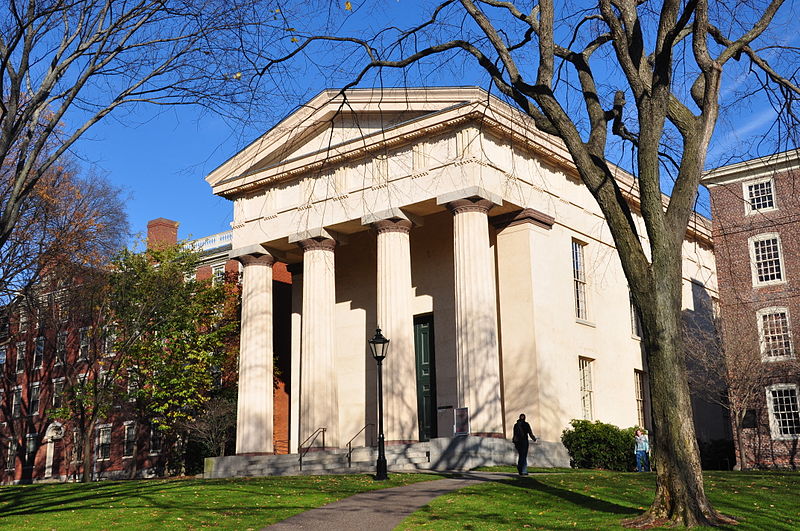
Oakes Ames, after having resisted giving his son a college education, had evidently made a decision to let Oliver go. Father and son traveled together to Providence.  Perhaps Oakes helped his son find his living quarters, perhaps he explored the campus at Brown in an attempt to know it for himself, if he didn’t know it already. Sarah Lothrop Ames’s brother from Detroit, George Van Ness Lothrop, had once attended the school; Oakes and Oliver must have known that.

Established in 1764, Brown was the third oldest college in New England. Manning Hall, the neoclassical building shown in the photograph above, was the newest building on campus. No doubt it was a building that Oliver went into often, for it held both the library and the chapel. The president of the college at the time was Francis Wayland, a Baptist minister, who was stern but beloved and progressive.

As Evelina noted, Oliver was immensely pleased to be going to Brown, and she, in turn, seemed pleased for him. She was confident that he would study hard and do well.  Her pride didn’t protect her from feeling
“very lonely” today, though.  Choring was the only antidote she could imagine to liven up the quieter house.


Manning Hall, Brown University, Providence, Rhode Island

September 3, 1851

Trunk

Wednes Sept 3d  Alson came this morning & brought

Orinthia and staid to dinner and carried Mrs Stevens

home with him  Orinthia has been packing her clothes

Mrs Stevens stiched three more collars for me & Mrs

Witherell two that are for Frank.  Abby Torrey called

this afternoon &c and on her return Orinthia & I went

to the store  Pauline passed the afternoon with Helen

Orinthia Foss was packing her clothes, getting ready to return home to Maine. What prompted the departure isn’t clear. Did she lose her job, or was she called home on family matters? She would return to North Easton eventually, but did she know that when she left?  How did she feel about leaving this town where she had lived for six months? How did Evelina feel about the loss of her young friend, even temporarily?

Orinthia wasn’t the only one with a trunk to be packed. Oliver Ames (3), too, was a day away from departure and had a trunk into which his mother – and others, perhaps – were placing his new collars and mended shirts. Last minute sewing was still going on, but by this time the trunk would have been nearly full of the clothes that Oliver would need for a term at college.

That Oliver was going away to study at Brown was just shy of miraculous.  At 20, he was old to be going, for one thing; in the nineteenth century, the average students were teenaged, like Fred Ames at Harvard. But more than that, his father Oakes had not wanted him to go. According to one 19th century acquaintance of Oliver, Oakes “had inherited some measure of that Puritanical contempt for the liberal arts.” After completing prep school, Oliver had been directed to work at the factory, “to learn the trade of shovel-making. But the desire for a higher education remained strong, and when at the end of his five years apprenticeship he had mastered the trade, his father yielded to his solicitations, and allowed him to enter Brown University.” * Oliver had earned his ticket out.

* Hon. Hosea M. Knowlton, “Address,” Oliver Ames Memorial, 1898, pp. 98-99


September 2, 1851

Cloth

Tuesday Sept 2d  Again this morning sat down quite early to 

sewing for Oliver cut him out 5 dickeys & finished 

one that was cut last autumn.  Mrs Stevens stiched

2 of them.  Mrs Stevens Pauline & self passed the

afternoon with Mrs Witherell  The weather is

very unpleasant & cold and this evening it rains

hard

The northeast wind of yesterday brought no good weather with it.  The ladies stayed indoors and sewed clothes for Oliver (3), only breaking stride enough to move in the afternoon to the other part of the house to do more of the same. Most likely, Sarah Witherell sewed with them.

Evelina noted today that she worked on dickeys, or shirt fronts, for her son.  She finished one that she had cut out almost a year earlier, which begs the question: Where had she kept it all that time?  Where did she store the fabric, thread and trim for her multiple projects? She had a workbasket, certainly; any sewing woman in that time and place would have had one.  But a workbasket was just that, a basket, or a box.  It might hold a thimble, scissors, needles, a bodkin, an emery bag, plus “tapes, and buttons, and hooks and eyes, and darning cotton, and silk winders, and pins, and all sorts of things,* but it wouldn’t hold bolts of cloth or unfinished, flounced skirts. The yards of fabric and dickeys-in-progress, the aprons to be hemmed and the chemises to be sewn together, would be stored elsewhere. Where?

Perhaps Evelina had shelves in a corner closet to hold her projects, or maybe she laid claim to a particular chest of drawers in the sitting room. When she was working on large projects, such as the cover for the lounge she made earlier in the summer, perhaps the piece simply lay out in one of the rooms until completed. Was she tidy or messy? How did she manage? She may have wished for a room that could be just hers for her projects.  With that large family, and all the houseguests they welcomed, an extra room wasn’t likely to be available.


* Susan Warner, The Wide, Wide World, p. 40


September 1, 1851

000100849[1]

*

Sept 1st Monday  Jane & Ellen washed and have done most

of the housework and I have been to work on Olivers

clothes have sewed pretty steady to day.  Pauline has

been sewing on a pr of Muslin undersleeves that

I gave her but has not finished them.  Mrs Stevens

covered some button and sewed them with Olivers vest

& mended the buttonholes


Sewing was “pretty steady” today as the date of her son Oliver (3)’s departure for college loomed nearer. Evelina was mending everything and making new items like collars and dickeys. She tried to mark Oliver’s clothes so that they wouldn’t get lost – a time-honored effort by many a mother when a child leaves for college. How did she mark the clothes, though, in those days before indelible ink markers?  There were certainly no “iron-ons” and probably no manufactured name-tags that would have been sewn in by hand, either.  Her most likely solution would have been to embroider Oliver’s initials or name on the inside or underside of each piece of apparel. That sounds like a lot of work.

Houseguest Pauline Dean accompanied Evelina and sewed some on a pair of new undersleeves while another guest, Mrs. Stevens, helped cover the buttons of a vest belonging to Oliver. Clothes must have been everywhere, as laundry was being washed while all this sewing went on. It was Monday, and Jane McHanna and another servant named Ellen had the stove going and the tubs full. The “fair day” and north east wind that Old Oliver noted in his journal would have helped dry the clothes.

Old Oliver also noted that he “went to Canton to day with Mr Clark + others to put in the stone bridges below the shop.” Can any of our local historians identify these bridges?  Are they still in place? The shop, which was originally built in 1847 to supplement the factory in North Easton, is no longer standing. The image above was taken circa 1965.

* Ames Shovel Shop on Bolivar Street, Canton, Canton Historical Society, from Arthur Krim’s Historical Buildings of Canton, Vol. II.