March 11, 1851

photo*

/51

March 11  Tuesday.  Orinthia & myself each finished a coarse shirt

this morning before school  I then went to mending

shirts and worked on them all the forenoon & untill

about two Oclock & went to cutting out shirts.  Cut three

coarse ones for Oakes Angier & one fine one from the pattern

I had of Sister Sally.  Cut out some stories for my scrap

book.  This evening commenced the sleeves of a shirt.

Augustus dined at Mr Peckhams  Pleasant but windy

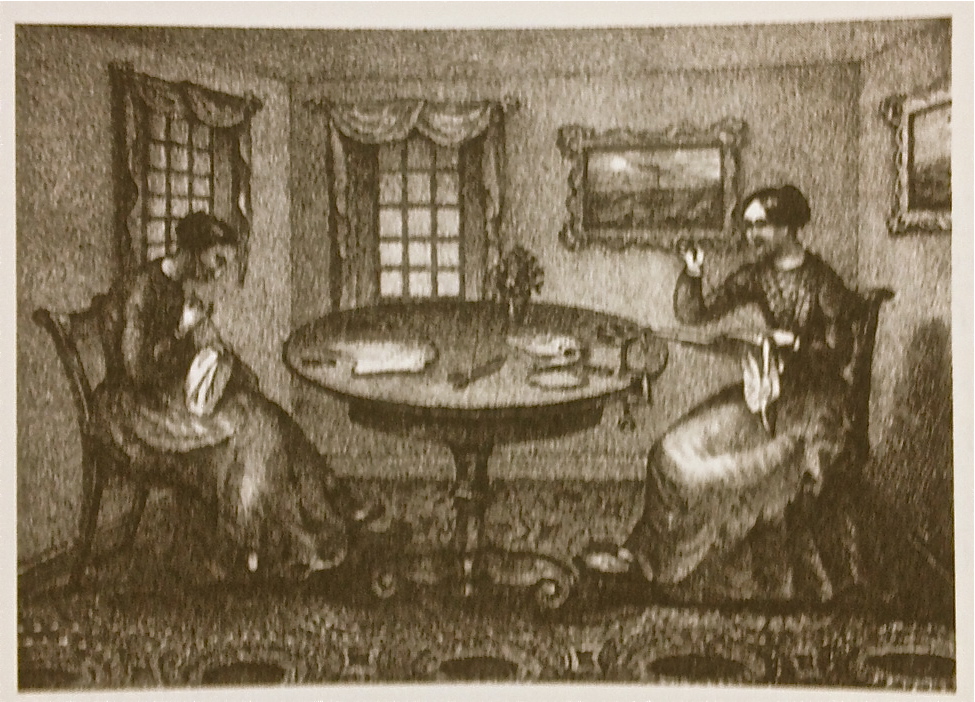
The ladies continued sewing on shirts.  Evelina sewed for so long that her eyes must have hurt by the end of the day, yet she was still working with her needle when the lamps were lit. She mended many shirts, finished sewing one and cut out four more. Orinthia Foss, the young schoolteacher who was boarding with the Ameses, helped her.

Of the four shirt patterns Evelina cut, one was a new design from “Sister Sally,” most likely the wife of Horatio Ames. Horatio was the second son of Old Oliver and brother to Oakes, Oliver Jr., William, and Sarah Witherell. The black sheep of the family, he lived in Connecticut where, like his brother William, he ran an ironworks operation.  He and his wife Sally had begun their married life in North Easton; his father had built them a home there and their first child, another girl named Susan, was born only a few months after Oakes Angier.  As the two earliest grandchildren of Old Oliver and Susanna, the two cousins had certainly played together.

Evelina did take one break from sewing.  She cut out some items for her scrapbook, which up to now had been filled mostly with “receipts” or recipes.  That, or Evelina was creating two scrapbooks, one for keepsakes and favorite readings, the other filled with recipes for the kitchen.

*Illustration “Ladies Sewing Birds,” advertising broadside of C. E. Stearns, Middletown, Connecticut, 1851. Connecticut Historical Society, Hartford

March 10, 1851

images-2

/51

March 10  Monday  This is town meeting day.  Mr Ames & O Angier went

They spent the whole day there but accomplished very little

Mr Pratt & Brown chosen School committee O Angier was

nominated for one & lacked by one vote of being chosen

They brought home the school report of the last year

which is not very favourable for the schools in town generaly

Miss Foss & Clarks school are spoken very well of.

It commenced snowing about ten Oclock & is quite stormy this evening

Town Meeting was – still is – a great New England tradition. In the 19th century (and well into the 20th) the meetings were often scheduled in March, making them an annual marker of winter’s impending departure.

People turned out for town meeting.  Rather, men turned out for town meeting.  Women, who before 1780 in Massachusetts had enjoyed suffrage, no longer could vote.  National suffrage for women, a cause that would create deep divisions among the Ames women of a later day, would not be achieved until 1920.

Oakes Ames and his eldest son, Oakes Angier Ames, attended meeting and stayed all day. Oakes Angier evidently ran for school board but just missed being elected. He was showing a taste for politics, something that his father felt as well. His mother, perhaps influenced by her son’s loss, harrumphed that “very little” was accomplished at this year’s meeting, although she seemed pleased that their boarder, Orinthia Foss, was mentioned as being a good teacher.

Today’s town meeting was moderated by one of Easton’s greybeards, Capt. Tisdale Harlow. A resident of the Poquanticut section of town, Harlow was a former selectman, town treasurer, school board member, veteran of the War of 1812, and captain of the Easton Light Infantry in 1833-34. He had crossed swords with the Ames family in the 1830’s in a town row about the introduction of Unitarianism into the Congregational church. Harlow and many others were against it; Old Oliver, his sons and others were for it.  The sectarian controversy wore on for about eight years and ultimately led to a permanent split in the congregation. Historian William Chaffin suggested that “[i]ts unhappy effects were felt for many years.”  Were there remnants of hard feelings on display at today’s town meeting?

March 9, 1851

Down_in_the_Cave_Church_Pews_Company_Town_Exhibition_Coal_Mine_Beckly_WV_8576_(7536218802)_(2)

/51

March 9  Sunday  Have attended meeting all day.  Mr

Whitwell gave us two excellent sermons particularly the

afternoon  William is here & went to meeting.  came

Friday morning  I spent the intermition with Mrs Elijah

Howard at the meeting house very pleasantly indeed.

After meeting looked over some of the old Saturday

Couriers  Edwin made a call is about sick with a cold

It is quite pleasant, but snow on the ground & bad

traveling

Evelina and Oakes saw Oakes’s younger brother William at church, probably for the first time since William had returned to town. The relationship between the two brothers was not cordial, but the families sat together in the same pew (or set of pews, given the size of the extended family) and could hardly have avoided one another.

As usual, Evelina enjoyed listening to Mr. Whitwell’s sermons.  She enjoyed the “intermition” between the morning and afternoon service at the church, too.  She spent it sitting with Nancy Howard, mother of Ellen Howard on whom Evelina had called earlier in the week.  The formality of the times shows in Evelina’s referring to Nancy not by her first, or Christian, name, but by her husband’s name. Even in her own journal, writing of friends, Evelina maintained the nomenclature of “Mr.” and “Mrs.”  Formality of address was second nature to her, as it was to most well-bred people of the day.  Even husbands and wives typically referred to one another as “Mr.” and “Mrs.” when speaking in the third person.

Oakes Ames must not have gone into Boston the day before or, if he did, he failed to return with the latest magazines.  For her reading that night, Evelina opted to look over old issues of  The Saturday Courier .  Where was this paper published?  Not in Easton, not in Boston.  Bridgewater? Canton? Stoughton? Taunton? Does any reader know about this newspaper?

It also may be that Oakes was away from Easton this week.  He often traveled to other nearby states for the shovel company, taking orders and collecting accounts, a task that his middle son, Oliver (3), would eventually take on.

*Photo from Down in the Caves Church Pew Company.

March 8, 1851

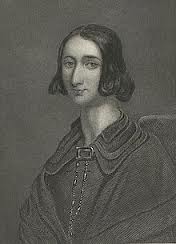
Grace Aguilar (1816 - 1847)

Grace Aguilar
(1816 – 1847)

/51

March 8th Sat.  This has been a very stormy day,  Windy & snowy.

Orinthia did not keep school and we have had

a nice quiet time.  I have finished putting the 

bosom & wristbands into Franks shirt and worked

some on a coarse shirt.  Orinthia finished a 

coarse shirt that she has been making & commenced 

another for one of the boys.  I have finished reading

Womans Friendship & like it pretty well.

Woman’s Friendship was a domestic novel by English author Grace Aguilar.  In her short life,  Aguilar wrote not only novels, but also poetry, histories, and  religious treatises that explored her Jewish heritage.  Among the latter, she translated “The Spirit of Judaism” from the French, and wrote her own extensive exploration of the scriptures, “The Jewish Faith: Its Spiritual Consolation, Moral Guidance and Immortal Hope.”  She was prolific and extremely bright.

Her domestic novels – the kind of writing that Old Oliver called “love trash” – were her most successful publications. Such novels were a literary genre, not unlike today’s “chick lit,” that was written for, and often by, women.  The novels usually had storylines that featured the travails of young heroines.  Woman’s Friendship, published posthumously, was the tale of one such young woman who suffers many misfortunes and reversals but manages to save her family after her father’s early death and her brother’s losing fight with consumption, all the while retaining the lifelong friendship of a countess. Putting the improbabilities of its plot aside, Evelina liked it. As she sewed today with Orinthia Foss, Evelina may even have had the story from the book in her head.  She certainly liked the book well enough to eventually commence another novel by Miss Aguilar.

It was Saturday, the day that Oakes Ames usually went into Boston.  Did he go today, or did the weather make traveling too difficult?   Were they all getting tired of winter?

March 7, 1851

photo

1851

March 7th  Have been giving my rooms a thorough sweeping

& dusting which took me all the forenoon

This afternoon worked on an old shirt of Franks

Am putting new wristbands & bosom into it.

This evening Oliver, Frank & Orinthia have gone to

Alsons to a party.  Orinthia would not go to the dancing

school last night on account of something Frank said & had to be urged

to go to Alsons to night  Augustus not here   Pleasant

Some entertainment today for the young people: a party at Alson and Henrietta Gilmore’s house out in the country.  What was the occasion?  Was it a casual get-together, a spur-of-the-moment gathering, perhaps extending from the assembly of the night before?  Had Lavinia Gilmore or her brother Francis asked for the party, or had it been planned by their parents?  Were they hoping to promote their daughter’s eligibility for marriage?  Was there method to the gathering, or was it just for fun?

Orinthia Foss, the young schoolteacher boarding with the Ameses, was included in the festivities, although she apparently went with some reluctance.  It seems that Frank Morton Ames had teased her in some fashion, hurting her feelings or insulting her the day before. Frank could be a handful, according to William Chaffin, who wrote that Frank “needed more discipline than Oakes [Angier] or Oliver [3].”   Frank was a seventeen year old youth, after all, with more energy than wisdom, probably competing with his older brothers for respect and attention, and letting his mouth do his thinking.

Another younger sibling came to North Easton today.  William Leonard Ames, fourth son of Old Oliver, “came this morning from New Jersey,” according to Old Oliver’s daily record.  In New Jersey, William Leonard ran an ironworks operation, a related family business that had recently failed. According to extensive research by industrial scholar Greg Galer, William Leonard and his eldest brother, Oakes Ames, were at odds over the handling of the demise of the business.  Oakes had “engineered the bankruptcies of these operations for his financial gain,”* while William had barely managed to walk away.  As a result, the two brothers were not on good terms.  Evelina doesn’t mention William’s arrival.  She sticks to her sewing, new wristbands for Frank.

* Greg Galer, Forging Ahead, p. 6.

March 6, 1851

Thread

March 6th  Thursday.  This morning Orinthia cleaned the sitting room

and I sat down to work quite Early on Mr Ames shirt

and finished it about ten Oclock  I then went to

mending some old shirts & colars &c  Sarah Witherell

brought me the fourth bosom that she has stiched for

me.  Jane went to Mrs Willis to get her dress  Miss Foss

and myself called to see Mr Guild about the school & on

Ellen Howard  A[u]gustus here to dine  Morning pleasant  storm at night

More men’s shirts.  If we’re getting tired of reading about them, imagine how tired Evelina must have been sewing them – and she had many more to go. She evidently had a method to her sewing, in that she worked on the same kind of clothing in succession until she had finished.  She didn’t make just one shirt for her boys or husband, she made several in a row.  She didn’t just make one apron for her daughter, she made three or four in a row.  Perhaps the cutting of the fabric and the arrangement of the pattern components were made easier when addressed as multiples.  The economy of cloth-cutting trumped the tedium of repetition.

Leaving the shirt bosoms and collars behind, Evelina went out with Orinthia Foss in the afternoon.  They paid a call on a Mr. Guild on a school-related matter, showing that Evelina continued to be involved with some aspect of the private school.  It was unusual for a married woman to be so active in this way.

Their second call was on Ellen Howard, daughter of Nancy (Johnson) Howard and Elijah Howard.  Mr. Howard was a sometime business partner of the Ames men and a prominent citizen of Easton.  Mrs. Howard was his third wife, he having buried his first two.  He had twelve children, of whom seven were with Nancy; Ellen was in the latter group.  In 1851, Ellen was seventeen, the same age as Frank Morton Ames, and she often socialized with the Ames sons.  In introducing Orinthia to Ellen, Evelina was perhaps hoping the two young women might become friends.  In the future, Orinthia would board with the Howards.  In Ellen’s future, in 1860, she would marry George Withington, a young minister who came to town to replace the departed William Whitwell.

The fine weather that allowed Evelina and Orinthia to travel around town disappeared by evening and ushered in a storm.  Such variability was to be expected this time of year.  It was March, after all.

March 5, 1851

Village

1851 March 5th  Wednesday  Early in the morning worked about

house.  About nine Oclock called at Mr Holmes 

to see Mrs Wright and to enquire for Miss Eaton

She is comfortable but failing  Went into school

and staid until dinner time  like the appearance 

of the school very much & think Orinthia a good

teacher, calculated to gain the good will of the Scholars

This afternoon working on a shirt for Mr Ames.   A[u]gustus here

Abby spent the evening here  Very pleasant

A “very pleasant” day pulled Evelina out of doors this morning at a time when she ordinarily would be choring or sewing. Fresh air and sunshine were too welcome to resist.  She walked the short distance to the village and called at the Holmes’s to ask after the two invalid women there, Mrs. Wright and Miss Eaton.

This is the last point in the diary when Mrs. Wright is mentioned, which begs the question of whether or not she survived her bout with pleurisy.  Probably not, even though Evelina didn’t mention her demise or her funeral.  Based on Evelina’s continued, if periodic, interaction with the Holmes household without ever again mentioning the presence of Mrs. Wright, it makes sense that the latter passed away about this time.  Additionally, an 1855 census confirms her absence.

Interesting to note that Evelina wrote of calling at “Mr. Holmes”, even though she clearly went by to see the women of the house.  The patriarchal culture – and laws – of the day saw men, and men alone, as heads of any household.  A house belonged to a husband, not to a wife.  Unless Mrs. Holmes were widowed, the proper reference to her abode would acknowledge her husband’s tenancy, not hers.  This was a dictate that Evelina almost always practiced; even when she went next door to see her sister-in-law, Sarah Lothrop Ames, she wrote that she had gone to Oliver’s.  It was his house, not Sarah’s.

The little schoolhouse where Orinthia Foss taught was also in the village, and it was here that Evelina spent the rest of the morning, watching the young teacher and approving of her way with the children. Meanwhile, back at the house, Jane McHanna was preparing the midday dinner, for which all family members returned at noon.  Evelina stayed home after her morning out, and took up the inevitable sewing.  Her niece Abby Torrey visited, and may have helped with some of the stitching.

March 4, 1851

IMG_2913

March 4th  Tuesday  This forenoon finished a shirt for O Angier

Have got some old accounts books from the office

for scrap Books  Have been looking over some old

papers for receipts &c  Sarah came to pass the 

afternoon with Jane  Dr Deans & wife & Mr &

Mrs Whitwell spent the afternoon & evening in the

other part of the house  I was there at tea.

Augustus was here to dine  Pleasant but quite windy

Scrapbooks were a popular phenomenon in the 1800’s, as they had been for some time before. Sometimes called friendship albums, scrapbooks were assembled by individuals, usually ladies.  The books contained personal items as varied as pressed flowers, favorite illustrations cut out of periodicals, sketches or poetry, or special pieces of correspondence.  They were creative keepsakes, the “Pinterest” of the day.

Evelina’s approach to scrapbooking was more pedestrian than imaginative or sentimental. Her scrap books were pasted primarily with “receipts”, or recipes, cut out from newspapers, predecessors to the recipe boxes or similar notebooks that today’s cook might keep handy on a kitchen shelf.  These recipes supplemented, if not surpassed, the cookbooks available on the market by women such as Lydia Maria Child, Catherine Beecher, Sarah Josepha Hale, and Mary Peabody Mann.  With the articles clipped from periodicals, cookbooks and other household guides, a housewife or homesteader had a variety of options to refer to when it came to preserving and preparing food.  Even Old Oliver was known to pay attention to receipts; he hand-copied one for brining beef into his personal journal.

Always thrifty, Evelina used discarded account books or ledgers from the “Counting House” in which to paste her receipts.  She also used an empty ledger – the one illustrated in the photograph above, in fact – for her diary.  Its pages, meant for the posting of debits, credits or other accounting notations, were filled instead with her daily jottings.  Waste not, want not.

After a day of inevitable sewing and the more novel entertainment of working on her scrapbook, plus the company of her nephew Augustus at the dinner table, Evelina went to the other part of the house for tea.  There she joined her sister-in-law Sarah Witherell and their friends William and Eliza Whitwell and Samuel and Hannah Deans.

Dr. Deans and his family lived in Furnace Village, an area of Easton south and west of the Ames’s.  Dr. Deans, originally from Connecticut, had settled in Easton after studying medicine at the New Haven Medical School.  In addition to medicine, he also had “a warm and constant” interest in education, according to William Chaffin.  As a physician, Deans occasionally attended members of the Ames family when they took ill.

March 3, 1851

Men's Work Shirt, mid-19th c.

Men’s Work Shirt, mid-19th c.

March 3rd Monday  Have given the furnace up to Ann to take

care of, and feel thankful to get rid of it  Orinthia

assisted me in doing the work this morning

Have been working on a shirt for Oakes Angier

Jane went out this afternoon to Mrs Willis to get

a dress cut  Mrs Witherell & Mrs S Ames spent

the evening with us.  A letter from Helen  She 

is contented at her school  Cloudy & windy to night

Augustus not here

Evelina solved the problem of keeping the coal furnace going by delegating the task to Ann Orel, the 24-year old Irish servant who worked for Sarah Witherell in “the other part of the house.”  It being Monday, and thus laundry day, Jane McHanna was occupied in the kitchen boiling water and washing and rinsing clothes.   Today’s load couldn’t have been too heavy, however, or Jane wouldn’t have been able to leave the house in the afternoon to see about getting a new outfit made.

Jane’s preoccupations left the usual morning chores to Evelina, who got a little boost of help from Orinthia Foss, the boarder and schoolteacher.  Orinthia presumably soon departed for the schoolhouse, however, and Evelina had to carry on alone.

She turned to sewing, naturally, as she did on most days. Interesting that so far this year, except for a bonnet, she hadn’t sewed on much of anything for herself. Most of the sewing had been shirts and mending for the men, and aprons and chemises for her daughter.  Evelina sewed almost constantly, but her production capacity was limited.  Even with occasional help from others, she didn’t produce a surfeit of any article of clothing.  Historians of this period – Jane Nylander, in particular – have suggested that people had much less clothing then than we might imagine:

“[V]ery few people had large numbers of any kind of garment.  Women seldom owned more than four or five gowns and petticoats at a time; men usually owned a few coats and pairs of breeches or pantaloons, a few vests, and perhaps as many as half a dozen shirts..  Both owned a few pairs of stockings […] one or two pairs of shoes and boots; and a hat or bonnet […] Nobody changed all of their clothes daily.”*

If the average grown male owned an average of six shirts, and there were four men under Evelina’s roof, she was responsible for producing and/or maintaining approximately twenty-four shirts at any given time.  No wonder she often sought assistance from Sarah Witherell and others.  No wonder she worked at keeping them mended.  No wonder the laundry load was so big on Mondays.

One lovely note today: Sarah and Oliver Ames Jr heard from their daughter, Helen Angier Ames, who seemed to be settling into life at boarding school just fine.  If she was content, then her relatives were, too.

*Jane Nylander,  Our Own Snug Fireside, 1993, p. 156

March 2, 1851

Church

March 2nd  Sunday.  Have been to meeting all day.  Mr Whitwell read

notes for Mr Guilds family  His text in the morning was

I would not live alway  It was an excellent sermon.

In the afternoon his sermon was for the male part

of the congregation.  The good man of the house.

An excellent sermon for my dirty boys if they

would only profit by it.  This evening commenced

reading Woman’s Friendship.  Rather pleasant but cold

Evelina went back to church today for the first time in three weeks.  She had been absent since February 10, the week that she hosted a Unitarian Sewing Circle meeting to which no one came.  To her diary she cited a bad cough as reason for her absence.   On this Sunday, she had finally recovered from that cold.  She had also, evidently, regained her dignity.  Back to church she went and sat right down in the family pew.

Her attention was focused on Reverend Whitwell and his thoughtful words.  She wouldn’t live “alway,” and in the meanwhile she had to work on her sons to become better people.  What did she think of her sons to describe them as “dirty boys?” What did Mr. Whitwell mean, “the good man of the house?”  Did her own good man of the house, Oakes, pay attention to this sermon?

Oakes Ames was actually known for sleeping in church, according to town historian, Reverend William Chaffin.  Chaffin charitably suggested that “Mr. Ames was so hardened with business affairs that he invariably went to sleep in church during the sermon.”  Chaffin also remembered that Oakes Ames stayed awake during his own maiden sermon in North Easton.  Used to seeing Oakes with his eyes closed, someone in the congregation that day chided him about it, to which Oakes replied with typical bonhomie, “Well, I knew Mr. Chaffin was here as a candidate for settlement, and I had to keep awake the first Sunday to see if his preaching was safe enough to sleep under.”