February 6, 1851

Dance

Dance

Feb 6th Thursday  This forenoon was working about house & did

a little mending  Prepared some mince pie meat for baking

Have been into school this afternoon  There were but

about 50 schollars.  Mr Jackson appears to lack energy

Miss Lothrop appeared the best of the two.

There is a ball at Lothrop Hall to night for the first

time.  Oakes Angier & Frank have gone & Helen

Sarah A & Sarah W spent the evening here.  Pleasant but cold.

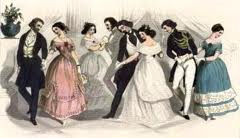
Thursday night seemed to be the night for dancing in southeastern Massachusetts. The Ames sons had already attended at least two Thursday evening assemblies in Canton during January and now in February they’re attending a gathering at Lothrop Hall (the location of which is uncertain: Eastondale, perhaps?  Does any reader of this blog know?) Tonight Oakes Angier and Frank Morton went. (Where was Oliver [3]?)  Evelina’s diary is unclear on whether their cousin Helen went with them or, more likely, stayed home with her mother and aunts – the latter option being more typical for shy Helen.

Earlier in the day, Evelina was evidently still involved with looking into local schooling, getting the lay of the land, perhaps, for the incoming Orinthia Foss.  By mid-century in Easton, there were four school districts, or “ricks” as they were known, in four different geographic areas of town.  Paid for by the occasionally reluctant Easton taxpayers, the schools taught local girls and boys up to grade eight or so.  Massachusetts, and New England as a whole, led the nation in its emphasis on education and, in Evelina’s time, Massachusetts had boasted a 96% literacy rate.

Susie was the only Ames child still attending school.  Oakes Angier, Oliver (3) and Frank Morton as boys had each attended school locally before being sent away to nearby private schools such as Leicester Academy.  On this night, however, dancing, not schooling, was foremost on their minds.
February 3, 1851

Toe

1851

Monday Feb 3 have not been about house much on

account of my foot.  It pains me a great deal & has

turned black under the nail.  Could not sleep last night.

Have been most of the day mending Oakes A shop coat.

work awhile mending Mr Ames shop coat

Susan has a bad cold & cough so that she did not

go to school.  This afternoon wrote a letter for Jane

to her nephew.  This is a remarkably pleasant day.

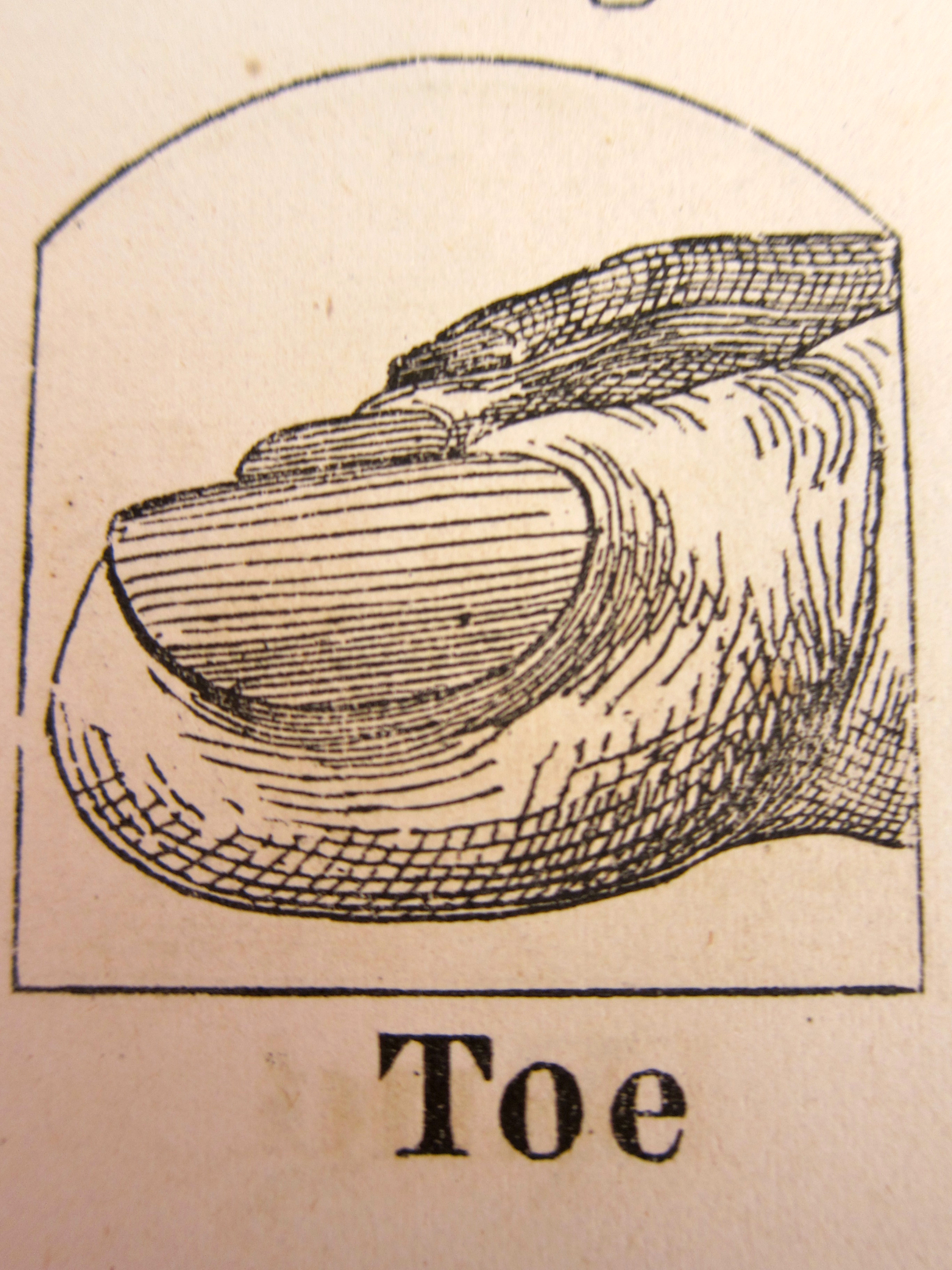
Evelina had to sit down today on account of having dropped a flatiron on her foot and injured her toe.  She wasn’t idle, however.  It was Monday, after all, and no one was ever idle on a Monday. She took up her mending, working on the shop coats of her husband, Oakes, and her eldest son, Oakes Angier.  The shop coats were used by the men for work, and only work, and had to be plenty sturdy enough to do physical labor in.

Little Susan (known as Susie  by her brothers) stayed home from school today and rested. At age eight, Susan was beginning to learn how to sew, but her skills at this stage were too elementary to help her mother with the mending.  Instead, she may have sat with her mother and read aloud, as sometimes happened, or perhaps her cough kept her in bed.

Jane McHanna, the servant who was busy today washing clothes, wanted to write a letter to a nephew.  Like many of the other Irish immigrants, Jane was probably illiterate and so asked Evelina to write the letter for her.  Evelina obliged.  But would the nephew have been able to read the letter once he got it?  And where was he?  Back in Ireland or had he, too, made his way to America?

January 24, 1851

Doll

Jan 24 Friday.  Was very busy this morning about house  Sent

for Abby to go to Augustus’s.  Mr Torrey called to say that

she could not go & made a long call and was as plausible

and good as ever.  Went to Augustus about ten

and alone, but had the pleasure of Mr Whitwells

company back as far as his house  This evening have

called at Mr Holmes but did not see Miss Eaton

Have finished both of the dolls frocks of pink, blue lace  Fine day

The doll that Evelina has been working on since the beginning of the year was finished today.  Wooden with painted features and lace dresses, it was fashioned as a miniature adult.  Baby dolls didn’t come in until almost the 20th century. Isn’t it interesting that the doll was handmade and not store-bought?  It was just a few years too early for Evelina to be able to buy a porcelain doll out of Germany and France, the ones with the big glass eyes, leather hands and silk dresses that speak to us today of Victorian taste. Those manufactured dolls began to enter the American market in the 1860s. With Yankee ingenuity, and not a little help from others, Evelina made her own doll for her daughter. How did Susie like the it?  We don’t get to find out, nor do we know when Evelina gave it to her daughter, but we can guess it was a pleasant surprise.

John Torrey called at the Ames house today.  A former colonel in the local militia, Torrey was also Evelina’s brother-in-law.  He had been married to Evelina’s late sister, Hannah, who died in December, 1848, leaving behind two daughters, Abigail and Mary “Malvina”.  The Torrey family lived right in the village of North Easton, so Evelina was able to see her nieces often.  Abby is 20 years old as the diary opens, Malvina only ten.

Reverend Whitwell featured in Evelina’s diary again today; she certainly seemed to enjoy his company.  She may have been someone who placed ministers up on a pedestal; they were the spiritual leaders of the day and she was a woman of sincere faith.  But, despite his being described by Chaffin as a serious, scholarly type, he may also have been an attractive novelty at a gray time of year.  He was new to the neighborhood and sought the acquaintance of Oakes and Evelina. Did Evelina have a little crush on him?

January 20, 1851

olive-branch

Jan 20th Monday  This morning worked about the house as usual

on washing days & varnished Susans wooden doll.

Jane put her clothes out but soon had to take them

in again as it commenced raining.  This afternoon

I have been mending Oakes Angiers black pants

and finished cutting Susans plaid sack

This evening have been working on Susan’s plaid

apron and reading Mr Lovell’s paper

Keeping clothes clean is always a challenge, but it was especially so in the 19th century when doing laundry was an all-day, manual chore.  Small wonder, then, that little girls wore “sacks” or aprons over their dresses to keep their outfits from getting soiled.  Sacks had no buttons, so were easier to wash than dresses. They were rather shapeless, sleeveless tunics, often made from simple muslin; aprons were the same idea except fitted with a sash. There were no hard and fast rules about the design or material, however.  To imagine the approximate outline of what Evelina was making for Susie, think of the little girls in John Singer Sargent’s famous 1882 portrait, “The Daughters of Edward Darley Boit,” at the MFA.  Three of the four daughters are wearing something over their dresses. Later in the century, sacks and aprons  would evolve into pinafores, an iteration that became as much decorative as protective.  Aprons never went away, however.

After sewing for most of the day, Evelina took up “Mr. Lovell’s paper” to read. Reverend Stephen Lovell lived in Easton and was, for a few years, minister of the short-lived Protestant Methodist church.  Although Rev. Lovell “gave general satisfaction,” attendance at his church was “feeble,” according to town historian William Chaffin, so the congregation disbanded about this time.  Still, Lovell remained visible in town through his involvement with Olive Branch.

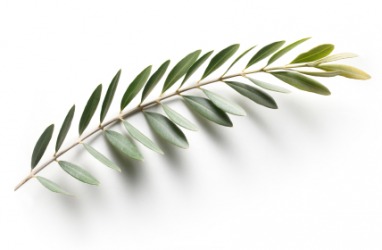
Olive Branch was a popular weekly newspaper published in Boston by Reverend Thomas F. Norris .  Although Chaffin writes that Lovell was editor of this paper, all other sources assign that honor to Norris.  Olive Branch proclaimed itself to be “Devoted to Christianity, Mutual Rights, Polite Literature, Liberal Intelligence, Agriculture, and the Arts.” *  It advocated peace in the increasingly divisive period leading up to the Civil War.  Norris, Lovell and others who worked for the paper – women among them – must have been disheartened by the elusiveness of their goal.  The paper ran from January 1837 through December 1860.

* Joanna River, “Eliza Ann Woodruff Hopkins and The Olive Branch,” josfamilyhistory.com

January 9, 1851

images

/51

Jan 9th Thursday

This morning after cleaning my room & doing

my usual mornings work, finished my collars & the

book Mr Whitwell brought.  Cut Susan a sack out of

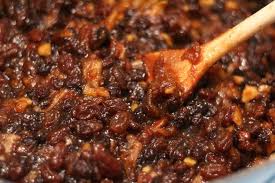
her plaid cloak.  Prepared some mince pie meat ready

for baking & this evening have been writing in this book.

Had to take the foregoing from memory.  Mr Ames, ague in his face

and come home from the office very early.  Has been

troubled with it several days.  Unpleasant this afternoon

Oakes Ames still had his head cold and came home early from work, something almost unheard of.  He was always on the go. Evelina, meanwhile, worked in the cook room preparing mince meat, a lengthy process that calls for a lot of chopping of meat and suet, not to mention the “stoning” of raisins.

Sarah Josepha Hale, intrepid editor of Godey’s Lady’s Book, had nothing nice to say about mince meat pies. In her book, The Good Housekeeper (1841), she urged American housewives to serve mincemeat only on special occasions:

“The custom of eating mince pies at Christmas, like that of plumb puddings, was too firmly rooted for the ‘Pilgrim fathers’ to abolish; so it would be vain for me to attempt it.  At Thanksgiving, too, they are considered indispensable; but I may be allowed to hope that during the remainder of the year, this rich, expensive and exceedingly unhealthy diet will be used very sparingly by all who wish to enjoy sound sleep or pleasant dreams.”

Evelina was a regular reader of  Godey’s Lady’s Book, but she paid scant attention to Mrs. Hale’s admonishment against mince meat pies.  She served them often; they were a familiar presence at the Ames dinner table.  Considering  the large family to be fed, including three physically active sons between ages 17 and 21, and the ready availability of meat and suet from the oxen provided by her father-in-law, it’s small wonder that Evelina turned to a dish that was hearty and filling.   Mincemeat was a standard in many farming families.

New Year’s Day, 1851

IMG_2728

January 1st 1851

Did not rise as early as I ought to commence a new year …

it being about 7 Oclock before we had our breakfast   All wide

awake to get the start of wishing Happy New Year.  Finished

our ironing, and swept the chambers   A A Gilmore & wife

called P M stoped about two hours.  Mrs Witherell finished 

the underclothes for Susans doll.  Elisa at Olivers [Jr] cutting

Helens dress  Commenced a letter to Pauline in answer to one

received last night  Pleasant but very cold.

Most of the people named in Evelina Ames’s first diary entry are family members.  A. A. Gilmore, for instance, is her 30-year old nephew Augustus.  Mrs. Witherell is her sister-in-law, Sarah, busy with doll clothes for Evelina’s youngest child, Susan.  Oliver, Jr. is Evelina’s brother-in-law; his daughter Helen is having a dress made.  They all live in the small, industrial village of North Easton, Massachusetts.  Most live within the Ames family’s substantial compound.

Evelina herself is 42 years old.  Raised on a farm several miles south of the center of town, she has been married to Oakes Ames, a shovel-maker, since 1827.  With three sons and one daughter, she and Oakes live in the family homestead that they share with Evelina’s father-in-law and his aforementioned, widowed daughter, Sarah Witherell, along with her two children.  The Ames men work at the shovel shop, the younger children go to school, and the women tend the home.  Everyone is occupied.

The diary that Evelina kept during 1851 and 1852 offers a modest but illuminating window on daily family life in New England in the ten years before the American Civil War, which they will call “The Great Rebellion.”  It was a decade that marked the end of much of what had come before.  Evelina’s remote, quotidian and predictable life was changing as the railroads moved in, travel became expedited, goods became more accessible and plentiful, and religious thinking was challenged.  As far as her personal circumstances are concerned, much more will change for the family in the years ahead than anyone could have imagined on that cold New Year’s day in 1851.  Of course, we know this now, looking back with perspective, but Evelina didn’t.  She only knew about each day as it happened – which is much of the charm of reading her record.

Hope you will enjoy following along.