September 20, 1851

Train

Sat Sept 20th  Was out shopping all day purchased a number

of articles among the rest a Cashmere & french print

dress paper for my parlour brought home two chairs

from Bigelowes  We all returned home this evening

Frank came to Stoughton after us & rode back

on the stage.  Went into Olivers awhile this evening.

Have had a great deal of trouble with my feet while

I have bee[n] gone & to night they are very sore.

The Boston spree continued for most of the day as Evelina walked and shopped for everything from fabric to wallpaper to furniture.  She and Oakes brought their purchases home on the train (or “in the cars” as they might have said) to Stoughton. It was, finally, time to return to North Easton.  Son Frank Morton Ames met them at the depot with a carriage – or wagon –  but rode home by himself on the local stagecoach. The conveyance he brought to the group getting off the train was, perhaps, too crowded with goods from town to fit everyone in.

Perhaps not wanting to let go of the many sensations that three exciting days in the city had produced, Evelina went next door to Oliver Jr and Sarah Lothrop Ames’s house. They had returned the day before, and so missed the fireworks. Surely they compared notes on their experiences at various events at the Railroad and Steamship Jubilee.  They may have compared blisters and sore shanks, too.  They did much walking and standing during their junket, and Evelina at least was feeling the effects. Her feet hurt.

Meanwhile, never having bothered to go into town for the celebration, Old Oliver was moving ahead on improvements for the shovel shop.  In his journal he noted that “this was a fair day wind south west and quite warm we put in the bottom stone for the floom at the great pond to day and the 5 foot one on the east side of it.” A flume for the factory was going in at Great Pond.

September 18, 1851

1851_Fillmore_Boston_MA_USA_GleasonsPictorial

*

Thurs Sept 18  Went to Boston with Oliver & wife

& Helen to the railroad celebration.  In company

with Mr Orrs family went to see the regatta & about

nine Returned and dined at Mr Orrs with Mrs

Witherell Emily Mrs S Ames & Helen  Mrs Stevens

&c  Afternoon went out shopping with them  All

except Mrs Witherell spent the night at Mr Orrs

Evelina traveled to Boston today to join the crowds at the Great Railroad and Steamship Jubilee.  President Fillmore, Senator Daniel Webster and dignitaries from Canada as well as the United States had arrived the day before. Speeches were made and congratulations went all around for the new “railroad communication” between the two countries. On this, the second day of the festivities, races were held, one a “grand excursion in Boston Harbor” in which cutters from both countries raced; Canada won.

The Ameses attended a regatta out at Hull, near Point Alderton (better known today as Point Allerton.) It must have been interesting for the usually land-locked Evelina to be at the shore; she rarely got to see the ocean, as her trips to Boston were typically spent in the retail center of the city.It was to that retail center that she and other ladies in her party went in the afternoon. Time to shop.

Also on this date, some 200 miles southwest of this railroad jubilee, in another thriving retail and business center, a new newspaper was born. The New York Times was founded and sold for 2cents a paper.


Reception of President Fillmore at the Boston and Roxbury lines by the municipal authorities, 1851

July 31, 1851


images

Thursday 31st July  Was out shopping most all day but

did not purchase a great deal.  Got one of my cuff

pins & marked it at Bigelows  Returned home through

Jamaica plains & by the pond.  passed a number of 

fine place among other[s]  Mrs Greens is a beautiful

situation but Kate went so fast so I could 

not see much of it.  Im told she was a widow Emery

& that her first husband left her the property


Bigelow Bros. & Kennard was a successful store in Boston that ran from ca. 1824 until 1971. Evelina and Oakes were familiar with it, as many of their children, grandchildren and great-grandchildren would be as well.  Evelina took a cuff pin – a women’s version of a cuff-link – to Bigelow’s to be marked.

As the crow flies, the distance from Boston to North Easton is approximately 21 miles. The distance on the available roads was closer to 23 miles. Given the speed at which a wagon might travel along a nineteenth century road with a predictable distribution of hills and curves, a journey in 1851 from one location to the other could conceivably take all day. As already proven yesterday, however, when Oakes and Evelina made the trip in from North Easton in time to shop before lunch, the Ames’s horse Kate could move right along.

Kate (also spelled Cate) was well-known in North Easton. She had a sense of purpose and style all her own.  Oakes had taught her to respond with speed when someone tried to rein her in, and he enjoyed tricking the occasional wagoneer who tried to slow Kate down with a normal tug on the reins. Kate would simply go faster, especially if she were headed for home.

Thus, Evelina wasn’t exaggerating when she wrote that Kate was going too fast for her to see everything.  Evelina wasn’t able to properly scrutinize the fine homes along the road in Jamaica Plains, some of which were quite big and beautiful.


May 21, 1851

faneuil-hall


May 21

Wednesday  This day have been to Boston and had a hard days

work but accomplished very little  Had a green silk

bonnet made for me which fitted […] no better than the

other that I sent back. Mr Remick paid back the four

dollars and I was glad to get off so well after all my 

trouble.  Spent most of the time with Sarah [and] Oliver in

looking for her things.  Bought me a pair of cuff pins

Called at Martin Halls store about some sugar

The search for the perfect bonnet continued today. It was back to Boston, to Alfred Remick & Co. to pick up a bonnet that Evelina had ordered – green silk this time instead of blue plaid – and it still didn’t fit. She had left the instructions up to her husband, Oakes.  Had he gotten it wrong or was the milliner once again at fault? So much for “all my trouble.”

Like yesterday’s diary entry, the tone of this one is self-deprecatory, even grumpy. Gone is the light-hearted pleasure she had expressed earlier in the month when gadding about buying plants for the garden in the company of Orinthia Foss or her nieces. Evelina couldn’t seem to get things to go her way. Her inability to find a bonnet was proving irksome, and the best she could manage was to tag along with her sister-in-law, Sarah Ames, and brother-in-law, Oliver Ames Jr., while they did some shopping. She did buy a pair of cuff pins, however, which was consolation of a sort.

While they were at Faneuil Hall, Evelina purchased or ordered or, at the very least, inquired about some sugar from a grocer there. Faneuil Hall was – and is – a prominent, historic building in Boston. In the middle of the 19th century, it featured a spreading marketplace, called Market Square, where merchants such as Martin Hall sold their wares.  Upstairs there was a large hall for civic gatherings. The illustration above, by Winslow Homer, shows Faneuil Hall in 1861, at the very start of the Civil War, ten years after Evelina bought sugar there. The image of a regiment of Massachusetts volunteers famously marching off to Washington was published in Harper’s Weekly, a periodical to which Evelina and Oakes subscribed.


May 11, 1851

photo

*

Sun May 11th  Have been to church this afternoon. Did

not feel like going in the morning It rained

this forenoon but cleared off quite pleasant

after dinner and after church Oakes A, Orinthia

and I called at Mothers, carried her a poplin

dress that I purchased in Boston.

Have not read any to day. Oakes Lavinia & Orinthia

called on Ann Pool

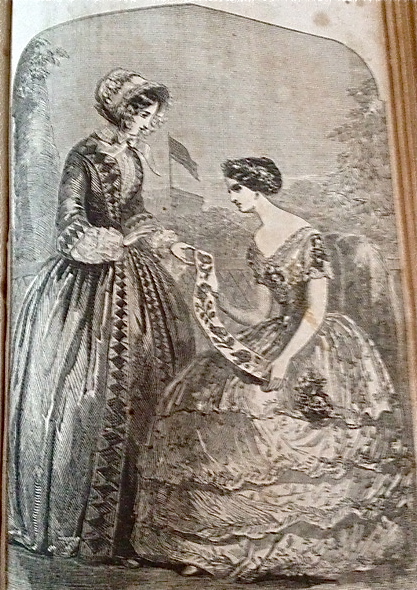
One item that Evelina brought back from Boston was a poplin dress – ready-made, presumably, or perhaps made to order – that she bought for her mother. It had to have been an item that her mother, an elderly country woman, would never have purchased for herself. Hannah Lothrop Gilmore had spent a lifetime sewing her own garments.  She was also unlikely to board a wagon or carriage to go into Boston to shop. The ride from the farmhouse to church on Sundays was about as adventurous as she got. How kind of Evelina to treat her mother in this extravagant way.

Poplin was a popular cotton fabric in the nineteenth century. It was smooth, lightweight and finely woven, more refined than broadcloth, although they were not dissimilar in weave. Both were sturdy and today both are often used for men’s shirts. The dress on the left in the illustration above was a day-dress and probably similar in shape and weight to the poplin dress Evelina bought, perhaps with less trim. The undersleeves were a particular feature of women’s dresses right before the Civil War.

The dress on the right was not something that Evelina would have purchased for her mother, or even for herself at this stage in her life. It was an evening dress with a stylish flounced skirt that would have been entirely too “jeune fille” for old Mrs. Gilmore.

* Spring fashions from Godey’s Lady’s Book, 1851


May 9, 1851

champney2-thumb

*

May 9th Friday  Went out shopping about eight Oclock

and at ten met Mrs George Ames at Mr Daniels

She walked around with me looking for a dress

and other things, likewise met Abby & her cousins

and about 5 Oclock came across Orinthia She

said she should certainly be at home, but missed

of the cars. Mrs Ames left at half past 5 for N.Y.

with Mr Peckham. Returned home much fatigued


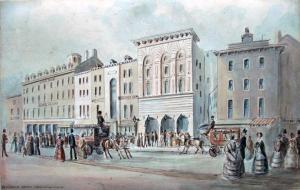
In Boston, stores opened so early that Evelina could start shopping at eight in the morning. She had ordered a bonnet the day before which she was able to pick up later in the day, so today’s shopping was more leisurely. She and her cousin-in-law, Almira Ames, stepped along “looking for a dress and other things.”  They probably walked along Washington Street and its side streets. Others from Easton were in town, too: her niece Abby Torrey and her own boarder, Orinthia Foss. The women were breaking out of their little town to find goods in the big city. The weather must have been especially cooperative.

Evelina finally returned to Easton “much fatigued.” Almira Ames, meanwhile, left for New York accompanied by the head clerk for O. Ames & Sons, John Peckham. They would have traveled by stagecoach or train from Boston or Stoughton. They were not running off together.  Rather, Mr. Peckham had shovel business in the city and, like a gentleman, accompanied the Widow Ames on what otherwise would have been a solo journey for each of them. Presumably, Almira lived in New York at this point in her life, although previously, she had lived in North Easton.


*Benjamin Champney (1817-1901), New Boston Theater, Washington Street, 1850

WC GC031/Benjamin Champney Watercolors Collection, Princeton University Library


April 12, 1851

City

1851

April 12 Saturday  Went to Boston with Mr Ames. Have 

purchased a carpet & paper for the dark bedroom,

bought Susan a dark french print & borage

DeLaine Bible &c &c dined at Mr Orrs no one

at home but Mrs Orr & Mr Norris.  All gone to East

Bridgewater Mrs George Ames returned from 

New York with Mr Peckham Snowed a

little this morning but otherwise pleasant.


Oakes Ames made his usual Saturday trip to Boston and took a happy Evelina with him. It was the first time she had been to the city since January 17, and she didn’t seem to mind a light snow at the start of her journey. After three months in the country, she was excited to be in town, gazing at cobblestones, masonry, store fronts, and being part of the bustle of carriages and pedestrians.  Time to do some shopping.

She found some fabric for dresses for Susan. She bought a Bible. For whom? Why? With purpose and forethought, she selected new carpet and wall paper for at least one of the bedrooms at home that she and Jane had emptied out the day before. The carpet and wall paper, and more perhaps, would surely be delivered to North Easton rather than carried home.

As she had before, Evelina and Oakes, presumably, dined with their long-time friends, the Orrs, whose family, like theirs, had originally settled in Bridgewater. Evelina often stayed with the Orrs, but today she and Oakes only dined with Melinda Orr (Mrs. Robert Orr) and her son-in-law, Caleb Norris.

Today also marked a return visit to Easton by Almira Ames, widow of Old Oliver’s nephew George. She was a first cousin by marriage to Oakes, Oliver Jr., and Sarah Witherell and was used to visiting North Easton. In fact, she had spent enough time in North Easton to be listed in the 1850 census as living in the Ames household. In 1851, however, Almira seemed to be living in New York City. She was something of a favorite relative among the Ames women.


January 17, 1851

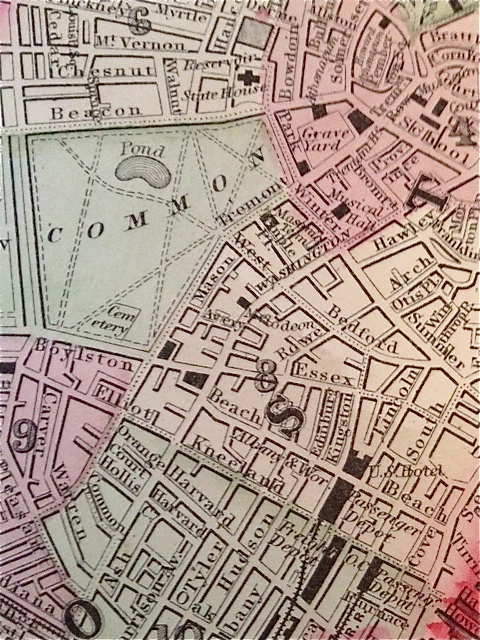
Map of Boston, ca. 1865, detail

1851

Jan 17 Friday  Spent last night at Mr Orrs.

S A at H Mitchells.  We met at Essex St

about ten Oclock and went shopping  I did not

purchase as much as I usually do when I go to Boston

We dined at Mr Orrs on Turkey & oysters.  Mrs Mary

Hyde was there under Dr Reynolds care.  Her eyes are

very painful but the Dr thinks he can cure them  On our

way to the cars we called at H Mitchells  Mr Orr is at

Plymouth building some kind of factory.  Beautiful 

weather.

Evelina and her sister-in-law, Sarah Lothrop Ames, stayed overnight in Boston after missing the train to Stoughton.  Sarah stayed with someone named H Mitchell  (probably not the youngest Ames sister , Harriett Ames Mitchell, who was reportedly in Pittsburgh at this period, but rather a cousin named Harriet Lavinia Angier Mitchell.  At this writing, difficult to know for sure.)  Evelina, however, stayed with the Orr family.

The Orrs and Ameses were friends of many years standing.  Like the Ameses, the Orrs originally hailed from Bridgewater, where they, too, had been involved in the making of tools.  Old Hugh Orr was a decade or so older than Old Oliver.  Hugh’s son, Robert, had moved into Boston with his wife, Melinda Wilbur Orr, of Raynham.  Melinda and Evelina were friends, and Evelina usually stayed with the Orrs when she spent the night in Boston.

More shopping today, at least for Sarah Ames; Evelina appeared to be shopped out.  Still, she was happy enough to trudge along Essex and Washington Streets with Sarah (on the map detail, Essex and Washington Streets meet near the “8”, to the right of the Boston Common) dipping in and out of shops. The “beautiful” weather boosted their spirits and more oysters – and turkey – bolstered their stamina.  This time, they caught the cars and returned home.