May 7, 1852

il_340x270.517720740_i0s3

Polyanthus

Friday May 7th  Was in the garden to work a short

time transplanted some pinks but worked on

Olivers clothes most of the time.  Mr Brown &

Oliver rode to Mr Copelands and got me a polyanthus

and to the furnace in the afternoon to Canton 

and Sharon.  Mrs S Ames returned from Boston to

night & Helen with her  Helens face is very

swollen has not been to school for a week


With her middle son Oliver home from Brown, Evelina had a great deal of mending to tend to. She might have preferred to be in her flower garden, but she only had a short window in which to repair her son’s shirts, hose, and coats. Oliver, meanwhile, rode out with his college roommate, Mr. Brown. They roamed from Easton to Canton and Sharon and in the process picked up a polyanthus, or primrose, for Evelina. They got the latter from a Mr. Copeland, who was perhaps Josiah Copeland, an elderly resident of Easton who lived with his wife and unmarried daughter.

George Witherell continued to be ill in the other part of the house, but he wasn’t the only family member who was ailing.  Helen Angier Ames had to come home from boarding school because of a swollen face. Perhaps she had an infection – an abcess of some sort – or perhaps she was having an allergic reaction to an insect bite or other allergen. Whatever was ailing her, she hadn’t attended class for a week, and her mother had to fetch her home.
 

May 5, 1852

Thread

Wednesday May 5th  Worked about house & got my sleeves for Delaine ready

for Mrs Witherell to work  The sewing circle met

at Mrs Nahum Pools.  Mrs S Ames gone to Boston

George quite sick with the rheumatics Augusta gone

to N Bridgewater and so poor I should have had to

go alone.  Preferred to stay at home  Mr Peckham +

family all at Mr Swains.  called to see them & after they

left Mr & Mrs Swain went with me to Edwins garden got

two Gladiolus bulbs.  A beautiful pleasant day

The Sewing Circle met today at the home of Nahum and Lidia Pool, but Evelina didn’t attend. Her usual companions from the village were otherwise occupied, and “poor” she didn’t want to go by herself. She stayed home, or at least she stayed in North Easton. She parcelled out some sewing to her sister-in-law, Sarah Witherell, to work on, and headed out. Perhaps Sarah sat and sewed near her son George, who was “quite sick.”

The day was beautiful, and Evelina seemed to be in fine spirits despite missing the sewing circle, or perhaps because of missing it. She went to see John and Ann Swain and there encountered the Peckham family, who had moved away from North Easton the previous year. They must have been back for a visit.  When they left, Evelina and the Swains went up to the garden of Edwin Manley and bought two Gladiolus bulbs.

May 4, 1852


IMG_0159

Trellis on the door of the home of Oakes and Evelina Ames and extended family, ca. 1860


Tuesday May 4th  Mr Healy & Morse commenced the trellis

for our front door  We had quite a consultation how it should

be made  I[t] was very cold & windy this morning & I fear I

have taken cold in being out so long  Have mended Olivers

sack and cut the pattern and have done some other mending

Augusta made a long call. It is really very pleasant to have

her so near.  Mrs S Ames went to Boston

The trellis that Evelina refers to today could very well be the modest trellis that graces one of the doors in the above photograph. The doorway facing the street in the approximate middle of the photograph was the door that Evelina, Oakes, and their family used for their own. The doorway on the far left, facing the yard, was likely the entry that Old Oliver and his daughter, Sarah Witherell, used. The house on the far right was a separate dwelling that belonged to Oliver Ames Jr. and his wife, Sarah Lothrop Ames.

None of these buildings is still standing. The one on the far right was torn down in 1863 and replaced by a larger, more formal house that is still extant today, with lovely gardens and a well-kept air.  The house in the center, halved on the interior to accommodate the two households of Evelina and Sarah Witherell, was torn down in the 1950s, at the behest of Oakes Angier Ames’s eldest son, Hobart Ames. The site has since been reclaimed by trees and undergrowth.

The trellis was meant to add a fashionable air to Oakes’s and Evelina’s side of the house. Evelina was trying to bring the simple, old Federal dwelling into the Victorian age, inside and out. She had a particular vision for her home, and she worked hard to realize it. Small wonder that the construction required “quite a consultation.”


May 2, 1852

IMG_0157 (1)

Frontispiece, Breck’s Book of Flowers, 1851

Sunday May 2d

1852 Have been to church and at noon went

into Mrs Howards with Mother & Henrietta

After meeting went with Oakes A & Mrs

S Ames to call on Mrs Perkins at Mr Kimballs

also called at Mr Nahum Williams

Mrs Kimball has her garden laid out quite

prettily but the walls are too narrow I think

Evelina was almost as interested in other people’s gardens as she was in her own. After church, she and her son, Oakes Angier Ames, and sister-in-law,  Sarah Lothrop Ames, made a few calls around the neighborhood. The day “was cloudy + fair by turns,”* and as they visited, Evelina was able to see what others were doing in their yards.

The group stopped at the home of John and Lusannah Kimball, whose garden Evelina judged to be pretty, certainly, but “too narrow.” Perhaps Mrs.Kimball was building a perennial border, as opposed to the central bed configuration that Evelina used. Taste in gardening design was changing, with the latest ideal illustrated in Joseph Breck’s popular new book on flowers. Was this the look that Evelina was aiming to achieve in her yard?

The whole family seemed to be out and about, at least for the ride to and from the meeting house. The usual group, representing all three Ames households, was in attendance.  It would be the last Sunday ever for this particular ensemble.  In only two weeks, the Ameses would be back at church for a funeral for one of their own.

*Oliver Ames, Journal, Stonehill College Archives, Arnold Tofias Collection


April 24, 1852

7841216_6_l

Sat 1852

April 24  Mrs Ames returned last night I came

from Boston to night.  Like my things pretty well

have bought me some bronze candelabras

drugget a lot of gentlemans hose &c &c

Got through with my shopping about three

and went to Mr Orrs.  Lucia Harris is

there Mrs Witherell & Ames came to see my

things in the evening

The bronze candleabras that Evelina bought in Boston today were purchased, in all likelihood, for the parlor. They were a formal throwback to the time when candles were used for lighting, which was the period that began when the Pilgrims first arrived and lasted to the early part of the 19th century.  By 1852, however, oil lamps and very soon, kerosene lamps, were becoming standard fare for lighting. They were more economical than candles.

Burning candles, then, was something of a “retro” effort that honored the grace and warmth of the familiar candlestick, and suggested that the homeowner had enough money to burn candles if he so chose. No smudgy little whale oil lamp for the parlor or the dinner table, though oil lamps of varying styles and efficiency might operate in the rest of the house. In the room in which company was entertained, the candleabras would glow, and brag.

Both sisters-in-law came over at the end of the day to see what Evelina had bought, and it’s hard to imagine they were interested in the “gentlemans hose &c.” They came over to check out the new candleabras.

April 23, 1852

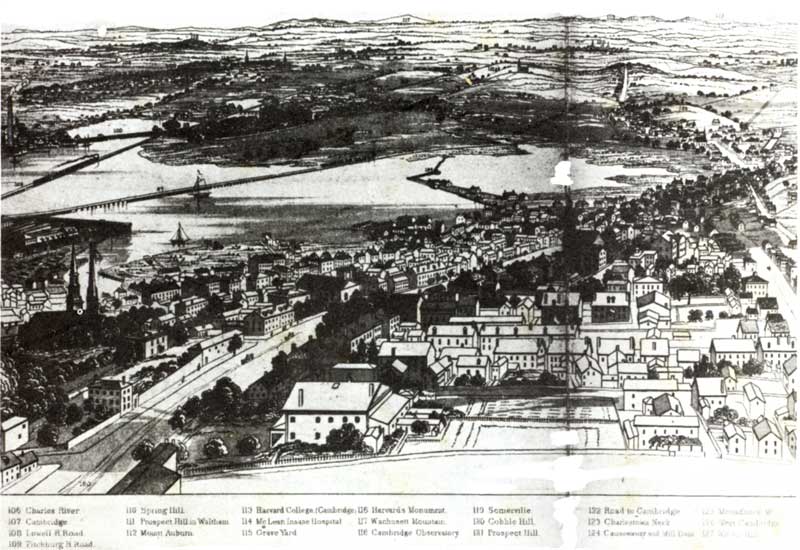
Boston, early 1850s, partial panoramic view

 Partial view of Boston and Cambridge from the Bunker Hill Monument, early 1850s*

1852

Friday April 23d  Went to Boston with Mrs S Ames

Called on Mrs Stevens did not stop with

her more than 15 minutes. Went to Mr Orrs

at night  Julia is there with her babe she

grows nicely and Julia is quite smart

I was about a great deal and was very

much fatigued but had a good […]

comfortable day

Evelina had not been out of Easton for more than two months.  Her last trip to Boston had been in the middle of February, when she’d traveled in with her son Oliver (3) and shopped for prints for the parlor.  That was before the fire at the shovel shop. With so much time having elapsed, she must have been eager to get to the city again.

She traveled into town with her sister-in-law, Sarah Lothrop Ames. They may have called together on family friend Mrs. Stevens, but they likely went their own ways afterwards. As usual, Evelina stayed with the family of Robert and Melinda Orr, where she visited their daughter Julianne Orr Harris (Mrs. Benjamin Winslow Harris) and her new baby, Mary, at whose birth Evelina had been present. Both mother and daughter seemed healthy.

Boston was probably bustling at this time of year, trees at the bud and the air cold but promising. The partial view of the city in the illustration above, made about this time, shows a city that was growing west and south. Between 1840 and 1850, its population had grown from 93,383 people to 136,881. By 1860, the count had reached 177,840. In this vista, railroads are visible, and a Back Bay sits ready to be completely filled..

The view was captured from the top of the Bunker Hill Monument, itself a recent feature of the landscape. Replacing an earlier monument also dedicated to the Revolutionary War battle in Charlestown, it was completed in 1842 and dedicated in 1843. Antiquarian Samuel Gardner Drake (and one of the founders of the New England Geneaological Society) published the panorama in his The History and Antiquities of Boston  in 1856 .


*Partial image of Panorama of Boston and Cambridge from top of Bunker Hill Monument, from The History and Antiquities of Boston, published in 1856 by Samuel Gardner Drake

April 21, 1852

01-01_full

Examples of 19th c. lunch pails*

1852

Wednesday April 21st  It still continues to rain through not as

hard as yesterday  Have been to work on

Susans dresses altering them  Went with

Mrs S Ames to the store  Susan has carried

her dinner to school three days and thinks

it something nice  Swept my chamber and put

it in order

The heavy rain of the past two days wasn’t giving up easily. Old Oliver wrote that “it raind considerable last night + the wind blew hard and it is cloudy + rainy this morning + the water is verry high.”**

Despite the weather, the Ames women continued many of their usual routines: sewing, of course, and housework, but errands, too. Evelina and her sister-in-law Sarah Lothrop Ames went to the company store in the village. Little Susie Ames went to school, as she had even during the worst part of the storm. Instead of coming home for dinner in the middle of those rainy days, however, she carried her meal to school and ate there.  No school cafeteria or hot lunch program in those days! She thought it “something nice” to stay at school for the midday meal.

Courtesy of the National Museum of American History, Smithsonian

** Oliver Ames, Journal, Stonehill College Archives, Arnold Tofias Collection

April 18, 1852


paul-revere-1

1852

April 18 Sunday.  Another unpleasant sabbath but we have

all been to meeting.  Oliver & wife staid at home

this afternoon.  Mr Whitwell gave us two short but

good sermons of about 20 minutes  At intermission

went into Mrs J Howards with Mrs E Howard

Mrs L Howard & Mrs Dr. Deans    called a few moments

on Mrs Whitwell.  Have finished Night & Morning

As was their custom, the Ameses attended church today en masse, at least in the morning. They drove separate carriages to the meeting house through the “cloudy, cold + misty”* morning. Oliver Jr. and his wife Sarah Lothrop Ames rode home at noon, but Evelina and her family, presumably, busied themselves at intermission with various opportunities to socialize.

Oakes Ames most likely slept through the sermons, even though they were “short.” Evelina, however, liked Reverend Whitwell’s sermons today, as she often did. Would he have made any allusion to the historic date?  April 18 was the anniversary of the 1775 ride of Paul Revere and William Dawes to warn “every Middlesex village and farm” of the approach of British forces.  It was a date that American schoolchildren once had to memorize.

Less than a decade later, poet Henry Wadsworth Longfellow would immortalize the historic date in Paul Revere’s Ride:

Listen my children and you shall hear

Of the midnight ride of Paul Revere,

On the eighteenth of April in Seventy-Five;

Hardly a man is now alive

Who remembers that famous day and year…

Longfellow, one of the most popular American poets of the 19th century, wrote Paul Revere’s Ride some eighty-five years after the dramatic events in Concord and Lexington that opened the Revolutionary War. It was published in The Atlantic Monthly in January, 1861, on the eve of the Civil War.  Many believe that the poet, an adamant abolitionist, wrote the piece to remind American citizens of the historic principles and great bravery that shaped the formation of the United States.


Oliver Ames, Journal, Stonehill College Archives, Collection of Arnold Tofias


April 16, 1852

 women sewing*

1852

April 16th Friday.  Julia here again to day and we have

been to work on my dresses  Mrs S Ames & Witherell

helped some time this afternoon and we have

got along nicely  Hannah & Augusta called

Augusta brought her work and Hannah finished

Susans stocking.  Susan has the other stocking about

half done.  The first pair that she ever attempted to knit.

Stormy again to day.

The day before had rained “pritty fast” all day long, and today opened in much the same vein, with “snow squals + rain + a high wind.”***  The women stayed indoors and focused on fashion.  Dressmaker Julia Mahoney came over to work on new outfits for Evelina. Sisters-in-law Sarah Ames and Sarah Witherell helped for a time, too, both of them as accomplished at sewing as Evelina. They all “got along nicely,” a phrase that suggests good progress was made on Evelina’s dresses, although the women’s sociability quotient was also probably pretty high.

Others joined the hum.  Nieces-in-law Hannah Gilmore and Augusta Gilmore, a younger set of eyes and hands, arrived with work in hand. Hannah helped her little cousin, Susie Ames, knit a pair of stockings.

The sewing of new dresses – as opposed, say, to the mending of men’s shirt fronts – was the favorite expression of the women’s collective talent with needle and thread. As Winthrop Ames noted, “An immense amount of sewing went on in every family.”** We’ve certainly learned that from Evelina’s diary.  In 1852, they still made their own dresses. “[T]he materials and trimmings, after much consultation about their style and quality, were made up in the house with the help of the town seamstress and pictures from the fashion magazines.”

Things would change. By the start of the Civil War, the Ames women began to have their dresses made up in Boston. But on this day in North Easton, needles flew.


*Image courtesy of nhdsewingmachine.weebly.com

** Winthrop Ames, The Ames Family of Easton, Massachusetts, p.126

*** Oliver Ames, Journal, Stonehill College Archives, Arnold Tofias Collection


April 14, 1852

Washing

1852

April 14th Wednesday  Jane washed yesterday and put

her clothes out to day […] and it is very pleasant and

most like spring of any day we have had.  Made two

toilet cushions and covers for them of plaid muslin

Mrs Sarah Ames brought in her work this afternoon

awhile and I put a bosom into a shirt for

Mr Ames.  Read this evening in Night & Morning

The rain and snow of the preceding two days had disrupted domestic routine, meaning that servant Jane McHanna washed the weekly laundry on Tuesday instead of Monday and hung clothes out today. Evelina didn’t seem to mind, given how “most like spring” the day turned out to be. She seemed to have recovered from having gone without much sleep the day before.

Sarah Lothrop Ames came over from next door and the two sisters-in-law sat and sewed. Evelina sewed a shirt front for her husband and made two toilet cushions. The word “toilet” in the nineteenth century referred to personal grooming, as in getting dressed or cleaning one’s teeth or sitting at a dressing table.  A toilet cushion, then, was most likely a seat for a stool or small chair for a bedroom or dressing area. Evelina made both the pillow itself and its cover of “plain muslin.”

Night and Morning was, presumably, a work of fiction. Evelina must have found it in one of the periodicals she liked to read, such as Gleason’s Pictorial, or in a book she or Oakes had purchased in Boston.  Any readers out there familiar with this work?