March 10, 1852

Handkerchief

1852

March 10th  Wednesday  Early part of the day

was sewing on a waist or rather cutting

it out and getting it to fit.  Augusta

came in this afternoon but as Amelia

& self were invited into Olivers she went

with us and Edwin.  Mr Ames came to tea

Amelia trimmed some pocket handkerchiefs

for me that Mrs Ames got in New York

The rebuilding of the shovels shops was moving along well. They “put the roof on the stone shop to day,”* according to Old Oliver, who watched each day’s progress carefully. It had been a full week since fire had destroyed most of the factory buildings. The response and reconstruction had been immediate!

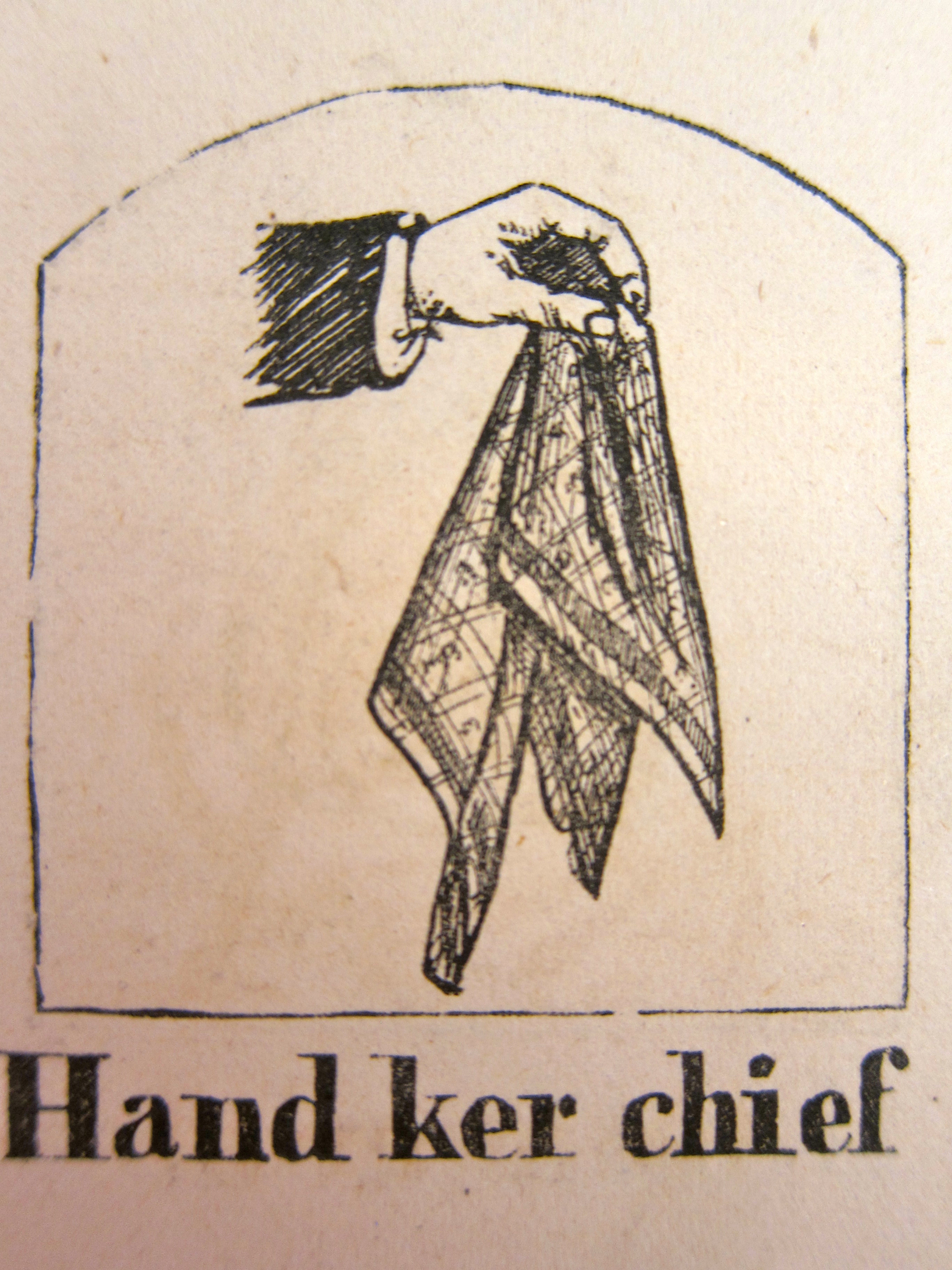
Amelia Gilmore, the widow of Evelina’s younger brother, Joshua Gilmore, Jr., was visiting for several days.  She undertook the hemming of some handkerchiefs – essential components of a lady’s outfit – that Almira Ames had brought Evelina from New York City. The purpose of a handkerchief, a personal item dating back to antiquity, was primarily hygenic, used to wipe one’s nose or brow and cover one’s cough. In a time of contagious diseases such as tuberculosis, cloth handkerchiefs were essential.  Their ubiquity necessitated their incorporation into the fashion profile.

Late in the day, the two went next door to Oliver Jr.’s and Sarah Lothrop Ames’ home for tea.  Oakes Ames went, too, and the newlyweds, Augusta and Edwin Gilmore, tagged along.


*Oliver Ames, Journal, Stonehill College Archives, Arnold Tofias Collection


March 8, 1852

Carpenter

March 8th

1852 Monday  To day is town meeting.  George brought

sister Amelia here this afternoon  Have got

the carpet down in the front entry and 

the chamber carpet partly down

S Ames sent for the entry lamp for fear

I suppose that I should keep it but

she […] might not been alarmed

Carpenters have come to rebuild the shops

A new week signaled a fresh start. It had only been six days since the fire at the shovel factory, but the clean-up had gone quickly. The ruins were “dismal,” as Evelina noted yesterday, but the debris was mostly gone, hacked down, shoveled up and carted away. Carpenters had arrived to begin rebuilding, as Old Oliver, too, noted in his diary:  “some of the carpenters came on to day to build up our shops + Mr Phillips + his son came.”*

Life in the village was returning to normal.  Housewives, some with servants, tended to washing day. Children went to school and men went to town meeting.  As at church, the fire must have been part of the conversation as the men gathered to decide on town affairs and expenditures for the coming year. People must have wondered how soon the shovel shop would be up and running.

At the meeting, a new moderator, Alson Augustus Gilmore, presided. Not yet thirty years old, it was his first time holding the gavel; he would repeat the performance twenty-four times over the coming decades.  According to William Chaffin, Gilmore and his predecessor, Elijah Howard, Jr., “served with signal ability.”**

Evelina and her sister-in-law, Sarah Lothrop Ames, had a minor set-to over “the entry lamp,” which appears to have been a luminary that was shared by both houses. Sarah was evidently skittish about not having it, and Evelina was annoyed to have it commanded away.  No cause for alarm, she might have said. She wouldn’t have been annoyed for long, however, as a favorite family member, Amelia Gilmore, arrived for a visit. Amelia was the young widow of Evelina’s younger brother, Joshua Gilmore, Jr. She had lately been working as a private nurse.

*Oliver Ames, Journal, Stonehill College Archives, Arnold Tofias Collection.

**William Chaffin, History of Easton, 1886, p. 637

March 7, 1852

Ruin


/52

March 7th Sunday  It has been a beautiful day and we 

have all been to meeting except Frank

When we came from meeting we rode down to

the ruins. They have cleared away a great deal 

but it looks dismal enough  Mr & Mrs William

Reed spent the evening  Mrs Witherell & Mrs

S Ames came in awhile & Father Ames

No work was done today at the site of the shovel factory fire, for it was Sunday, a day of rest – a day of rest that everyone in town must have welcomed after the shock of the fire and the subsequent hard work of clearing the debris.

The Ames family rode down Centre Street to church, the weather “beautiful.” At the intermission between sermons, they must have been approached by fellow parishioners expressing concern and curiosity about the fire. In a town of 2,500 citizens, such a huge event would have been on everyone’s mind. Is it too far-fetched to imagine that Reverend Whitwell might have alluded to it from the pulpit?

After the services, the family drove by the factory site on their way home. The wintry sunlight hid nothing; the “ruins” were “dismal.” Later in the day, several family members gathered at Evelina’s and Oakes’; even Old Oliver came over from the other part of the house, which he seldom did, perhaps to greet guests William and Abigail Reed or to discuss the plans for rebuilding, to begin the next day.

March 5, 1852

charred-wood-texture_61-1902

Charred Wood

1852

March 5th Friday  Have been mending pants most all

day that were worn at the fire  Lavinia

went to Augustus’ this forenoon and Augusta

went this afternoon.  Mr Scott & Holbrook have 

finished painting the entry and chamber

got through about four Oclock.  I was in

Olivers about an hour this afternoon.  This 

evening received another letter from Harriet Ames


The women of Easton had work to do, too, in recovering from the factory fire.  Surely Evelina wasn’t the only housewife in North Easton who had to repair or clean clothes worn by their husbands, brothers or sons the night of March 2. Needles were out and laps were full as women all over town tended to the rips, tears and soot. Conversation probably centered on the fire as they worked.

The day itself was cloudy and cold, the smell of the charred buildings dampened by a light snow that fell overnight. Yet the cleanup continued. As the men worked at the site, hauling timbers and shoveling up debris, their blackened soles left ashy footprints in the snow, footprints that quickly turned into grime. Many a man was made to wipe or remove his shoes before entering his house for midday dinner.

Evelina stayed focused on her domestic responsibilities. Mr. Scott and Mr. Holbrook were back on task in her parlor, painting and papering, and finished up at the end of the afternoon. Evelina spent some time next door with Sarah Lothrop Ames, and got a letter from cousin Harriet Ames, with whom she had been corresponding lately. And perhaps under her direction, her niece Lavinia and niece-in-law Augusta were looking after their sister-in-law, Hannah Lincoln Gilmore, who was laid low with a mouth infection and a weaning baby. Fire or no fire, life was moving forward.


February 21, 1852

 21621-004-0B1C48DE

Angelina Grimke (1805-1879)

1852

Feb 21st Sat  Spent all the forenoon mending Mr Ames

shopcoat.  Cut Susan a pink long sleeve apron and

Orinthia sewed on it  Have finished Mr Ames another

dickey which makes seven that I have made lately

This afternoon carr[i]ed Mrs Solomon Lothrop &

Orinthia to mothers.  Orinthia stopt at a sing at

the Schoolhouse near Doct Swans  Frank went and

brought her back.  Mrs S Ames called this evening to 

settle and paid me 1,70 cts which makes us even

Normal wintertime activities went on under a sky that Old Oliver described as “fair in the fornoon + cloudy afternoon + much warmer.”*  Evelina mended, sewed and socialized with her friend and former boarder, Orinthia Foss; she also settled accounts with her sister-in-law, Sarah Lothrop Ames. Per usual, Oakes Ames went into Boston.

It was in Boston, in fact, on this date fourteen years earlier that for the first time ever in the United States, a woman addressed a legislative body. On February 21, 1838, abolitionist Angelina Grimke presented the Massachusetts Legislature with an anti-slavery petition signed by 20,000 Massachusetts women. In a speech that was lauded by abolitionists, deplored by traditionalists and parsed by all, she not only called for the abolition of slavery, but declared the right of women to act politically. “We are citizens of this republic and as such our honor, happiness, and well-being are bound up in its politics, government and laws.”**

Daughter of a southern slave-holder, Angelina (known as “Nina” in her family) and her older sister, Sarah Grimke, also an active abolitionist, faced predictable opposition as they transgressed convention. Angelina’s speeches in Boston and elsewhere drew taunts, outrage, disbelief, and disrespect. The Congregational clergy of Massachusetts condescended together one Sunday and, across pulpits, accused Grimke of jeopardizing “the female character with widespread and permanent injury.” Others – men and women – were impressed. One member of the audience at the statehouse said, “Angelina Grimke’s serene, commanding eloquence [she spoke for two hours] enchained attention, disarmed prejudice and carried her hearers with her.”**

How might the Ames clan have reacted?


*Oliver Ames, Journal, Stonehill College Archives, Arnold Tofias Collection

**www.massmoments.org


February 17, 1852

imgres

Example of mid-19th century headdress*

1852

Tuesday Feb 17th  This forenoon made me a headdress of Satin

ribbon of the colour of my hair and lace  Alsons

wife came to Augustus this forenoon and to Edwins this

afternoon  Called here awhile after dinner

Mrs Witherell S Ames & self spent the afternoon & evening

at Mr John Howards with Mr & Mrs Whitwell

Mr & Mrs Reed & Mrs Elizabeth Lothrop  Frederick

carried us down & [came] after us this evening

Bonnets may have been the most common covering for the heads of well-dressed mid-century females, but head gear of other persuasions was not to be ignored.  A fore-runner of today’s fascinators, light, decorative headdresses such as the one in the illustration above were very popular for certain indoor or evening outfits. Evelina must have enjoyed sewing one for herself, taking extra pleasure in how well it matched her own coloring.

Evelina’s father-in-law, Old Oliver, noted that this “was a fair day wind north west + cold.” The wind would have been somewhat behind them when the three sisters-in-law, Sarah Ames Witherell, Sarah Lothrop Ames, and Evelina were driven south in the afternoon by Fred Ames. The women visited a group of friends at the home of fellow Unitarians John and Caroline Howard.  The tea they must have been served there perhaps helped stoke them up for the cold drive back home into the wind.


*Courtesy of Library of Congress

February 14, 1852

 history

Detail of Cover of Gleason’s Pictorial, February, 1852

Sat Feb 14th  Finished Olivers shirt before dinner and did

some mending  About three went into Edwins and trimmed

a black silk cravat for Oliver  Mrs S Ames & Frederic

returned from New Bedford to night where they have been

since Tuesday  I spent most of the evening there

Evelina’s favorite periodicals, such as Gleason’s Pictorial, Godey’s Lady’s Magazine, and Graham’s, were full of allusions to Valentine’s Day this week. Gleason’s featured a valentine on its cover, in fact.  And while commercial Valentine cards hadn’t yet developed in the United States – that would happen in the 1870s – special letters and personal poems were popular on February 14. Yet Evelina makes no mention of receiving or sending a valentine, nor does she suggest that any of her children did, either.

Perhaps when Evelina went over to see Augusta Pool Gilmore, young bride of Evelina’s nephew Edwin Williams Gilmore, she found evidence of a valentine exchange between the newlyweds. Besides being in love and – presumably – open to sentimental expression, Augusta and Edwin were young enough to adopt new approaches to holidays that older Yankees like Evelina and Oakes ignored.

Meanwhile, winter was still very much present. As Old Oliver noted: “there was about half an inch of snow last night and it is cloud[y] + cold to day wind north west”

January 31, 1852

500

Jan 31st  1852

Saturday  have been choring about house & mending most

all day.  Made a robe for Mitchell Willis child with

Mrs S Ames assistance  Edwin & wife here to tea  Mrs S

Ames has been here about three hours with her work

Mrs Witherell here awhile this afternoon.  Mr Frank

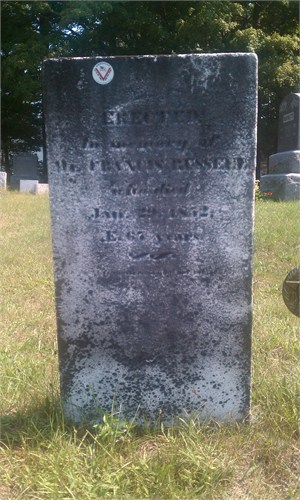
Russell was buried this afternoon.  My three sons went

to the funeral.  Quite a hard snow storm  Mr Ames to Boston

Inclement weather didn’t keep the Ames men from moving around today. Oakes Ames traveled into Boston on business, as he usually did on Saturdays. His sons, Oakes Angier, Oliver (3) and Frank Morton, rode to Easton Center for the funeral of Frank Russell, a 67-year-old blacksmith and veteran of the War of 1812. Russell had died two days earlier from pleurisy, and, despite the “hard snow storm,” he was buried at the Seth Pratt Cemetery with friends and family in attendance.  What had been his connection to the Ames’s sons? Had he worked for the shovel company?

Evelina, too, was tending to a death outside the family.  She and her sister-in-law, Sarah Lothrop Ames, sewed a burial robe for Luella Willis, the two-year old daughter of Mitchell and Amanda Willis.  Like Frank Russell, little Luella would have to be buried in cold ground during snowy weather. Once the services were over, the living would carry on with their chores, their commitments and their lives.  Evelina would turn to “mending most all day.”

January 27, 1852

TMM03FOOD10_a_237278c

1852

Jan 27  Tuesday.  Mrs S Ames & Frederick were to dinner  had a roast

goose.  This afternoon Mr & Mrs Whitwell, Mr & Mrs

John Howard & Miss Jarvis    Mrs Witherell Augustus

& Hannah came this evening    Frederick went after the

ladies. Oliver & George carried them all home this

evening.  Baked some tarts in the other house stove

Have sewed but very little  Mr Wm Brown was also here.

Quite a sociable day for the Ameses, full of company.  Midday dinner was attended by Sarah Lothrop Ames and her son Frederick. (The absence of Oliver Jr. and Helen Angier Ames suggests that the former might have been away on business while the latter had returned to school.) Fred, like Oliver (3), was home from the Ivy League; their conversation at the dinner table probably provided some fresh subject matter. Perhaps they entertained family members with a modified description of life on campus.

Evelina served a roast goose (that Jane McHanna had cooked), a dish that normally denoted a special occasion such as Christmas or New Year’s. Were they serving it in anticipation of Oliver (3)’s 21st birthday, or was it just a whim? Either way, serving roast goose on an odd weekday signified wealth behind the larder.

Sarah Josepha Hale offered a recipe for roast goose in her popular household guide, The Good Housekeeper, suggesting that it be stuffed and roasted on a spit over a “brisk” fire for at least two hours. Otherwise, she had a qualified opinion of the dish:

“Geese seem to bear the same relationship to poultry that pork does to the flesh of other domestic quadrupeds; that is, the flesh of goose is not suitable for, or agreeable to, the very delicate in constitution. One reason doubtless is, that it is the fashion to bring it to table very rare done; a detestable mode!”*

Mrs. Hale would likely have approved of the baked tarts, however, that Evelina served for tea later in the day to the Whitwells and others.  It’s a happy note that Sarah Witherell ventured over at the very end of the day; she must have been feeling better after the extraction of her teeth some days back.  She was comfortable enough to let Evelina’s nephew Augustus and his wife Hannah see her face, which had been swollen for days.


*Sarah Josepha Hale, The Housekeeper’s Guide, 1841, p. 52


January 24, 1852


IMG_2669


1852

Jan 24th  Saturday   Worked all the forenoon mending

Olivers overcoat & pants. Have finished my worsted

hood in Olivers this afternoon.  Julia Pool

Augusta & Edwin were there to tea. Mr Ames

has been to Boston & has brought home Oliver a

gold watch  Fred & Oliver have fine time and 

are wide awake  They sleep together.  Fred came 

in here tonight.

Evelina must have written this entry at night, perhaps in her bedroom where she could hear her son Oliver (3) and nephew Fred Ames conversing and laughing elsewhere in the house.  The first cousins, college men both, enjoyed one another’s company and were spending the night together. Up to now, they were the only family members in recent memory to go to university and must have had some stories to compare.

The fond regard that Oliver (3) and Fred held for one another would last throughout their lives, although it would be sorely tested on occasion. As grown men caught up in the high stakes of the railroad business, they found themselves holding opposing views more than once.  And after the sudden death of Oakes Ames and the attendant financial woes that followed, Oliver (3) defended his father’s legacy, while Fred supported his own father’s efforts to recoup funds that Oliver, Jr. believed were his.  In other words, Oliver (3) and Fred faced off over money. Yet they moved in similar circles, invested in similar capitalist ventures and, in 1893, when Fred himself died quite suddenly, Oliver (3) grieved, “completely broken down by [the] sad news.”*

Those difficult times lay ahead, but on this day, Oliver (3) had something to celebrate.  His father, Oakes, had given him a gold watch, perhaps in honor of his 21st birthday, which was right around the corner. Perhaps, too, Oakes was honoring his middle son for his successful studies at Brown University, studies that Oakes had initially resisted. The watch was certainly a sign that Oakes was proud.

*Oliver Ames Third, Diary, September 13, 1893, Collection of Stonehill College Archives