March 26, 1852

imgres


1852.

Friday March 26  Mrs S Ames returned from Boston last

night, had unpleasant weather for two days.  She called

at Mr Orrs found them all well. Julia is there

yet with her little one  Mrs S Ames & Witherell

called on Mrs Elizabeth Lothrop and invited me

to go with them but I felt it more my duty to call

on Mrs Swain, did so, and was prevailed upon to 

spend the afternoon & evening.  She has weaned her

babe, has been quite unwell but is now better

Two young women closely connected to Evelina recently weaned their babies. Hannah Lincoln Gilmore, wife of Evelina’s nephew Augustus, had just weaned her seven month old son, Willie. Ann Swain, wife of the head clerk of the shovel works, John Swain, had done the same with her five month old boy, John.

Weaning was an anxious time for both babies and mothers, although in this circumstance it appears the babies came through the ordeal better than their mothers, at least at first. Both Hannah and Ann had been unwell during the process. Evelina, in her attentive way, had spent time with the two young mothers while they ailed. As a practiced mother who had nursed and weaned five babies of her own, she may have offered advice and provided significant comfort to the younger women.

In Boston on this day in 1852, far from the concerns of the nursery, a new house of worship, the Temple Ohabei Shalom, the first synagogue in Boston, was consecrated. Although the temple, built on Warren Street, is no longer standing, we know that was architecturally handsome and well-appointed. It could seat 400 worshipers and also offered an area for a Hebrew School, a meeting room, and a bath, known as a mikveh.* A temple by the same names exists today on Beacon Street in Brookline.

Although Easton now has a synagogue, the Temple Chayai Shalom, it did not have one, nor did it have a visible Jewish community, in 1852.


* Jim Vrabel, When in Boston, Boston, 2004, p. 160
March 24, 1852

1024px-Robert_Koch_BeW

Robert Heinrich Herman Koch

(1843 – 1910)

1852

March 24th  Wednesday  This morning made a call in the other

part of the house, while there I was sent for  Augusta came here

and staid untill half past eleven.  this afternoon

she came again and we went into Mrs Witherells for

an hour or two.  We went into the office when Mr Swain

went to his tea, brought some Ploughmans from the office

chamber to look over  Spent the evening at Mr Joel Randalls

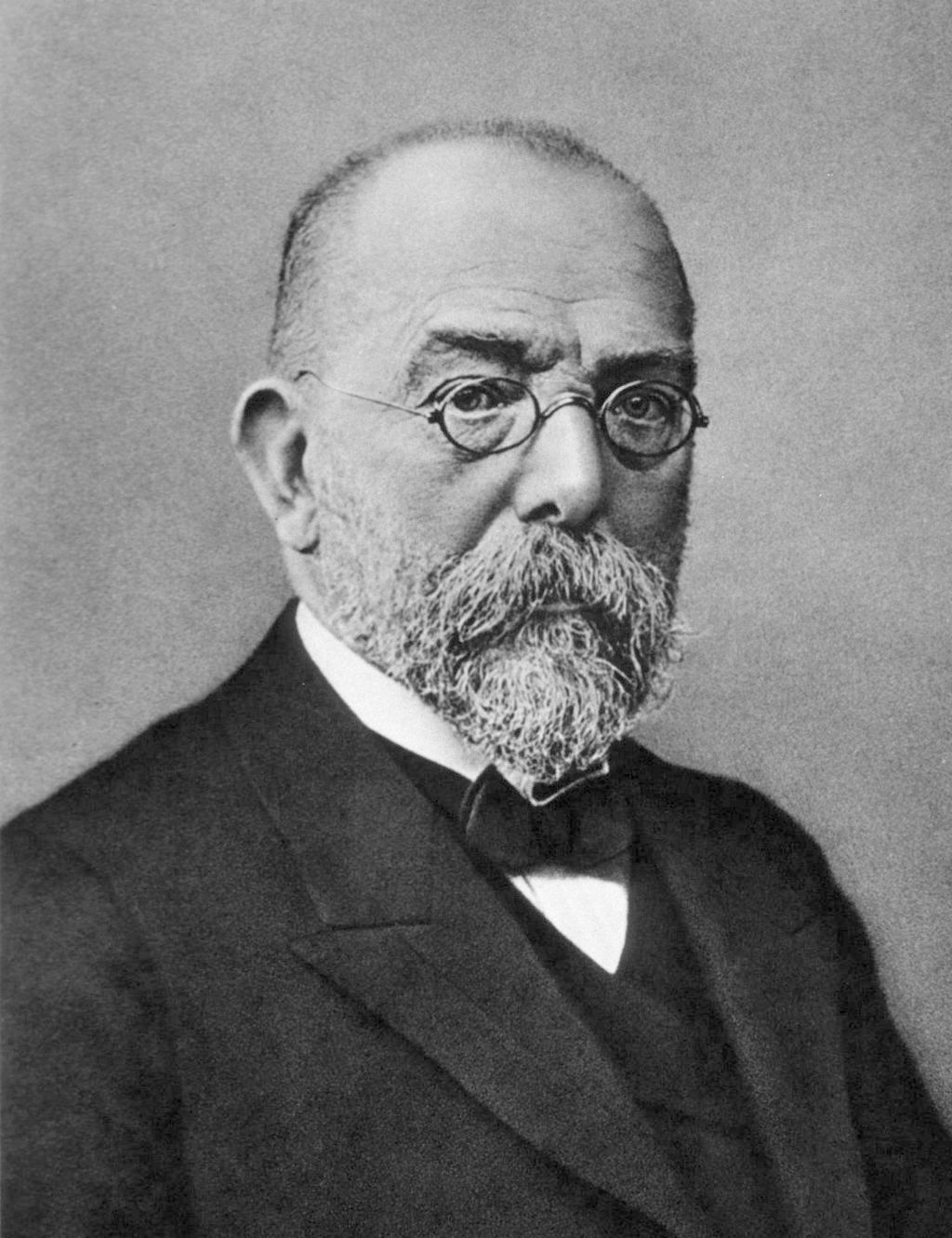
Since 1992, March 24 has been commemorated around the globe as World Tuberculosis Day. The date commemorates the discovery of the cause of a disease that has scourged the world since ancient times. On March 24, 1882, thirty years after Evelina wrote about her day in her diary, the brilliant German microbiologist Dr. Robert Koch presented to the medical community his finding that tuberculosis – also known as “consumption,” the “white plague,” and phythsis – was caused by the Mycobacterium tuberculosis. His discovery changed the world, and earned him a Nobel Prize.

In 1852, no one knew what caused consumption.  If anything, people believed that it was a hereditary disease that attacked those with weak constitutions. No one realized that it was contagious, an ignorance that lead to its spread everywhere, especially in urban areas with crowded living conditions. The disease was often, but not invariably, fatal.

Easton may have been a country town, but it was just as vulnerable to tuberculosis as any urban area. In fact, in Easton, just the day before Evelina’s diary entry, a 55 year-old housewife named Silence Macomber died of the disease. Of 47 deaths in Easton in 1852, consumption led the list; Mrs. Macomber was one of eight residents that year to die from it. All but one of the eight were women.

Tuberculosis has not been eradicated. Third World countries, especially, are still vulnerable despite great advances in prevention and treatment. In the 21st century, it’s still a disease to fear, just as Evelina and her contemporaries did.


March 21, 1852

9291031-apples-are-stored-in-the-cellar-to-keep-fresh

1852

March 21 Sunday  Have all been to meeting except

Susan who is not very well  George carried

Amelia home at noon  I had a very pleasant

visit from her of nearly two weeks.  Orinthia

called with me into Edwins after church & we

helped ourselves to apples from the cellar.  Augusta

sent us one filled with sand and cheese.

Called at Mr Whitwells at noon & at Mrs J Howard a moment

Spring had arrived; Amelia Gilmore left the Ames’s home and hospitality and headed back to her own quarters in southeastern Easton. George Oliver Witherell, 14-year old son of Sarah Ames Witherell, obligingly carried her home in a carriage during the intermission at church. Evelina, meanwhile, visited with the Whitwells and the Howards.

After church Evelina and Orinthia went to the home of Edwin and Augusta Gilmore and helped themselves to “apples from the cellar.” That the young couple still had apples from the previous fall suggests that the harvest had been good and the storage arrangements even better. We presume that Evelina and Orinthia took the apples with the permission of the Gilmores; Augusta sending over a barrel “filled with sand and cheese,” corroborates that. But why is a barrel with cheese also filled with sand? Any thoughts, readers?


March 20, 1852

faces


from The Philosophy of Laughter and Smiling , 1877

1852

March 20th Saturday  Have cut and basted a purple print

apron for Susan of a pattern that Lavinia

brought from Mary  Abby & Edwin & wife were

here to tea  Orinthia dressed in Franks clothes

and paraded around here awhile.  Send for Mrs

Witherell & Mrs S Ames to see her  We have had

a pretty lively time  Orinthia brought over

Edwin & wife.

The ladies laughed today.  After sewing for hours, breaking only for midday dinner, Evelina and her young friend Orinthia Foss laid down their needles to have tea. Orinthia got it into her head to put on nineteen-year-old Frank Morton Ames’s clothes “and paraded around.” She donned his shop pants, perhaps, and shop coat over one of his white muslin shirts. Evelina and her guests were so amused at the sight that they called in Sarah Ames and Sarah Witherell to see the fun. Cross-dressing was a novelty for these women, and Orinthia’s daring act generated hilarity.

All things considered, these women were probably due for some laughter.  It was the first day of spring, and everyone had been pretty well cooped up for months, excepting the occasional trip into town. More recently, they had suffered through a major fire. Some innocent amusement was a good release.

Evelina’s favorite author, Charles Dickens, knew all about laughter: “It is a fair, even-handed adjustment of things, that while there is infection in disease and sorrow, there is nothing in the world so irresistibly contagious as laughter and good humor.”**

While the women amused themselves at home,  the best-selling novel of the 19th century was published in book form today, in Boston.  We’ll soon find Evelina reading Uncle Tom’s Cabin.


* Clockwise: “The Giggling Laugh, excited by Boisterous Fun and Nonsense.” “The Obstreperous Laugh, instigated by Practical Jokes or Extreme Absurdities.” “The Hearty Laugh of the Gentler Sex.” “The Stentorian Laugh of the Stronger Sex.” “The Superlative Laugh, or Highest Degree of Laughter.“ From The Philosophy of Laughter and Smiling, George Vesey, 1877. Courtesy New York Historical Society, courtesy of CABINET: The Art of Laughter, Issue 17, Spring 2005

**Charles Dickens, A Christmas Carol

March 16, 1852

130705-A-DS407-001

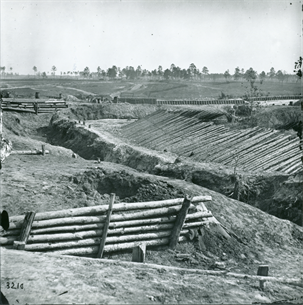
Defensive breastworks dug by Army Corps of Engineers outside of Petersburg, Virginia during the Civil War – probably using Ames shovels

March 16th

1852 Tuesday  Sewed on my waist very quietly

with Amelia this forenoon and this afternoon

have been into Edwins  Julia Pool came

there & tomorrow is going into Boston  Mrs S

Ames was there and this evening Mrs Witherell

Amelia is in fine spirits and am having

a very pleasant visit from her.

A quiet day was this, and “not verry cold.”*  Evelina and her sister-in-law, Amelia Gilmore, sat and sewed for hours and visited with Augusta Pool Gilmore, Sarah Lothrop Ames and Sarah Ames Witherell.  The reconstruction of the shovel shops continued.

Although Evelina was unlikely to have known it, today happened to be the 50th anniversary of the founding of the Army Corps of Engineers. Officially organized  by President Thomas Jefferson on this date in 1802, the Corps was headquartered at West Point, where it established and led the military academy until after the Civil War. For many years, West Point was the major engineering school in the country.

In addition to its oversight of West Point, the Corps was tasked for much of the 19th century with exploration of America’s vast lands and waterways. As the country moved westward, the Corps surveyed road and canal routes.  During the Civil War, it built bridges, railways, forts, batteries and roads – often using Ames shovels.

In 1852, in particular, the Corps was focused on waterways.  In Detroit, one group of engineers conducted and published a survey of the Great Lakes. In Utah, an engineer named Lieutenant James W. Gunnison, for whom the Gunnison River is named, explored the Salt Lake area and spent time with the Mormons. He published a report entitled, “The Mormons or Latter-Day Saints, in the Valley of The Great Salt Lake. A History of their Rise and Progress, Peculiar Doctrines, Present Condition, and Prospects, Derived from Personal Observation During a Residence Among Them.”

A year later, Gunnison and several members of his team would be massacred by Indians from the Pahvant Ute tribe.  Gunnison’s widow, Martha, always believed that the Mormons were the actual perpetrators. The Army Corps of Engineers kept right on going, continuing its work and eventually expanding its original mission to include flood control, dam construction, and environmental cleanup.


Oliver Ames, Journal, Stonehill College Archives, Arnold Tofias Collection

March 11, 1852

Build

1852

March 11 Thursday.  Cut out another waist of stout

bleached cotton cloth  Have been to Mr

Horace Pools with Mrs Witherell & Mrs

S Ames.  Met Henrietta Rachel & Mrs Harrison

Pool there, got home about eight Oclock

finished writing a letter to Harriet Ames.

Amelia went to Mr Torreys.

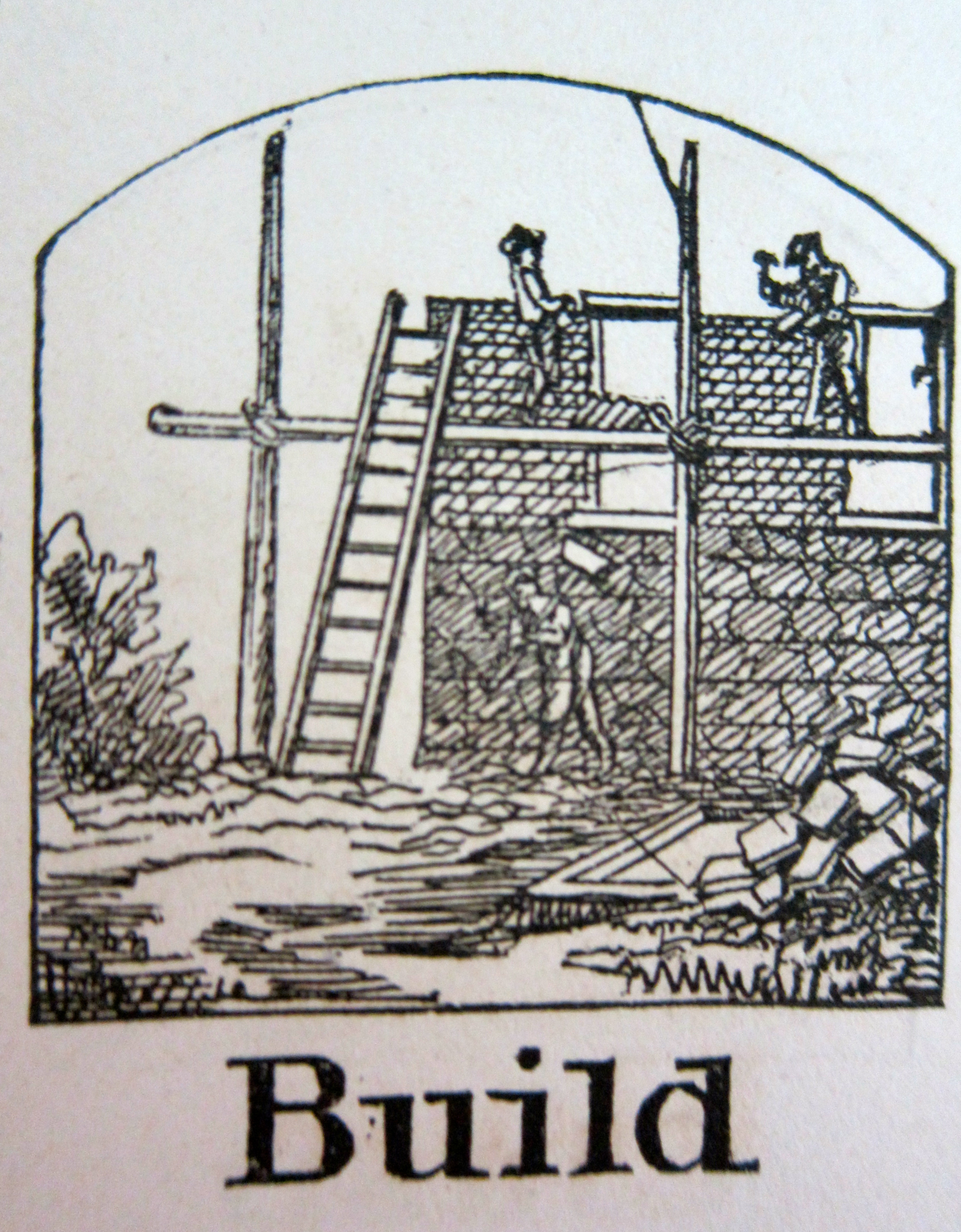
Old Oliver made his daily report:“the ground froze pritty hard last night – wind north in the morning butt southerly in the afternoon + pritty warm. it was a still day butt little wind – we began to rais the hammer shop to day.”  If ever there was an instance of Yankee industry, this cold, windy March in North Easton was it. Whatever the weather, all hands were on deck for the rebuilding of the shovel shops, which had burned to the ground less than ten days earlier.

While the men hammered, the women sewed – at least at the Ames compound. Evelina, anticipating warmer weather, worked on a new cotton dress. She had been fiddling with the waist lines on her dresses lately, suggesting that her waist might have altered. Larger or smaller?

With her sisters-in-law, Sarah Ames and Sarah Witherell, Evelina rode to the home of Horace and Abby Pool, where they met Henrietta Gilmore, Rachel Pool, and Mary Pool. This sounds like a gathering of the Sewing Circle, which we haven’t heard about since December when they temporarily disbanded. Now that spring had arrived, they might have started meeting again.

March 7, 1852

Ruin


/52

March 7th Sunday  It has been a beautiful day and we 

have all been to meeting except Frank

When we came from meeting we rode down to

the ruins. They have cleared away a great deal 

but it looks dismal enough  Mr & Mrs William

Reed spent the evening  Mrs Witherell & Mrs

S Ames came in awhile & Father Ames

No work was done today at the site of the shovel factory fire, for it was Sunday, a day of rest – a day of rest that everyone in town must have welcomed after the shock of the fire and the subsequent hard work of clearing the debris.

The Ames family rode down Centre Street to church, the weather “beautiful.” At the intermission between sermons, they must have been approached by fellow parishioners expressing concern and curiosity about the fire. In a town of 2,500 citizens, such a huge event would have been on everyone’s mind. Is it too far-fetched to imagine that Reverend Whitwell might have alluded to it from the pulpit?

After the services, the family drove by the factory site on their way home. The wintry sunlight hid nothing; the “ruins” were “dismal.” Later in the day, several family members gathered at Evelina’s and Oakes’; even Old Oliver came over from the other part of the house, which he seldom did, perhaps to greet guests William and Abigail Reed or to discuss the plans for rebuilding, to begin the next day.

February 28, 1852

image059

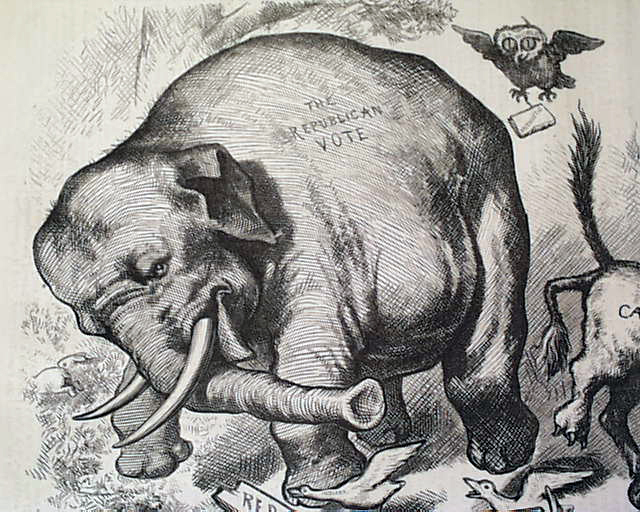
Thomas Nast’s first rendition of the Republican party’s symbol, early 1870s

1852

Feb 28th Saturday  It has been a stormy uncomfortable 

day  Mother is quite unwell & rather homesick

Mrs Witherell spent two hours here this

forenoon  I have finished the flannel

skirt that I commenced Jan 30th and put

a cape top to an old one  Mr Ames has

been to Boston as usual says the slab will be here Monday

Evelina stayed indoors today, sewing, of course, but also tending to her elderly mother, who seemed fretful and “unwell.” The whole town was subjected to what modern weather forecasters would call ” a wintry mix.”  According to Old Oliver, the day began “a snowing this morning wind south east but the snow is dry – it snowd + haild untill about 4 O clock + than began to rain + raind pritty fast untill some time in the night when it cleard of[f] with the wind north west and + cold and the wind blew verry hard”*

In another section of the country also known for its harsh winters, this date in history (plus two years) marks the genesis of our country’s Republican party. According to political historian Robert Remini, “[o]n February 28, 1854, a number of Free-Soilers, northern Whigs and antislavery Democrats met in Ripon, Wisconsin, and recommended the formation of a new party to be called “Republican.”**  Several months later, on July 6, after Congress passed the controversial Kansas-Nebraska act, the nascent group met again in Jackson, Michigan, where they “formally adopted the new name and demanded the repeal of the Kansas-Nebraska and Fugitive Slave Acts and the abolition of slavery in the District of Columbia.”

It wouldn’t take long for the Ames men, former Whigs, to join the new political party.

*Oliver Ames, Journal, Stonehill College Archives, Arnold Tofias Collection

Robert Remini, The House: The History of the House of Representatives, 2006, p. 150  

(NB: A source cited in Wikipedia in February, 2015, says that the date for this meeting in Ripon was March 20)

February 27, 1852

Tea kettle


Feb 27

1852  Friday  this morning I invited Mrs Lothrop here

but she went to Mrs Jason Howards to spend the day

came here this evening  Mrs S Ames & Fred dined

here  Mrs & Mr Horace Pool  Mrs W Williams  Abby

Edwin & wife Oliver & wife & Fred & Mrs Witherell

were here to tea  All came unexpectedly.  Had 

a very pleasant visit from them.

Many folks came to call today.  Sarah Ames Lothrop and her son, Frederick Lothrop Ames, joined the Ameses for midday dinner. (Although Oliver (3) had returned to Brown, Fred hadn’t yet gone back to Harvard.) A real crowd arrived “unexpectedly” for tea.  Sarah and Fred returned, bringing Oliver Ames Jr. with them. Sarah Ames Witherell came in from the other part of the house, resulting in all three sisters-in-law being together. Newlyweds Edwin and Augusta Gilmore walked over from their nearby home, and old Mrs. Gilmore – Evelina’s mother – was already on the premises. The family gathered.

From farther away came Horace and Abby Avery Pool, uncle and aunt to the bride, Augusta.  A Mrs. W. Williams arrived, as did Abby Torrey, Evelina’s niece. Abby’s head must have been full of the previous evening’s entertainment, that of Willard Lothrop’s visit and trance. It’s likely that some of this evening’s conversation turned on spiritualism.  One wonders what Oakes and Oliver Jr. thought of the topic.

Perhaps Evelina served some ginger snaps or currant cake from Tuesday’s baking. The tea itself could have been one of any number of types. Lydia Maria Child published her opinion on the subject: “Young Hyson is supposed to be a more profitable tea than Hysons; but though the quantity to a pound is greater, it has not so much strength. In point of economy, therefore, there is not much difference between them. Hyson tea and Souchong mixed together, half and half, is a pleasant beverage, and is more healthy than green tea alone.  Be sure that water boils before it is poured upon tea  A tea-spoonful to each person, and one extra thrown in, is a good rule.  Steep ten or fifteen minutes.”*

*Lydia Maria Child, The American Frugal Housewife, 1846


February 17, 1852

imgres

Example of mid-19th century headdress*

1852

Tuesday Feb 17th  This forenoon made me a headdress of Satin

ribbon of the colour of my hair and lace  Alsons

wife came to Augustus this forenoon and to Edwins this

afternoon  Called here awhile after dinner

Mrs Witherell S Ames & self spent the afternoon & evening

at Mr John Howards with Mr & Mrs Whitwell

Mr & Mrs Reed & Mrs Elizabeth Lothrop  Frederick

carried us down & [came] after us this evening

Bonnets may have been the most common covering for the heads of well-dressed mid-century females, but head gear of other persuasions was not to be ignored.  A fore-runner of today’s fascinators, light, decorative headdresses such as the one in the illustration above were very popular for certain indoor or evening outfits. Evelina must have enjoyed sewing one for herself, taking extra pleasure in how well it matched her own coloring.

Evelina’s father-in-law, Old Oliver, noted that this “was a fair day wind north west + cold.” The wind would have been somewhat behind them when the three sisters-in-law, Sarah Ames Witherell, Sarah Lothrop Ames, and Evelina were driven south in the afternoon by Fred Ames. The women visited a group of friends at the home of fellow Unitarians John and Caroline Howard.  The tea they must have been served there perhaps helped stoke them up for the cold drive back home into the wind.


*Courtesy of Library of Congress