March 19, 1851

Slaves

1851

March 19 Wednesday  This morning commenced another

shirt that was cut out last fall & the

sleeves finished & the body nearly ready for the

bosom. Made the bosom & collar and finished

it all off this evening. Mr Ames went to

Boston this morning The snow is not deep but

much banked Augustus here to breakfast & dinner

Orinthia finished the shirt that she worked on yesterday

The last days of winter in Easton appeared calm, with the final snowfall (they hoped) on the ground, nephew Augustus still pulling up a chair to the Ames dinner table, and Evelina and Orinthia sitting near the windows, sewing more men’s shirts. But all wasn’t well in the nation. Since the passage of the Fugitive Slave Act the previous fall, discord over the issue of slavery had increased.  In Boston, where Oakes Ames went today, passions ran high among abolitionists.

What did Oakes and Evelina think of the debate? The Ames men admired Daniel Webster, but the famous Whig senator had helped engineer the political compromise that led to the slave act and been roundly denounced for what many in Massachusetts saw as a sell-out. In the interest of preserving national unity, Webster urged his constituents to obey the federal law. If the story that historian William Chaffin tells is true, Oakes Ames disobeyed it. Writes Chaffin:

“Rev L. B. Bates was once here as Methodist minister.  He says that one night not long after the passage of the infamous Fugitive Slave Law a poor slave called him up at midnight for food and help. Rev. Bates fed him and then took him to Oakes Ames who gave him money and sent him on his way rejoicing.”

Lewis Bates was certainly a respected minister in North Easton, but he wasn’t appointed until 1859, so the timing in his recollection of Oakes Ames assisting a runaway slave close on the heels of the passage of the Fugitive Slave Act doesn’t jibe. Either Bates got it wrong in the telling or, because he was writing the story many decades later, Chaffin got it wrong in the remembering. The whole tale may be apocryphal, but two ministers believed it to be true. Helping a slave would have been in keeping with Oakes’s generous spirit.

March 10, 1851

images-2

/51

March 10  Monday  This is town meeting day.  Mr Ames & O Angier went

They spent the whole day there but accomplished very little

Mr Pratt & Brown chosen School committee O Angier was

nominated for one & lacked by one vote of being chosen

They brought home the school report of the last year

which is not very favourable for the schools in town generaly

Miss Foss & Clarks school are spoken very well of.

It commenced snowing about ten Oclock & is quite stormy this evening

Town Meeting was – still is – a great New England tradition. In the 19th century (and well into the 20th) the meetings were often scheduled in March, making them an annual marker of winter’s impending departure.

People turned out for town meeting.  Rather, men turned out for town meeting.  Women, who before 1780 in Massachusetts had enjoyed suffrage, no longer could vote.  National suffrage for women, a cause that would create deep divisions among the Ames women of a later day, would not be achieved until 1920.

Oakes Ames and his eldest son, Oakes Angier Ames, attended meeting and stayed all day. Oakes Angier evidently ran for school board but just missed being elected. He was showing a taste for politics, something that his father felt as well. His mother, perhaps influenced by her son’s loss, harrumphed that “very little” was accomplished at this year’s meeting, although she seemed pleased that their boarder, Orinthia Foss, was mentioned as being a good teacher.

Today’s town meeting was moderated by one of Easton’s greybeards, Capt. Tisdale Harlow. A resident of the Poquanticut section of town, Harlow was a former selectman, town treasurer, school board member, veteran of the War of 1812, and captain of the Easton Light Infantry in 1833-34. He had crossed swords with the Ames family in the 1830’s in a town row about the introduction of Unitarianism into the Congregational church. Harlow and many others were against it; Old Oliver, his sons and others were for it.  The sectarian controversy wore on for about eight years and ultimately led to a permanent split in the congregation. Historian William Chaffin suggested that “[i]ts unhappy effects were felt for many years.”  Were there remnants of hard feelings on display at today’s town meeting?

March 2, 1851

Church

March 2nd  Sunday.  Have been to meeting all day.  Mr Whitwell read

notes for Mr Guilds family  His text in the morning was

I would not live alway  It was an excellent sermon.

In the afternoon his sermon was for the male part

of the congregation.  The good man of the house.

An excellent sermon for my dirty boys if they

would only profit by it.  This evening commenced

reading Woman’s Friendship.  Rather pleasant but cold

Evelina went back to church today for the first time in three weeks.  She had been absent since February 10, the week that she hosted a Unitarian Sewing Circle meeting to which no one came.  To her diary she cited a bad cough as reason for her absence.   On this Sunday, she had finally recovered from that cold.  She had also, evidently, regained her dignity.  Back to church she went and sat right down in the family pew.

Her attention was focused on Reverend Whitwell and his thoughtful words.  She wouldn’t live “alway,” and in the meanwhile she had to work on her sons to become better people.  What did she think of her sons to describe them as “dirty boys?” What did Mr. Whitwell mean, “the good man of the house?”  Did her own good man of the house, Oakes, pay attention to this sermon?

Oakes Ames was actually known for sleeping in church, according to town historian, Reverend William Chaffin.  Chaffin charitably suggested that “Mr. Ames was so hardened with business affairs that he invariably went to sleep in church during the sermon.”  Chaffin also remembered that Oakes Ames stayed awake during his own maiden sermon in North Easton.  Used to seeing Oakes with his eyes closed, someone in the congregation that day chided him about it, to which Oakes replied with typical bonhomie, “Well, I knew Mr. Chaffin was here as a candidate for settlement, and I had to keep awake the first Sunday to see if his preaching was safe enough to sleep under.”


January 25, 1851

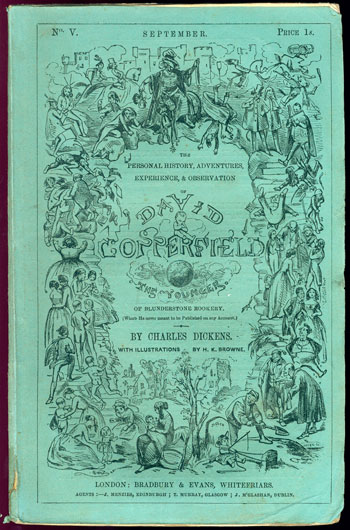
Charles Dickens, David Copperfield

1851

Jan 25 Saturday.  Have been sweeping and dusting the house and 

have done a little of everything and not much of anything.  Have got

the chambers in pretty good order for once in my life.  Have

mended Mr Ames coat & vest.  Took the time when he was 

from home because he has but one suit beside his go to meeting

poor man!  Called at Mr Torreys just at night.  This eve

have been mending & have had no time to read.  Commenced

reading David Copperfield.  Mr Ames at Boston.  Very warm & fine

Evelina could be critical of others, but she was most critical of herself.  Her self-deprecation often took a humorous tone, as in having done “a little of everything and not much of anything.”  She really tried to get things organized at home today, tackling perhaps one of her biggest challenges: keeping her husband Oakes in decent clothes.

Family lore would have it that Evelina was miserly, lore that is reinforced by Reverend William Chaffin.  Chaffin blamed Evelina for Oakes’ shabby “pantaloons,” believing that Evelina  “being economical kept them well mended instead of encouraging him to buy new ones.”  Yet Chaffin also acknowledged Oakes’s indifference to outfit, telling us that while on a trip into Boston with a friend, Reuben Meader, Oakes responded to Meader’s suggestion that he should wear better clothes by saying: “Oh, I can wear poor clothes if I want to, but some men can’t.”

Oakes spent money on gifts; he was well-known and well-liked for his charitable instincts.  However, unlike his brother, Oliver Jr., who shopped for bespoke outfits in Boston, Oakes didn’t spend a dime on his apparel; he simply didn’t care, so  Chaffin was unjustified to blame Oakes’s appearance on Evelina.  She tried to keep him mended, and we know that she was willing to spend money on clothes; certainly she kept the dressmakers in Easton occupied.  But she must have met resistance if and when she tried to improve her husband’s wardrobe.

Today’s hard work had a reward: opening the pages of David Copperfield, the newest book by Charles Dickens.

January 20, 1851

olive-branch

Jan 20th Monday  This morning worked about the house as usual

on washing days & varnished Susans wooden doll.

Jane put her clothes out but soon had to take them

in again as it commenced raining.  This afternoon

I have been mending Oakes Angiers black pants

and finished cutting Susans plaid sack

This evening have been working on Susan’s plaid

apron and reading Mr Lovell’s paper

Keeping clothes clean is always a challenge, but it was especially so in the 19th century when doing laundry was an all-day, manual chore.  Small wonder, then, that little girls wore “sacks” or aprons over their dresses to keep their outfits from getting soiled.  Sacks had no buttons, so were easier to wash than dresses. They were rather shapeless, sleeveless tunics, often made from simple muslin; aprons were the same idea except fitted with a sash. There were no hard and fast rules about the design or material, however.  To imagine the approximate outline of what Evelina was making for Susie, think of the little girls in John Singer Sargent’s famous 1882 portrait, “The Daughters of Edward Darley Boit,” at the MFA.  Three of the four daughters are wearing something over their dresses. Later in the century, sacks and aprons  would evolve into pinafores, an iteration that became as much decorative as protective.  Aprons never went away, however.

After sewing for most of the day, Evelina took up “Mr. Lovell’s paper” to read. Reverend Stephen Lovell lived in Easton and was, for a few years, minister of the short-lived Protestant Methodist church.  Although Rev. Lovell “gave general satisfaction,” attendance at his church was “feeble,” according to town historian William Chaffin, so the congregation disbanded about this time.  Still, Lovell remained visible in town through his involvement with Olive Branch.

Olive Branch was a popular weekly newspaper published in Boston by Reverend Thomas F. Norris .  Although Chaffin writes that Lovell was editor of this paper, all other sources assign that honor to Norris.  Olive Branch proclaimed itself to be “Devoted to Christianity, Mutual Rights, Polite Literature, Liberal Intelligence, Agriculture, and the Arts.” *  It advocated peace in the increasingly divisive period leading up to the Civil War.  Norris, Lovell and others who worked for the paper – women among them – must have been disheartened by the elusiveness of their goal.  The paper ran from January 1837 through December 1860.

* Joanna River, “Eliza Ann Woodruff Hopkins and The Olive Branch,” josfamilyhistory.com

January 7, 1851

 Sleighing

/51 Tuesday Jan 7th Jane better and finished her washing and I did the

housework this morning.  Mr Ames went to Boston to get

some grindstones  This afternoon wrote a letter to O

Foss & cut Susan a gingham apron  Mr Whitwell called.

Robinson primed the mantelpieces ready for painting

Ann commenced making fire in the Furnace  Daniel

Wheaton & wife passed the evening at Olivers and we

played cards.  Pleasant & beautiful sleighing

After the cold weather of the previous few days, this Tuesday was mild enough for people to be out and about, enjoying the relative ease of gliding along in their sleighs.  Not so for Oakes Ames; he went into the city in search of grindstones for the shovel shop, most likely taking an ox-drawn wagon to bear the heavy load home.

The Reverend Mr. William Whitwell paid a call at the house.  He and his wife Eliza were relatively new to the community and were becoming good friends with Oakes and Evelina.  Mr. Whitwell would serve as acting  pastor for Easton’s Unitarian congregation for the next seven years.  His eventual successor, the Reverend William Chaffin, described Whitwell as “a good man and a cultivated scholar” whose term was “quiet and uneventful.”*  In fact, Whitwell’s writing on St. Paul can be found in a famous Unitarian publication of the day, The Christian Examiner.

Other little moments in this ordinary day included a new sewing project and the repainting of mantels by Mr.  Robinson, a local painter and paperer.  Meanwhile, Ann Orel, a teenage Irish maid who worked for Sarah Witherell, started up the new coal furnace.  Perhaps the arrival of coal dust necessitated the painting of the mantels?

This evening, Evelina and Oakes walked next door to play cards with Sarah and Oliver Ames Jr. and their mutual acquaintances, Daniel and Hannah Wheaton.  Unitarians had no problem with card playing.

* Chaffin, History of Easton, Massachusetts, 1886, p. 362