May 13, 1851

dried-apples

*

Tues May 13  Mrs Witherell heat her oven and I baked

a loaf of brown bread & some cake & tarts with

her  Orinthia made some sifted dried apple pies

Mr Robinson here to paper the dark bedroom

chamber. Mr Pratt called this morning for Orinthia

to go to meet him & Brown for an examination

We went to Mr Pratts this afternoon and

called at Mr Whitwells


Mr. Robinson, all-purpose painter-and-paperer, was back at Evelina and Oakes’s house today to paper one of the bedrooms. It may be the one that Frank Morton Ames had to move out of some days ago while it was being refurbished.

Orinthia Foss, meanwhile, underwent some kind of scholastic examination.  Evidently, she was being considered to teach at the town’s public school system for which she had to undergo at least an interview.  Her interviewer was Amos Pratt, a former school teacher himself, and member of the Easton school superintending committee (the one on which Oakes Angier had hoped to serve, but had missed by one vote.)  Her other interviewer was Erastus Brown, a butcher by trade who also served on the school committee and taught. Not unlike today, some folks from 160 years ago had to pursue more than one trade to make ends meet. Pratt, who lived in the Furnace Village area of Easton, some miles south and west of North Easton, eventually gave up his teaching career to run a mill.

Before being escorted by Mr. Pratt to her interview, Orinthia helped Evelina and Sarah Witherell with baking.  Evelina made brown bread, cake and tarts; Orinthia made an unseasonal apple pie from dried apples. The apples were remnants of last fall’s harvest, and ordinarily Orinthia would have had to plump them up with hot water or cider or some other liquid in order to form the pie.  How the apples would have been “sifted” is a puzzle; did this mean that the apples were in powder form?  All you cooks out there: what is a sifted dried apple pie?

*jeremy.zawodny.com
 

May 12, 1851

ServiceBerry1

Monday May 12th  Was about house all the forenoon but

cannot tell what doing  Jane has done the washing.

Orinthia washed the dishes for her. This afternoon

Orinthia and I have been out to plant the flower seeds

and I got some Shad berry & Burgundy Rose bushes

from Olivers & flowering Almonds from Alsons We 

were at work in the garden three or four hours

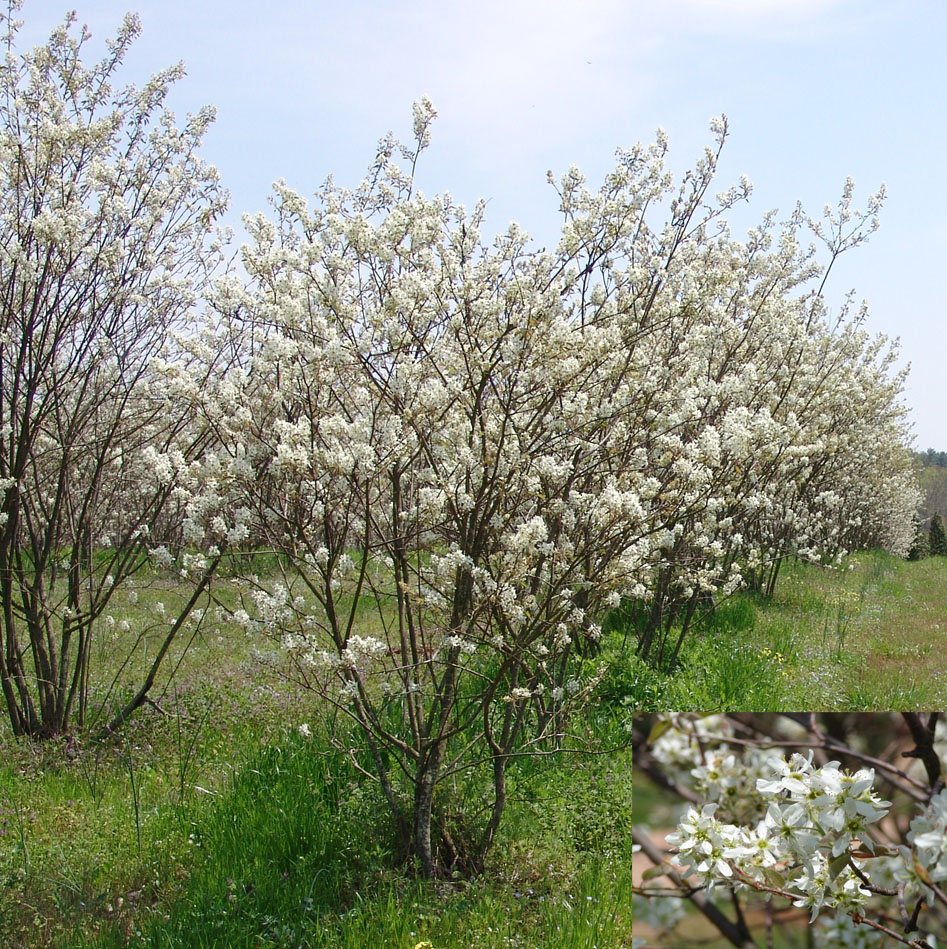
A sure sign of spring in New England is the blooming of the shadbush.  Because its little white flowers are among the earliest to be seen, its blossoms were often used at springtime funerals in the seventeenth, eighteenth and nineteenth centuries. Thus shadbush is also called the “serviceberry” bush for its appearance at funeral services; in some other locations it’s known as the “Juneberry” bush.  Wherever and whenever it grew, its presentation of blossoms was as welcome as the first robin.  The red berries it produced could be used in pies or, if not harvested, would be consumed by those same robins and other birds like cedar waxwings.

The shadberry bushes at Evelina’s were most likely planted out back behind the house near the Queset Brook, where they would tolerate the partial shade and indifferent soil.  However, the Burgundy Rose bushes that Evelina also obtained from her obliging brother-in-law, Oliver Jr., would have required a more selective location in the sun.  Were those roses planted right in Evelina’s flower beds?  Were they as red as their name sounds?

Her brother, Alson Gilmore, provided Evelina with flowering Almond bushes (Latin name is Prunus triloba.)  In contrast to the white serviceberry and the red roses, the flowering almonds produced pink blossoms.  Evelina was evidently aiming for a rosy spectrum in her yard. The flowering almonds like sun, so where might she have planted them?

The work of planting the various bushes took Evelina and Orinthia several hours to complete, and must have given them a real sense of accomplishment – not to mention sore backs.

May 11, 1851

photo

*

Sun May 11th  Have been to church this afternoon. Did

not feel like going in the morning It rained

this forenoon but cleared off quite pleasant

after dinner and after church Oakes A, Orinthia

and I called at Mothers, carried her a poplin

dress that I purchased in Boston.

Have not read any to day. Oakes Lavinia & Orinthia

called on Ann Pool

One item that Evelina brought back from Boston was a poplin dress – ready-made, presumably, or perhaps made to order – that she bought for her mother. It had to have been an item that her mother, an elderly country woman, would never have purchased for herself. Hannah Lothrop Gilmore had spent a lifetime sewing her own garments.  She was also unlikely to board a wagon or carriage to go into Boston to shop. The ride from the farmhouse to church on Sundays was about as adventurous as she got. How kind of Evelina to treat her mother in this extravagant way.

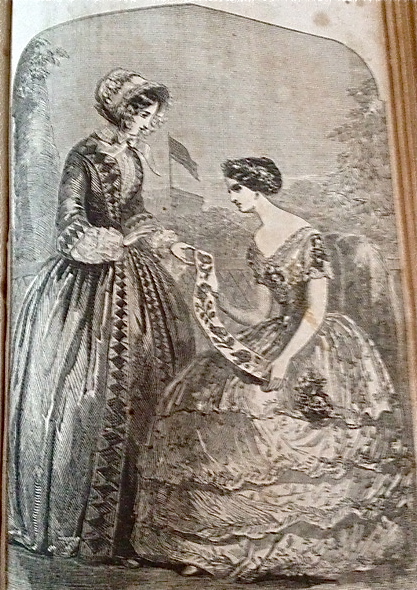
Poplin was a popular cotton fabric in the nineteenth century. It was smooth, lightweight and finely woven, more refined than broadcloth, although they were not dissimilar in weave. Both were sturdy and today both are often used for men’s shirts. The dress on the left in the illustration above was a day-dress and probably similar in shape and weight to the poplin dress Evelina bought, perhaps with less trim. The undersleeves were a particular feature of women’s dresses right before the Civil War.

The dress on the right was not something that Evelina would have purchased for her mother, or even for herself at this stage in her life. It was an evening dress with a stylish flounced skirt that would have been entirely too “jeune fille” for old Mrs. Gilmore.

* Spring fashions from Godey’s Lady’s Book, 1851


May 6, 1851

sweet-peas

*

May 6th Tuesday  Orinthia & I went into the flower garden

and worked some time on the beds but the

ground was very wet as it rained last night.

Robinson has painted the bedroom up stairs

over the first time. This afternoon we planted

some sweet peas and have got the beds ready for

the seeds Had Mr Swain to dine with us

Orinthia finished her school Saturday […]


Mr. Robinson was back doing work for Evelina.  He was the handyman who, earlier in the year, had spilled varnish on the parlor carpet and taken too long to paint the mantels. Either he was an affable favorite of the family or his price was right, or both, for he was back at the Ames’s, this time painting an upstairs bedroom.  Jane McHanna must have been at work, too, keeping busy with meals and chores while she waited for the sun to dry yesterday’s wash. John Swain, the new clerk at O. Ames & Sons, came for dinner.

Despite the wet ground, Evelina and Orinthia, the young teacher who had become her friend, planted sweet peas and worked the ground for seeds yet to come. Sweet peas were a popular flower in the 19th century; John Keats praised them in a stanza of his 1817 poem “I stood tip-toe upon a little hill:”

Here are sweet-peas, on tip-toe for a flight:

With wings of gentle flush o’er delicate white,

And taper fingers catching at all things,

To bind them all about with tiny rings.

The flowers were fragrant, delicate-looking but hardy, and slow to germinate.  Evelina and Orinthia probably placed them in a sunny spot in the beds. Did they need a trellis? Did the ladies wear gloves as they worked, or did they just dig into the dirt? Evelina, at least, probably wore some kind of protection, as she wasn’t at all fond of chaffing her hands.


*sweetpeas, landlund.com

May 1, 1851

Basket


1851

May 1st Thursday  Have cleaned the shed chamber to

day and a long dirty job it is  there is so much in it.

I got through just in time to go to Mr Torreys

after some plants when Orinthia came out of

school.  She went with me and we brought home

three baskets full and have set them out in

the garden This morning it was quite unpleasant

and Susan was disappointed in her walk

May Day! In our modern world, the first day of May means many things to many people, among them International Workers’s Day, the Roman Catholic Celebration of the Blessed Virgin Mary Day, even a day for the 21st century Occupy Movement. May Day has ancient iterations, too, most of them having to do with pagan rites of spring.

In 1851, the first of May meant “maying.” Young people like nine-year old Susie Ames filled small baskets with flowers, ribbons, or other little treats and left them, anonymously, on doorsteps around the town. The game was to leave a basket, ring the doorbell, and run away.  If the recipient caught you, he or she was allowed to chase you for a kiss; at least, that was one version. Another version was to leave the basket as a surprise at the home of an elderly person. On this particular May Day, the weather was too disagreeable for the traditional maying walk, so Susie and her friends were unable to deliver their baskets.

Evelina dealt with baskets, too. She and Orinthia Foss filled three of them with plants from John Torrey and put them in her garden. It was her reward for having spent most of the day cleaning out the “shed chamber.”  Spring cleaning was still underway.

April 26, 1851

Spade

Sat Apr 26th  This morning a man came from the shops 

to spade my flower garden & hoe the currant

bushes Miss Foss Susan & self rode to Edwin Manlys

to speak for some plants and then went to Mothers

got there about half past twelve. Brought

home some Horseradish, Carraway roots & some

few plants Made the skirt to Susans green 

borage Delaine Miss Foss has finished the two shirts.

At last, gardening in earnest. A shovel shop employee was taken off his usual task to go up to the Ames homestead to turn over the soil in Evelina’s flower beds.  He used an Ames shovel, no doubt, and also an Ames hoe to loosen the dirt around the currant bushes behind the house.

Evelina celebrated the spring day with her daughter Susie and boarder Orinthia Foss; the three took a wagon, most likely, north to the home of Edwin Manly.  At the time, Manly lived close to the town line with Stoughton, and was employed at the shovel shop. He was obviously interested in plants and kept an informal nursery on his farm, raising flowers to sell.  His green thumb brought in customers like Evelina. Not too long after this, however, he hurt his hand and had to leave his job at O. Ames & Sons. Fascinated by biology, chemistry and science in general, he studied medicine at Harvard, became a physician and set up an office in North Easton in the early 1860s. Later he moved to Taunton, where he worked as the town librarian for a number of years. Eventually, he moved to California.

Flowers weren’t all that the women brought home in the wagon.  They drove south to the other end of Easton to visit Evelina’s mother, Hannah Gilmore, at the Gilmore farm, where they picked up the horseradish and caraway roots and “some few plants.”   That Evelina and Orinthia had time to sew after all that riding around says a lot about their stamina and work ethic.

April 25, 1851

Coat

1851

Friday April 25  Have done some mending and been putting

things in order about the house Made Mrs

S Ames bed and stoped with her awhile

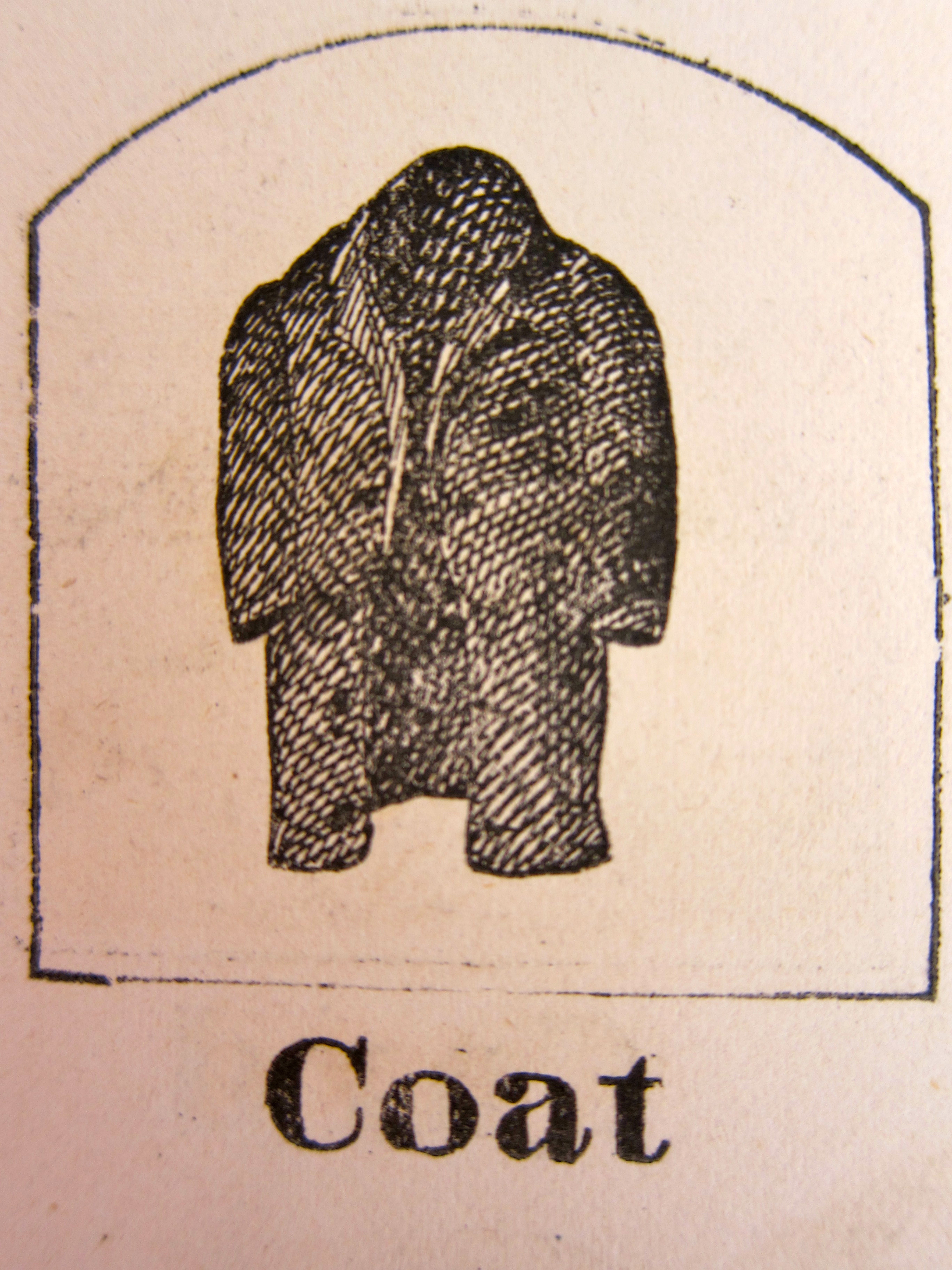
This afternoon mended Oakes Angier two coats.

dirty things they were! Met Mis[s] Foss coming from

school and called with her at Mrs Holmes & Mrs 

Connors spent the evening with Mrs S Ames

Mr Harrison Pool & wife & Mrs Horace Pool called

Sarah Lothrop Ames was still sick and unable to get up and around. Once again, Evelina went next door to visit and helped out by making Sarah’s bed up fresh.  Later in the day, Sarah had a companion, Mrs. Connors, sit with her. Was she being “watched” or was she on the mend? Who made the decision to have someone sit with her?  Her husband or her female relatives?

Mending and housework otherwise took up Evelina’s time today. She and Jane McHanna were still carrying on with spring cleaning, but the effort was sporadic lately, with mending taking over much of Evelina’s time. In the transition from cold to warm weather, all the spring and summer wardrobes had to be brought up to snuff, “dirty things” that some of them were.

The Pools came to call this evening.  Harrison and Horace Pool were brothers, fifteen years apart in age, who lived in the south eastern section of Easton, near the Raynham line and the Gilmore farm.  They made mathematical instruments: surveyors’ tools, levels, compasses and thermometers, among other items. Harrison’s wife was Mary J Pool, a young wife close in age to Oakes Angier.  Horace’s wife was Abby A. Pool, identical in age (43) to Evelina.  Mary and Abby were members of Evelina’s Sewing Circle, two of the women who didn’t attend the meeting that Evelina held back in February. Evelina would have grown up knowing the Pool (also sometimes spelled Poole) family.

April 14, 1851

Coffin

1851

April 14 Monday  Julia Mahoney has been here to day

to work on my foulard silk It is bad to 

work on and she has not succeeded very well

but is coming again to finish it. Jane has

done the washing and her clothes dry

Orinthia has finished the shirt for Oliver that

was cut out March 31st Weather Pleasant

Mrs Witherell Mrs G Ames & Mrs S Ames called evening

In his journal today, Old Oliver noted that his son, Horatio Ames, was visiting. Although Horatio would have been, literally, under the same roof as Evelina and Oakes, Evelina didn’t mention his visit. She might not have seen him, of course, although she must have known he was in town and probably staying in the other part of the house.  Horatio, like their brother William, was on poor terms with Oakes and it appears that neither wanted to encounter the other.

Another heartfelt topic that found no tongue today was the anniversary of the birth of Henry Gilmore Ames, the son of Evelina and Oakes who did not survive childhood.  Henry would have been twelve years old today, but died at age two-and-a-half of an unrecorded cause.

In the future – 1876 in fact – family graves would be disinterred from their original locations and moved to a dedicated family cemetery behind the new Unitarian church on Main Street. Oakes Angier would oversee the relocation; among the graves moved would be the small one for Henry.  At the time, Oliver (3) made a few observations about the relocation, including one of the little brother they had lost: “Bro Henry was moved to day and his hair was as perfect as when he was buried. His hair was smooth and parted.”  Oliver (3) also noted that his father’s coffin was so heavy that it took seven men to lift it from its original resting place.

If Evelina remembered today’s date, she indicated nothing.  She was busy with overseeing laundry day (not that Jane McHanna needed any direction on what needed to be done,) as well as Orinthia Foss’s completion of one last men’s shirt, and Julia Mahoney’s sewing on her silk dress.  Many needles at work.


April 10, 1851


photo

1851

April 10th Thursday  This day is Fast but no one would

think it by the way I have spent it.  I have

moved the bed from the dark bedroom and 

put it in Franks chamber and moved his

cot into Oakes & Olivers chamber for a few

weeks Oakes A Lavinia Orinthia & Susan went

over to the Methodist meeting house to a sing & called

on Ellen H took her with them.  Weather Pleasant

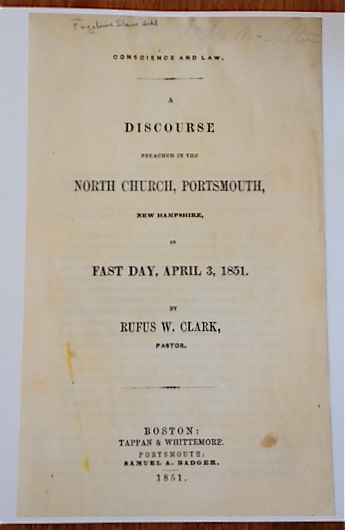
For nearly 275 years, Fast Day was a published holiday in Massachusetts and other New England states (like New Hampshire, above, which celebrated Fast Day on April 3.)   A religious practice brought over from England by the Puritans, the original Fast Days were pious rites of repentance and supplication marked by abstinence and day-long prayer in church, “a day set apart that all might join in the prayer to the Almighty for strength and wisdom”.*  Any calamity, misfortune, drought or disease, regardless of season, might prompt a church leader to call for fasting.

Dating from about 1622, the earliest Fast Days were under the purview of the local clergy, but the practice eventually became widespread enough to become the domain of the state governments.  And where once they were observed on an ad hoc basis as the need for divine intervention arose, Fast Days gradually became a single, annual holiday, usually observed in early April right before spring planting. Over the years, it became a more secular observance and by the latter part of the 19th century, “Not much fasting is done and less praying.”*  In 1894, the governor of Masschusetts abolished the practice of Fast Day and substituted a new holiday, “Patriots’ Day,” in honor of the 1775 Battles of Lexington and Concord and the anniversary of the first bloodshed of the Civil War at a skirmish in which four Massachusetts militiamen died.

Evelina’s entry in her diary proves that Fast Day was anything but a day of prayer and supplication at the Ames’s. Instead, this temperate day in early April marked the start of spring cleaning. Evelina and Jane and perhaps others began upstairs, moving furniture around in order to clean and refurbish two or three of the bedrooms. Much would be disrupted before they were through.

The temporary upshot was that Frank Morton Ames moved into the bedroom shared by his two older brothers. This rearrangement of their sleeping quarters brought the three brothers together in dormitory fashion, yet each maintained his own personal agenda. Tonight, Oakes Angier headed out to a sing at the Methodist meeting house right in the village, taking along a small coterie of females: Cousin Lavinia, sister Susie, the boarding teacher, Orinthia and their mutual friend, Ellen Howard.  Spring was in full swing.


*New York Times, April 20, 1896


March 31, 1851

Shears

1851

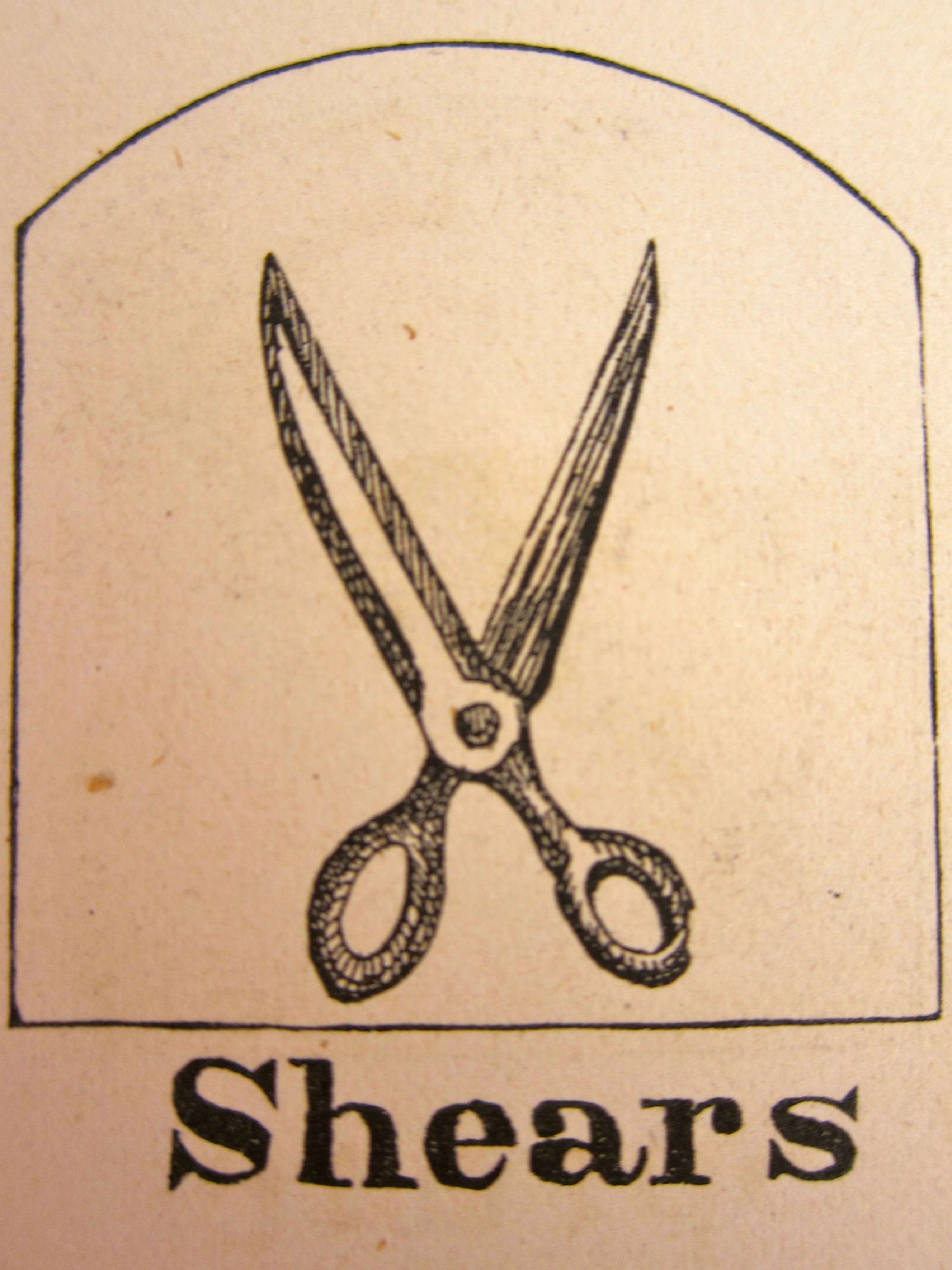
March 31st Monday  This morning after doing my chores about

house, cut out a shirt of rather coarse unbleached

cloth for Mr Ames, am going to put a linen

bosom into it.  Also cut a coarse shirt for 

Oliver, have been mending some, but have not

sewed any on the shirts.  Called this afternoon

on Mr Holmes & at Bridgets to see the dress

maker, Worked awhile on my scrap book.  Orinthia

& I spent the evening at Olivers, Jane at G. Bartletts P.M.

After her morning chores on this last day of March, Evelina cut out more shirt parts. Any reader who has been following this blog on a daily basis has seen Evelina’s prodigious production of shirts for her husband and three sons. This particular project is soon to end. After one or two more mentions, Evelina will leave behind the cuffs, bosoms, and coarse and fine cloth of men’s shirtmaking and move into dressmaking for herself and her daughter, Susan.  And when fair weather truly arrives, she will head for her flower garden.  She will never completely stop sewing – there was always mending to be done – but she will relax her grip on needle and thread.

Today being Monday, Jane McHanna was busy with the weekly laundry, washing the family linens and clothes and hanging them out to dry.  In the evening – after preparing tea for the family, no doubt – Jane left to go to a Mr. Bartlett’s.  The call was probably a social one, but we don’t know whom she visited.  Because so many of the servants in the village had recently immigrated from Ireland, they tended to know one another and often visited each other when they had time off.  Meanwhile, Evelina and the young boarder, Orinthia Foss, headed next door to visit Sarah Lothrop Ames.  It was a sociable evening for all the women in the Ames household.