April 9, 1852

images-1

April 9th Friday  Have made the skirt of my Delaine

dress and Orinthia has been sewing on her own

clothes most of the day  I have done but very

little sewing this spring.  Have had some one staying

here for the last few weeks and have been upon the

go a great deal of the time.  Abby came about four

this afternoon and spent the evening

Evelina was trying to catch up on her sewing today, admitting that she had been distracted by “someone staying” at the house for several weeks. She had been “upon the go” with visits from her sister-in-law Amelia Gilmore, her mother, and her former boarder, Orinthia Foss. As a consequence, her sewing had suffered. It was time to get busy.

Her father-in-law, Old Oliver, was busy, too. After noting that“it was cloudy all day wind north east + snowd a little,” he went on to report the purchase of several animals.  “[W]e bought 12 pigs to day that weighd 2041 lb at 7 ½ cents a lb – paid 143=00 cents for them [and] we bought a black hors[e] to day of Mr Feild of North Bridgewater which he cald 5 years old for 125$ if he proves good we are to pay 25$ more for him”

A few days ago it was oxen, today it was pigs and a horse.  Old Oliver was filling the barn.


April 7, 1852

images-2

Five Dollar Gold Piece, 1850

1852

April 7th  Mother is 80 years old this day and notwithstanding

the snow banks have been down to see her and made

her a present of a five dollar gold piece.  She is

not very smart to day but is generaly very well and

capable for one of her years.  Orinthia Abby & Augusta

went with me and we have had a very pleasant visit

Augustus stoped the evening here  Helen came

home this afternoon with her father.

Evelina’s mother, Hannah Lothrop Gilmore, turned 80 years old. She was the grandmother of Oakes Angier, Oliver (3), Frank Morton and Susan Eveline Ames – among other grandchildren –  and first cousin-once-removed of Sarah Lothrop Ames. She was born in Bridgewater in 1772, the fifth child and only daughter of Daniel and Hannah (Howard) Lothrop.  Her mother died soon after she was born and her father remarried two times more and had six additional children.

In 1789, at age 17, Hannah married Joshua Gilmore of Easton. They had a large family, too, producing eight children, of whom Evelina was seventh. By this 80th birthday in 1852, Hannah was a widow with only three offspring still alive. As we have seen, she lived on a farm with a son, Alson Gilmore, but often visited her daughter, Evelina.

Beyond these genealogical facts, little is known of the life of Hannah Lothrop Gilmore. When she was barely twenty, however, and already a mother of her first baby, John, she walked on a trail one day with her husband in an area of Easton known at the Great Cedar Swamp. Town historian William Chaffin recorded the tale:

“There was then no road through Cedar Swamp. Trees were however felled, and on these by hard work pedestrians at certain seasons could pick their way through from Easton to Raynham, or return.

“In 1792 […] Raynham had petitioned the Court of General Sessions for Bristol County to require Easton to build a road through the swamp to connect the two towns. The advantages of such a road were obvious. But Easton stood aghast at the prospect of incurring the expense of building a causeway such a distance and in such depths of mire.  The difficulty is illustrated by the fact that as Joshua Gilmore was going on the footpath through the swamp one day with his wife, carrying a little child in his arms, Mrs. Gilmore was speaking of the difficulty of the passage, and her husband replied that some day the child would ride through the swamp in a carriage; and the idea struck her as so essentially preposterous that she had a hearty laugh over it. However, the Court of Sessions did not, it would seem, share her skepticism, for it ordered Easton to construct the road.”*

The road, known then as the Turnpike Road or Street, was built, and Hannah Gilmore lived to ride it in a carriage.

*William L. Chaffin, History of Easton, Massachusetts, 1886, pp. 454-455
April 2, 1852

Ox

1852 March [sic] 2d Friday  Have been mending pants for Frank

Made a long call on Mrs S Ames in the morning

Have been sweeping and dusting.  Mrs S Ames dined

in the other part of the house  I carried my sewing

in there a couple of hours this afternoon  Oakes A

went to Mr Howards after Orinthia this evening

Frank is not well and did not go  Have

written a letter to Mrs Norris  Augusta here this evening

After yesterday’s April Fool’s fun, Evelina resumed her domestic routine. She swept, dusted, mended, sewed and wrote a letter to a friend. Same old, same old. Her son Frank Morton, however, was under the weather, but her oldest son, Oakes Angier, was fine and even went out for the evening after work.

Old Oliver Ames, meanwhile, also resumed some of his routine, most of which had been disrupted by the shovel shop fire a month earlier. He was occupied by planning for the new stone factory buildings, but as he listened to the rain fall, he knew it was almost planting time. The farmer in him was getting ready for a new growing season. Perhaps in recognition of that, he “bought a yoke of oxen to day of Samuel Clap for $117-50.”*


March 17, 1852

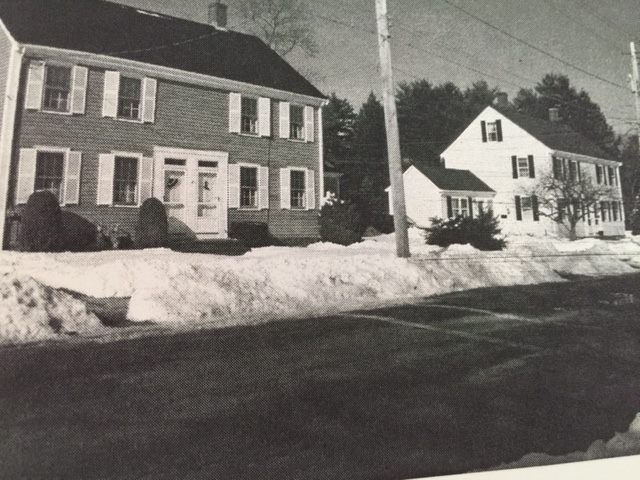
 IMG_0085Modern photograph of two private homes on Oliver Street in Easton, originally built in 1852 as part of the temporary structure for the shovel factory.*

March 17

1852  Wednesday.  Passed the day at Mothers with Amelia

and Susan   Carried Augusta to her fathers

and afternoon she and Rachel came down

to see us  Miss Foss closed her school Sat.

Came to Mothers this morning and to

night came home with us.  Carried cloth

and cut out a bleached shirt  Amelia worked

on the sleeves.

Evelina spent a pleasant day with her mother and several relatives. Her friend Orinthia Foss came to stay for a time. Evelina’s father-in-law, Old Oliver Ames, was completely focused on the rebuilding of the shovel shops. He seemed pleased to report:

“this was a cloudy day wind northeast. + in the afternoon it was cold + chilly. the roof is on the stone shop + the windows are in + the down stream end finisht- + the piece from that to the water shop is up + the roof shingled + the walls are boarded – one hundred + eight feet of the handeling shop is up and part of it clapboarded. the polishing shop is up and the roof shingled and the sides boarded + partly clapboarded the hammer shop is up + the sides + ends boarded and the roof and two thirds sleighted”**

This is one of the longest entries that Old Oliver ever wrote in his journal. He was clearly proud of the progress that had been made in the two weeks since the fire that destroyed almost all. The factory would soon be back on its feet, and planning for more permanent stone buildings could move forward. The wooden buildings that went up so fast would have another use after the stone buildings were erected, that of housing for some of the shovel workers. They would be moved from the original site by the pond and become residences. As you can see from the illustration, some of them are still used today.


* Image taken by Gregory Galer, Forging Ahead, MIT, 2001, Figure 50

** Oliver Ames, Journal, Stonehill College Archives, Arnold Tofias Collection

March 15, 1852


PENTAX Image


1852

March 15th Monday  Gave the sitting room & entry

a thourough sweeping & dusting and then

went to sewing.  Susan washed the dishes

Amelia & self carried our work into Edwins but did 

not stop to tea, are invited there tomorrow.  We called

at Mrs Bucks  She has 41 schollars and 5 or 6 boarders


After “considerable rain” over night, Monday broke “cloudy in the morning but fair + warm in the afternoon and in the evening there was some rain + it grew colder [.] Mr Arnold came to day to sleight the hammer shop”* Thus wrote Old Oliver.

After Sunday’s respite, work on the rebuilding of the shovel shops picked right back up.  A slate roof was going up on the hammer shop, thanks to the expertise of John Arnold, a local man who had done roofing for the Ameses before.  Old Oliver seemed pleased.

At the Ames home, Amelia Gilmore continued her visit with Evelina. Once the morning chores were complete, with Susie washing dishes and trusted Jane McHanna doing the laundry, and midday dinner consumed, Evelina and Amelia walked across the way to visit Augusta Pool Gilmore, carrying their sewing with them. They must have spent several hours there, but didn’t stay for tea. Instead they headed home, stopping off to see another neighbor, Polly Buck.  Evidently, Mrs. Buck was running a private school with day students and boarders. One imagines that the ruckus there might have been equivalent to the bustle of workers at the building site.


*Oliver Ames, Journal, Stonehill College Archives, Arnold Tofias Collection

March 12, 1852

192_600_Red_Doll_Bed

1852  

March 12th Friday.  Spent most of the forenoon about

the house gave the sitting room a thorough

sweeping  This afternoon & evening have

spent at Mr Torreys  Amelia came home

with me.  Called to see Hannah in bed

almost sick with the canker & has weaned her babe.


Poor Hannah Lincoln Gilmore, wife of Alson Augustus Gilmore and mother of two little boys, 3-year old Eddie and 7-month old Willie, had been feeling poorly for more than a week.  Her complaint was canker sores, a common enough ailment but one that struck her unusually hard. As Evelina points out, Hannah was “in bed almost sick.”

As most of us know, a canker sore is a benign but painful sore located inside the mouth and lips or at the base of the gums. Known medically as aphthous stomatitis, a canker is not contagious and has no cure. It is often caused by stress; perhaps Hannah’s recent efforts to wean Willie had set them off. A canker sore can last from seven to ten days, and can be painful enough to make talking and eating difficult. Hannah must really have felt crummy.

Meanwhile, at the shovel shop, reconstruction was continuing.  Old Oliver noted that “the 12th + 13th were both good fair days for our work.”*

*Oliver Ames, Journal, Stonehill College Archives, Arnold Tofias Collction


March 11, 1852

Build

1852

March 11 Thursday.  Cut out another waist of stout

bleached cotton cloth  Have been to Mr

Horace Pools with Mrs Witherell & Mrs

S Ames.  Met Henrietta Rachel & Mrs Harrison

Pool there, got home about eight Oclock

finished writing a letter to Harriet Ames.

Amelia went to Mr Torreys.

Old Oliver made his daily report:“the ground froze pritty hard last night – wind north in the morning butt southerly in the afternoon + pritty warm. it was a still day butt little wind – we began to rais the hammer shop to day.”  If ever there was an instance of Yankee industry, this cold, windy March in North Easton was it. Whatever the weather, all hands were on deck for the rebuilding of the shovel shops, which had burned to the ground less than ten days earlier.

While the men hammered, the women sewed – at least at the Ames compound. Evelina, anticipating warmer weather, worked on a new cotton dress. She had been fiddling with the waist lines on her dresses lately, suggesting that her waist might have altered. Larger or smaller?

With her sisters-in-law, Sarah Ames and Sarah Witherell, Evelina rode to the home of Horace and Abby Pool, where they met Henrietta Gilmore, Rachel Pool, and Mary Pool. This sounds like a gathering of the Sewing Circle, which we haven’t heard about since December when they temporarily disbanded. Now that spring had arrived, they might have started meeting again.

March 8, 1852

Carpenter

March 8th

1852 Monday  To day is town meeting.  George brought

sister Amelia here this afternoon  Have got

the carpet down in the front entry and 

the chamber carpet partly down

S Ames sent for the entry lamp for fear

I suppose that I should keep it but

she […] might not been alarmed

Carpenters have come to rebuild the shops

A new week signaled a fresh start. It had only been six days since the fire at the shovel factory, but the clean-up had gone quickly. The ruins were “dismal,” as Evelina noted yesterday, but the debris was mostly gone, hacked down, shoveled up and carted away. Carpenters had arrived to begin rebuilding, as Old Oliver, too, noted in his diary:  “some of the carpenters came on to day to build up our shops + Mr Phillips + his son came.”*

Life in the village was returning to normal.  Housewives, some with servants, tended to washing day. Children went to school and men went to town meeting.  As at church, the fire must have been part of the conversation as the men gathered to decide on town affairs and expenditures for the coming year. People must have wondered how soon the shovel shop would be up and running.

At the meeting, a new moderator, Alson Augustus Gilmore, presided. Not yet thirty years old, it was his first time holding the gavel; he would repeat the performance twenty-four times over the coming decades.  According to William Chaffin, Gilmore and his predecessor, Elijah Howard, Jr., “served with signal ability.”**

Evelina and her sister-in-law, Sarah Lothrop Ames, had a minor set-to over “the entry lamp,” which appears to have been a luminary that was shared by both houses. Sarah was evidently skittish about not having it, and Evelina was annoyed to have it commanded away.  No cause for alarm, she might have said. She wouldn’t have been annoyed for long, however, as a favorite family member, Amelia Gilmore, arrived for a visit. Amelia was the young widow of Evelina’s younger brother, Joshua Gilmore, Jr. She had lately been working as a private nurse.

*Oliver Ames, Journal, Stonehill College Archives, Arnold Tofias Collection.

**William Chaffin, History of Easton, 1886, p. 637

March 7, 1852

Ruin


/52

March 7th Sunday  It has been a beautiful day and we 

have all been to meeting except Frank

When we came from meeting we rode down to

the ruins. They have cleared away a great deal 

but it looks dismal enough  Mr & Mrs William

Reed spent the evening  Mrs Witherell & Mrs

S Ames came in awhile & Father Ames

No work was done today at the site of the shovel factory fire, for it was Sunday, a day of rest – a day of rest that everyone in town must have welcomed after the shock of the fire and the subsequent hard work of clearing the debris.

The Ames family rode down Centre Street to church, the weather “beautiful.” At the intermission between sermons, they must have been approached by fellow parishioners expressing concern and curiosity about the fire. In a town of 2,500 citizens, such a huge event would have been on everyone’s mind. Is it too far-fetched to imagine that Reverend Whitwell might have alluded to it from the pulpit?

After the services, the family drove by the factory site on their way home. The wintry sunlight hid nothing; the “ruins” were “dismal.” Later in the day, several family members gathered at Evelina’s and Oakes’; even Old Oliver came over from the other part of the house, which he seldom did, perhaps to greet guests William and Abigail Reed or to discuss the plans for rebuilding, to begin the next day.

March 6, 1852

Whitewash

1852

March 6th Saturday  Mr Scott whitewashed the parlour

& sitting room chamber this morning and I

varnished the front entry oil cloth.  Lavinia

came at eleven and Augusta this afternoon

Alson came after Lavinia and stopt to tea

Charles Pool came up and carried Edwin

and Augusta home to stay till Monday

I have been to work on a stiched pink apron

for Susan

A full moon shone down on North Easton this night, highlighting the charred ruins of the shovel factory.  Before it rose, however, Old Oliver took the opportunity of “a fair day”* to travel to Bridgewater, quite probably on shovel business.  He and his sons were developing plans to rebuild the factory, and some help for that would be found in Bridgewater.

Evelina’s way of coping after the devastating fire appears to have been to keep the domestic front moving smoothly. Redecorating continued, social calls were made and enjoyed, and sewing continued without a blink of an eye. Daughter Susan would soon have a new pink apron.

Years later, Evelina and Oakes’s grandson, Winthrop Ames, would credit his grandmother and other Ames wives with exerting a positive influence on his male ancestors. “They made the homes, reared the many children, saved their husbands’ money, encouraged their undertakings, and steadied them in failure and misfortune,”** he said. Evelina’s evident steadiness during this challenging period is one such instance of positive influence. Oakes Ames had come home from the fire “more cheerful” than Evelina had expected; she seems to have behaved with equal optimism. Though naturally sanguine, Oakes’ bright outlook and ability to cope in the aftermath must also have been bolstered by his wife’s unflappable focus on home and (redecorated) hearth. Together, they maintained continuity.

Charles Pool, Augusta’s eldest brother, drove up from southeastern Easton today and fetched his sister and her husband, Edwin Williams Gilmore, “home to stay” for a few days. Perhaps this visit had been prearranged, or perhaps it was an effort by the young couple to get out of the way of remnant smoke and disruption from the fire.

*Oliver Ames, Journal, Stonehill College Archives, Arnold Tofias Collection

**Winthrop Ames, The Ames Family of North Easton, Massachusetts, 1937, p. vi.