November 10, 1851

255px-George_Sewall_Boutwell_by_Southworth_&_Hawes,_c1851_restored

George S. Boutwell, Governor of Massachusetts, 1850 – 1852

Daguerreotype by Southworth & Hawes, circa 1851


Monday Nov 10th  Election day and the whigs have got

whiped and look rather down.  It has been very

stormy.  Our new horse came home sick from town

meeting.  Oakes A, Mr Barrows & Augustus went to Taunton

this evening to carry & get the news.  Jane came home

from Mansfield to night.  Bridget is better to day

she has done the housework and I have cleaned

the shed chamber &c &c  Passed the evening at Olivers

There were full-bore politics in Massachusetts today, with the Whigs getting “whiped,” much to the disappointment of the Ames men and others. The politics of the era were untenable as the country cantered toward civil war. The Fugitive Slave Act and the Compromise of 1850, a misguided legislative expression of an unsustainable gulf between north and south, had resulted in upheaval and disarray among the existing political parties.

According to George S. Boutwell, then governor of Massachusetts, the Whigs – a pro-business, market-oriented group – had fallen into two camps over slavery: the Conscience Whigs and the Cotton Whigs.* The Conscience Whigs generally supported, and many eventually became, Free-Soilers (those who opposed the extension of slavery into new states or territories), while the Cotton Whigs held with the pro-slavery policies of the south. By 1855, a new Republican Party had risen from the ashes of the old Whigs, bringing along a few disenchanted Democrats and advocating many of the issues that Conscience Whigs had stood for. Oakes and Oliver Ames, Jr. became Republicans.

Although less well known today than fellow Massachusetts politician Charles Sumner, George Boutwell would go on to have a distinguished career, one that often involved interaction with the Ames brothers. A crackerjack lawyer by profession, an abolitionist by passion, he spent most of his life as a statesman. Besides being governor, he was, over time, the first head of the Internal Revenue Service, a member of the U.S. House of Representatives and the U.S. Senate, and Secretary of the Treasury under President Grant.  While in Congress, he would spearhead the impeachment of Andrew Johnson.

Also while in Congress, Boutwell would be approached by Oakes Ames to buy shares in the Union Pacific but, according to several period sources, he would turn the offer down because he thought it a poor investment. He left Congress in 1869 to serve as Secretary of the Treasury, a position he held during the Credit Mobilier scandal in 1873.  Ten years later, at the dedication of the Oakes Ames Memorial Hall in North Easton, Boutwell would speak in memory of Oakes, describing him as “tolerant of hostility, forgetful of injuries, and persistent in his friendships.”**

All this was ahead for the Ames men, Boutwell, and the nation.

*George S. Boutwell, Reminiscences of Sixty Years of Public Affairs, 1900

**Oakes Ames, A Memoir, 1883


November 4, 1851

450px-Caraway_seed_cake


Tuesday Nov 4th  Put down the parlour carpet this

forenoon baked some cake &c &c  Mrs Buck &

Mrs Drake (formerly Lucy Reed) called about half

past eleven.  Mrs Hubbell & Ames & Mrs Witherell

Father were here to tea  They all dined

at Olivers.  Mrs Hubbell commenced knitting

me a hood. I have put the trimming on the sleeves

of Susans Delaine dress


The day was “cloudy […] + cold + chilly,”* according to Old Oliver, meaning that baking “cake &c &c” in the shared brick oven at the Ames compound might have been pleasurable.  At least it was one way to stay warm. It may still have been in the oven when Polly Buck and Lucy Drake, the former Reed sisters, came for a short call.  Local women, Polly was married to Benjamin Buck, who lived in the village; Lucy was the wife of Ebeneezer Drake.

In all likelihood, Evelina baked the cake – seed cake, perhaps – to serve at tea later in the day. She invited Mrs. Hubbell and Almira Ames, visitors from New York, as well as Sarah Witherell and “Father Ames” to join the family in their newly redecorated parlor. How happy Evelina must have been to show off the recent refurbishments.

Mrs. Hubbell and Almira Ames had midday dinner earlier in the day next door, at Sarah Lothrop and Oliver Ames Jr., a gathering to which Evelina and Oakes don’t appear to have been invited. In turn, Oliver Jr and Sarah Lothrop didn’t appear for tea at Evelina and Oakes’s. It may be that Evelina and Sarah Lothrop Ames agreed to split hospitality responsibilities for the day. Almira Ames was a favorite cousin who often came to visit; she had even lived with family for a period after Old Oliver’s wife, Susannah, died.


* Oliver Ames, Journal, Courtesy of Stonehill College Archives


October 26, 1851

1421516038_22078acff3

*

Sunday Oct 26.  John Ames from Springfield is here at

fathers came last night.  We have all been

to meeting  Mr Whitwell preached two

excellent sermons.  Went at intermission

into Mr John R Howards with Mother and several

others  The first time I have called since

they moved.  It has rained since eleven this

morning, quite hard.

For the first time since September 21, Evelina attended church; even the “hard” rain couldn’t keep her away. She surely was pleased to be back in the family pew, head tilted up to listen to Reverend Whitwell’s “excellent” sermons, happy to visit with friends and acquaintances at intermission. The opportunity to congregate at church was central to Evelina’s social life, and she was quick to catch up.  Her visit at intermission with John and Caroline Howard was her first visit to their new home.

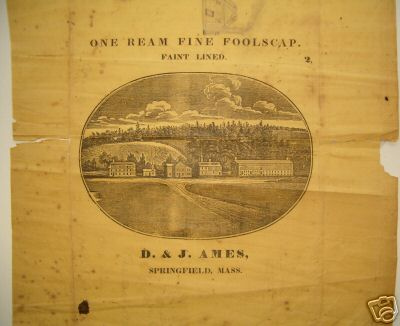
A cousin from Springfield, John Ames, was visiting in the other part of the house. There were several relatives named John Ames with close ties to Old Oliver, including his father and a brother. This John Ames was, most likely, a nephew of Old Oliver, the son of Old Oliver’s much older brother David. His dates were 1800-1890. He was famous for certain inventions pertaining to the manufacture of paper and with a brother, also named David, ran the Ames Paper Company in Springfield. According to one 20th century historian, “[f]rom the outset the firm, which became known as D. and J. Ames, prospered wonderfully, making money rapidly and growing until it was one of the largest and most powerful in the country.”**

A life-long bachelor, John Ames lived with a sister, Mary, and the two managed the family farm well into their old age. Oliver Jr. writes of visiting them in Springfield in 1871. The families stayed in touch.Yet Old Oliver made no mention of his nephew’s visit.  Instead, in his journal, he noted only that “it was cloudy all day to day + raind some in the day time + in the evening + night ther was considerable.” He was more interested in the rain which, given the fact that rain meant more water and more water meant more power for the factory, was perhaps understandable.

Image courtesy Benjamin L. Clark, Massachusetts Book Trade

**Lyman Horace Weeks, The History of Paper-manufacturing in the United States, 1690-1916, New York, 1916, p. 125

October 9, 1851

IMG_1057

Thursday Oct 9th  Jane has been sick to day went to bed directly

after washing the breakfast dishes and I had to get

dinner  After dinner she was much better and was

able to […do] the dishes  This afternoon I have passed

in Olivers with Miss S. Orr.  Mrs Witherell & Mitchell

Mr Ames & William there to tea Have trimmed

Susans bonnet with dark ribbon


Jane McHanna was sick.  The domestic team at the Oakes Ames house was barely operational, what with Evelina herself still feeling the effects of a mean case of nettlerash. But between them, the two women, servant and mistress, managed to make meals appear on the dinner table in a timely fashion. Did the men of the house appreciate the extra effort going on behind the kitchen door?

Tea was a special event today, served next door at Oliver, Jr. and Sarah Lothrop Ames’s. Present were five of Old Oliver’s six surviving children: Sarah Witherell, Harriett Mitchell, Oakes Ames, William Leonard Ames, and the host, Oliver Ames, Jr. William was visiting, if not from New Jersey, then from his current way station on his journey to Minnesota. Harriett, too, held visitor status;  she and her children were about to return to her husband in Pennsylvania. Only Sarah Witherell, Oakes, and Oliver Jr. lived in North Easton and saw one another regularly.

Missing from the group was Horatio Ames, who lived down in Connecticut. No one’s favorite sibling, some – Oakes, particularly – may even have appreciated his absence. Interesting that Old Oliver himself isn’t mentioned as being present.

Another guest who was also there at this rare gathering of the clan was Miss Susan Orr, a long-time family friend (or relative?) who had known the group when they were children. She could remember Oakes Ames as a baby. Susan had been staying with Sarah Witherell and Old Oliver for about ten days. Meanwhile, a different Susan, only nine-years-old, got her bonnet trimmed with a new ribbon.


October 2, 1851

9904548_1_l


*


Oct 2d Thursday  Helped Ellen quilt some this forenoon 

She seems to do pretty well at it

Mrs Elijah & Ellen Howard & Mrs Abba Leach

spend the day and evening in the other part

of the house  I was there at tea.  Oliver &

wife have been to her fathers  Mr Ames has been

to Boston   Lavinia Williams came in the stage

with him but he did not speak to her

Evelina and her servant, Ellen, worked on the new quilt this morning .  Evelina had set the quilt up in the sitting room using a frame that could be dismantled and stored. The frame would have had four wooden legs at the corners, such as those in the illustration above.  Long boards around which the quilt edge was wrapped would have been fastened into the corners, creating an adjustable rectangle on which the women could work.  When finished the pieces of wood would be stowed away until needed again.

In the other part of the house, Sarah Witherell welcomed Nancy Howard, her daughter Ellen Howard, and Mrs. Abba Leach for the day. The women made a social visit that lasted all day and into the evening. Did they bring any needlework or sewing with them, or was conversation the only occupation? Evelina dropped in for tea, but Sarah Lothrop Ames from next door didn’t join them. She and her husband Oliver Jr were calling on her parents, the Hon. Howard Lothrop and his wife Sally. The Lothrop family may still have been wrestling over how to manage the family farm since the death of Clinton Lothrop, Sarah’s younger brother.

From Boston, where he was probably collecting orders for shovels, Oakes Ames returned home on the stagecoach where he sat with an acquaintance of Evelina, Lavinia Williams.  Mrs. Williams was the wife of Cyrus Williams, a local farmer of some means. Evelina seemed surprised that Oakes and Lavinia didn’t converse en route.

Even as Evelina was looking back at the day’s small social exchanges, she was beginning to feel unwell, something she wouldn’t report for another few entries.


October 1, 1851

Impatiens_Bush

 ***

Oct 1st Wednesday.  Put a quilt into the frame in the

sitting room got it in about ten marked it

and quilted awhile and went into the garden

to save some flower seeds.  have got some nice

Balsam seed and a few china pink seed among

others. Passed the afternoon at Olivers with

Mrs Drake & Torrey

Quilting, gardening, and socializing made up Evelina’s day.  She set up a quilt frame in the sitting room and worked on a quilt she had begun about ten days earlier. She couldn’t stay inside, though, as the day was “fair” and “pritty warm for the time of year.”* The sunshine drew her to the garden where she moved through her annuals, saving seeds for next year.

She got “some nice Balsam,” a flower that today we call impatiens. At the time, it was reckoned to be “one of the most prominent ornaments of the garden,”** according to Joseph Breck, a Boston horticulturalist.  Breck’s important guide, his eponymous Book of Flowers, had proved helpful to Evelina earlier in the year and must have been doing so again as she put her garden to bed. Breck particularly admired some of the variegated varieties of Balsam as “decidedly the most elegant.” He had specific advice about saving Balsam seed: “Old seed is considered by some to be the best, as more likely to produce double flowers. The seeds should be saved from double flowering plants only; all single flowering ones should be destroyed as soon as they appear.” Did Evelina follow his advice?

After gardening, Evelina probably changed her dress and went next door to see Sarah Lothrop Ames and her guests, Caroline Drake (Mrs. Lincoln Drake) and another woman, Mrs. Torrey. The two guests may have been related to one another (Caroline’s maiden name was Torrey.) They had no immediate connection to Col. John Torrey, however, who appeared often in Evelina’s journal. The women would have sat, had tea and chatted – a pleasant occupation on a pleasant day.


* Oliver Ames, Journal, Courtesy of Stonehill College Archives

** Joseph Breck, Book of Flowers, Boston, 1851, pp. 185 – 186

*** Heirloom impatiens balsamina, Courtesy of edenbrothers.com


September 20, 1851

Train

Sat Sept 20th  Was out shopping all day purchased a number

of articles among the rest a Cashmere & french print

dress paper for my parlour brought home two chairs

from Bigelowes  We all returned home this evening

Frank came to Stoughton after us & rode back

on the stage.  Went into Olivers awhile this evening.

Have had a great deal of trouble with my feet while

I have bee[n] gone & to night they are very sore.

The Boston spree continued for most of the day as Evelina walked and shopped for everything from fabric to wallpaper to furniture.  She and Oakes brought their purchases home on the train (or “in the cars” as they might have said) to Stoughton. It was, finally, time to return to North Easton.  Son Frank Morton Ames met them at the depot with a carriage – or wagon –  but rode home by himself on the local stagecoach. The conveyance he brought to the group getting off the train was, perhaps, too crowded with goods from town to fit everyone in.

Perhaps not wanting to let go of the many sensations that three exciting days in the city had produced, Evelina went next door to Oliver Jr and Sarah Lothrop Ames’s house. They had returned the day before, and so missed the fireworks. Surely they compared notes on their experiences at various events at the Railroad and Steamship Jubilee.  They may have compared blisters and sore shanks, too.  They did much walking and standing during their junket, and Evelina at least was feeling the effects. Her feet hurt.

Meanwhile, never having bothered to go into town for the celebration, Old Oliver was moving ahead on improvements for the shovel shop.  In his journal he noted that “this was a fair day wind south west and quite warm we put in the bottom stone for the floom at the great pond to day and the 5 foot one on the east side of it.” A flume for the factory was going in at Great Pond.

September 18, 1851

1851_Fillmore_Boston_MA_USA_GleasonsPictorial

*

Thurs Sept 18  Went to Boston with Oliver & wife

& Helen to the railroad celebration.  In company

with Mr Orrs family went to see the regatta & about

nine Returned and dined at Mr Orrs with Mrs

Witherell Emily Mrs S Ames & Helen  Mrs Stevens

&c  Afternoon went out shopping with them  All

except Mrs Witherell spent the night at Mr Orrs

Evelina traveled to Boston today to join the crowds at the Great Railroad and Steamship Jubilee.  President Fillmore, Senator Daniel Webster and dignitaries from Canada as well as the United States had arrived the day before. Speeches were made and congratulations went all around for the new “railroad communication” between the two countries. On this, the second day of the festivities, races were held, one a “grand excursion in Boston Harbor” in which cutters from both countries raced; Canada won.

The Ameses attended a regatta out at Hull, near Point Alderton (better known today as Point Allerton.) It must have been interesting for the usually land-locked Evelina to be at the shore; she rarely got to see the ocean, as her trips to Boston were typically spent in the retail center of the city.It was to that retail center that she and other ladies in her party went in the afternoon. Time to shop.

Also on this date, some 200 miles southwest of this railroad jubilee, in another thriving retail and business center, a new newspaper was born. The New York Times was founded and sold for 2cents a paper.


Reception of President Fillmore at the Boston and Roxbury lines by the municipal authorities, 1851

September 16, 1851

Cake


Tuesday Sept 16th  Mrs Witherell Emily & Cousin H Mitchell

went into Boston this morning and are going to stop the

remainder of the week  I made some cake

this morning & had to be away from Miss Eddy

more than I could wish  Mrs S Ames & Helen &

Oliver here to tea  Harriet came in but did not stop

long  Miss Eddy will stop the night here

A visit from Miss Eddy, a woman who has been staying with various friends – or relatives – in Easton, may have been the impetus for Evelina to bake a cake this morning to serve at tea.  It’s worth noting that despite having collected peaches and grapes during the last few days, Evelina didn’t make a fruit pie or tarts to serve. She was saving that fruit to put up for the winter, and wouldn’t have wanted to waste any of it on a tiny social occasion. Cake it was.

The Ames family from next door, Oliver Jr., Sarah Lothrop Ames, and their daughter Helen came for tea, ate some cake and presumably chatted with Miss Eddy.  Sister-in-law Harriett Ames Mitchell stopped by briefly, too. Not making an appearance in the front parlour, however, was Sarah Witherell and her daughter from the other part of the house. They had departed that morning for a planned week in Boston, traveling with a Mitchell cousin.

Sarah Witherell had headed to Boston in anticipation of a special event, The Great Railroad and Steamship Jubilee. The Jubilee was to be a “celebration commemorative of the opening of railroad communication” to Canada.”*  It recognized the creation of a railroad line from Boston to Burlington, Vermont that connected with a steamship to Canada via Lake Champlain. Travel in the United States had become international. The celebration would go on for three days, and many members of the Ames family would strive to attend some part of it.


*The Railroad Jubilee: an account of the celebration commemorative of the opening of railroad communication between Boston and Canada, Sept. 17th, 18th and 19th, 1851.


September 13, 1851

OLYMPUS DIGITAL CAMERA

Sept 13  Mrs Stevens & self sat down quietly to

sewing this morning but it was so warm that

we could not do much  There is quite a

change in the weather this morning.  Had

quite a heavy tempest this afternoon.

Carried our work into the other part of

the house this evening.  Mrs S Ames & Helen

passed the afternoon there

No matter how still Evelina and her guest, Mrs. Stevens, sat this morning, they found themselves enervated by the extreme heat.  They tried to sew but “could not do much,” heavy as the extra cloth must have felt on their laps as they hemmed or mended. Surely they wore their lightest cotton dresses (which were likely to have been somewhat plainer than the morning attire suggested in the illustration above from Godey’s Lady’s Magazine) and probably eschewed wearing caps indoors. Even in their coolest attire, however, they still would have “glowed,” as the old saying goes. Horses sweat, men perspire, women glow.

An afternoon rainstorm – “two showers before sunsett” noted Old Oliver in his daily jounal  – helped clear the air and by evening, Evelina and Mrs. Stevens had joined Sarah Ames Witherell in the other part of the house.  Did Old Oliver sit with them, or was he over in the office with Oakes and Oliver Jr.?  Assuming that Oakes spent the day in Boston on the usual shovel business, did he get caught in the downpour on his way home?