September 16, 1852

Flatiron

1852

Thursday Sept 16  Watched with Mrs Savage last night

came home at half past five went to bed

and laid untill past eight  Starched some

more shirts that were washed yesterday  We

have 20 fine shirts this week in the wash

Miss Elizabeth Capen called & Mrs Stevens was

with Mrs Witherell to tea  I was ironing & did not go

Oakes A went to carry Helen & C Hobart to Bridgewater

Today we have proof positive that Oakes Angier Ames, back from his recuperative rest in Vermont, was spending time with Catherine Hobart, the girl who would become his wife. For several days, Catherine had been staying next door with her classmate, Helen Angier Ames, but the time had come to return home to Bridgewater. Whether Oakes Angier volunteered to carry the girls or was assigned the duty, we don’t know, but we can believe that he enjoyed the trip. Was Evelina aware of their mutual attraction? Did Helen stay for a visit with Catherine, or did she return to Easton? Did the two girls discuss Oakes Angier after he left them off?

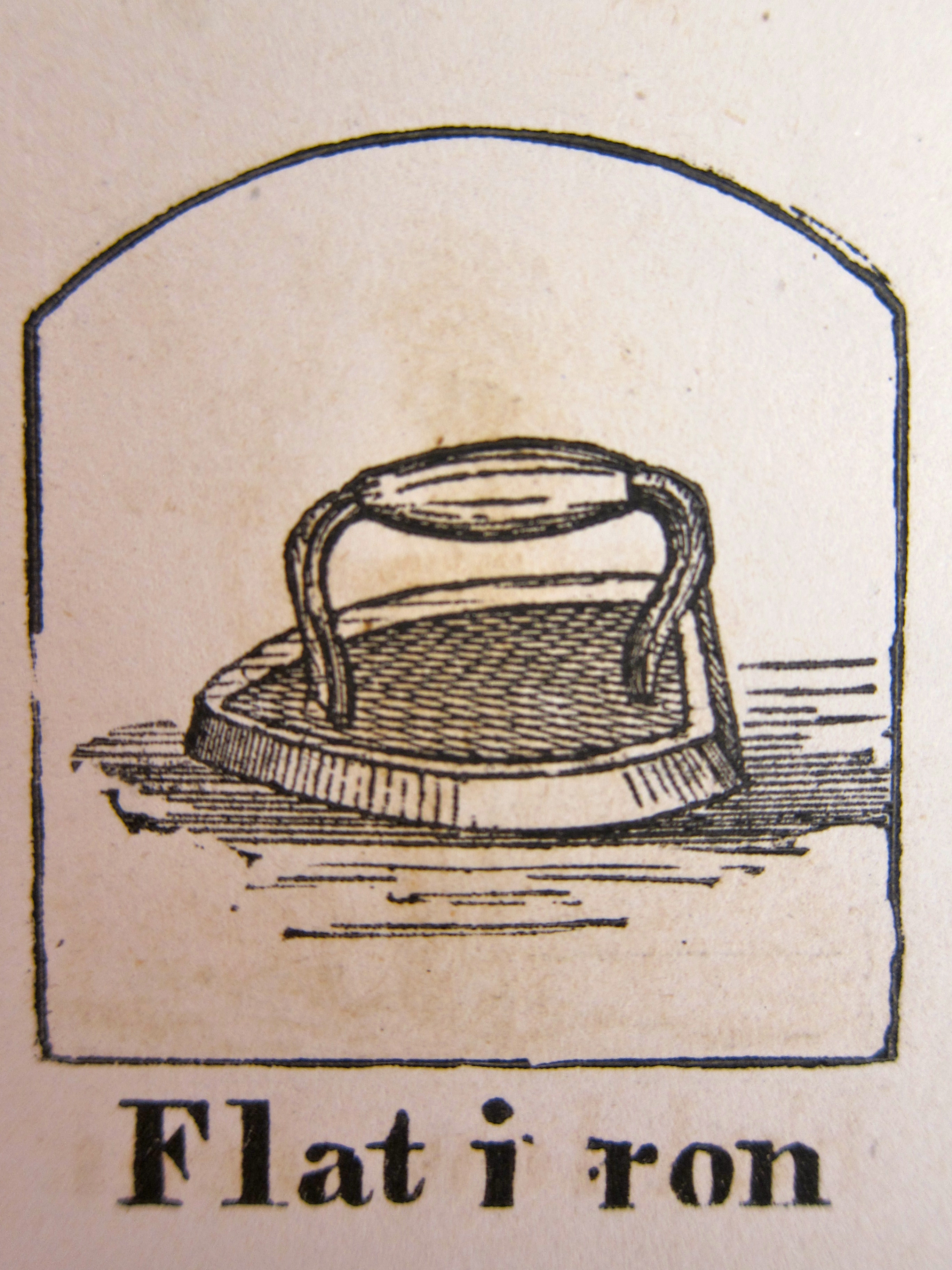
Evelina may have been too busy with all the shirts that needed starching and ironing to attend to her eldest son’s romantic inclination. Having spent most of the night before sitting up with Hannah Savage, she was only operating on three hours sleep. She positioned herself at the kitchen or dining table and covered it with a protective blanket and sheet, kept “on purpose for ironing.”* Using thick cloth to protect her hand from the hot handle, she lifted and pushed the heavy implement across each one of those new cotton shirts. Back and forth, back and forth, putting away one iron when it cooled to pick up another one that had heated up. It was hot, heavy work. She didn’t break her stride, either, not even for tea in the other part of the house.

* Lydia Maria Child, The American Frugal Housewife, 1832, p. 11

September 15, 1852

Cake

Wednesday Sept 15th  Mr & Mrs Oliver Ames Helen & Miss Hobart

here to tea  Made cake & baked it in the stove

Mr Torrey made a long call here just after

dinner  He is quite neighbourly about this

time  Mrs Stevens need not take the credit of it

Augusta is not quite as well  sent for me to

come there & has had the Dr again

Oliver went to Providence this morning to the fair


Evelina baked a cake in her new cast-iron stove, something she was proud to note.  That was a real change for her, as before this she had used the family’s old, built-in brick oven for her baking. New technology in the kitchen was changing her ways.

The cake must have been a success; she served it at tea. Her husband and sons, minus Oliver (3), were present. Sarah Lothrop Ames and Oliver Ames Jr. came over from next door, too, bringing their daughter Helen Angier Ames and her friend, Catherine Hobart, with them. This was the last night of Catherine’s visit and it was sweet that her host and hostess took her next door for tea. Was there a conscious design behind the invitation and acceptance? Had the elders noticed a spark between Catherine and Oakes Angier Ames? Had Evelina contrived to make this happen? Were the young folks self-conscious on the occasion? Or was it just an average family gathering that inadvertently portended something more?

Catherine wasn’t the only guest. Mrs. Stevens was still visiting the Ameses and, inadvertently or otherwise, had made Evelina a little jealous. Col. Torrey, Evelina’s former brother-in-law – now a widower – had been calling more often than usual, and Mrs. Stevens had evidently volunteered the possibility that his attention was directed at her. Evelina, however, as we read from her rather ungracious entry, is reluctant to let her guest get any “credit.” Generous as she could sometimes be, Evelina was not inclined to share her friendship.

Across the street, meanwhile, young Augusta Pool Gilmore had had a relapse of her intestinal disorder, known in that day as “Cholera Morbus.” Certainly, her family and friends were worried about her.


September 10, 1852

Conductor

Friday Sept 10th  Mother Mrs Stevens Susan & self rode to

the shops this morning.  Mother seemed as delighted

as a child  we called on Mrs Shepherd also invited 

her to come here Saturday  Have passed the

afternoon at Mr Torreys Augustus & wife were

there  Mr Torrey very sociable & clever

Oakes A returned home from Burlington yesterday

and is looking much better

Oakes Angier Ames returned to Easton today, looking healthier than when he had left three weeks earlier. Family members would have hoped that the 23-year-old had recovered from his lung ailment in the fresh air of Vermont, that his indisposition hadn’t proved to be consumption. No doubt, he hoped that, too.

Another male relative also arrived in town; although not traveling together, both men must have arrived by train at Boston, then Stoughton or Taunton, and then traveled by carriage to North Easton. William Leonard Ames “came here from Minesota the 10th,”* bringing with him his five-year old son, Angier Ames. He had left his wife back in St. Paul with their older son, William Leonard Ames Jr., and their youngest child, Oliver Ames. William visited Easton periodically and always stayed with his father. He and Oakes Ames did not get on well, as we have seen before, and we can perhaps infer from Evelina’s failure to mention his arrival that she wasn’t keen on William, either.

With her friend Mrs. Stevens in tow, Evelina took her mother and daughter out on a number of calls. Her mother enjoyed the ride around the new shop, and all seemed to enjoy an afternoon visiting Col. John Torrey in the village. He was a widower of Evelina’s late older sister, Hannah. Evelina seemed to be planning a special tea for the following day, perhaps in honor of Mrs. Stevens.


*Oliver Ames, Journal, Stonehill College Archives, Arnold Tofias Collection

September 1, 1852

Men's Work Shirt, mid-19th c.

Men’s Work Shirt, mid-19th c.

Wednesday

Sept 1st 1852  Have been cutting out shirts & fixing

them for Catharine to sew  She does very

well at sewing but I have to get it ready for

her  Mrs James Mitchell & Catharine Hobart

came before noon at Olivers   And I have

been in there  Did not get ready to go

very early  Mr Ames has gone to the 

Whig convention at Worcester


Evelina had settled back into her sewing routine, the latest project being shirts for the men in her family. The last time she had sewn a large batch of shirts was back in March, 1851. It looks like the men had worn through the allotment and needed new ones. Evelina and her servant, Catharine, probably used the Bartlett sheeting mentioned two days earlier for material.

Next door, Sarah Lothrop Ames welcomed some visitors from Bridgewater: Harriet Lavinia Angier Mitchell (not to be confused with Harriet Ames Mitchell) and Catharine Hobart, the latter a classmate of her daughter, Helen.  In another three years, Catharine Hobart would later become a member of the family when she married Oakes Angier Ames. We might imagine that Catharine asked after him, perhaps expressing concern for his health. How much information did the family share about Oakes Angier’s lung condition?

While the women worked and socialized at home, the Ames men were out and about. Oakes Ames attended the Whig Convention in Worcester to help put together the Whigs’s slate for the fall election, and Old Oliver “went to quincey + Braintree to get stone for the foundation for the steam enjoin”.  The building of the new factory to replace the one that had burned down in the spring was not yet complete.


August 27, 1852

Locomotive

Friday Aug 27th  Left Burlington at 1/4 before eleven on

our return home  They were very unwilling that we

should leave before next week and it was a sudden

start our leaving at last  It rained most of the 

way which made it much more pleasant as it

laid the dust  Arrived at Boston about

eight passed the night at Mr Orrs. Mrs Ames

Helen & Fred went to the Adams House

Somewhat precipitously, Evelina departed Burlington today with Sarah Lothrop Ames and her children Fred and Helen. Almira Ames didn’t return with her nor, more important, did Oakes Angier Ames. He would stay behind to rest and try to get the better of his pulmonary ailment.

After a nine hour train trip, which proved to be “much more pleasant” than the ride they had taken eight days earlier, Evelina and company arrived “at Boston.”  Light rain had fallen throughout the journey, which helped lay the dust, but was a precursor of more wet weather to come. This was hurricane season, after all.

Evelina says nothing about shopping in Boston. She may have been too fatigued by the journey to follow her favorite pursuit in the city.  Instead, she went right to the home of Robert and Melinda Orr, her usual headquarters when there. Sarah Lothrop Ames and her children stayed elsewhere.

August 25, 1852

Letter

Wednesday Aug 25th  We were invited to dine again at

Mrs Mills to day.  Fred & Helen called at Mrs

Stetsons and we went home with them to Mrs

Mills. Afternoon went to Mrs Footes had a 

large & pleasant party and quite a treat

In the evening they acted charades and

we had a merry time  Oakes A bears

the excitement pretty well  Received a letter from 

home saying that Willie Gilmore died last Friday

Evelina heard from the folks at home today and found out that her great-nephew had died. This news was unfortunate, but perhaps not entirely a surprise.  She had been concerned about the little boy before she left on her trip; infant mortality was high in those days. Despite the bad news, surely Evelina was glad from her family, even if the tidings were sad.  We can pretty well assume that she had not been so far from home before, and she may have been missing her family and friends. Who wrote her, do you suppose? Her husband? Her nephew? One of her nieces? Oliver (3) or Frank Morton? Or perhaps Sarah Witherell wrote, knowing that Evelina would want to know about little Willie.

Evelina probably learned of other Easton goings-on as well. Even the weather would have been a topic of some interest. Old Oliver was, as ever, keeping an eye on the sky and tracking rainfall. As she opened her letter, he might have been making note that on this Wednesday, it “was cloudy most of the day + one small shower.”*

A game of charades filled the evening – fun for all including Oakes Angier, who seemed to be feeling well.

*Oliver Ames, Journal, Stonehill College Archives, Arnold Tofias Collection

August 23, 1852


panoram

Victorian Panorama Picture

Monday Aug 23st (sic)  Spent this day at Mrs Stetsons.  Cousin

Harriet called in the morning and I went out 

with her into some of the stores  Oakes A

went with her to the Panorama this afternoon

Mrs Mills came in awhile and Ann Clark

called and staid to tea and Mrs Ames & self

went home with her to make a call

Evelina really was on vacation.  Here it was Monday, laundry day back home, and she wasn’t choring, or sewing, or washing the breakfast dishes.  She was out shopping and socializing for most of the day.

Oakes Angier went out, too, in the afternoon. He and Cousin Harriet Ames went to a special display, one that Evelina had visited the first day they arrived. It was a Panorama of the Garden of Eden, perhaps on temporary display in the town’s new Lyceum.

Panoramas, a popular art form in the 19th century, were large, horizontal paintings of popular subjects. In a manner of speaking, panoramas and its later cousins, cycloramas, were the installation art of their time. Usually depicting a single grand subject, like the Garden of Eden, or a famous battle (i.e. Gettysburg), the paintings were designed to be displayed in a consecutive or circular fashion, so that a viewer like Evelina or Oakes Angier could essentially walk into a display area and be surrounded by the subject matter.

British historian Jonathan Potter has written extensively on panoramas, citing a 19th century “desire to see all” as the impetus behind the art form. “The Victorian Panorama was one of many attempts to embrace the world in a single glance,” he writes.  Among the most famous American examples was a Panorama of the Mississippi, painted in 1847 by John Banvard. It covered three miles of canvas and depicted a compacted view of 1,200 miles of river, from the mouth of the Missouri River south to New Orleans. Published in Boston by J. Putnam, it was advertised as “being by far the largest picture ever executed by man.”** Other panoramas were much smaller; some were reproduced as framed engravings suitable for parlor walls.


*Example of 19th century Panorama/

**Jonathan Potter, University of Leicester, www2.le.ac.uk 

August 22, 1852

1835sketch

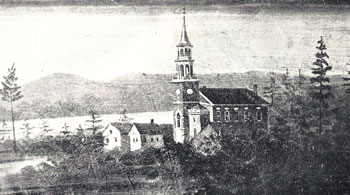
Unitarian Church, Burlington, Vermont, circa 1835*

Sunday Aug 22  We went with Mrs Stetson to the

Unitarian church & heard Mr Rich in the morning

dined at Mrs Mills and all went to the

Episcopal church this afternoon  This is a

beautiful church but I did not think much

of the preaching or singing.  Returned

to Mrs Stetsons to tea and had a quiet evening


Naturally, Evelina attended church on Sunday, just as she would have done had she been at home. In this case, she went to Burlington’s Unitarian Church with her hostess, Mrs. Stetson,and “heard Mr Rich” preach. But for the afternoon service, she went to an Episcopalian church with a group of women with whom she had dined.

She liked the looks of the Episcopal Church but, as she often did when attending any church but her own, she didn’t approve of the service, sniffing at the poor “preaching and singing.”  Evelina invariably preferred her own church in Easton – and her own preacher. No one could ever equal Mr. Whitwell.

The family (still minus Sarah Lothrop Ames and her two children, who had stopped at a town further south) kept a pretty low profile in the evening. Keeping quiet, after all, was the point of this vacation for Oakes Angier Ames. It was hoped that his staying in Vermont would improve his health.


*Courtesy of the First Unitarian Universalist Church, Burlington, http://www.uusociety.org


August 21, 1852

513684745

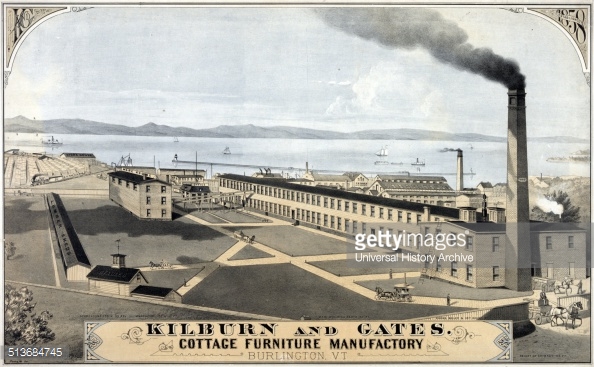
Factory in Burlington, Vermont, 19th century

Saturday Aug 21th (sic)  Cousin Harriet came up to see us

this morning and invited us to spend the day

at Mrs Mills but she stopt to dinner there

and we went to Mrs Mills to tea  Miss Ann Clark

and Mr S Mower called. After tea Mrs A Ames

Oakes A & self called at Mrs Mowers and they were

going to the Panorama of the garden of Eden and Mrs Ames

Mrs Stetson and I went with them.  Oakes A returned to Mrs Stetsons

Evelina, Oakes Angier, and Almira Ames woke up in Burlington, Vermont, at the home (or boarding house) of a Mrs. Stetson. Surely they spent the morning unpacking and whisking road-dust off the outfits they had traveled in. Their quiet time was soon interrupted by visitors, however, including their spinster cousin, Harriet Ames.

Burlington is Vermont’s largest city, and even in 1852 was a bustling town. Located on Lake Champlain, it had a railroad line that connected not only with Boston and New York, but also with a steamship company on the lake, making shipping and manufacturing a big part of the local commerce. Like many communities in Massachusetts, the city had attracted a large Irish population that became its dominant work force.

Vermont as a whole struggled through most of the 19th century between the influence of industrialization in its few urban areas and the entrenched rural preferences of its many small towns.* Many would say that the agrarian forces triumphed, for in the 21st century, Vermont remains New England’s most rural state.  Burlington itself is now home to the main campus of the University of Vermont and, more important, the headquarters of Ben and Jerry’s.

All that lay ahead, of course, and would have been beyond the reach of Evelina’s imagination. For her, this 19th century day was full of becoming acquainted with a new city, seeing her eldest son get settled, and finding friends.


*Paul M. Searls, Vermont in the Nineteenth Century, http://www.flowofhistory.org


August 19, 1852

PC+Bellows+Falls01VT

Bellows Falls, Vermont, late 19th century

Aug 19th Thursday.  Started with Mrs A L Ames

S Ames Fred Helen & Oakes A for Burlington

Left Boston at 12  Stopt for the night

at Bellows Falls much fatigued & covered

with dust.  It is a very romantic place and […]

very good accommodations at the Island house

Walked out after tea to view the place & falls

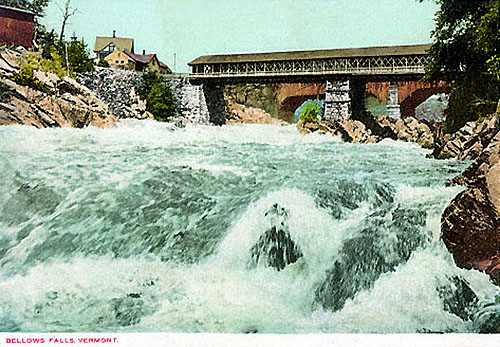
Off they went! Half the family, it would seem, exited North Easton to accompany Oakes Angier on his trip to Burlington, Vermont. Obviously, the group traveled first from North Easton to Boston, where they boarded a train, most likely, and departed at noon. Six or so hours and about 100 miles later, “much fatigued and covered with dust,” they disembarked at Bellows Falls, Vermont, a small village on the state line between New Hampshire and Vermont.

The village may have been small, but its location on the Connecticut River and its powerful falls made it a fine industrial site. Two railroads already met there, and a mill industry thrived. The bridge across the water – a later version of which is featured in the postcard illustration above – added to the picturesque quality of the town.  Evelina found it “very romantic.” Today the village is part of the larger town of Rockingham, whose population boasts a little over 5,300.