October 28, 1851

fig7

*

Tuesday Oct 28.  Have been assisting Mr Scott about papering

again to day and have painted over some things

and places about the house. Finished papering the

sitting room and little entry just after dinner

Hannah called with Eddy a few moments

Mr Ames is still in Boston passed last

night there.  I spent the evening in the other

part of the house.


Yesterday’s unseasonable snow storm departed and left behind “a fair day**”  Evelina seemed not to notice the difference, focused as she was on the repapering and repainting of the downstairs of her part of the house. She was helping with the actual papering. Her husband, Oakes, was away in Boston, so her only responsibility was making sure that meals were on the table for sons Oakes Angier and Frank Morton and daughter Susan Eveline, a task she typically delegated to her servants.

Hannah Lincoln Gilmore, who was married to Evelina’s nephew, Alson “Augustus” Gilmore, paid a call with her older son Eddy. Edward Alger Gilmore was a toddler who had fidgeted more than once in his great-aunt’s parlor. He was only two years old, and probably couldn’t yet pronounce his name.

Eddy’s middle name came from his maternal grandmother, Rachel Howard Alger (1802-1823), the first wife of Alson Gilmore and mother of Hannah’s husband, Augustus.  Rachel died less than a year after Augustus was born; Augustus couldn’t have remembered her, but he clearly wished to honor her by naming his own first-born after her. The Alger family was settled in Bridgewater, Taunton, and Easton, all descendants of a Thomas Alger in the 17th century. Both Evelina and Sarah Lothrop Ames were among the hundreds of descendants in the Thomas Alger line.


* Illustration in “Scientific American”, ca. 1880, of machine production of wallpaper, New York, Courtesy of National Park Service, http://www.cr.nps.gov/history/online_books/tpsd/wallpaper.

** Oliver Ames Journal, courtesy of Stonehill College Archives


October 19, 1851

OLYMPUS DIGITAL CAMERA

Sunday Oct 19  Last night was very stormy, rained very fast

and heavy wind.  This evening is very pleasant

but it has rained all day so that none of the 

family went to meeting  Alson came after Lavinia

about three Oclock  I have been reading most

all day “Olive”  It is rather interesting but wish 

I had spent the day more profitably

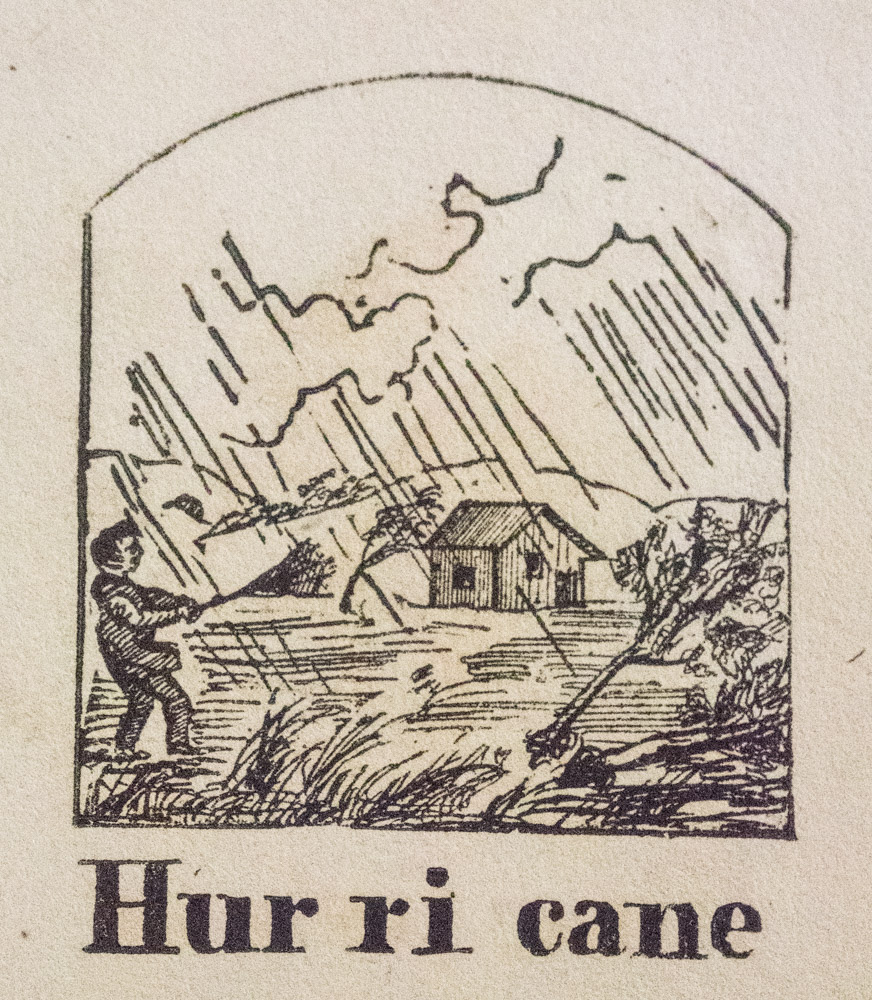
Evelina’s father-in-law, Old Oliver Ames, also recorded the day’s bad weather in his daily journal: “it began to rain last night + this morning there is a north eas[t] storm + the wind blows verry hard. it stormed nearly all day but was clear at night – there was an inch + a half of water fell”

According to the weather record for 1851 – the first year that Atlantic hurricanes were officially tracked – the storm that Evelina and Old Oliver describe was Tropical Storm #6. It made landfall in Rhode Island, thus its impact on nearby North Easton would have been severe. Despite the rain and wind, the buildings in the Ames complex appear to have come through fine. Old Oliver would have mentioned it otherwise.

For the fourth week in a row, Evelina missed church. One Sunday, there had been no service; on two other Sundays, she had been ill and today, weather prevented attendance. She was probably missing her weekly dose of religious direction from Reverend Whitwell and social interaction with her fellow Unitarians.  She occupied herself by reading “Olive,” which was most likely a domestic novel in the genre that she often read.  It would have been the kind of book that Old Oliver called “love trash.”

October 16, 1851


OLYMPUS DIGITAL CAMERA

*

Thurs Oct 16th Lavinia came back with O & F and spent the 

night  Sat with her awhile and sewed some on

the waist of my dress and sewed some buttons on

Franks vest  Went with Augustus with her

about Eleven and stopt an hour.  This afternoon

have been to Augustus Lothrop with Mrs S Ames

He has been sick about a week with the

Typhoid fever.  Bought 3 Bl apples of N Alger

Mrs Swain has a son born this morning

Evelina’s niece, Lavinia Gilmore, stayed the night with the Ameses, having ridden from the Gilmore farm with her cousins Oakes Angier and Frank Morton Ames.  Lavinia often visited with the Ameses in North Easton, evidently enjoying the bustle that the village of North Easton provided, relative to life on the farm. Today she sat and sewed with her aunt, who always enjoyed company while sewing. Somewhere along the way in today’s comings and goings, Evelina purchased three bushels (or barrels) of apples from Mr. N. Alger, a probable neighbor of Lavinia and her family.

In the afternoon, Evelina went with her sister-in-law, Sarah Lothrop Ames, to visit one of Sarah’s many brothers. This youngest brother, Horace “Augustus” Lothrop, lived in nearby Sharon where he ran a cutlery company.  He was quite ill with typhoid fever, a bacterial disease that was all too common in the 19th century. Spread by unsanitary conditions, typhoid fever killed more than 80,000 soldiers during the Civil War. Happily, Augustus Lothrop would survive his bout with the disease.

Another survivor today was Ann Swain, who came safely through the birth of her first child, a son. No doubt the relatives who had gathered to help were thankful and pleased.


Illustration of nursery furniture from Godey’s Lady’s Book, 1851

October 13, 1851

OLYMPUS DIGITAL CAMERA

Oct 13th  Susan washed the […] dishes this morning and 

went to sewing quite early made the sleeves

to my cashmere dress and pocket made and

have got all ready for Julia to cut the waist in 

the morning.  Spent most of the afternoon in the

other part of the house  Mrs Willis died about

one or two Oclock this afternoon


“[V]erry warm and sultry like dog days” was Old Oliver’s assessment of today’s unseasonal weather. Evelina didn’t complain about it, nor did she mention any discomfort from the nettlerash that had plagued her for the last ten days.  Perhaps the burning and itching was finally subsiding.

Mrs J. Willis died today. There were a few women in North Easton who might have been this person; a possible candidate was a 44-year-old woman named Hannah Willis who lived in the Pauper’s House with her probable father-in-law, James Willis, and a child named James W. Willis. She had done some sewing for Jane McHanna back in March.

Evelina herself spent the morning with a needle and thread, making the sleeves and pocket for a cashmere dress.  She planned to use the services of Julia Mahoney to sew the waist. In the afternoon she went to the other part of the house, presumably to visit with her sister-in-law Sarah Witherell and a guest, Susan Orr. Given the heat and her slow recovery, Evelina moved around surprisingly well.

October 9, 1851

IMG_1057

Thursday Oct 9th  Jane has been sick to day went to bed directly

after washing the breakfast dishes and I had to get

dinner  After dinner she was much better and was

able to […do] the dishes  This afternoon I have passed

in Olivers with Miss S. Orr.  Mrs Witherell & Mitchell

Mr Ames & William there to tea Have trimmed

Susans bonnet with dark ribbon


Jane McHanna was sick.  The domestic team at the Oakes Ames house was barely operational, what with Evelina herself still feeling the effects of a mean case of nettlerash. But between them, the two women, servant and mistress, managed to make meals appear on the dinner table in a timely fashion. Did the men of the house appreciate the extra effort going on behind the kitchen door?

Tea was a special event today, served next door at Oliver, Jr. and Sarah Lothrop Ames’s. Present were five of Old Oliver’s six surviving children: Sarah Witherell, Harriett Mitchell, Oakes Ames, William Leonard Ames, and the host, Oliver Ames, Jr. William was visiting, if not from New Jersey, then from his current way station on his journey to Minnesota. Harriett, too, held visitor status;  she and her children were about to return to her husband in Pennsylvania. Only Sarah Witherell, Oakes, and Oliver Jr. lived in North Easton and saw one another regularly.

Missing from the group was Horatio Ames, who lived down in Connecticut. No one’s favorite sibling, some – Oakes, particularly – may even have appreciated his absence. Interesting that Old Oliver himself isn’t mentioned as being present.

Another guest who was also there at this rare gathering of the clan was Miss Susan Orr, a long-time family friend (or relative?) who had known the group when they were children. She could remember Oakes Ames as a baby. Susan had been staying with Sarah Witherell and Old Oliver for about ten days. Meanwhile, a different Susan, only nine-years-old, got her bonnet trimmed with a new ribbon.


October 2, 1851

9904548_1_l


*


Oct 2d Thursday  Helped Ellen quilt some this forenoon 

She seems to do pretty well at it

Mrs Elijah & Ellen Howard & Mrs Abba Leach

spend the day and evening in the other part

of the house  I was there at tea.  Oliver &

wife have been to her fathers  Mr Ames has been

to Boston   Lavinia Williams came in the stage

with him but he did not speak to her

Evelina and her servant, Ellen, worked on the new quilt this morning .  Evelina had set the quilt up in the sitting room using a frame that could be dismantled and stored. The frame would have had four wooden legs at the corners, such as those in the illustration above.  Long boards around which the quilt edge was wrapped would have been fastened into the corners, creating an adjustable rectangle on which the women could work.  When finished the pieces of wood would be stowed away until needed again.

In the other part of the house, Sarah Witherell welcomed Nancy Howard, her daughter Ellen Howard, and Mrs. Abba Leach for the day. The women made a social visit that lasted all day and into the evening. Did they bring any needlework or sewing with them, or was conversation the only occupation? Evelina dropped in for tea, but Sarah Lothrop Ames from next door didn’t join them. She and her husband Oliver Jr were calling on her parents, the Hon. Howard Lothrop and his wife Sally. The Lothrop family may still have been wrestling over how to manage the family farm since the death of Clinton Lothrop, Sarah’s younger brother.

From Boston, where he was probably collecting orders for shovels, Oakes Ames returned home on the stagecoach where he sat with an acquaintance of Evelina, Lavinia Williams.  Mrs. Williams was the wife of Cyrus Williams, a local farmer of some means. Evelina seemed surprised that Oakes and Lavinia didn’t converse en route.

Even as Evelina was looking back at the day’s small social exchanges, she was beginning to feel unwell, something she wouldn’t report for another few entries.


September 21, 1851

1525-105430-a-flumere

*

Sunday Sept 21st  Have been to meeting  Mr Ames & self came

home at noon and Horace Pool came with us

and they rode up to the great pond where they are

building a new floom.  Brought Abby Torrey from

meeting & carried her back  She & Malvina are spending 

a week at Alsons  Miss Latham & her brother Edward

came to our meeting this morning and to the other 

part of the house after  I called into see them

The new flume going in at Great Pond was attracting local attention. After church, Oakes Ames and Horace Pool rode up to see it. Oakes had been in Boston when his father, Old Oliver, had begun the work, and no doubt he was curious to see the progress.  No one would have been working on it today, as it was Sunday.

The flume was intended to harness water power for the shovel factory. It was basically an inclined ditch lined with stones and boulders to shunt the water along. Some flumes – such as those used in lumbering – are lined with wood, but that wasn’t likely to be the case here, given the scarcity of wood, the availability of stones, and the expectation of longevity. Old Oliver’s oxen must have been used to haul the many stones, and man-power used to put each one in place.  The channel itself would have been dug with Ames shovels, naturally.

Evelina, perhaps moving about slowly on sore feet, went to church and caught up with various friends and family members, including nieces Abby and Malvina Torrey. She popped into the other part of the house – the section lived in by Old Oliver and his daughter Sarah Witherell – to greet some visitors there.  She was settling back into her routine after the Boston holiday.

Photograph of an old flume, blogoteca.com/afonsoxavier, courtesy of Hadrian


September 20, 1851

Train

Sat Sept 20th  Was out shopping all day purchased a number

of articles among the rest a Cashmere & french print

dress paper for my parlour brought home two chairs

from Bigelowes  We all returned home this evening

Frank came to Stoughton after us & rode back

on the stage.  Went into Olivers awhile this evening.

Have had a great deal of trouble with my feet while

I have bee[n] gone & to night they are very sore.

The Boston spree continued for most of the day as Evelina walked and shopped for everything from fabric to wallpaper to furniture.  She and Oakes brought their purchases home on the train (or “in the cars” as they might have said) to Stoughton. It was, finally, time to return to North Easton.  Son Frank Morton Ames met them at the depot with a carriage – or wagon –  but rode home by himself on the local stagecoach. The conveyance he brought to the group getting off the train was, perhaps, too crowded with goods from town to fit everyone in.

Perhaps not wanting to let go of the many sensations that three exciting days in the city had produced, Evelina went next door to Oliver Jr and Sarah Lothrop Ames’s house. They had returned the day before, and so missed the fireworks. Surely they compared notes on their experiences at various events at the Railroad and Steamship Jubilee.  They may have compared blisters and sore shanks, too.  They did much walking and standing during their junket, and Evelina at least was feeling the effects. Her feet hurt.

Meanwhile, never having bothered to go into town for the celebration, Old Oliver was moving ahead on improvements for the shovel shop.  In his journal he noted that “this was a fair day wind south west and quite warm we put in the bottom stone for the floom at the great pond to day and the 5 foot one on the east side of it.” A flume for the factory was going in at Great Pond.

September 17, 1851

Ruth_Morrill_wife_of_Justin_S._Morrill


*

Wednesday Sept 17th  Mrs Stevens left for Boston

this morning & sorry I am to have her go

Miss Eddy dined with Mrs Mitchell &

took tea at Olivers  I went in to tea but

went in but a few moments before as I have

been very busy all day.  Made about a dozen

Lbs of peach preserve & some grape jelly

Ruth Swan married to night Oakes A & Mrs H Mitchell

gone to the wedding

The Great Railroad and Steamship Jubilee kicked off in Boston today with the arrival of President Millard Fillmore and other dignitaries from the United States and Canada, all ready to express mutual congratulations over the new railroad and steamboat connection between their countries.

Evelina knew about the events in Boston but stayed focused on domestic responsibilities in North Easton. From fruit she had recently obtained, she made preserves and jelly, a day-long task that kept her “very busy”.

In the evening, her son Oakes Angier Ames and sister-in-law Harriett Ames Mitchell went to the wedding of Ruth Barrell Swan and Justin Smith Morrill of Vermont.  Ruth, a daughter of Dr. Caleb Swan and his first, late wife, was 28 years old and, in the culture of the day, was marrying late. Independent of the affection she must have felt for him, she may also have thought that he was worth the wait. Three years later, Justin Morrill was elected to the U.S. House of Representatives where he served until 1867, when he became a U.S. Senator. He served the state of Vermont until his death in 1898. A founder of the Republican party, he was a leader in establishing the land-grant colleges with his Morrill Land Grant bill in 1862. That same year, he authored the Anti-Polygamy Act which was aimed at the Church of the Latter Day Saints. He was clearly a one-woman man, and that woman was from Easton.

Ruth Ballard Swan of Easton who married Justin Smith Morrill.

September 9, 1851

DSCF2567small

 *

Tuesday 9th  Frank & Mrs Mitchell returned this

morning & Oakes A went from Bridgewater to the

convention at Springfield.  Mother Mrs

Stevens & self & Susan passed the afternoon

at Mr Torreys.  The Col was very clever

gave us lots of peaches.  Harriet Mitchell

came home with them this morning and spent

the evening here.

Evelina and others enjoyed an afternoon call on John Torrey, who was evidently quite amusing, and came home with at least one basket of peaches. Frank Morton Ames brought his Aunt Harriett Mitchell back from a party in Bridgewater, but his oldest brother, Oakes Angier Ames, didn’t return with them. Instead, he traveled west to Springfield, probably by rail, to attend a Whig Convention. At the age of twenty-two, Oakes Angier was diving into politics, and the Whigs in Easton thought well enough of him to represent them at the meeting.

Led by Senators Henry Clay and Daniel Webster, the Whig Party had developed in the 1830’s as an anti-Andrew Jackson party, and had managed to put four presidents in the White House, including its present occupant, Millard Fillmore. The party would soon dissolve over the issue of slavery, leading many of its northern adherents to attach themselves to the new Republican Party. Many were against slavery because it conflicted with an economy based on free-trade. But in the meanwhile, the Whigs wanted modernization and strong policies to guide economic growth.  Jeffersonian in their preference for Congress over the Presidency, they would have said they opposed tyranny.

The convention in Springfield was held on one day, September 10, “to make the customary arrangements for the annual State elections”.*  The group of about 1,000 attendees nominated the Hon. Robert C. Winthrop of Boston as candidate for Governor and the Hon. George Grennell of Greenfield as candidate for Lieutenant-Governor. The keynote speaker at the convention, Ezra Lincoln, spoke of state matters, but spent a moment on national issues as well:

“…[I]t is felt throughout the country that a crisis of no ordinary difficulty exists. Whether we look to the debates and the proceedings of Congress; to the popular elections throughout the country; to the tone of public opinion, as indicated throughout the Union by the press, and the discussions everywhere taking place, we cannot be insensible to the fact that the stability of our institutions is put to a severe test.  It is probably left to this generation to ascertain, by a severe experiment, the soundness and vitality of those principles which were embodied by our fathers in these Constitutions, as well as of the several States, as of the Union…” *

Oakes Angier and others at the convention could not have known how severe the experiment ahead of them would be.

* Proceedings of the Whig State Convention, Held at Springfield, Massachusetts, September 10, 1851.