May 7, 1852

il_340x270.517720740_i0s3

Polyanthus

Friday May 7th  Was in the garden to work a short

time transplanted some pinks but worked on

Olivers clothes most of the time.  Mr Brown &

Oliver rode to Mr Copelands and got me a polyanthus

and to the furnace in the afternoon to Canton 

and Sharon.  Mrs S Ames returned from Boston to

night & Helen with her  Helens face is very

swollen has not been to school for a week


With her middle son Oliver home from Brown, Evelina had a great deal of mending to tend to. She might have preferred to be in her flower garden, but she only had a short window in which to repair her son’s shirts, hose, and coats. Oliver, meanwhile, rode out with his college roommate, Mr. Brown. They roamed from Easton to Canton and Sharon and in the process picked up a polyanthus, or primrose, for Evelina. They got the latter from a Mr. Copeland, who was perhaps Josiah Copeland, an elderly resident of Easton who lived with his wife and unmarried daughter.

George Witherell continued to be ill in the other part of the house, but he wasn’t the only family member who was ailing.  Helen Angier Ames had to come home from boarding school because of a swollen face. Perhaps she had an infection – an abcess of some sort – or perhaps she was having an allergic reaction to an insect bite or other allergen. Whatever was ailing her, she hadn’t attended class for a week, and her mother had to fetch her home.


May 4, 1852


IMG_0159

Trellis on the door of the home of Oakes and Evelina Ames and extended family, ca. 1860


Tuesday May 4th  Mr Healy & Morse commenced the trellis

for our front door  We had quite a consultation how it should

be made  I[t] was very cold & windy this morning & I fear I

have taken cold in being out so long  Have mended Olivers

sack and cut the pattern and have done some other mending

Augusta made a long call. It is really very pleasant to have

her so near.  Mrs S Ames went to Boston

The trellis that Evelina refers to today could very well be the modest trellis that graces one of the doors in the above photograph. The doorway facing the street in the approximate middle of the photograph was the door that Evelina, Oakes, and their family used for their own. The doorway on the far left, facing the yard, was likely the entry that Old Oliver and his daughter, Sarah Witherell, used. The house on the far right was a separate dwelling that belonged to Oliver Ames Jr. and his wife, Sarah Lothrop Ames.

None of these buildings is still standing. The one on the far right was torn down in 1863 and replaced by a larger, more formal house that is still extant today, with lovely gardens and a well-kept air.  The house in the center, halved on the interior to accommodate the two households of Evelina and Sarah Witherell, was torn down in the 1950s, at the behest of Oakes Angier Ames’s eldest son, Hobart Ames. The site has since been reclaimed by trees and undergrowth.

The trellis was meant to add a fashionable air to Oakes’s and Evelina’s side of the house. Evelina was trying to bring the simple, old Federal dwelling into the Victorian age, inside and out. She had a particular vision for her home, and she worked hard to realize it. Small wonder that the construction required “quite a consultation.”


April 6, 1852

330px-Harriet_Beecher_Stowe_c1852

Harriet Beecher Stowe

(1811 – 1896)

1852

April 6th  Tuesday  We have had one of the driving

snow storms of the season  the snow is very

much banked.  We have been reading Uncle

Toms Cabin  Susan has read to us most of the

time  have been sewing & mending.  Orinthia hemmed

a black cravat for O Angier and sewed some

on Susans pink apron.  Have made a little needle

book for mother

Yesterday, Evelina and Orinthia had been in Evelina’s garden planting flowers. Today the two women sat indoors “sewing & mending” because the unstable spring weather had brought on “one of the driving snow storms of the season.” According to Old Oliver, the snow “was all in heaps and the wind blowing verry hard from northeast” *

Yet the women weren’t disconsolate. While they sewed, Evelina’s daughter Susan read aloud to them from Uncle Tom’s Cabin, a popular new novel. Originally published in serial form in the National Era, an abolitionist periodical out of Washington, D. C.,  the full book had just been published in Boston by John P. Jewett and was on its way to becoming the best selling work of fiction of the 19th century.

Written by Harriet Beecher Stowe, Uncle Tom’s Cabin, or a Tale of Life Among the Lowly tells the story of two Kentucky slaves, Tom and Eliza, who are forced to leave their home plantation and make their way in a hostile society, one sold south, the other escaping north. It was a tale that gripped readers north and south, within the country and abroad, and provoked various imitations, interpretations and theatrical iterations. It has never been out of print.

Mrs. Stowe was not only an author, mother of seven children and wife of a Biblical scholar and educator; she and her husband were also active abolitionists. For a number of years they had lived in Cincinnati, Ohio, an active depot for escaping slaves, where they were participants in the Underground Railroad and personally helped hide slaves on the run. When the Fugitive Slave Act was enacted in 1850, Mrs. Stowe was distraught. She wrote Uncle Tom’s Cabin in protest.

How might Evelina have liked Uncle Tom’s Cabin?  Very much, one suspects. Though hardly an active abolitionist, Evelina was sympathetic to the slaves. After the Civil War, she even tried to hire some freed black women to come work for her but, according to her grandson Winthrop Ames, the plan never worked out.

*Oliver Ames Journal, Stonehill College Archives, Arnold Tofias Collection

April 2, 1852

Ox

1852 March [sic] 2d Friday  Have been mending pants for Frank

Made a long call on Mrs S Ames in the morning

Have been sweeping and dusting.  Mrs S Ames dined

in the other part of the house  I carried my sewing

in there a couple of hours this afternoon  Oakes A

went to Mr Howards after Orinthia this evening

Frank is not well and did not go  Have

written a letter to Mrs Norris  Augusta here this evening

After yesterday’s April Fool’s fun, Evelina resumed her domestic routine. She swept, dusted, mended, sewed and wrote a letter to a friend. Same old, same old. Her son Frank Morton, however, was under the weather, but her oldest son, Oakes Angier, was fine and even went out for the evening after work.

Old Oliver Ames, meanwhile, also resumed some of his routine, most of which had been disrupted by the shovel shop fire a month earlier. He was occupied by planning for the new stone factory buildings, but as he listened to the rain fall, he knew it was almost planting time. The farmer in him was getting ready for a new growing season. Perhaps in recognition of that, he “bought a yoke of oxen to day of Samuel Clap for $117-50.”*


March 25, 1852

OLYMPUS DIGITAL CAMERA

1852

March 25  Thursday  Quite a heavy snowstorm this 

morning but it soon cleared and the sun came out

bright and for a short time the trees were clothed

with snow and were realy beautiful to behold

Have been mending quite a number of 

garments that were laid by from time to time

thinking I would mend them at a more convenient 

opportunity but that time seldom comes especialy

if it is what I dislike to do

Evelina had a quiet day, within and without. The snowstorm and its immediate aftermath produced a beautiful hush over the village. The trees in her backyard, along the Queset, were “clothed in snow,” and “beautiful to behold.”  This would be one of the last snowstorms of the season.

It was a lack of activity, perhaps, that made Evelina introspective today. She was more apt to describe her days in external terms, as in what she did and where she did it; but on this day she looked inward and faulted herself for not doing her duty. Because mending was so disagreeable to her, she was apt to procrastinate in tending to it. On this quiet day, she had no excuse not to do it.


*Photograph by John S Ames III

March 18, 1852

images-2

1852

March 18th  Thursday  A very heavy rain storm to day

Amelia Orinthia & self have had a quiet day

but mine has not been pleasant work, have

mended Mr Ames old shop coat have put new

cloth in the under part of the sleeves, mended

button holes so, think it will last some time.

Also mend Franks pants  Orinthia has been 

to work on her delaine dress

The women at the Ames residence stayed indoors today, held inside by “a cold driving rain storm.”* They sewed, naturally, but Evelina didn’t particularly enjoy herself. Orinthia got to work on a new dress, but Evelina had to mend her husband’s shop coat and her son Frank’s pants. Mending was never as much fun as sewing, but it was essential. As we have noticed before, Evelina was devoted to making things last. Like other Yankee housewives, she had been brought up to: “Eat it up, wear it out, make it do or do without.”**

Yet as the family grew more wealthy, Evelina began to enjoy the luxury of not doing without. She shopped in Boston for fashion accessories and household items that she would never have had in her youth. As modern historian Jack Larkin has pointed out, a “household’s furnishings constituted a material world that defined the limits of comfort, heating and lighting, and filled functional needs for sitting, sleeping and eating, but they also spoke of Americans’ economic status and aspirations.”***

Old habits die hard, as we know. The Ameses had money, and Evelina didn’t have to mend her husband’s shop coat; she could have insisted that he buy a new one, or she could have sewn one for him, perhaps. Her ingrained sense of economy, however tempted by the changing world around her, wouldn’t allow it. William L. Chaffin, the town historian who knew the Ames family, described Evelina as “economical” in his late-life remembrance of Oakes Ames, and shared the tale that Oakes joked about Evelina at the dinner table, suggesting to guests that his wife wanted them to help themselves to preserves that were going bad so she could use them up.

On this day, rather than demand that her husband purchase a new work coat – which we can surmise he had no interest in doing – Evelina fixed up the old one, and sighed that she wasn’t sewing a new dress instead.

*Oliver Ames, Journal, Stonehill College Archives, Arnold Tofias Collection

** A 20th century, World War II-era version of this maxim was “Use it up, wear it out, make it do or do without.”

***Jack Larkin, The Reshaping of Everyday Life, 1988, p. 264


March 5, 1852

charred-wood-texture_61-1902

Charred Wood

1852

March 5th Friday  Have been mending pants most all

day that were worn at the fire  Lavinia

went to Augustus’ this forenoon and Augusta

went this afternoon.  Mr Scott & Holbrook have 

finished painting the entry and chamber

got through about four Oclock.  I was in

Olivers about an hour this afternoon.  This 

evening received another letter from Harriet Ames


The women of Easton had work to do, too, in recovering from the factory fire.  Surely Evelina wasn’t the only housewife in North Easton who had to repair or clean clothes worn by their husbands, brothers or sons the night of March 2. Needles were out and laps were full as women all over town tended to the rips, tears and soot. Conversation probably centered on the fire as they worked.

The day itself was cloudy and cold, the smell of the charred buildings dampened by a light snow that fell overnight. Yet the cleanup continued. As the men worked at the site, hauling timbers and shoveling up debris, their blackened soles left ashy footprints in the snow, footprints that quickly turned into grime. Many a man was made to wipe or remove his shoes before entering his house for midday dinner.

Evelina stayed focused on her domestic responsibilities. Mr. Scott and Mr. Holbrook were back on task in her parlor, painting and papering, and finished up at the end of the afternoon. Evelina spent some time next door with Sarah Lothrop Ames, and got a letter from cousin Harriet Ames, with whom she had been corresponding lately. And perhaps under her direction, her niece Lavinia and niece-in-law Augusta were looking after their sister-in-law, Hannah Lincoln Gilmore, who was laid low with a mouth infection and a weaning baby. Fire or no fire, life was moving forward.


February 23, 1852

Looking glass

Monday 23d Feb 1852  Worked about the house this forenoon

dusted the chambers and washed around the

windows &  doors.  Susan washed the dishes. Am

trying to have her learn to knit, improves some

but rather slowly  This afternoon have been mending

some and have put one new sleeve into my

blue & orange Delaine  The looking glass came

out from Boston to night

We might call it a mirror, but Evelina and most of her contemporaries called her new purchase a looking glass. (Think of “Through the Looking Glass and What Alice Found There,” Lewis Carroll’s 1871 sequel to his 1865 “Alice’s Adventures in Wonderland.”) Like the framed prints Evelina had recently bought for her walls, the looking glass was a fashionable piece of decor. She must have been tickled to have one hanging in her parlor.

New “methods of mass-producing large, flat panes of glass had been perfected and, by combining them with heatless, chemical-coating technologies,”* mirrors had become easy to manufacture – and affordable.  At mid-century they became stylish and ubiquitous, symbolic of the new taste and purchasing power of the middle class. In a home like Evelina’s which, 50 years earlier, might have boasted no more than a small, courting-type mirror, a big, new looking glass, hung on braided silk roping from molding above it, had become de rigeur.

Other than this exciting upgrade in the parlor, today was a Monday like any other. Jane McHanna did the laundry, Susie Ames washed the breakfast dishes, and Evelina took to her needlework.  She was teaching her daughter to knit.


*Wikipedia, Mirrors, accessed February 19, 2015.

February 21, 1852

 21621-004-0B1C48DE

Angelina Grimke (1805-1879)

1852

Feb 21st Sat  Spent all the forenoon mending Mr Ames

shopcoat.  Cut Susan a pink long sleeve apron and

Orinthia sewed on it  Have finished Mr Ames another

dickey which makes seven that I have made lately

This afternoon carr[i]ed Mrs Solomon Lothrop &

Orinthia to mothers.  Orinthia stopt at a sing at

the Schoolhouse near Doct Swans  Frank went and

brought her back.  Mrs S Ames called this evening to 

settle and paid me 1,70 cts which makes us even

Normal wintertime activities went on under a sky that Old Oliver described as “fair in the fornoon + cloudy afternoon + much warmer.”*  Evelina mended, sewed and socialized with her friend and former boarder, Orinthia Foss; she also settled accounts with her sister-in-law, Sarah Lothrop Ames. Per usual, Oakes Ames went into Boston.

It was in Boston, in fact, on this date fourteen years earlier that for the first time ever in the United States, a woman addressed a legislative body. On February 21, 1838, abolitionist Angelina Grimke presented the Massachusetts Legislature with an anti-slavery petition signed by 20,000 Massachusetts women. In a speech that was lauded by abolitionists, deplored by traditionalists and parsed by all, she not only called for the abolition of slavery, but declared the right of women to act politically. “We are citizens of this republic and as such our honor, happiness, and well-being are bound up in its politics, government and laws.”**

Daughter of a southern slave-holder, Angelina (known as “Nina” in her family) and her older sister, Sarah Grimke, also an active abolitionist, faced predictable opposition as they transgressed convention. Angelina’s speeches in Boston and elsewhere drew taunts, outrage, disbelief, and disrespect. The Congregational clergy of Massachusetts condescended together one Sunday and, across pulpits, accused Grimke of jeopardizing “the female character with widespread and permanent injury.” Others – men and women – were impressed. One member of the audience at the statehouse said, “Angelina Grimke’s serene, commanding eloquence [she spoke for two hours] enchained attention, disarmed prejudice and carried her hearers with her.”**

How might the Ames clan have reacted?


*Oliver Ames, Journal, Stonehill College Archives, Arnold Tofias Collection

**www.massmoments.org


February 19, 1852

images-1


1852

Thursday Feb 19th  Have been to work on Olivers clothes getting

them ready to go back to school  Have spent the

whole afternoon mending a coat for him which he

has spoiled wearing it in the shop  Augusta was

here this afternoon did not stop to tea.  Lavinia called

came up to bring Mrs Lothrop & son to Willards

Susan & self have spent the evening at Willards

Oliver came after us about nine Oclock

Finally, Oliver Ames (3) was going back to Brown. He had been home in North Easton, on a break, since January 21st. Evelina had her hands full mending a coat “which he has spoiled” so he could take it back to Providence. He wore it while working at the shovel factory and damaged it somehow. There was no time – and probably little inclination – to get a new one made for him. His mother had to fix it.

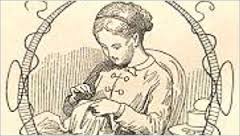
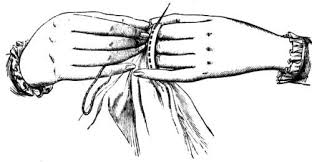
As Caroline Healey Dall, a contemporaneous female in Boston during this era, commented at one point in her mid-19th century diary, it was “a lonely, dull day – stitch, stitch, stitch.”* For most of the 19th century, all women sewed, and sewed often. Sometimes sewing was fun or companionable or rewarding; sometimes it wasn’t.  It was more often a necessity, a chore, and for Evelina today, the uninteresting and obligatory side of sewing prevailed.

Fortunately, Evelina had a few visits today from her younger female friends and relatives to help the time pass. Augusta Pool Gilmore visited in the afternoon – possibly with her own needle in hand – and niece Lavinia Gilmore called, having come into town from the family farm. In the evening, Evelina and her daughter Susan spent the evening with one of Easton’s more eccentric characters,Willard Lothrop, a medium. Oliver Ames (3) “came after” them after dark, probably anxious that all was ready for his return to college in the morning.

*Caroline Healey Dall, Daughter of Boston: The Extraordinary Diary of a Nineteenth Century Woman , ed. Helen R. Deese, Boston, 2005, p. 314