April 11, 1851

Old Oliver Ames


1851

April 11th Friday.  This morning sat down with Lavinia

quite early but did not feel very well.  Washed & ironed

the skirt of my foullard silk dress ready to make 

over  This afternoon went with Lavinia into school 

and then to Mr Torreys and stoped a hour or two

Abby & Malvina came home with us and were here to

tea also Augustus  Quite windy this forenoon 

Oliver Ames, known to Evelina as “Father Ames” and to us as “Old Oliver,” turned 72 today. He didn’t mention his birthday in his journal and the likelihood is that no one else mentioned it either.  He was not a person who encouraged frivolity. As the man who built O. Ames & Sons and made the best American shovels of the 19th century, Old Oliver was well known in his time, as this excerpt from a 19th century biographical sketch shows:

“Hon. Oliver Ames, the founder of the great manufacturing firm of O. Ames & Sons, was born at Plymouth, Mass., April 11, 1779, being the youngest son of Capt. John and Susannah Ames, and was a lineal descendant of William Ames, who came to this country in 1638 and settled in Braintree, Mass. His early education was gained by ordinary common-school instruction, and by the practical experiences of hard work in his father’s blacksmith-shop. These furnished him the groundwork of sober judgment, industrious habits, and a stable and energetic character. At the age of eighteen he went to Springfield, where he learned the trade of gunsmith. In April, 1803, he married Susannah Angier […] and commenced the manufacture of shovels. After a stay of over two years at Easton, he removed to Plymouth to manufacture shovels for Messrs. Russell, Davis & Co. […] until about 1813, when he returned to Easton […where he] had purchased land and a good water-privilege, and had begun the erection of a dwelling-house.

He was one of a company to build a cotton-factory for the manufacture of cotton fabrics. He had manufactured hoes and shovels during his first stay in Easton, but on his second arrival he began again the business that has now become world-famed. Difficulties and embarrassments that would have defeated any one but a man of great ability and persistent energy beset him in these early days. The cotton-factory burned; the war of 1812 had had a disastrous effect upon business; he was endeavoring to restore the business of his father to a prosperous condition; and he had made great outlays in getting established at Easton. But his credit was good and his courage strong; his character and ability alike inspired unlimited confidence; and he worked steadily on to a sure and lasting success.

With only a humble beginning, shovels being made by hand and carried to market upon a one-horse wagon, the business steadily increased, shop being added to shop, workmen increasing by scores, until it has become by far the largest and most prosperous shovel business in the world. He would never allow any work to be sent to the market that was imperfect, and he thus laid the foundation for the great reputation which the Ames shovel has borne, and which it continues to bear.

In 1828-29 he represented his town in the Massachusetts Legislature, serving with marked ability upon the Committee on Manufactures. In 1845 he was elected, contrary to his desires, and by a large vote, to the Massachusetts Senate. He was, however, no lover of office, and desired only that he might have the charge of the highways of his town intrusted to him, a charge he took pride in, and faithfully fulfilled. He was a man of strong and resolute will, of great force of character, indomitable energy, and persevering industry. He was the possessor of a splendid physique, and easily bore off the palm in all feats of strength and skill, especially in wrestling, of which he was very fond. His manly and dignified bearing gave everyone who saw him the impression that they looked upon a man of mark. He was such a man as a stranger, meeting upon the street, would turn to look at a second time. Born of the people, he was always very simple in his tastes and democratic in his feelings and principles. In his likes and dislikes he was equally decided, but his judgments were based upon what he believed to be the real worth of any one, without reference to his station or condition.   He was consequently greatly respected and beloved by his neighbors and fellow-townsmen. He was enthusiastically fond of farming, and, like Daniel Webster, was especially fond of the oxen, always obtaining the best, and taking great pleasure in their management. He took an early stand, both as a matter of principle and practice, in favor of temperance, and brought up his family according to total abstinence principles. He was a decided Unitarian in his religious convictions, having a cordial dislike to the rigid tenets of the Calvinism of his day. He was liberal in his aid of religious institutions, to which he also gave the sanction of his personal attendance. His charities were large, and they were not bounded by the limits of his sect or neighborhood. His defects were such as pertained merely to his limited culture and to the stern conflict and discipline of his early life. Mr. Ames lived to the ripe old age of eighty-four years, dying at North Easton, Sept.11, 1863.”*

*Duane Hamilton Hall, ed., History of Bristol County, Massachusetts,Vol.2, Philadelphia, 1883


January 28, 1851

Pray

1851

Jan 29th Tuesday  This morning sit down quite early to 

making a carpet bag of pieces that were left of the parlour

carpet.  This afternoon cut a place in the drugget for

the parlour register  Abby & Malvina passed the afternoon

here and this evening.  Mother Abby & myself have been

to a prayer meeting at Mr Bucks.  Mr Buck, wife &

their children all spoke & prayed  Charley best of all.

Abby made a few remarks & a number of others.  Cloudy.

It appears that the recent domestic mishap of spilled varnish on the parlor carpet was solved by the installation of new “drugget” or carpeting. The change of carpeting must have been in the works before Evelina’s purchase of drugget in Boston two weeks back.  After the rug was installed (by whom?,) Evelina scavenged enough scraps from the cutting to begin to assemble a carpetbag for herself.  Waste not, want not.

The mention of cutting the rug to fit around a register helps confirm the existence of a central furnace in the old house.  In fact, Old Oliver had installed coal furnaces only recently on his property, in the counting house or office as well as in the residence.  Coal as fuel was a marked change from earlier days when the family had relied on wood-burning fireplaces for heat.  Oakes Angier must have been pleased with the change.  According to his grandson Winthrop, Oakes Angier detested the old fireplaces, remembering that they  “broiled you on one side while you froze on the other.” *

Tonight Evelina took her mother and niece Abby Torrey to a prayer meeting at the Bucks’ house where they heard all the Buck family members pray.  Evelina’s take on young Charley Buck was prescient, for he would grow up to be the Reverend Dr. Charles Henry Buck, well-respected Methodist minister in a succession of churches in Connecticut, New York and, eventually, Easton.

*Winthrop Ames, The Ames Family, 1937, p. 125.

January 26, 1851

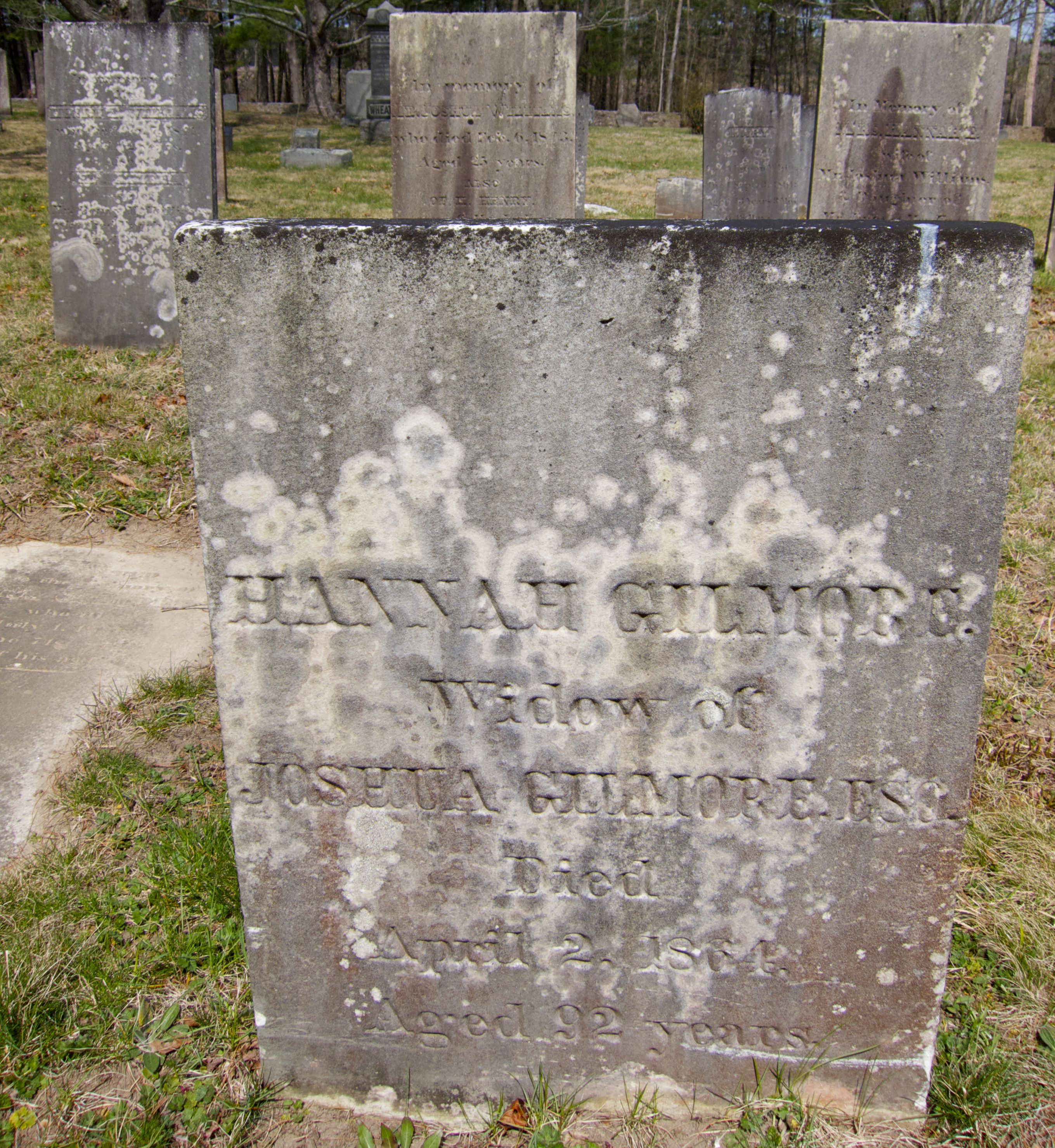
Gravestone of Hannah Gilmore

Gravestone of Hannah Gilmore

Jan 26  Sunday  Have been to meeting all day and heard two

excellent sermons from Mr Whitwell  Came home

between meetings.  Alson rode home with Mr Ames

Mother came with us from the afternoon meeting will

stop a few days.  Mr Whitwell walked up this morning

expecting to exchange with Mr Lovell but he (Mr Lovell)

was not prepared.  Mr W says a minister ought always to

be prepared.  Edwin called this evening.  It is a beautiful day.

A scheduling mix-up at church today caused consternation.  Most congregations had a practice of exchanging ministers.  On a regular basis, a minister from one church would swap one Sunday with a minister from another, allowing the congregations to listen to other voices and sermons.   On this Sunday, the scheduled switch between Reverend Whitwell of the Unitarian Church and Reverend Lovell of the soon-to-disband Protestant-Methodist assembly failed to take place.  Mr. Whitwell wasn’t pleased, but he seemed to recover just fine.  He delivered two more “excellent sermons.”

“Mother” was Hannah Lothrop Gilmore, or Mrs. Joshua Gilmore, as she would have been known, or perhaps  The Widow Gilmore, her husband having passed away in 1836.  One year shy of eighty, she was the mother of eight children, of whom only three were still alive.  Evelina was her only living daughter.

Mrs. Gilmore lived most of the time with her middle son, Alson, his wife, Henrietta, and their children at the family farm in the southeastern corner of Easton.  Just north of the town line with Raynham, the Gilmore property lay on what was known as the Turnpike Road.  In the distant past, Joshua Gilmore had maintained a tavern at that site, and had collected the fees from travelers on that road.  In 1851, the family still got income from the Turnpike, but the tavern was gone.  The land was all farm.

Occasionally, Mrs. Gilmore would visit with her daughter in North Easton.  Alson would carry her to church and after the service was over, Hannah would leave with Oakes and Evelina to stay at their home for the week.   While in North Easton, she’d be able to visit not only with her Ames grandchldren, but also with other grandchildren in the area, like Abby and Malvina Torrey.  And on this Sunday, her grandson Edwin Williams Gilmore, a grown son of Alson who no longer lived at the farm, paid a visit.  He would soon be building a home close to the Ameses.

January 24, 1851

Doll

Jan 24 Friday.  Was very busy this morning about house  Sent

for Abby to go to Augustus’s.  Mr Torrey called to say that

she could not go & made a long call and was as plausible

and good as ever.  Went to Augustus about ten

and alone, but had the pleasure of Mr Whitwells

company back as far as his house  This evening have

called at Mr Holmes but did not see Miss Eaton

Have finished both of the dolls frocks of pink, blue lace  Fine day

The doll that Evelina has been working on since the beginning of the year was finished today.  Wooden with painted features and lace dresses, it was fashioned as a miniature adult.  Baby dolls didn’t come in until almost the 20th century. Isn’t it interesting that the doll was handmade and not store-bought?  It was just a few years too early for Evelina to be able to buy a porcelain doll out of Germany and France, the ones with the big glass eyes, leather hands and silk dresses that speak to us today of Victorian taste. Those manufactured dolls began to enter the American market in the 1860s. With Yankee ingenuity, and not a little help from others, Evelina made her own doll for her daughter. How did Susie like the it?  We don’t get to find out, nor do we know when Evelina gave it to her daughter, but we can guess it was a pleasant surprise.

John Torrey called at the Ames house today.  A former colonel in the local militia, Torrey was also Evelina’s brother-in-law.  He had been married to Evelina’s late sister, Hannah, who died in December, 1848, leaving behind two daughters, Abigail and Mary “Malvina”.  The Torrey family lived right in the village of North Easton, so Evelina was able to see her nieces often.  Abby is 20 years old as the diary opens, Malvina only ten.

Reverend Whitwell featured in Evelina’s diary again today; she certainly seemed to enjoy his company.  She may have been someone who placed ministers up on a pedestal; they were the spiritual leaders of the day and she was a woman of sincere faith.  But, despite his being described by Chaffin as a serious, scholarly type, he may also have been an attractive novelty at a gray time of year.  He was new to the neighborhood and sought the acquaintance of Oakes and Evelina. Did Evelina have a little crush on him?