March 31, 1851

Shears

1851

March 31st Monday  This morning after doing my chores about

house, cut out a shirt of rather coarse unbleached

cloth for Mr Ames, am going to put a linen

bosom into it.  Also cut a coarse shirt for 

Oliver, have been mending some, but have not

sewed any on the shirts.  Called this afternoon

on Mr Holmes & at Bridgets to see the dress

maker, Worked awhile on my scrap book.  Orinthia

& I spent the evening at Olivers, Jane at G. Bartletts P.M.

After her morning chores on this last day of March, Evelina cut out more shirt parts. Any reader who has been following this blog on a daily basis has seen Evelina’s prodigious production of shirts for her husband and three sons. This particular project is soon to end. After one or two more mentions, Evelina will leave behind the cuffs, bosoms, and coarse and fine cloth of men’s shirtmaking and move into dressmaking for herself and her daughter, Susan.  And when fair weather truly arrives, she will head for her flower garden.  She will never completely stop sewing – there was always mending to be done – but she will relax her grip on needle and thread.

Today being Monday, Jane McHanna was busy with the weekly laundry, washing the family linens and clothes and hanging them out to dry.  In the evening – after preparing tea for the family, no doubt – Jane left to go to a Mr. Bartlett’s.  The call was probably a social one, but we don’t know whom she visited.  Because so many of the servants in the village had recently immigrated from Ireland, they tended to know one another and often visited each other when they had time off.  Meanwhile, Evelina and the young boarder, Orinthia Foss, headed next door to visit Sarah Lothrop Ames.  It was a sociable evening for all the women in the Ames household.


March 3, 1851

Men's Work Shirt, mid-19th c.

Men’s Work Shirt, mid-19th c.

March 3rd Monday  Have given the furnace up to Ann to take

care of, and feel thankful to get rid of it  Orinthia

assisted me in doing the work this morning

Have been working on a shirt for Oakes Angier

Jane went out this afternoon to Mrs Willis to get

a dress cut  Mrs Witherell & Mrs S Ames spent

the evening with us.  A letter from Helen  She 

is contented at her school  Cloudy & windy to night

Augustus not here

Evelina solved the problem of keeping the coal furnace going by delegating the task to Ann Orel, the 24-year old Irish servant who worked for Sarah Witherell in “the other part of the house.”  It being Monday, and thus laundry day, Jane McHanna was occupied in the kitchen boiling water and washing and rinsing clothes.   Today’s load couldn’t have been too heavy, however, or Jane wouldn’t have been able to leave the house in the afternoon to see about getting a new outfit made.

Jane’s preoccupations left the usual morning chores to Evelina, who got a little boost of help from Orinthia Foss, the boarder and schoolteacher.  Orinthia presumably soon departed for the schoolhouse, however, and Evelina had to carry on alone.

She turned to sewing, naturally, as she did on most days. Interesting that so far this year, except for a bonnet, she hadn’t sewed on much of anything for herself. Most of the sewing had been shirts and mending for the men, and aprons and chemises for her daughter.  Evelina sewed almost constantly, but her production capacity was limited.  Even with occasional help from others, she didn’t produce a surfeit of any article of clothing.  Historians of this period – Jane Nylander, in particular – have suggested that people had much less clothing then than we might imagine:

“[V]ery few people had large numbers of any kind of garment.  Women seldom owned more than four or five gowns and petticoats at a time; men usually owned a few coats and pairs of breeches or pantaloons, a few vests, and perhaps as many as half a dozen shirts..  Both owned a few pairs of stockings […] one or two pairs of shoes and boots; and a hat or bonnet […] Nobody changed all of their clothes daily.”*

If the average grown male owned an average of six shirts, and there were four men under Evelina’s roof, she was responsible for producing and/or maintaining approximately twenty-four shirts at any given time.  No wonder she often sought assistance from Sarah Witherell and others.  No wonder she worked at keeping them mended.  No wonder the laundry load was so big on Mondays.

One lovely note today: Sarah and Oliver Ames Jr heard from their daughter, Helen Angier Ames, who seemed to be settling into life at boarding school just fine.  If she was content, then her relatives were, too.

*Jane Nylander,  Our Own Snug Fireside, 1993, p. 156

February 24, 1851

School

Feb 24th Monday.  This morning Orinthia commenced a

private school at the school house had twenty

scholars.  Was choring about house all the forenoon

This afternoon made over a valance for

Franks bed and did some mending.

Martin Guild was burried at two Oclock.  None

of us attended the funeral  Helen & Sarah Ames

called a few moments this evening.  Heavy rain.

Looks like little Susie was back in school today, this time under the tutelage of Orinthia Foss, the new teacher.  Not only would Susie see Miss Foss in the school room every day, but also at home for breakfast, dinner, and tea. During her tenure in Easton, Orinthia would take turns boarding with different families in town beginning with the Oakes Ameses. The exact location of the schoolhouse where she taught is undetermined, but it may have been located right in the heart of the village, at the Rockery.*

As usual, Evelina spent this busy Monday doing housework, or “choring,” as she called it, in the morning, or “forenoon,” while Jane McHanna labored with the weekly washing. What do you suppose was served for midday dinner on Mondays, when the women of the house were preoccupied with everything except cooking?  Perhaps the family ate one of those mincemeat pies that had been prepared days in advance and kept very cold somewhere. Yankee housewives were known to keep some baked goods frozen for months, either by placing them on shelves in an ice house, or simply by storing them in unheated spaces not far from the kitchen. A risky practice, one might think, especially with the varied temperatures and rainy weather that has characterized this particular February.

Also as usual, Evelina turned in the afternoon to her mending and sewing. She refurbished a valance for Frank Morton’s bed.  Although his brothers Oakes Angier and Oliver (3) shared a bedroom, Frank had a space, if not a room, to himself.  A valance was an essential component of his bedstead, naturally offering some warmth and privacy that might otherwise be lacking.

* Information from Frank Mennino, Curator of the Easton Historical Society.  Thank you, Frank.

February 10, 1851

Storm

Feb 10th Monday  Warm this morning but not pleasant  Jane 

put her clothes out but the wind commenced blowing quite

hard with some rain, so that the clothes had to be taken

in & were dried over the registers  Cut Susan a Chemise

out of the width of  1  1/4 yd wide cloth and partly made it

Worked about house as usual on washing days in 

the forenoon  Wind blows quite hard this eve.

What a jungle of white linens the Ames house featured this Monday, with Jane McHanna having to drape dripping laundry around the heat registers.  So much for Evelina’s cleaning the floors the other day.  Miserable winter weather – snow, rain, ice, wind and rain again – was wreaking havoc with the domestic schedule.

One person in the Ames household celebrated her 12th birthday today: Sarah “Emily” Witherell.  Emily was born in New Jersey where her parents had lived while her father, Nathaniel Witherell, Jr., worked with William Leonard Ames, her mother’s brother, at various Ames enterprises.  Tragedy had struck in recent years, though, with the death of her father and the subsequent “drounding” of her two year old brother, Channing.  Emily was stricken with loss at an early age.

With her mother, Sarah; older brother, George Oliver Witherell; and grandfather Old Oliver Ames,  Emily now lived in North Easton, Massachusetts in “the other part of the house”.  She probably still attended school, but she and Susie Ames were too far apart in age at this point to be close friends, although they would soon find themselves sharing  piano lessons.  Her cousin Oliver (3) found Emily to be outspoken and opinionated; she was, evidently, unafraid of speaking her mind at a time when candor in women was not prized.

Emily never married.  After Old Oliver died in 1863, when she was about twenty-four, Emily and her mother moved into Boston, eventually taking up residence in Back Bay at the Hotel Hamilton and living off of distributions from investments managed by her male cousins.  A spinster cousin, Amelia Hall Ames, the only daughter of William Leonard Ames, eventually moved in with Emily.  These two cousins, in turn, may have undertaken to raise yet another cousin, Eleanor Ames, a granddaughter of William Leonard Ames. All that is in the future; on this day in 1851, we can hope that Emily had a special birthday despite the weather. She deserved a happy moment.

February 3, 1851

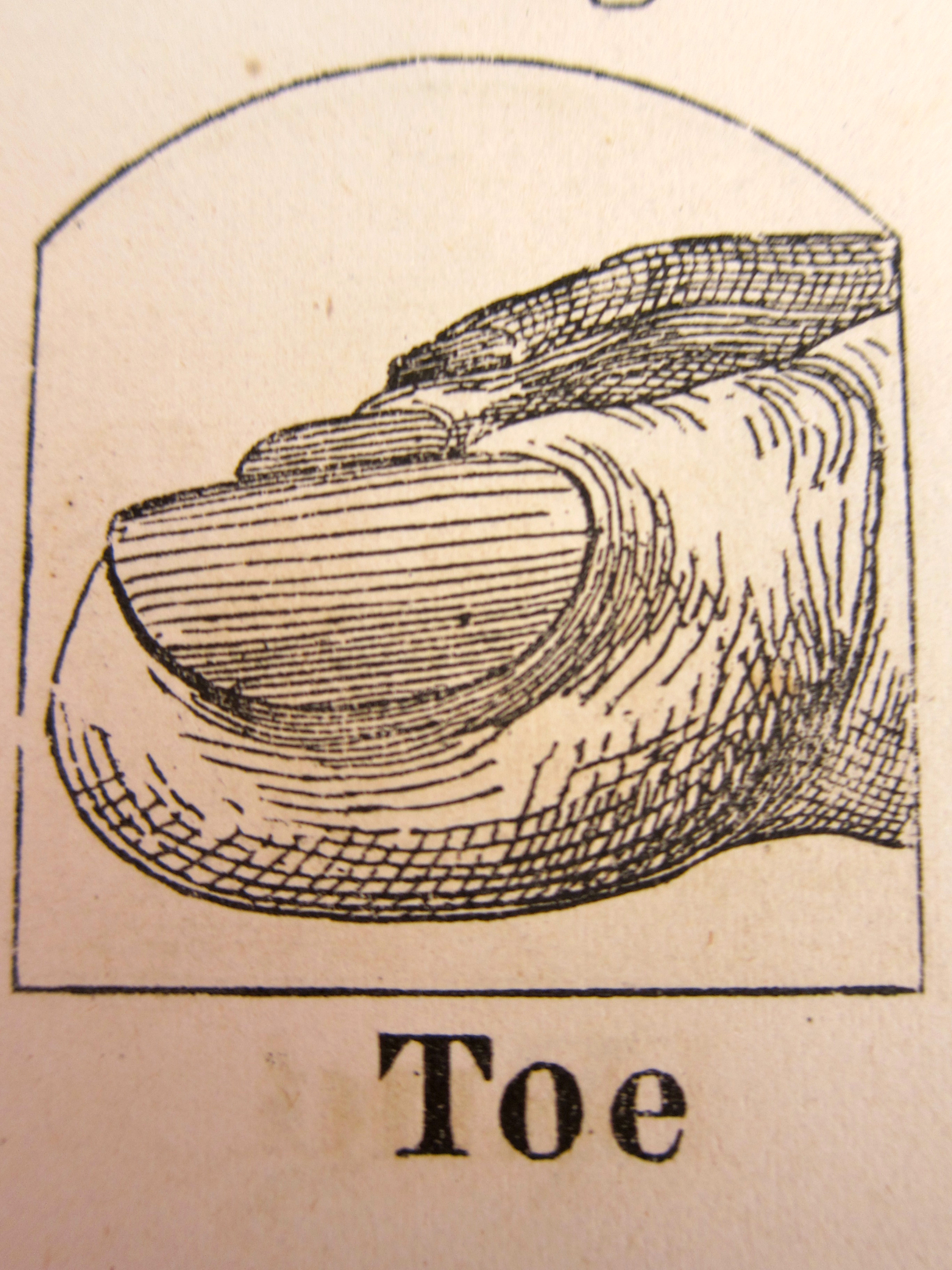
Toe

1851

Monday Feb 3 have not been about house much on

account of my foot.  It pains me a great deal & has

turned black under the nail.  Could not sleep last night.

Have been most of the day mending Oakes A shop coat.

work awhile mending Mr Ames shop coat

Susan has a bad cold & cough so that she did not

go to school.  This afternoon wrote a letter for Jane

to her nephew.  This is a remarkably pleasant day.

Evelina had to sit down today on account of having dropped a flatiron on her foot and injured her toe.  She wasn’t idle, however.  It was Monday, after all, and no one was ever idle on a Monday. She took up her mending, working on the shop coats of her husband, Oakes, and her eldest son, Oakes Angier.  The shop coats were used by the men for work, and only work, and had to be plenty sturdy enough to do physical labor in.

Little Susan (known as Susie  by her brothers) stayed home from school today and rested. At age eight, Susan was beginning to learn how to sew, but her skills at this stage were too elementary to help her mother with the mending.  Instead, she may have sat with her mother and read aloud, as sometimes happened, or perhaps her cough kept her in bed.

Jane McHanna, the servant who was busy today washing clothes, wanted to write a letter to a nephew.  Like many of the other Irish immigrants, Jane was probably illiterate and so asked Evelina to write the letter for her.  Evelina obliged.  But would the nephew have been able to read the letter once he got it?  And where was he?  Back in Ireland or had he, too, made his way to America?

January 13, 1851

Washing

/51 Jan 13  Washing day of course, and I have been

about house in the morning as usual.  A Augustus dined

with us, come up in the stage.  Made a hair cloth back to

another rocking chair  Went to Mr Whitwells with Mr

Ames this evening, met with Alson & wife.  It is a

beautiful moonshiny evening and we have had a

pleasant ride and have enjoyed myself very much.  Mr &

Mrs Whitwell I like very much  Father killed another

yoke of oxen to day and we have a quarter & the tripe.

Boiled that we had last week to day.

Monday is Wash Day.  This might be a Yankee commandment, were there a written code.  History has it that the first day the Pilgrims got off the Mayflower was a Monday, and the first thing the women did after all those weeks at sea was to wash their clothes.  The timing stuck, and remained a custom for centuries.  On Mondays at the Ames house, Jane McHanna washed the family clothes and linens while Evelina did almost everything else in terms of housework and cooking.  Evelina was not fond of putting her hands into soapy water.

The roads around town must have improved.  This evening, Evelina and Oakes finally got over to the Whitwells’ house, presumbly for a delayed acknowledgment of Mr. Ames and Mr. Whitwell’s shared birthday.  Evelina clearly enjoyed herself.  Another couple was there: Alson and Henrietta Gilmore. Alson is Evelina’s older brother.  He owns the old family farm in the southeast corner of Easton, just north of the town of Raynham.  He and his wife have six children together, as well as a son from Alson’s first marriage.  This is Alson “Augustus” Gilmore, who had midday dinner at the Ames house today.  Augustus lives in Boston as the year opens but will soon move back to North Easton.  He does courier work for the Ames brothers.

Evelina is close to her nieces and nephews; their presence in her life, and her affection for them, is evident throughout the diary.  Less certain is the regard that other members of the Ames family held for the Gilmores; family lore has it that the two families moved in different social circles and that even into the 20th century, the Gilmore clan was looked down on by members of the Ames clan. From Evelina’s happy description of the day, however, we can surmise that she was unaware, on this lovely, “moonshiny” night, anyway, of any discrimination.