April 3, 1851

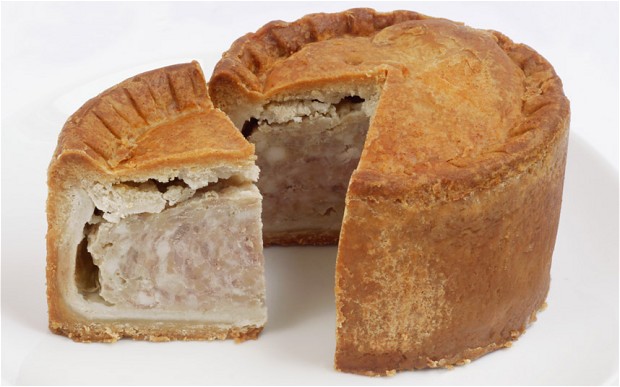
pork-pie_2180207b

1851

April 3  This morning went quite early to baking in the brick

oven made mince & dried apple pies two custards brown

bread three large pork pies & ginger snaps. Alson here

to dine.  Henrietta & the two little girls dined at Mr Torreys

& were all here to tea  This Evening we all went to the 

dancing school.  Mr Whitwell called a few minutes

this afternoon & Mrs S Ames  Quite Pleasant

Small wonder that pork pies were on the menu, after Evelina and Jane McHanna spent all of yesterday processing a freshly-“kild” pig. Once again in the kitchen with her apron on, Evelina turned today to baking. As usual, she baked a large quantity of goods in the brick oven that she shared with her sister-in-law, Sarah Witherell. About every ten days or two weeks – or every fortnight, as they might describe it – one or both women would bake up a storm of pies, cakes, bread and cookies, enough to last until the next big baking.

Mince meat pies, brown bread and ginger snaps regularly featured in Evelina’s baking. These are the first pork pies to appear, however.  New, too, are the dried apple pies. Gone by now are the apples in the barrel that was delivered in January from the Gilmore farm, the one that was kept locked in the cellar so that the sons of the house wouldn’t eat up the fruit. Any apples that remained were from a group that must have been dried the previous fall for just this purpose, to provide a little fruit in an otherwise barren season.  By this time of year, housewives had to rely on preserves and dried fruit for variety in the family diet.

The Ames had company for tea: another sister-in-law, Henrietta Gilmore, and her two youngest children, little Henrietta and little Helen, made a rare visit from the Gilmore farm. These two youngest nieces of Evelina are about the same age as little Susie, yet they don’t get much mention in the diary.  They probably lived too far away for regular play time. Mr. Whitwell, the highly-regarded Unitarian minister, paid a call today, too.  Pleasant spring weather was bringing people out of the houses to visit.


March 13, 1851

mens_fashion_1856

1851  March 13  Thursday  This forenoon worked on an old pair of 

pants for Oliver  They needed a great deal of 

repairing and I worked on them untill two Oclock

This afternoon & evening spent at Alsons with Oliver 

& wife, Wm Reed & wife, Mrs Whitwell, A[u]gustus & J. Pool

& wife passed a very pleasant afternoon.  I knit on

Susans Angola yarn stocking.  It has stormed

quite hard all the afternoon, got there about five Oclock

Did the Ames men dress like the gentlemen in this 1850’s illustration?  Oakes Ames, as we know from stories his appalled friends told, did not dress so well. But his sons might have aspired to be fashionable. Certainly Oliver (3), whose old pants Evelina mended today, might have wished for such an outfit, one that befitted a man with his eye on college.

It’s doubtful that the pants Evelina sewed today came out looking like those in the fashion plate.  As accomplished a seamstress as she was, the men’s pants she was most familiar with were working pants, the ones her sons wore to the shovel shop everyday. It took her several hours to repair this pair. Then, not willing to let her hands be idle, she carried a knitting project to her brother Alson’s, perhaps traveling there with her brother-in-law, Oliver Jr. and his wife Sarah Lothrop Ames. The Gilmores were having a little gathering.

Alson and Henrietta Gilmore seemed to be socializing a great deal this month.  Last week they held a dance that the Ames sons attended, this week they had friends in for tea, and sometime before that they had sent their nineteen-year-old daughter, Lavinia, into town to stay with the Ames family for a week. What was going on? Did this increased social activity stem from cabin fever or was it mere coincidence? Were the Gilmores working to find a husband for Lavinia?

The Angola yarn that Evelina knitted into a stocking for little Susie is something of a mystery ingredient. Does any reader know about this yarn?

January 26, 1851

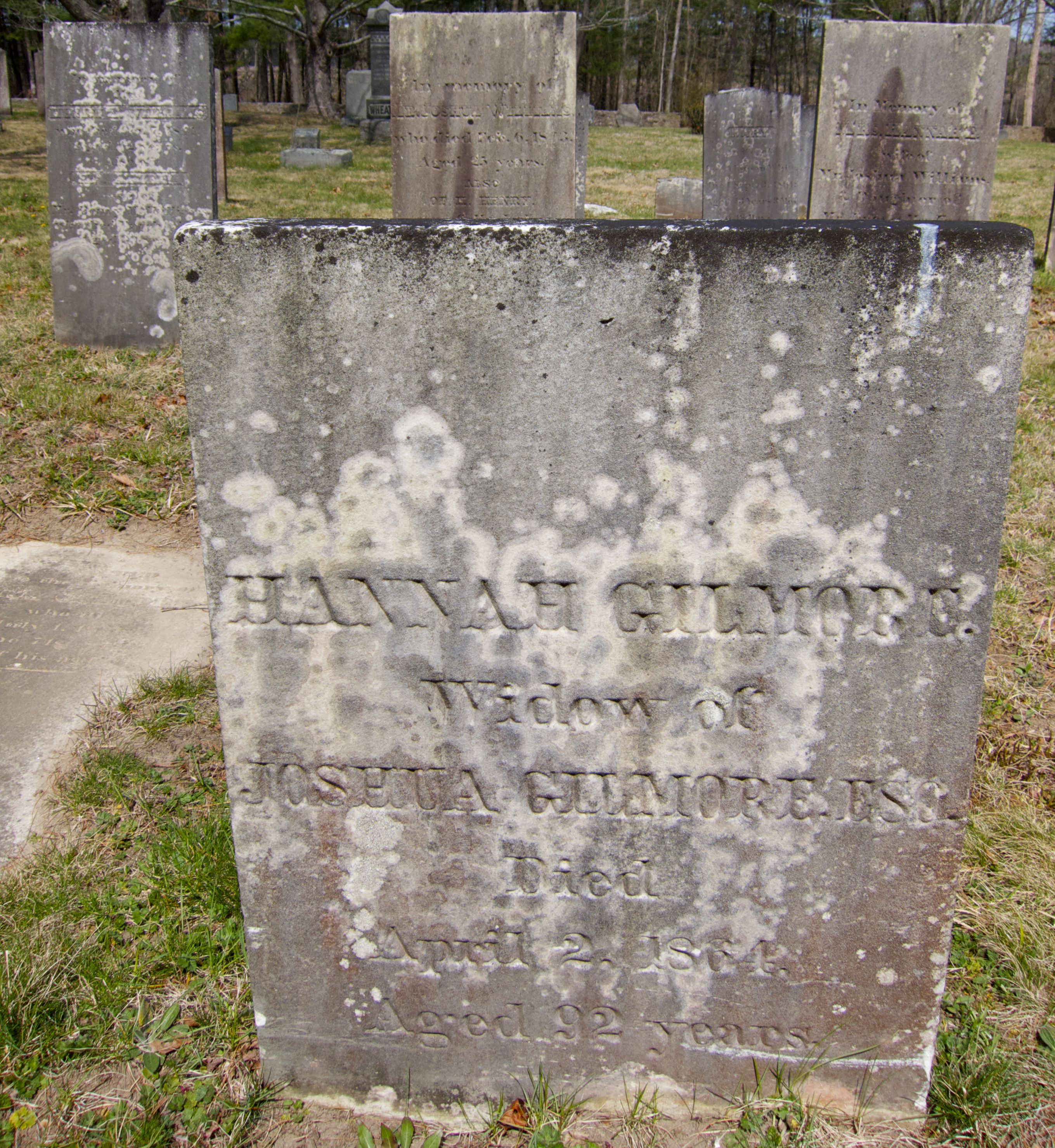
Gravestone of Hannah Gilmore

Gravestone of Hannah Gilmore

Jan 26  Sunday  Have been to meeting all day and heard two

excellent sermons from Mr Whitwell  Came home

between meetings.  Alson rode home with Mr Ames

Mother came with us from the afternoon meeting will

stop a few days.  Mr Whitwell walked up this morning

expecting to exchange with Mr Lovell but he (Mr Lovell)

was not prepared.  Mr W says a minister ought always to

be prepared.  Edwin called this evening.  It is a beautiful day.

A scheduling mix-up at church today caused consternation.  Most congregations had a practice of exchanging ministers.  On a regular basis, a minister from one church would swap one Sunday with a minister from another, allowing the congregations to listen to other voices and sermons.   On this Sunday, the scheduled switch between Reverend Whitwell of the Unitarian Church and Reverend Lovell of the soon-to-disband Protestant-Methodist assembly failed to take place.  Mr. Whitwell wasn’t pleased, but he seemed to recover just fine.  He delivered two more “excellent sermons.”

“Mother” was Hannah Lothrop Gilmore, or Mrs. Joshua Gilmore, as she would have been known, or perhaps  The Widow Gilmore, her husband having passed away in 1836.  One year shy of eighty, she was the mother of eight children, of whom only three were still alive.  Evelina was her only living daughter.

Mrs. Gilmore lived most of the time with her middle son, Alson, his wife, Henrietta, and their children at the family farm in the southeastern corner of Easton.  Just north of the town line with Raynham, the Gilmore property lay on what was known as the Turnpike Road.  In the distant past, Joshua Gilmore had maintained a tavern at that site, and had collected the fees from travelers on that road.  In 1851, the family still got income from the Turnpike, but the tavern was gone.  The land was all farm.

Occasionally, Mrs. Gilmore would visit with her daughter in North Easton.  Alson would carry her to church and after the service was over, Hannah would leave with Oakes and Evelina to stay at their home for the week.   While in North Easton, she’d be able to visit not only with her Ames grandchldren, but also with other grandchildren in the area, like Abby and Malvina Torrey.  And on this Sunday, her grandson Edwin Williams Gilmore, a grown son of Alson who no longer lived at the farm, paid a visit.  He would soon be building a home close to the Ameses.