March 22, 1851

images-1

1851

March 22 Sat. Early this morning Mrs S Ames & Helen

called.  Helen likes her school & room mates

This forenoon I have been busy but cannot

tell of much that I have accomplished.

In the afternoon I put a new bosom into a

shirt for Mr Ames & Orinthia finished the 

fifth shirt that she has made since

she has been here.  A[u]gustus dined here

Sarah Lothrop Ames brought her daughter Helen over this morning for a visit, so Evelina could see and hear for herself that Helen was happy at boarding school.  Was Sarah Ames’s motive in bringing Helen by the house prompted by unalloyed familial affection, or did she also wish to show that she and her husband had been right to send Helen away? Did she want to share with Evelina some of the challenges – and gratifications – of raising a daughter?

Sarah herself had grown up as one of ten children, of whom she was the only girl.  It seems probable that Sarah had been doted on as a child. Now, as a mother of her own, she may have replicated – almost automatically – the singular attention with which she had been raised, and focused it on Helen.

More. Shirts. Orinthia Foss, by boarding at the Ames house in the middle of shirt-making March madness, had no easy escape from the chore.  And once she was pressed into service, the production of shirts sped up.  Did Orinthia mind all the sewing?  Did she wish she could get outside into the spring air to explore the town?    A dutiful young woman from the upcountry of Maine, she may have marveled at finding herself in North Easton and appreciated its novelty.  Orinthia seemed to look up to Evelina as her guide, a role Evelina fell into happily, enjoying, in her turn, the novelty of being looked up to.

March 21, 1851

OLYMPUS DIGITAL CAMERA

SPRING, from Godey’s Lady’s Magazine, April, 1851

1851

March 21 Friday  Have heat the oven twice to day

baked 15 mince pies, 2 loaves bread & 

two sheets cup cake & ginger snaps  got the 

last oven full in about twelve.

This afternoon have been looking over my

accounts and mending stockings A[u]gustus dined

here.  Helen came to night in the stage

Pleasant weather but sloppy.

Vernal Equinox, at last.  The first day of spring was mild, with the earth tilting in the right direction. If the ground hadn’t been “sloppy” and she hadn’t been tied to the oven, Evelina might have gone outside to inspect her flower beds to see if any bulbs were peeking up through the disappearing snow.

Evelina, and probably Sarah Witherell, too, baked today.  Evelina made her patented host of mince meat pies to be served over the next week or two. Brown bread, cake and ginger snaps also had a turn in the capacious brick oven, no doubt filling the house with some wonderful aromas.  Pleasant day outside, pleasant day inside.

Nephew Augustus Gilmore, still bookkeeping next door, continued to dine with the family at midday, perhaps walking back from the office or counting house at noon with Oakes.  Niece Helen Ames arrived home via stagecoach from her boarding school in New Bedford for a weekend visit, although “weekend” was not a term most people in town would have used.  The shovel shop ran six days a week, after all, so Saturday had no special connotation for most citizens of North Easton.

March 3, 1851

Men's Work Shirt, mid-19th c.

Men’s Work Shirt, mid-19th c.

March 3rd Monday  Have given the furnace up to Ann to take

care of, and feel thankful to get rid of it  Orinthia

assisted me in doing the work this morning

Have been working on a shirt for Oakes Angier

Jane went out this afternoon to Mrs Willis to get

a dress cut  Mrs Witherell & Mrs S Ames spent

the evening with us.  A letter from Helen  She 

is contented at her school  Cloudy & windy to night

Augustus not here

Evelina solved the problem of keeping the coal furnace going by delegating the task to Ann Orel, the 24-year old Irish servant who worked for Sarah Witherell in “the other part of the house.”  It being Monday, and thus laundry day, Jane McHanna was occupied in the kitchen boiling water and washing and rinsing clothes.   Today’s load couldn’t have been too heavy, however, or Jane wouldn’t have been able to leave the house in the afternoon to see about getting a new outfit made.

Jane’s preoccupations left the usual morning chores to Evelina, who got a little boost of help from Orinthia Foss, the boarder and schoolteacher.  Orinthia presumably soon departed for the schoolhouse, however, and Evelina had to carry on alone.

She turned to sewing, naturally, as she did on most days. Interesting that so far this year, except for a bonnet, she hadn’t sewed on much of anything for herself. Most of the sewing had been shirts and mending for the men, and aprons and chemises for her daughter.  Evelina sewed almost constantly, but her production capacity was limited.  Even with occasional help from others, she didn’t produce a surfeit of any article of clothing.  Historians of this period – Jane Nylander, in particular – have suggested that people had much less clothing then than we might imagine:

“[V]ery few people had large numbers of any kind of garment.  Women seldom owned more than four or five gowns and petticoats at a time; men usually owned a few coats and pairs of breeches or pantaloons, a few vests, and perhaps as many as half a dozen shirts..  Both owned a few pairs of stockings […] one or two pairs of shoes and boots; and a hat or bonnet […] Nobody changed all of their clothes daily.”*

If the average grown male owned an average of six shirts, and there were four men under Evelina’s roof, she was responsible for producing and/or maintaining approximately twenty-four shirts at any given time.  No wonder she often sought assistance from Sarah Witherell and others.  No wonder she worked at keeping them mended.  No wonder the laundry load was so big on Mondays.

One lovely note today: Sarah and Oliver Ames Jr heard from their daughter, Helen Angier Ames, who seemed to be settling into life at boarding school just fine.  If she was content, then her relatives were, too.

*Jane Nylander,  Our Own Snug Fireside, 1993, p. 156

February 25, 1851

Helen Angier Ames

Helen Angier Ames

1851

Feb 25  Tuesday  This morning Helen left home for school

at Dorchester.  She felt so bad when she left

that I did not go in to see her.  Her Father & Mother

went with her and returned to night, they went into

Boston and stoped an hour or two.  Mr Jennings

& Crommet called this evening to see Orinthia

I have been to work on a bosom of shirt putting

a new one into an old shirt of Oakes Angiers.  Very windy.

A[u]gustus here

Under some duress, the teenaged Helen Ames was taken to boarding school today, clearly not wishing to go.  Her parents insisted and accompanied her to see her settled.  Their stop in the city on the way home might have been a lift of spirits for a mother and father who had just driven away from a disconsolate child.

The children of both Oakes and Oliver Jr. each went away to school for a portion of their education.  Oakes and Evelina’s boys had already gone and returned home; Susan still had her boarding school ahead of her.  Oliver Jr. and Sarah’s two children, Fred and Helen, were at this stage both away at school.  Oliver Jr. and Sarah were empty-nesters, to use a term they wouldn’t have recognized.  They might have recognized the emotion, however.  Strange to think of them in their separate house, just the two of them now, quiet, (although Sarah’s younger brother, Cyrus Lothrop, sometimes lived with them) while right next door in the old homestead lived a whole commotion of relatives.

Schooling seemed to be the theme of the day.  A Mr. Jennings and a Mr. Crommet called to see Orinthia Foss, presumably on matters of her employment as a schoolteacher. Does any reader out there know either of these names?

His wife and son still living elsewhere – Bridgewater, perhaps – while he set up their rented lodgings in North Easton, Augustus Gilmore was staying temporarily with his aunt Evelina and her family.  He would soon bring Hannah, who was expecting, and little Eddie to town.

February 17, 1851

Hem

Feb 17th  Monday  Washed the dishes and worked about

house most of the forenoon  This afternoon cut out some

work for Susan & set her to hemming, counted

stiches with her.  Helen came home from

New bedford.  Spent the evening at Olivers with

Sarah W.  Worked on an apron of Susans but

had so much talking to do that […] I accomplished

but a little sewing  Pleasant but cold

Sewing was a necessity, but it was also a sociable occupation, which is perhaps one of the reasons that Evelina enjoyed it so. Her visit next door with her two sisters-in-law, Sarah Lothrop Ames and Sarah Witherell, turned into an evening of conversation with “but a little sewing,” which she didn’t seem to mind.  What did the women discuss?  Did they revisit the tender issue of the failed Sewing Circle meeting?  Or did they steer toward safer topics like Helen’s return from New Bedford? What had the fourteen-year-old been doing there?  Had she been in school? Why did she return home at the start of a week?  Susie Ames was home from school this week, too.  Was mid-February a typical time for schools to close?

At this time in our history, almost every woman knew how to sew. Sewing was a skill handed down from one generation to the next. Evelina, Sarah Ames and Sarah Witherell had each learned their stitches from their mothers or grandmothers; now it was Susie Ames’s turn to learn.  How could the women know that sewing was about to be transformed by the arrival of the domestic sewing machine, and that a forthcoming civil war would introduce mass-produced, “ready-made” clothing on an unimagined scale?  They, who in their youth had probably watched a elderly relative work a spinning wheel, would experience a dramatic trajectory in the making of apparel.  By the time Susie reached adulthood and became a housewife, some of what she was being taught would be obsolete.  But not all: hemming, mending, quilting, and neat hand-sewing would always have a place in the domestic arts, even though few women today practice the skills.

Young girls of the antebellum period like Susie and Helen and Emily Witherell  sat by their mothers’ sides and struggled to manage a needle and thread, basting or hemming or working cross stitches.  Some of them created the hand-wrought samplers that hang now in textile collections, featuring alphabets or numbers or biblical quotations with colorful, tiny stitches painstakingly wrought by stubby little fingers at age eight or twelve or fourteen. Sewing was a necessity, but it was an art form as well.

February 6, 1851

Dance

Dance

Feb 6th Thursday  This forenoon was working about house & did

a little mending  Prepared some mince pie meat for baking

Have been into school this afternoon  There were but

about 50 schollars.  Mr Jackson appears to lack energy

Miss Lothrop appeared the best of the two.

There is a ball at Lothrop Hall to night for the first

time.  Oakes Angier & Frank have gone & Helen

Sarah A & Sarah W spent the evening here.  Pleasant but cold.

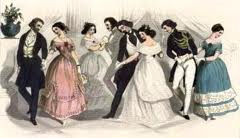
Thursday night seemed to be the night for dancing in southeastern Massachusetts. The Ames sons had already attended at least two Thursday evening assemblies in Canton during January and now in February they’re attending a gathering at Lothrop Hall (the location of which is uncertain: Eastondale, perhaps?  Does any reader of this blog know?) Tonight Oakes Angier and Frank Morton went. (Where was Oliver [3]?)  Evelina’s diary is unclear on whether their cousin Helen went with them or, more likely, stayed home with her mother and aunts – the latter option being more typical for shy Helen.

Earlier in the day, Evelina was evidently still involved with looking into local schooling, getting the lay of the land, perhaps, for the incoming Orinthia Foss.  By mid-century in Easton, there were four school districts, or “ricks” as they were known, in four different geographic areas of town.  Paid for by the occasionally reluctant Easton taxpayers, the schools taught local girls and boys up to grade eight or so.  Massachusetts, and New England as a whole, led the nation in its emphasis on education and, in Evelina’s time, Massachusetts had boasted a 96% literacy rate.

Susie was the only Ames child still attending school.  Oakes Angier, Oliver (3) and Frank Morton as boys had each attended school locally before being sent away to nearby private schools such as Leicester Academy.  On this night, however, dancing, not schooling, was foremost on their minds.

February 2, 1851

Flatiron

Sunday Feb 2d  It snowed very hard this morning but we

all went to meeting to hear Mr Brigham of Taunton

He gave us two very good sermons  he is very quick in his motions

& very independent in his manner  Mother went to meeting & home.

Since meeting have been reading in David Copperfield

Sarah A & Helen came in and stoped an hour or two.

This evening have hurt my foot quite badly by letting a

flatiron fall on it  It has cleared of[f] quite pleasant.

Snowy weather didn’t prevent attendance at meeting, and the Ames family stayed for both morning and afternoon service.  A visiting minister, Reverend C. H. Brigham, replaced Reverend Whitwell in the pulpit.  Mr. Whitwell, meanwhile, presumably officiated in Taunton.  This kind of swap was accomplished every month or so when ministers in the area switched places.  A Congregational practice that had been in place for years, the swap gave ministers the test of different congregations while, with fresh voice, it reiterated church dogma among a broad population.  Both congregations and ministers benefited however “quick in his motions” a visiting parson might be.

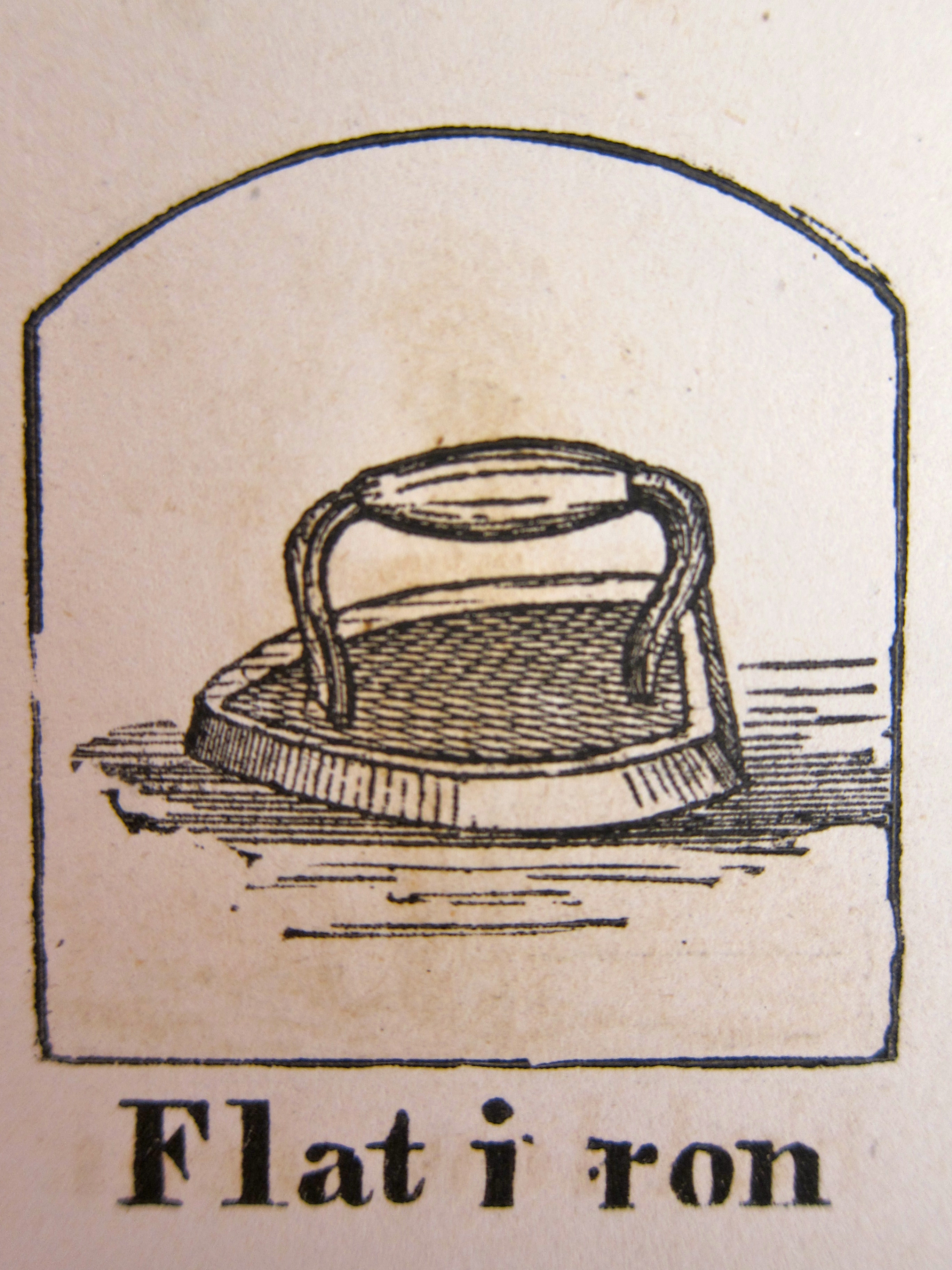
After church, Evelina’s brother Alson Gilmore carried their mother, Hannah, back to the farm in southeastern Easton.  Evelina had a little more time to herself, which she spent with Charles Dickens, at least until her sister-in-law Sarah Ames and daughter Helen stopped by.  Evelina has been reading David Copperfield – an 800 page book – for a week now.  But somehow in the course of the afternoon or evening – perhaps getting prepared for laundry day tomorrow? – Evelina dropped a flatiron on her foot.  Ow.  That took her out of commission for the rest of the day, perhaps allowing even more reading.

January 30, 1851

Flames

Jan 30th  Thursday  Mended Mr Ames pants which

took me most of the forenoon, read some to Mother.

Spent this afternoon at Olivers with mother & Mr

Whitwell.  They sent the carriage for Mrs Whitwell

but it was so cold that she did not come.  Mr Ames

took tea with us & Mr Ames Oliver Jr C Lothrop & 

Helen played cards I commenced a stocking of the yarn

Mrs Foss gave me.  A bitter cold day & quite windy.

A great fire in Taunton

“A verry bad day to go out in,” noted Old Oliver in his journal today.  Eliza Whitwell refused to leave her home several miles away to join the Ames ladies in the afternoon, even though her husband was there.  The carriage – did it belong to Old Oliver, or Oliver Jr, or to the family in general?  Whoever owned it, its likely driver was Michael Burns, an employee of Old Oliver who looked after the horses and carriages.

While Michael drove to and from the parsonage in the howling cold, various family members gathered next door at Oliver and Sarah Lothrop Ames’s house for tea. Oakes and his son Oliver (or possibly his brother Oliver – unclear) played cards – probably whist – with Cyrus Lothrop and Helen Ames.  Cyrus was an unmarried brother of Sarah Lothrop Ames who lived with Sarah and Oliver, Jr. for many years. Helen was their only daughter; their son, Fred, was probably away at Phillips Exeter Academy on this occasion.  Evelina knitted and kept her mother company.

In nearby Taunton, Massachusetts, Evelina reported, the furious wind contributed to a “great fire.”  The histories of that period don’t mention this fire, so perhaps it was not as great as Evelina thought.  That, or it paled in comparison to the larger fires that Taunton suffered in 1838 and 1859.*  Fire, naturally, was the dread of every homeowner and municipality; towns and cities in the 19th century (and before) were pock-marked by periodic burnings, its citizens haunted by the loss of life and property that fires engendered. The fire on this day in Taunton would have been made especially difficult by the frigid air and icy wind.

*Information obtained from Old Colony Historical Society, Taunton, Massachusetts

January 12, 1851

Preach

/51 Jan 12 Sunday  Have been to church all day and heard two

excellent sermons from Mr Whitwell.  The afternoon text was

“Train up a child in the way he should go and when he is old

he will not depart from it”  Passed this evening at Mr Willard

Lothrop with Mr Ames & met with Minister Norris & Mr Torrey

This noon I stopped to hear Mr Whitwells class in the Sabbath

School afterwards went into Mr Daniel Reeds with Mother

Very warm + pleasant for the time of the year

The Ames family, Unitarians all, attended meeting today and stayed for both services, which encompassed a morning program, an intermission, and an afternoon program.  In their family pew, Evelina, Oakes, Oakes Angier, Oliver (3), Frank Morton and Susan sat with or near Old Oliver, Sarah Witherell and her children, George and Emily.  Also nearby, if not in the same pew, sat Oliver Jr, Sarah Lothrop Ames and their children, Fred and Helen, faces upturned to hear Reverend Whitwell deliver the day’s two sermons.  Eight-year old Susie may have squirmed in her seat; she wasn’t inclined to sit still for the second service.  And Oakes Ames was known to fall asleep, however inspiring Mr. Whitwell’s words were to Evelina.

In 1851, the Unitarians congregated at a church in Easton Centre, a few miles south of the village of North Easton (but still within the boundaries of the Town of Easton, Massachusetts.)  Like many families, the Ameses had to travel by carriage or sleigh to attend Sunday service.  The adults would have ridden, or “been carried,” as the expression went,  but the children may have had to walk the distance.  Children walking to church, regardless of distance, was common.  If this was true for the Ames family, we might imagine that cousins Oliver (3) and Fred walked together, as they were close friends.

At intermission, children went into Sunday School and the adults socialized.  Winthrop Ames, a grandson-to-be, described the scene in his family history (from 1937):

“They tethered their horses in a long, open shed and stayed through both morning and afternoon services, eating the luncheons they had brought and gossiping with the townsfolk during the intermission.”

On this winter Sunday Evelina and her mother, Hannah Lothrop Gilmore visited at the nearby home of Daniel and Mary Reed.  Socializing continued in the evening as Evelina and Oakes called on Willard Lothrop.

January 6, 1851

Ox

/51 Monday Jan 6

Jane commenced washing this morning but was taken sick

and had to leave it.  And I had to do the housework again

Father killed two oxen & gave us the tripe  Went to North

Bridgewater this afternoon in a sleigh with S A, Helen 

and E Quinn.  A A Gilmore here to tea had business in

the office  Bought patch for a quilt for Susans bed   run

it together this evening  Received a letter from 

O Foss  She says Roland A has come from California

Jane McHanna was under the weather this Monday morning – perhaps from yesterday’s drive in the frigid air – and unable to manage the laundry and housework.  In the kitchen, something had to be done with the fresh tripe that arrived from Evelina’s father-in-law. Considered a delicacy, the tripe would soon be served at the midday dinner table.

As was typical for this time of year, Old Oliver slaughtered a yoke of oxen and distributed the meat and offal among the family. As he described it, “we kilt a yoke of oxen to day I had of Charles Gurney the off one weighed 1475 and the other 1330.”  Now 71 and retired from the shovel business, Old Oliver spent much of his time raising oxen. (Farming, too, as we’ll see later.)  He was evidently quite fond of them, and they were extremely useful in the family business for transporting raw material and finished shovels.  Oxen were a common sight in North Easton in 1851; anyone inside the Ames house would have heard ox carts rumbling by on the road.

The weather had improved and  housework couldn’t keep Evelina at home this afternoon.  Off in a sleigh to North Bridgewater she went with Sarah Ames, Sarah’s daughter Helen and a neighborhood dressmaker, Elisa Quinn.  The women were most likely on the hunt for fabric.  Evelina found quilting material, and after tea was over that night, began to put together a quilt for her daughter, Susan.