July 15, 1851

Wring

1851

July 15 Tuesday  Jane washed this forenoon and about

nine or ten Mother Henrietta Rachel and her

babe came  They went home about 11 Oclock

mother will stop a few days  Gustavus left

yesterday morning  The afternoon Mrs H Ames

passed here  Mrs S Ames had a dress maker & did

not come in

Laundry was done today, a day later than normal because of the extra work involved in tidying up after a weekend of houseguests.  It’s not hard to imagine that such a disruption in the routine made Evelina or Jane McHanna or other members of the household think today was Monday instead of Tuesday.

Just as things were getting back to normal, however, more visitors arrived. Evelina’s sister-in-law, Henrietta Gilmore (Mrs. Alson Gilmore), arrived with Evelina’s mother, Hannah Lothrop Gilmore. As often happened, the senior Mrs. Gilmore came to spend “a few days” with Evelina, her only living daughter.  With them was Henrietta’s daughter, Rachel Howard (Gilmore) Pool (Mrs. John M. Pool or Poole) and her little girl, Ella. Ella, barely one year old, was Hannah Gilmore’s great-granddaughter. Four generations of Gilmore women visited together in the Ames parlor.

In the afternoon, Evelina had yet another sister-in-law pay a call, this one from the Ames side of the family.  Sally Hewes Ames came to visit one last time before leaving; she planned to return to Connecticut the next day. The women likely sat and sewed together; Evelina almost always had sewing or mending in her hands when socializing at home.  As was her wont, she probably gave something to Sally to work on while they talked. Perhaps even old Mrs. Gilmore sewed with them.
June 27, 1851

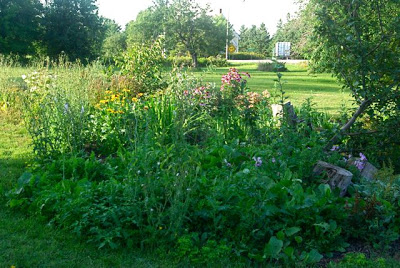
weedy flower bed

*

June 27 Friday  John left here this morning

Worked a long time in the garden

this morning for the weeds were very plenty

afterwards finished picking over the hair and

a long job it has been.  This afternoon put the hair

into the hair cloth cover and just commenced tying

it when Mrs Clark and Mrs Stetson came from

Sharon and of course had to leave it and go

into the other house house to see them. Mother & I stoped to tea

Pigweed, thistle, crabgrass, and purslane: Such weeds – and more – are the collective bane of the flower gardener. Evelina tackled some of them this morning as she addressed the “very plenty” weeds that were pushing into her flower beds. Perhaps she ruminated about her brother John and his short visit while her fingers dug into the soil.

After midday dinner she turned to her sewing, as usual, going right to her haircloth slipcover project, but abandoned it with alacrity when an opportunity for socializing turned up.  “Had to leave it and go..” she noted, when two friends from nearby Sharon arrived next door.  She and her mother, Hannah Lothrop Gilmore, went over for tea.

Frank Ames Mitchell, a nephew of Oakes and Evelina, turned ten years old today.  One of two grandsons of Old Oliver named Frank (the other being Frank Morton Ames,) he was the eldest son of Oakes’ sister, Harriett Ames Mitchell. He, his mother, and two younger siblings were living temporarily in Bridgewater while their father, Asa Mitchell, was working in coal in western Pennsylvania.

Our knowledge about Frank Mitchell is limited, as he never married or had any known issue. We do know that he was the only Ames grandson to fight in the Civil War.  He served in both the 44th and the 56th Massachusetts Regiments, and ultimately made captain.  In 1864, he was wounded at Cold Harbor.  Hospitalized in Washington DC, where his mother rushed to his side, he eventually recovered but remained in indifferent health for the rest of his life.

After the war, Frank bought a plantation in Tallullah, Louisiana, an effort that was underwritten and ultimately bought out by his Uncle Oliver Ames, Jr.  Family records show that Frank subsequently depended on financial support from his cousin Fred Ames. The remainder of his life consisted of traveling from one healthful climate or resort to another in search of good health.


* A modern flower garden, full of weeds, from canoecorner.blogspot

June 26, 1851

Window


1851

June 26th Thursday  This morning went to washing the windows

on the outside the first thing after breakfast and

got the chambers in order  Heat the brick oven and 

baked cake bread &c for tea and a custard pudding

for dinner  John & wife Miss Wait Alson & wife

and mother here to spend the day.  John is making

a short visit will leave in the morning for

home.  Have been to West Point

Evelina put her chambers in apple pie order this morning and baked up an array of food. She must have been outdoors as early as seven washing her windows. No gardening today. She had important company coming. Her mother, brothers John and Alson, their wives Huldah and Henrietta, respectively, and another woman, Miss Waite, came to spend the day with her. The family reunion continued.

The occasion was so special that Evelina baked a custard pudding to serve at dinner.  This was not usual fare for her, perhaps because it used so many eggs, and the Ameses didn’t keep chickens.

Evelina again mentioned West Point in her diary entry, which suggests that it was much in the conversation, probably in the manner of a place John, Huldah and Miss Waite had just visited. Why did they go there? Did they know someone who was just graduating? The United States Military Academy graduated 42 men in June, 1851, most of whom would go on to fight in the Civil War, 26 for the Union and 9 for the Confederacy. Many would also serve in the Third Seminole War in Florida or hold posts on the western frontier.


June 25, 1851

14 Fanny Palmer (American artist, 1812-1876) Published by N Currier American Farm Scenes 3 1853

*

1851

June 25th Wednesday  Worked awhile in the garden and 

then sit down to sewing with mother

After dinner Francis came after mother […]

John & wife and Miss Wait (Otis Howards lady)

arrived there about nine  I went home with

mother and Mr Ames came after me Had

a very pleasant visit  By what they say I 

should judge the west point students had rather

a hard time


Beyond today’s normal work load of gardening and sewing lay a very special event. Evelina traveled south to the family farm where she had grown up, something she often did.  The farm was now owned and worked by her older brother, Alson; it was there that her mother usually resided.  But today, another brother, John, came to visit and joined her there.  The three siblings, John, Alson, and Evelina, were the only survivors of a brood of eight. It was a rare family reunion for them and their mother.

Most historical accounts place John and his wife, Huldah Alger Gilmore, in South Leeds, Maine.  This was probably accurate, as no evidence exists otherwise. Gilmore is not an uncommon name, however, and the postmaster John Gilmore in Leeds, Maine may not be Evelina’s brother.  Evelina’s reference to a discussion about West Point suggests a possibility that John and his wife could have lived there.

Regardless, Evelina seemed very happy to see her two brothers.  Her husband, Oakes, came along eventually to see his in-laws and fetch his wife back home to North Easton.

* Currier & Ives, Farm Yard, ca. 1853


June 24, 1851

photo

*

June 24th  Tuesday  Emily is very much better this morning and

is quite rational  I was at work in the garden

awhile weeding and transplanting and then I

went to sewing on the hair cloth again.  Mother

is knitting a pair of coloured stockings for Susan

of yarn I bought at the factory yesterday

Mrs Sarah Ames stoped awhile here  I get along

very slowly with my work  Spent the afternoon picking hair

Everyone exhaled with relief today as young Emily Witherell recovered from her congestion of the brain. What exactly had been wrong with her? Had she fallen or spiked a fever or had an allergic reaction to something?

Evelina went back to her summer routine of morning work in the garden, midday dinner for the whole family, and sewing in the afternoon. The horse hair upholstery for the new lounge was taking a long time to make. She may have been skilled with a needle, but this project was proving difficult.  She had the company of her mother, however, who was visiting them in North Easton this week.

The elderly Hannah Gilmore was knitting some stockings for her granddaughter, Susie.  She was using yarn that Evelina most likely bought at the Morse factory shown in the photograph. Located in South Easton and owned at the time by E. J. W. Morse, the business produced high quality thread and yarn.

* Photo borrowed from Edmund C. Hands, Easton’s Neighborhoods, 1995, p. 28

June 22, 1851


strawberry

1851

Sunday 22nd June  Have been to meeting to day Heard two

very good sermons from Mr Whitwell  Mother came

home with us to spend a few days.  Since meeting

mother Mr Ames & myself rode to the ponds and to 

Mr Manlys garden  Mother was delighted with her ride

seemed to enjoy it as much as a child  When we

returned we found Emily sick  She is very much

out of her head  Dr Deans called but did not come in

Went to Mr Horace Pools at noon for strawberries


“Doubtless, God could have made a better berry, but doubtless God never did,” was a well-known remark about strawberries made in the 17th century by William Butler. Unlike today, when modern agriculture has developed a system that brings us strawberries any time of year, in 1851, the fruit was still strictly seasonal and short-lived. Strawberry season was much looked forward to.

Horace and Abby Pool evidently had a good strawberry patch at their home in south Easton, to which they invited a few fellow parishioners during the intermission at church.  Had the strawberries already been picked, or did folks wander through a strawberry patch in their Sunday finest, a la Emma Woodhouse at Donwell Abbey? Was the fruit served with cream and sugar, or taken home to be eaten later?

The fine day continued after church when Oakes and Evelina took old Mrs. Gilmore for a ride north to see the ponds and visit Edwin Manley’s garden. On a less delightful note, Sarah Witherell’s daughter, Emily Witherell, suddenly took sick. “Out of her head,” Evelina described her, suggesting perhaps that Emily had a high fever. The doctor was called.

June 14, 1851

Evelina Gilmore Ames

Evelina Gilmore Ames

June 14 Saturday

This is my birth day and it is very pleasant

weather.  Worked in the garden awhile in the

morning then baked in the brick oven.  Made

brown bread sponge & cup cake pies &c.

This afternoon have been to North Bridgewater

and paid Howard & Clark 16 dollars for bed

stead & lounge 50 cts for Castors.  Emily gave

me a box & Harriett a pr of Elastics


The diarist herself celebrated a birthday today, number 42.  She was born in 1809 on a farm in the southeastern quadrant of Easton, not far from the Raynham town line.  She was the seventh of eight children. Her parents, Joshua and Hannah Lothrop Gilmore, named her Evelina Orville after the heroine of Fanny Burney’s popular novel, Evelina, or the History of a Young Lady’s Entrance Into the World. In the book, pretty, fictional Evelina, after various comic travails, wins the heart of handsome, rich Lord Orville; did the real Evelina’s parents hope for similar material success for their youngest daughter?

In birth order, Evelina’s brothers and sisters were John, Arza, Daniel, Alson, Hannah, Rhoda, and Joshua Jr.  By the time Evelina reached 40, only John and Alson, and their mother, were still living. Evelina’s siblings carried mostly family names, meaning that Evelina’s name was a departure. Her grandson, Winthrop Ames, noted in 1937 that “Evelina, in its later form of Evelyn, has been a favorite female first name since Evelina Orville Ames first introduced it into the family when she married Oakes Ames in 1827.”*

As a eighteen-year old bride, Evelina moved to North Easton, right into the Ames homestead, a portion of which had been made over to accommodate the newlyweds. Still living at home at that point were most of her siblings-in-law: Oliver Jr., William Leonard, Sarah Angier Ames (aged 13 and, obviously, not yet married to Nathaniel Witherell), John Ames and Harriett Ames (who was only eight years old.) What a full dinner table they must have had!

The next quarter century flew by, as the years do, full of arrivals and departures.  Her children came into the world, even as family members on both sides departed it.  Only now, it seems, did Evelina lift her head from the home-making tasks that were always at her elbow to consider ways to fill the rare discretionary time that began to open up to her.  Flower gardening became one pleasant elective; writing in a diary was possibly another.


*Winthrop Ames, The Ames Family, 1937

May 11, 1851

photo

*

Sun May 11th  Have been to church this afternoon. Did

not feel like going in the morning It rained

this forenoon but cleared off quite pleasant

after dinner and after church Oakes A, Orinthia

and I called at Mothers, carried her a poplin

dress that I purchased in Boston.

Have not read any to day. Oakes Lavinia & Orinthia

called on Ann Pool

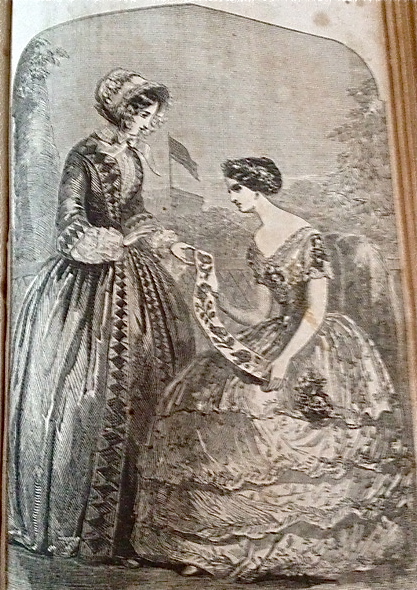
One item that Evelina brought back from Boston was a poplin dress – ready-made, presumably, or perhaps made to order – that she bought for her mother. It had to have been an item that her mother, an elderly country woman, would never have purchased for herself. Hannah Lothrop Gilmore had spent a lifetime sewing her own garments.  She was also unlikely to board a wagon or carriage to go into Boston to shop. The ride from the farmhouse to church on Sundays was about as adventurous as she got. How kind of Evelina to treat her mother in this extravagant way.

Poplin was a popular cotton fabric in the nineteenth century. It was smooth, lightweight and finely woven, more refined than broadcloth, although they were not dissimilar in weave. Both were sturdy and today both are often used for men’s shirts. The dress on the left in the illustration above was a day-dress and probably similar in shape and weight to the poplin dress Evelina bought, perhaps with less trim. The undersleeves were a particular feature of women’s dresses right before the Civil War.

The dress on the right was not something that Evelina would have purchased for her mother, or even for herself at this stage in her life. It was an evening dress with a stylish flounced skirt that would have been entirely too “jeune fille” for old Mrs. Gilmore.

* Spring fashions from Godey’s Lady’s Book, 1851


May 4, 1851


Vintage Ad for 1887 Brecks Seed Catalog (Original)

*

May 4th Sunday  Went to church this morning and at

intermission called with Mother at Mr Whitwells

Mrs Daniel Clark went with us Heard two good

sermons from Mr Whitwell. Orinthia went

in the afternoon, staid at home this morning

Have been reading since church in the book of

flowers & called in the other part of the house

to see Mrs Stetson who came Friday night


The Flower Garden or Breck’s Book of Flowers is probably the book to which Evelina gravitated on her return home from church.  Its subtitle was “In which are described all the various hardy herbaceous perennials, annuals, shrubby plants, and evergreen trees, desirable for ornamental purposes, with directions for their cultivation” and it probably took her mind away from Reverend Whitwell’s sermons. Written by Joseph Breck, head of an eponymous gardening firm, the “book of flowers” was published by J. P. Jewett of Boston and was immediately popular. It met a need among a burgeoning population of female gardeners like Evelina who were happily creating “parlor gardens” for their homes.

Naturally, women had gardened before the nineteenth century, but earlier gardens, at least of the kitchen variety, were generally planted for culinary or medicinal purposes. Flower gardens existed, certainly, but tended to be presented within a larger landscape that was most often designed by men. Female participation in gardening was a more recent phenomenon, promoted assiduously by landscape designers like Andrew Jackson Downing, authors such as Englishwoman Jane Loudon, taste-setters such as Sarah Josepha Hale, and commercial gardeners like Breck. All were guided by “the nineteenth century urge for the beautification of the American home and its surroundings.”**

The Church, too, latched on to the fashion for flower gardening. As Godey’s Lady’s Book counseled, women needed to “[s]tudy the flowers and behold the wisdom, the goodness and mercy of the Almighty.” *** According to a diary kept by Oliver Ames, Jr., Easton’s own Reverend William Chaffin, a few years later, drew an appreciative “analogy between the cultivation of the Garden and of the Spiritual nature.” Religion was to be found among the pinks and pansies.


* Catalogue for Joseph Breck & Sons, 1887

** Ann Leighton, American Gardens of the Nineteenth Century, 1987

*** Godey’s Lady’s Book, May 1851


March 27, 1851

0380042t

1851

March 27 Thursday.  Spent the day with Mother at A[u]gustus,

got home just before six Oclock and went

in the evening to the dancing school with Mrs S. Ames

Cut out and commenced a bleached shirt for

Mr Ames but have not done so much as to finish 

the sleeves.  Mrs. S. Ames has been to Boston from 

Sharon.  A fine day and very good travelling

the roads are quite dry.  Mother stopt at Mr Torreys.

After Evelina and her mother spent the day with, respectively, nephew and grandson Augustus, Hannah Gilmore left to spend the night at her son-in-law, John Torrey’s, house in the village, leaving Evelina briefly unencumbered from looking after the elderly woman. Evelina seized the opportunity to go out with her sister-in-law, Sarah Ames, to help chaperone a dance for the young people.

No doubt the Ames sons, Oakes Angier, Oliver (3) and Frank Morton were at the dancing school, as they had been for most of the previous Thursday evening assemblies. So, probably, was Fred Ames, making a rare appearance while home from school.  While adults from their parents’ generation were always present at these occasions, one wonders how the young men felt having their mothers among the group standing guard.

These assemblies were important social occasions that provided innocent pleasure and animation. They fostered acquaintances among the young people of the town who had few other opportunities to mingle.  Dance steps were learned, exercise was taken, manners were polished, courtships were sparked, hearts were engaged or disappointed, and perpetuation of the species forwarded in this important small town gathering. Surely both Evelina and Sarah Ames watched the proceedings with interest.