July 2, 1851

Thread


Wednesday July 2d  Have had quite a busy day.  This forenoon

cut out three shirts for the sewing circle and worked

a long while in the garden transplanting

Oliver went to Bridgewater and carried Mrs Whitwell

Mrs Witherell and me to the sewing circle at Alsons.

After I got home went to work on boquets

for Oakes & Frank.  Harriet assisted

Mrs S Ames went [to] Exeter this morning

Today is one of those instances when we can’t be certain which Oliver is being referred to.  Did Evelina’s brother-in-law, Oliver Jr., or son, Oliver (3) carry Evelina, Sarah Witherell and Eliza Whitwell to the Sewing Circle at Henrietta Gilmore’s?

Besides attending the monthly gathering of the Unitarian women to sew, Evelina also spent time in her flower garden.  She transplanted a number of flowers and picked several to fashion into two bouquets. Her sons, Oakes Angier Ames and Frank Morton Ames, planned to attend a party in Middleboro the next day and needed what we might call corsages to take to their dates (a modern word they wouldn’t have used.) She and her sister-in-law, Harriett, arranged the flowers appropriately.

Sarah Lothrop Ames had business of her own to attend to.  She went up to Exeter, New Hampshire, where her son Fred Ames was in school. Was she picking him up to bring him home or just visiting?

June 27, 1851

weedy flower bed

*

June 27 Friday  John left here this morning

Worked a long time in the garden

this morning for the weeds were very plenty

afterwards finished picking over the hair and

a long job it has been.  This afternoon put the hair

into the hair cloth cover and just commenced tying

it when Mrs Clark and Mrs Stetson came from

Sharon and of course had to leave it and go

into the other house house to see them. Mother & I stoped to tea

Pigweed, thistle, crabgrass, and purslane: Such weeds – and more – are the collective bane of the flower gardener. Evelina tackled some of them this morning as she addressed the “very plenty” weeds that were pushing into her flower beds. Perhaps she ruminated about her brother John and his short visit while her fingers dug into the soil.

After midday dinner she turned to her sewing, as usual, going right to her haircloth slipcover project, but abandoned it with alacrity when an opportunity for socializing turned up.  “Had to leave it and go..” she noted, when two friends from nearby Sharon arrived next door.  She and her mother, Hannah Lothrop Gilmore, went over for tea.

Frank Ames Mitchell, a nephew of Oakes and Evelina, turned ten years old today.  One of two grandsons of Old Oliver named Frank (the other being Frank Morton Ames,) he was the eldest son of Oakes’ sister, Harriett Ames Mitchell. He, his mother, and two younger siblings were living temporarily in Bridgewater while their father, Asa Mitchell, was working in coal in western Pennsylvania.

Our knowledge about Frank Mitchell is limited, as he never married or had any known issue. We do know that he was the only Ames grandson to fight in the Civil War.  He served in both the 44th and the 56th Massachusetts Regiments, and ultimately made captain.  In 1864, he was wounded at Cold Harbor.  Hospitalized in Washington DC, where his mother rushed to his side, he eventually recovered but remained in indifferent health for the rest of his life.

After the war, Frank bought a plantation in Tallullah, Louisiana, an effort that was underwritten and ultimately bought out by his Uncle Oliver Ames, Jr.  Family records show that Frank subsequently depended on financial support from his cousin Fred Ames. The remainder of his life consisted of traveling from one healthful climate or resort to another in search of good health.


* A modern flower garden, full of weeds, from canoecorner.blogspot

June 8, 1851

IMG_0139 2

June 8th  Have been to meeting all day  Heard Mr Dogget

of Ashby did not like him near as well as Mr.

Whitwell.  Came home at noon with Alson & wife.

Oakes Angier & Orinthia went to night to call on

Miss Perkins at Mr J Kimballs.  Mr Ames & self

called at Mr Peckhams.  It has been a cold cloudy

day for the season and to night rains some.


Today was a normal Sunday in Easton, which the Ames family spent at church listening to Mr. Dogget, a visiting preacher who probably had no chance of being as good as Reverend Whitwell, at least in Evelina’s eyes. After church Evelina and Oakes called on John Peckham, a clerk at the shovel works, and his wife Susan.

Things may have been more lively next door at the home of Sarah Lothrop and Oliver Ames, Jr. Their oldest child and only son, Frederick Lothrop Ames, turned 16 years old today. He may have been at home to celebrate, or he may still have been away at school.  Fred was just finishing a year of college preparatory study at Phillips Exeter Academy. Prior to that, he had studied at Concord Academy.  Young as he was, he and his parents expected his next year to be spent at college.

A brilliant business career lay ahead for Fred Ames. By all accounts, but best described by his personal friend Leverett Saltonstall, Frederick Lothrop Ames, “distinguished by his high character, was well known as one of the largest capitalists in the country.”* Not only was Fred a capable member of the management team of O. Ames & Sons, he was, like his father, an active investor and eventual director of the Union Pacific Railroad. He became a strong, competitive railroad man. At the time of his death in 1893, he was “officially connected to some seventy-five railroads,” and held oversight or investment positions in many other enterprises: banks, coal mines, elevators, and an innovative young company called General Electric.

Clearly capable in the world of business, Fred Ames was also a likeable fellow. “No one ever met him without being impressed by his uprightness, intelligence, and good judgment.” “A most kind and generous man,” he donated to and oversaw various charities and hospitals. He reportedly led a happy family life in North Easton and Boston, and created a lasting legacy through his support of the architecture of H. H. Richardson. “A devoted lover of horticulture,” also, he had a famous collection of orchids.

A star among the grandchildren of Old Oliver and Susannah Angier Ames, Frederick Lothrop Ames died too early, dropping of apoplexy – what we would now call a stroke – on the overnight train to New York. He was 58 years old. His legacy would live on.


* Leverett Saltonstall, Memoir of the Hon. Frederick Lothrop Ames, A.B.,  The Colonial Society of Massachusetts
March 30, 1851

headache1

*

March 30 Sunday  Have not been to meeting at all to day.  My

cold is very troublesome have a very bad head ache.

could not read much.  Mr Cyrus Lothrop 3d called this 

evening & Frederick, Oakes Angier & Orinthia rode

down to Mr E Howards this evening.  Mrs Howard

has gone to Nashua to make a visit.  Mother returned

home from meeting  A very fine day

I commenced making fire in the furnace

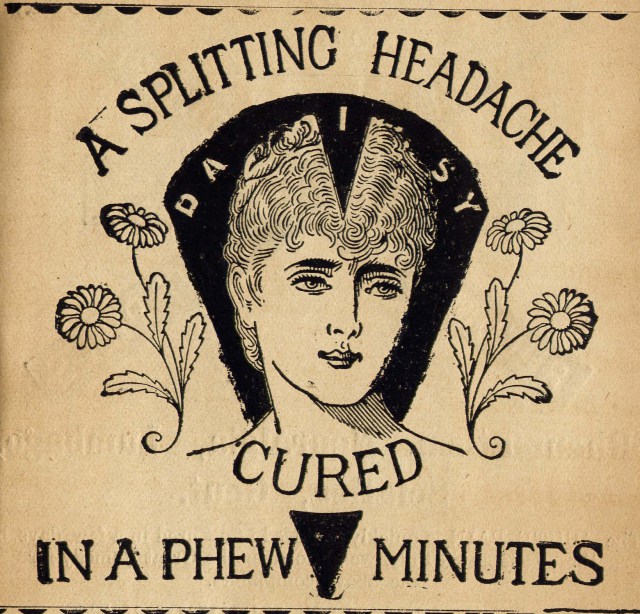
Evelina continued feeling poorly today. After yesterday’s helping of the commercial elixir, Wistar’s Balsam of Wild Cherry, one can’t help but wonder if her headache was, in fact, a symptom of hangover from the alcohol she unknowingly ingested.

The consumption of alcohol was absolutely forbidden at the Ames’s house.  Both Oakes and his brother Oliver Jr took a temperance pledge early on, and kept it. They hoped their workmen would follow their example. In this they differed from their father who, in his heyday of running the shovel works, had allowed his workers a ration of rum as part of their regular routine.  Old Oliver’s habits had been learned in the 18th century, which had a more lenient attitude about liquor.  In the 19th century, however, tolerance of alcohol disappeared. Temperance became the banner of the day, its support increasing yearly and culminating, ultimately, in the Prohibition amendment in the 20th.

In the Ames dining room, even something as mild as cider was frowned upon.  Cider was considered by some at a “gateway” beverage to liquor and hard spirits; others found it innocuous. Evelina kept some in the pantry to put in her mince pies but never served it at table.  Once, however, she offered a tumbler of cider to her future son-in-law, Henry French when he turned down a cup of coffee. Oakes admonished them both by stating flatly that, “No cider shall be drunk at my table.”

Alcohol was a controversial issue.  If Evelina had known that the medicine she was taking was laced with alcohol, she might not have indulged.  If Oakes had known, he wouldn’t have allowed her.

*Advertisement from ca. 1900.  


March 27, 1851

0380042t

1851

March 27 Thursday.  Spent the day with Mother at A[u]gustus,

got home just before six Oclock and went

in the evening to the dancing school with Mrs S. Ames

Cut out and commenced a bleached shirt for

Mr Ames but have not done so much as to finish 

the sleeves.  Mrs. S. Ames has been to Boston from 

Sharon.  A fine day and very good travelling

the roads are quite dry.  Mother stopt at Mr Torreys.

After Evelina and her mother spent the day with, respectively, nephew and grandson Augustus, Hannah Gilmore left to spend the night at her son-in-law, John Torrey’s, house in the village, leaving Evelina briefly unencumbered from looking after the elderly woman. Evelina seized the opportunity to go out with her sister-in-law, Sarah Ames, to help chaperone a dance for the young people.

No doubt the Ames sons, Oakes Angier, Oliver (3) and Frank Morton were at the dancing school, as they had been for most of the previous Thursday evening assemblies. So, probably, was Fred Ames, making a rare appearance while home from school.  While adults from their parents’ generation were always present at these occasions, one wonders how the young men felt having their mothers among the group standing guard.

These assemblies were important social occasions that provided innocent pleasure and animation. They fostered acquaintances among the young people of the town who had few other opportunities to mingle.  Dance steps were learned, exercise was taken, manners were polished, courtships were sparked, hearts were engaged or disappointed, and perpetuation of the species forwarded in this important small town gathering. Surely both Evelina and Sarah Ames watched the proceedings with interest.

March 24, 1851

canton-ma-landscaping

/51

March 24 Monday  It was so unpleasant this morning

that Jane could not put her clothes out but

about noon it cleared up and she has got

them all dry  I have cut out a shirt for Oliver 

of fine unbleached cloth and have sewed

some of it & mended Mr Ames coat & vest

He went to Canton this afternoon.  Mr Whitwell

called.  Mrs Witherell passed an [illegible] this evening

Perhaps wearing one of his new shirts, or at least wearing a mended one, Oakes Ames traveled to neighboring Canton today.  Named for Canton, China, because some imaginative citizen believed the Chinese city to be its geographical twin on the opposite side of the world, the Massachusetts city had manufacturing interests much like Easton. Since before the American Revolution, the Kinsley family had operated an ironworks there. Like the shovel works, the Kinsley business had started small and grown well. Initially, it produced farm implements and was entirely family-run. It had a forge, a large rolling mill and the capability of producing steel.

In 1851, Lyman Kinsley was its sole operator; by 1858, the company would be owned by the Ameses. Oliver Ames Jr. would become its first Ames president, with others to follow (Frederick Lothrop Ames would be next, and after him, his son Oliver.) Frank Morton Ames would be its General Manager. Perhaps Oakes’s visit to Canton today, although certainly having something to do with getting steel for shovels, was also quietly prompted by some foreknowledge that the Ameses were interested in acquiring this complementary business.

Once the Ames owned it, the Kinsley Iron and Machine Company would eventually develop to produce wheels and axles for railroad cars, another product that would fit nicely with Ames business interests.

March 23, 1851

Bible

1851

March 23 Sunday.  Have been to church to day and 

stoped at noon to hear the bible class

with Alsons wife & others, got some subscriptions

for the blinds.  Mother came home with

us from church to make a visit.

Orinthia & myself read to Mother a story in 

The Boston Museum a long one but not worth

much Edwin called and Fred & Helen

A beautiful day it has been

Not only was Helen home from school for a visit, but her older brother Fred was back, too, from Philips Exeter Academy where he was preparing for college. How pleasant for Oliver Jr and Sarah Lothrop Ames to have their two children home, however briefly. Helen and Fred stopped in to say hello, as did another cousin on the Gilmore side, Edwin Williams Gilmore. Plus, Evelina’s aged mother, Hannah Gilmore, returned from church with the Oakes Ames family to “make a visit” of a few days. The old house was busy toward the end of the day, and tea this evening must have been especially sociable.

Earlier in the day, at the intermission between services, Evelina popped into a Sunday School class – perhaps for adults? She also did a little fund-raising for the church, or for a charity with which the church was affiliated.  She and others raised some “subscriptions for the blinds” (which does not mean they were ordering new window treatment!)  They were hoping to help the sightless.

Although Evelina was both devout and charitable, she was not sanctimonious. In her diary, she never mentions reading the Bible. She loved reading, and made note of various novels, stories and articles, such as today’s story that “was not worth Much.” But the Bible itself went unnamed.  If she did read chapter and verse from time to time, which seems likely, she simply never said so.  Perhaps reading from it may have been as automatic as looking something up in the dictionary might be for us.  She didn’t feel the need to remark on it.

January 30, 1851

Flames

Jan 30th  Thursday  Mended Mr Ames pants which

took me most of the forenoon, read some to Mother.

Spent this afternoon at Olivers with mother & Mr

Whitwell.  They sent the carriage for Mrs Whitwell

but it was so cold that she did not come.  Mr Ames

took tea with us & Mr Ames Oliver Jr C Lothrop & 

Helen played cards I commenced a stocking of the yarn

Mrs Foss gave me.  A bitter cold day & quite windy.

A great fire in Taunton

“A verry bad day to go out in,” noted Old Oliver in his journal today.  Eliza Whitwell refused to leave her home several miles away to join the Ames ladies in the afternoon, even though her husband was there.  The carriage – did it belong to Old Oliver, or Oliver Jr, or to the family in general?  Whoever owned it, its likely driver was Michael Burns, an employee of Old Oliver who looked after the horses and carriages.

While Michael drove to and from the parsonage in the howling cold, various family members gathered next door at Oliver and Sarah Lothrop Ames’s house for tea. Oakes and his son Oliver (or possibly his brother Oliver – unclear) played cards – probably whist – with Cyrus Lothrop and Helen Ames.  Cyrus was an unmarried brother of Sarah Lothrop Ames who lived with Sarah and Oliver, Jr. for many years. Helen was their only daughter; their son, Fred, was probably away at Phillips Exeter Academy on this occasion.  Evelina knitted and kept her mother company.

In nearby Taunton, Massachusetts, Evelina reported, the furious wind contributed to a “great fire.”  The histories of that period don’t mention this fire, so perhaps it was not as great as Evelina thought.  That, or it paled in comparison to the larger fires that Taunton suffered in 1838 and 1859.*  Fire, naturally, was the dread of every homeowner and municipality; towns and cities in the 19th century (and before) were pock-marked by periodic burnings, its citizens haunted by the loss of life and property that fires engendered. The fire on this day in Taunton would have been made especially difficult by the frigid air and icy wind.

*Information obtained from Old Colony Historical Society, Taunton, Massachusetts

January 12, 1851

Preach

/51 Jan 12 Sunday  Have been to church all day and heard two

excellent sermons from Mr Whitwell.  The afternoon text was

“Train up a child in the way he should go and when he is old

he will not depart from it”  Passed this evening at Mr Willard

Lothrop with Mr Ames & met with Minister Norris & Mr Torrey

This noon I stopped to hear Mr Whitwells class in the Sabbath

School afterwards went into Mr Daniel Reeds with Mother

Very warm + pleasant for the time of the year

The Ames family, Unitarians all, attended meeting today and stayed for both services, which encompassed a morning program, an intermission, and an afternoon program.  In their family pew, Evelina, Oakes, Oakes Angier, Oliver (3), Frank Morton and Susan sat with or near Old Oliver, Sarah Witherell and her children, George and Emily.  Also nearby, if not in the same pew, sat Oliver Jr, Sarah Lothrop Ames and their children, Fred and Helen, faces upturned to hear Reverend Whitwell deliver the day’s two sermons.  Eight-year old Susie may have squirmed in her seat; she wasn’t inclined to sit still for the second service.  And Oakes Ames was known to fall asleep, however inspiring Mr. Whitwell’s words were to Evelina.

In 1851, the Unitarians congregated at a church in Easton Centre, a few miles south of the village of North Easton (but still within the boundaries of the Town of Easton, Massachusetts.)  Like many families, the Ameses had to travel by carriage or sleigh to attend Sunday service.  The adults would have ridden, or “been carried,” as the expression went,  but the children may have had to walk the distance.  Children walking to church, regardless of distance, was common.  If this was true for the Ames family, we might imagine that cousins Oliver (3) and Fred walked together, as they were close friends.

At intermission, children went into Sunday School and the adults socialized.  Winthrop Ames, a grandson-to-be, described the scene in his family history (from 1937):

“They tethered their horses in a long, open shed and stayed through both morning and afternoon services, eating the luncheons they had brought and gossiping with the townsfolk during the intermission.”

On this winter Sunday Evelina and her mother, Hannah Lothrop Gilmore visited at the nearby home of Daniel and Mary Reed.  Socializing continued in the evening as Evelina and Oakes called on Willard Lothrop.