November 14, 1851

Moby-Dick_FE_title_page


Tuesday Nov 14th  Bridget has cleaned the store room

and I have been working about in the chambers

have put Franks chamber in order papered

a little trunk &c &c  Have been working about

the house all day  I can scarcely tell what 

Im about all the time but I find something 

to keep me busy and I scarcely sew at all

Frank has been making a fuss about a robin to wear

The American edition of Herman Melville’s Moby-Dick or The Whale was first published on this date in New York, by Harper & Bros.  It followed a British edition that had come out about one month earlier.  Neither edition was a commercial success.

Today may have been a milestone for American literature, but the occasion went unnoticed by Evelina and most readers, discerning or otherwise. Evelina was focused, as usual, on domestic concerns “about the house,” including putting the bedroom or “chamber” of her youngest son, Frank Morton Ames, in order.  He, meanwhile, was complaining about an item of clothing that he needed to wear. Does anyone know what a “robin” is?

Old Oliver was, as usual, paying a farmer’s attention to the weather:  “this was a cloudy day most of the time the wind got round south west and was warmer than it has bin for several days past”.

October 29, 1851

1157676_l

*

Wednesday Oct 29.  I have been what I call puttering

about house most all day and have accomplished

but very little.  papered the fireboard and pasted

the loose places in Franks chamber  Mr Scott

has painted the sitting room & closet

Mrs Hubbel & Ames came from New York this morning

H O A Orr came for Susan this afternoon  Mr

Walton is there. Mrs Holmes and Abby called

Mr Ames came home from Boston to night

Many comings and goings in North Easton today, under a cloudy sky.  Almira Ames, widow of George, an Ames cousin, arrived from New York with a Mrs. Hubbel in tow. They came for a visit with the obliging Sarah Witherell and Old Oliver Ames in the other part of the house.

Susan Orr, meanwhile, who had been staying with Sarah Witherell and her father for almost a month, was picked up this afternoon by her brother, Hector Oakes Orr. Susan, age 53, and Hector, age 51, were first cousins of Sarah Witherell and her siblings on the Angier side of the family.  Susan and Hector were two of five children of Susanna Angier Ames’s sister, Mary and her husband, Dr. Hector Orr, of Bridgewater. Their shared grandparents were Oakes and Susanna (Howard) Angier.

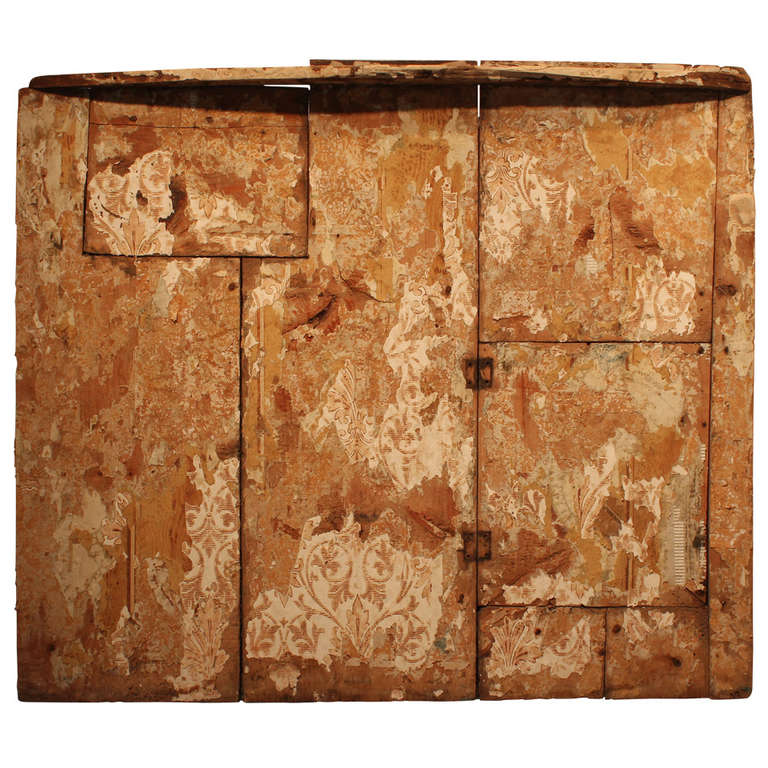
Evelina’s niece on the Gilmore side, Abigail Williams Torrey, paid a call with Harriet Holmes (the neighbor who had been so ill back in August). A Mr. Walton floated somewhere in the picture; Evelina’s inclusion of his name is a bit vague. And chugging along in the background of the various calls was Mr. Scott painting the woodwork in the sitting room. Evelina concentrated on papering a fireboard when she wasn’t attending to the influx of visitors. For readers who don’t have fireplaces, a fireboard was a piece of wood, textile or ironwork fitted to the opening of a fireplace for periods when the fireplace wasn’t being used.  Fireboards made from wood, most common in the countryside, were often decorated with wallpaper or painting.


* 19th century papered fireboard, Pennsylvania, courtesy of 1stdibs.com.


October 28, 1851

fig7

*

Tuesday Oct 28.  Have been assisting Mr Scott about papering

again to day and have painted over some things

and places about the house. Finished papering the

sitting room and little entry just after dinner

Hannah called with Eddy a few moments

Mr Ames is still in Boston passed last

night there.  I spent the evening in the other

part of the house.


Yesterday’s unseasonable snow storm departed and left behind “a fair day**”  Evelina seemed not to notice the difference, focused as she was on the repapering and repainting of the downstairs of her part of the house. She was helping with the actual papering. Her husband, Oakes, was away in Boston, so her only responsibility was making sure that meals were on the table for sons Oakes Angier and Frank Morton and daughter Susan Eveline, a task she typically delegated to her servants.

Hannah Lincoln Gilmore, who was married to Evelina’s nephew, Alson “Augustus” Gilmore, paid a call with her older son Eddy. Edward Alger Gilmore was a toddler who had fidgeted more than once in his great-aunt’s parlor. He was only two years old, and probably couldn’t yet pronounce his name.

Eddy’s middle name came from his maternal grandmother, Rachel Howard Alger (1802-1823), the first wife of Alson Gilmore and mother of Hannah’s husband, Augustus.  Rachel died less than a year after Augustus was born; Augustus couldn’t have remembered her, but he clearly wished to honor her by naming his own first-born after her. The Alger family was settled in Bridgewater, Taunton, and Easton, all descendants of a Thomas Alger in the 17th century. Both Evelina and Sarah Lothrop Ames were among the hundreds of descendants in the Thomas Alger line.


* Illustration in “Scientific American”, ca. 1880, of machine production of wallpaper, New York, Courtesy of National Park Service, http://www.cr.nps.gov/history/online_books/tpsd/wallpaper.

** Oliver Ames Journal, courtesy of Stonehill College Archives


October 25, 1851

WHEATLAN-h

*

1851

Sat Oct 25th  Mr Scott & Holbrook have been to work

all day papering the parlour and they have got

it papered only from the little entry door

around to that corner of the mantlepiece.

Mr Smiley worked here about two hours to day

put on the border in the parlour as far as it [was]

papered and some paint on top of the closet

shelves.  I have trimmed the paper and &c.


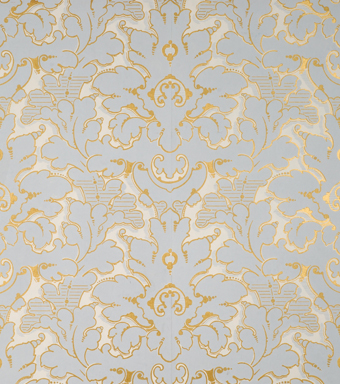
The wallpaper in the illustration above is an example of a mid-19th century pattern that might have been available in Boston, where Evelina purchased her new paper for the parlor. Two men, Mr. Scott and Mr. Holbrook, did some papering today, but not fast enough to suit Evelina. She was so eager to have the paper up that she helped by trimming some of it herself.  What did the workmen think about that? Mr. Smiley, who only seemed to work a few hours at a time, applied a border to what paper had been put up and painted a few shelves.

Oakes Ames was probably absent today, as Saturday was his usual day to be in Boston taking orders for shovels. Sons Oakes Angier and Frank Morton would have been at the factory across the street, honing their skills in the manufacture of shovels. Little Susie was probably at school.


*Example of mid-19th century wallpaper, courtesy of adelphiapaperhanging.com

October 24, 1851

pantry-shelves-vintage-650-225x300

*

Friday Oct 24th  Jane & Bridget have cleaned the buttery

and I have had some paint put on the 

shelves  Mr Smiley worked here about three

hours, he went to Mansfield and came here 

about two Oclock.  Scott & Holbrook have finished

the first coat to the sitting room & parlour

I have been about house most of the day.  Sit awhile

with Susan Orr.  Capt Isaac Lothrops wife buried this P. M.

Much cleaning was going on at the Ames’s house in tandem with major redecorating. Evelina the housewife was impelled to tidy everything up before and after various workmen came through to scrape, dismantle, build, paint and/or paper the downstairs rooms. Her servants, Jane McHanna and Bridget O’Neil, scurried around with her, clearing shelves so that the men could follow and do their work.

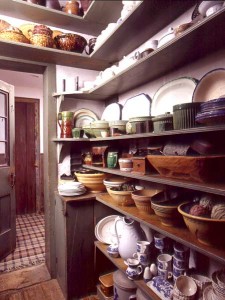
The buttery that Evelina mentions was, in fact, a shelved area off her kitchen that served pretty much as a pantry.  She had food storage “down cellar”, of course, but the buttery, being close by and on the same floor as the kitchen, would have been more accessible for daily use.  She would have stored everyday items like coffee or tea there, for instance. If the Ameses had kept dairy cows, milk would have been poured into pans there, to be skimmed for cream.  Yet the term buttery derives not from its use for dairy products, but from an archaic British term for the room where large caskets of wine, known as butts, were stored. (One butt was the equivalent of two hogsheads or four barrels of wine.) There was no storing caskets of wine at the Ames’s.

Oakes Ames was away during yesterday and today’s disruption, though sons Oakes Angier and Frank Morton and daughter Susan Eveline were home and had to sidestep the disarray. Oakes was away on shovel business, most likely.  No one from Evelina’s household appeared to attend the funeral of Isaac Lothrop’s wife.


* 19th century pantry, courtesy of http://www.oldhouseonline.com, photo by Gross & Delaney


October 16, 1851


OLYMPUS DIGITAL CAMERA

*

Thurs Oct 16th Lavinia came back with O & F and spent the 

night  Sat with her awhile and sewed some on

the waist of my dress and sewed some buttons on

Franks vest  Went with Augustus with her

about Eleven and stopt an hour.  This afternoon

have been to Augustus Lothrop with Mrs S Ames

He has been sick about a week with the

Typhoid fever.  Bought 3 Bl apples of N Alger

Mrs Swain has a son born this morning

Evelina’s niece, Lavinia Gilmore, stayed the night with the Ameses, having ridden from the Gilmore farm with her cousins Oakes Angier and Frank Morton Ames.  Lavinia often visited with the Ameses in North Easton, evidently enjoying the bustle that the village of North Easton provided, relative to life on the farm. Today she sat and sewed with her aunt, who always enjoyed company while sewing. Somewhere along the way in today’s comings and goings, Evelina purchased three bushels (or barrels) of apples from Mr. N. Alger, a probable neighbor of Lavinia and her family.

In the afternoon, Evelina went with her sister-in-law, Sarah Lothrop Ames, to visit one of Sarah’s many brothers. This youngest brother, Horace “Augustus” Lothrop, lived in nearby Sharon where he ran a cutlery company.  He was quite ill with typhoid fever, a bacterial disease that was all too common in the 19th century. Spread by unsanitary conditions, typhoid fever killed more than 80,000 soldiers during the Civil War. Happily, Augustus Lothrop would survive his bout with the disease.

Another survivor today was Ann Swain, who came safely through the birth of her first child, a son. No doubt the relatives who had gathered to help were thankful and pleased.


Illustration of nursery furniture from Godey’s Lady’s Book, 1851

October 7, 1851

Broom

Tuesday Oct 7th  Have been at work on the dark french

print  This forenoon swept the chambers and put Franks

chamber in order that he left.  Carried my work

into the other part of the house while  My humour

troubles me so that I can scarcely sit still.  Was quite 

sick awhile this evening  We have had very cold

weather for the season for a number of days


Whatever powdered medicine Dr. Swan gave Evelina on Sunday wasn’t working. Her “humour” troubled her all day and she was especially ill in the evening. Her nettlerash made her uncomfortable and sick. With some asperity, she noted the recent “very cold weather,” which wouldn’t have helped her frame of mind.  It’s interesting to note that her father-in-law, Old Oliver described this very same day as “a fair warm day wind northerly part of the day + southerly part of the day.” It’s likely that Evelina’s perception was colored by her overwhelming personal discomfort.

Does any reader think Evelina that might be suffering from shingles?

Nonetheless, she kept busy.  She swept the house and tidied up after her youngest son, Frank. She sat down to sew, though must have found it difficult to concentrate when her skin itched and burned.  She went into the other part of the house, where Miss Susan Orr, an elderly friend (or relative?) from Bridgewater was visiting. No doubt she sought conversation to take her mind off of her own troubles. Perhaps she wished her nephew, George Oliver Witherell, a happy birthday. He turned 14 on this date.


September 20, 1851

Train

Sat Sept 20th  Was out shopping all day purchased a number

of articles among the rest a Cashmere & french print

dress paper for my parlour brought home two chairs

from Bigelowes  We all returned home this evening

Frank came to Stoughton after us & rode back

on the stage.  Went into Olivers awhile this evening.

Have had a great deal of trouble with my feet while

I have bee[n] gone & to night they are very sore.

The Boston spree continued for most of the day as Evelina walked and shopped for everything from fabric to wallpaper to furniture.  She and Oakes brought their purchases home on the train (or “in the cars” as they might have said) to Stoughton. It was, finally, time to return to North Easton.  Son Frank Morton Ames met them at the depot with a carriage – or wagon –  but rode home by himself on the local stagecoach. The conveyance he brought to the group getting off the train was, perhaps, too crowded with goods from town to fit everyone in.

Perhaps not wanting to let go of the many sensations that three exciting days in the city had produced, Evelina went next door to Oliver Jr and Sarah Lothrop Ames’s house. They had returned the day before, and so missed the fireworks. Surely they compared notes on their experiences at various events at the Railroad and Steamship Jubilee.  They may have compared blisters and sore shanks, too.  They did much walking and standing during their junket, and Evelina at least was feeling the effects. Her feet hurt.

Meanwhile, never having bothered to go into town for the celebration, Old Oliver was moving ahead on improvements for the shovel shop.  In his journal he noted that “this was a fair day wind south west and quite warm we put in the bottom stone for the floom at the great pond to day and the 5 foot one on the east side of it.” A flume for the factory was going in at Great Pond.

September 9, 1851

DSCF2567small

 *

Tuesday 9th  Frank & Mrs Mitchell returned this

morning & Oakes A went from Bridgewater to the

convention at Springfield.  Mother Mrs

Stevens & self & Susan passed the afternoon

at Mr Torreys.  The Col was very clever

gave us lots of peaches.  Harriet Mitchell

came home with them this morning and spent

the evening here.

Evelina and others enjoyed an afternoon call on John Torrey, who was evidently quite amusing, and came home with at least one basket of peaches. Frank Morton Ames brought his Aunt Harriett Mitchell back from a party in Bridgewater, but his oldest brother, Oakes Angier Ames, didn’t return with them. Instead, he traveled west to Springfield, probably by rail, to attend a Whig Convention. At the age of twenty-two, Oakes Angier was diving into politics, and the Whigs in Easton thought well enough of him to represent them at the meeting.

Led by Senators Henry Clay and Daniel Webster, the Whig Party had developed in the 1830’s as an anti-Andrew Jackson party, and had managed to put four presidents in the White House, including its present occupant, Millard Fillmore. The party would soon dissolve over the issue of slavery, leading many of its northern adherents to attach themselves to the new Republican Party. Many were against slavery because it conflicted with an economy based on free-trade. But in the meanwhile, the Whigs wanted modernization and strong policies to guide economic growth.  Jeffersonian in their preference for Congress over the Presidency, they would have said they opposed tyranny.

The convention in Springfield was held on one day, September 10, “to make the customary arrangements for the annual State elections”.*  The group of about 1,000 attendees nominated the Hon. Robert C. Winthrop of Boston as candidate for Governor and the Hon. George Grennell of Greenfield as candidate for Lieutenant-Governor. The keynote speaker at the convention, Ezra Lincoln, spoke of state matters, but spent a moment on national issues as well:

“…[I]t is felt throughout the country that a crisis of no ordinary difficulty exists. Whether we look to the debates and the proceedings of Congress; to the popular elections throughout the country; to the tone of public opinion, as indicated throughout the Union by the press, and the discussions everywhere taking place, we cannot be insensible to the fact that the stability of our institutions is put to a severe test.  It is probably left to this generation to ascertain, by a severe experiment, the soundness and vitality of those principles which were embodied by our fathers in these Constitutions, as well as of the several States, as of the Union…” *

Oakes Angier and others at the convention could not have known how severe the experiment ahead of them would be.

* Proceedings of the Whig State Convention, Held at Springfield, Massachusetts, September 10, 1851.



September 8, 1851

1856_tea_BostonAlmanac


Monday Sept 8th  Mother Mrs Stevens & self sat down

to work in my chamber  The weather is very

hot  After dinner we went into the other

part of the house awhile it being so much

cooler  Abby came here to tea. Oakes A

Frank & Mrs Mitchell went to a party to Mr

Cushing Mitchells this Evening & are to spend the night

Tea had been on the serving tray very much of late, with or without short biscuits. Evelina served tea to her niece, Abby Torrey, today while yesterday she took tea at the parsonage during intermission. Three days ago, she hosted a small tea party for a guest, Mrs. Latham, her sister-in-law, Sarah Ames Witherell, and others. Evelina’s grandson, Winthrop Ames, described the importance of tea time some eighty years later:

“Supper, always called Tea, at seven was the sociable occasion.  It was usually consisted of cold meats, hot biscuits, preserves and cakes – an easy menu to expand for unexpected guests. Every week at least, and usually oftener, one household would invite the others and their visitors to tea; and the whole Ames family might assemble…”*

Although the Ameses grew and raised much of their own food, tea was a commodity that had to be purchased. Coffee and sugar, too.  As the above advertisement from 1856 indicates, tea and coffee could be purchased in bulk in Boston (not surprisingly, given Boston’s long history of importing tea into its harbor!) Black tea was the general favorite and, as the ad suggests, could be obtained in different grades of excellence.  Did the Ameses order in bulk?  Did they acquire a chest of tea at the family rate? Their careful use of money would imply that whichever Ames did the purchasing got the best product for the lowest price possible.

The weather, meanwhile, continued to be very hot. It didn’t prevent brothers Oakes Angier and Frank Morton and their youngest aunt, Harriett Ames Mitchell, from traveling to Bridgewater for a party and an overnight. Social goings-on continued.  No doubt, tea was served.

*Winthrop Ames, The Ames Family of Easton, Massachusetts, 1938, p. 128