February 9, 1851

Elizabeth Missing Sewell Gertrude 1866 ( American edition)

Elizabeth Missing Sewell
Gertrude
1866 ( American edition)

Feb 9th Sunday  I have such a cold today that I thought it best

not to go to church or to the funeral of Uncle Seth Hall.  who

died last Wednesday & is to be buried to day at 1 Oclock.

Commenced reading Gertrude by Rev W Sewell.  Edwin called

this Evening and staid an hour or more  Think it rather tiresome to read all day

although I like to do it, but seldom have the privilege.

Had Oysters to night for a rarity  Quite pleasant

Evelina described this day as pleasant, yet in his own journal Old Oliver mentioned “trees loaded with ice”.  Small wonder that Evelina opted to stay home from church to nurse a stubborn cold.  She used the quiet time to start a new novel, Gertrude, by Reverend William Sewell.

Gertrude was actually written by Rev. Sewell’s sister, Elizabeth Missing Sewell, an English author known as much for her religious tracts as for her fiction. She wrote it early in her career and, for publication purposes, gave credit for it to her Anglican brother. Neither she nor her brother were fans of Roman Catholicism, and her books usually featured the Church of England in some way. In this tale of a young woman named Gertrude Courtenay, Sewell examined a lively topic of the day: the claim of duty.  Was devotion to church more important than devotion to the home?  Spoiler alert: Sewell believed in both, but posited that duty begins at home.

The opening page of Gertrude featured a quote from Wordsworth’s poem, Excursion:

Turn to private life

and social neighborhood; look we to ourselves.

A light of duty shines on every day

For all.

This quote is an apt description of Evelina, for whom duty was an essential motivation in life.  She tried to do what was expected of her; she didn’t always succeed, but she did try. Even today, when she didn’t feel well, it must have been a struggle for her to miss both church and the funeral of a Gilmore cousin, to the point where the opportunity to indulge in reading all day eventually paled.  She needed the rest, though, and the oysters at tea in the evening were a treat, as was a visit from a nephew with whom she was particularly close: Edwin Williams Gilmore.
January 26, 1851

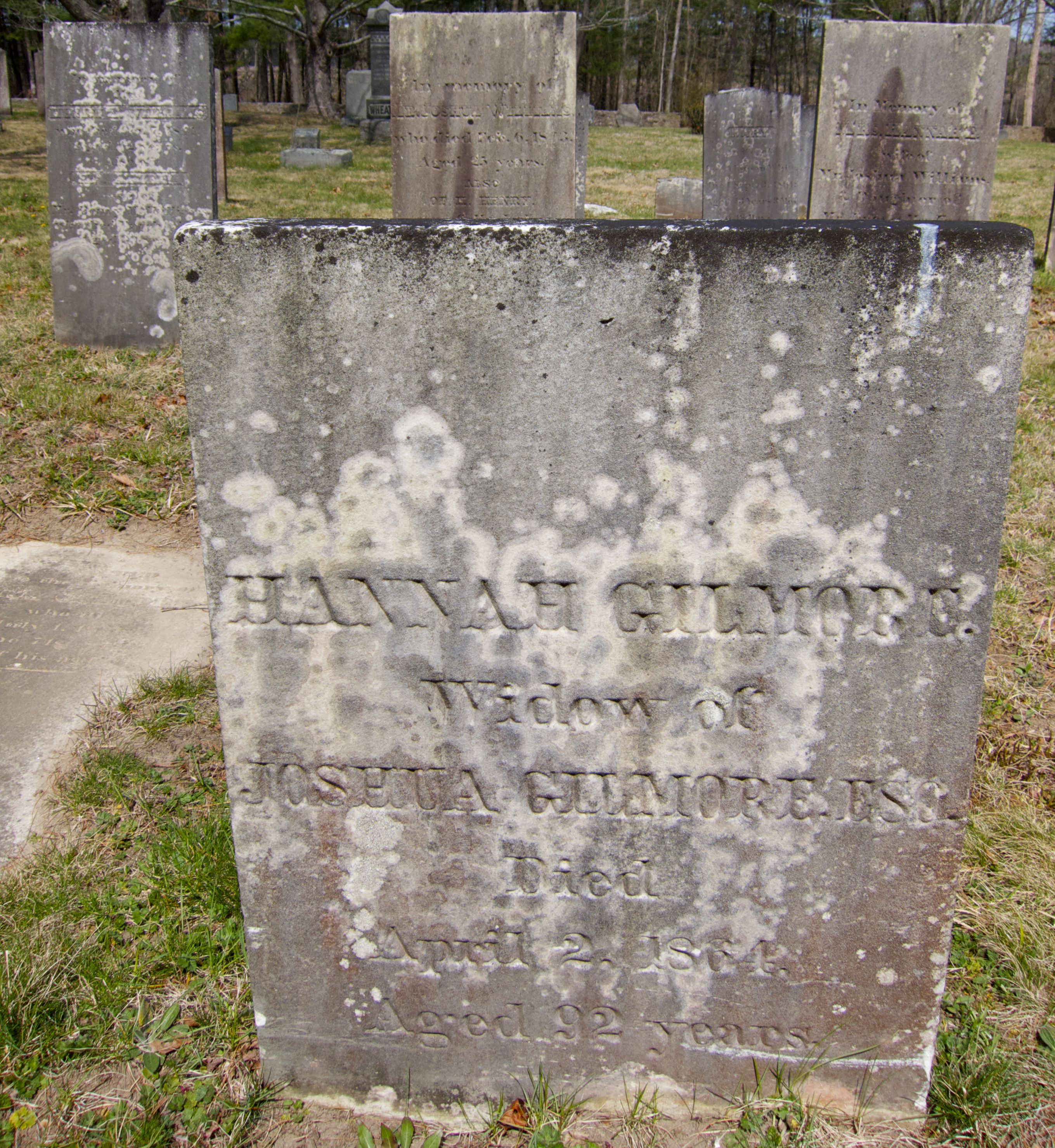
Gravestone of Hannah Gilmore

Gravestone of Hannah Gilmore

Jan 26  Sunday  Have been to meeting all day and heard two

excellent sermons from Mr Whitwell  Came home

between meetings.  Alson rode home with Mr Ames

Mother came with us from the afternoon meeting will

stop a few days.  Mr Whitwell walked up this morning

expecting to exchange with Mr Lovell but he (Mr Lovell)

was not prepared.  Mr W says a minister ought always to

be prepared.  Edwin called this evening.  It is a beautiful day.

A scheduling mix-up at church today caused consternation.  Most congregations had a practice of exchanging ministers.  On a regular basis, a minister from one church would swap one Sunday with a minister from another, allowing the congregations to listen to other voices and sermons.   On this Sunday, the scheduled switch between Reverend Whitwell of the Unitarian Church and Reverend Lovell of the soon-to-disband Protestant-Methodist assembly failed to take place.  Mr. Whitwell wasn’t pleased, but he seemed to recover just fine.  He delivered two more “excellent sermons.”

“Mother” was Hannah Lothrop Gilmore, or Mrs. Joshua Gilmore, as she would have been known, or perhaps  The Widow Gilmore, her husband having passed away in 1836.  One year shy of eighty, she was the mother of eight children, of whom only three were still alive.  Evelina was her only living daughter.

Mrs. Gilmore lived most of the time with her middle son, Alson, his wife, Henrietta, and their children at the family farm in the southeastern corner of Easton.  Just north of the town line with Raynham, the Gilmore property lay on what was known as the Turnpike Road.  In the distant past, Joshua Gilmore had maintained a tavern at that site, and had collected the fees from travelers on that road.  In 1851, the family still got income from the Turnpike, but the tavern was gone.  The land was all farm.

Occasionally, Mrs. Gilmore would visit with her daughter in North Easton.  Alson would carry her to church and after the service was over, Hannah would leave with Oakes and Evelina to stay at their home for the week.   While in North Easton, she’d be able to visit not only with her Ames grandchldren, but also with other grandchildren in the area, like Abby and Malvina Torrey.  And on this Sunday, her grandson Edwin Williams Gilmore, a grown son of Alson who no longer lived at the farm, paid a visit.  He would soon be building a home close to the Ameses.