December 9, 1851

21e3fa70a71cf1a247c917909a88dc2f Dec 9th Tuesday.  Have been painting all day.

Got some putty from Edwins house to stop

the cracks in the hearth and painted that 

and then went to work in the storeroom

chamber finished that and the porch 

and this evening Mr Scott has painted

the floor & stairs.  Have quite a bad

cold felt it first Sunday morning

Mrs Holmes called about her milk has stoped taking

Despite having a “bad cold,” Evelina was up and working.  She walked over to her nephew’s new house and borrowed some putty which she used to fill some cracks on her own hearth. She “went to work in the storeroom chamber,” painting there and on the porch as well. It was a chilly time of year to be working in those areas, and not at all conducive to getting the better of a new cold, but Evelina seemed to have a goal in mind that she was determined to meet.

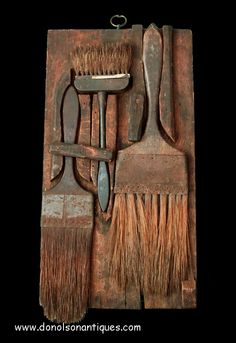
Mr. Scott was painting in the house as well, going over the floor and stairs. What kind of paint were he and Evelina using? The ingredients would have included pigment and a binding agent, such as milk or animal glue; the paint was meant to last as long as possible. Whitewash had prevailed on the plaster walls of early American homes, but other colors had since become popular. We don’t know what color Evelina picked. Mr. Scott would have mixed the paint up himself; there was no going down to a hardware store to pick up a gallon – at least not yet. Commercial house paint wouldn’t become available until after the Civil War, when Henry Sherwin and Edward Williams began to manufacture and sell ready-mixed paint.

In addition to the painting she did, Evelina mentioned a visit from her neighbor, Harriet Holmes, who came over to discuss “her milk” which “has stopped taking.”  This last sentence doesn’t quite make sense, and may be incomplete; if so, there’s no telling how the thought was intended to conclude. If we only consider what’s written, however, it sounds as if Harriet’s breast milk had just dried up. Yet there’s no commentary anywhere about Harriet Holmes having had a baby recently.  It’s a mystery.

*19th century painter’s caddy, Courtesy of http://www.donalsonantiques.com
December 5, 1851

tumblr_mbsy6tKaeV1r5pmqlo1_r1_1280

Unidentified group having tea


Dec 5th Friday  As usual this morning after being in

Boston felt tired & lazy did not get my

room in order very early.  Before it was

cleaned Mrs S Ames came in and we chatted

awhile.  Went into Edwins to get Mr Scott

to paint the porch & thus the forenoon passed

Have passed the afternoon in father Ames

with Mrs J R Howard her sister & Mrs Whitwell

With her husband away, and only her four nearly-grown children to look after, Evelina chose to relax this morning rather than make her bed, tidy up and get to her chores and sewing. “As usual,” she felt lethargic after her Boston shopping trip, but uncharacteristically, she didn’t try to overcome this lazy spell. An early morning visit from Sarah Lothrop Ames gave her some excuse to take it easy and hang out, as we might say today.

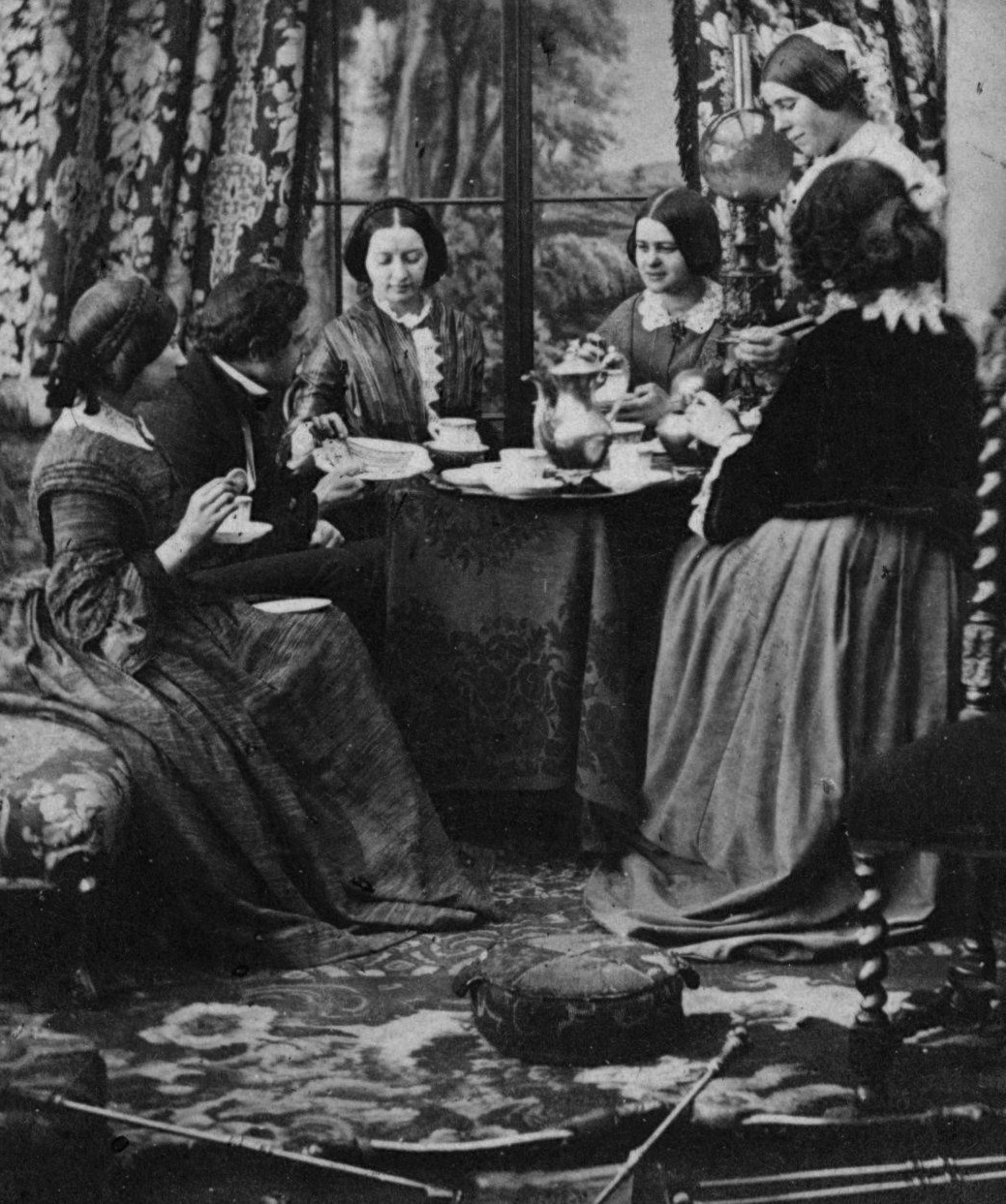
Most of the rest of her day was spent socializing.  In the afternoon Evelina went to the other part of the house to visit with sister-in-law, Sarah Ames Witherell, and other ladies who had gathered: Eliza Whitwell, Caroline Howard and the latter’s sister.  The women may simply have sat and chatted, teacups in hand, but Evelina, perhaps, had some sewing or mending at the ready as she visited.

The one piece of business that Evelina managed to do today was walk down the street to the new house being built by her nephew, Edwin Williams Gilmore, to track down Mr. Scott, a painter who was working there. He and another painter, Randall Holbrook, came over in the afternoon and began working for her. The presence of painters at Edwin’s house suggests that it was nearing completion.  Perhaps Edwin was getting ready to move in, if he hadn’t already.


November 16, 1851

IMG_0017

Modern photograph of house in North Easton built by Edwin Williams Gilmore, 1851


Sunday 16th  We have all been to meeting all day

Went to Mr Whitwells at noon with mother

rode with our new horse do not believe he

is any great affair  Edwin took tea with 

us and I went into his house with him  Wrote

a letter to Oliver.  Oakes A went to North

Bridgewater to see Mr French about selling

some hogs for father.  I asked once to let me go but

he went without me


The Ameses went to meeting today, naturally, and Evelina visited with her mother at the parsonage during intermission.  The Ames family often rode in tandem if not together to church; Evelina perhaps rode in a carriage with Old Oliver and Mrs Witherell.  She certainly seemed underwhelmed by the new horse that Old Oliver had recently acquired.

Edwin Williams Gilmore, Evelina’s nephew, stopped by for tea at the end of the day.  He was building a house in North Easton, barely a stone’s throw away from the Ames compound. Although he may have worked at the shovel factory at this time, he would soon embark on a business of his own: a hinge factory that would be a successful enterprise for decades to come. He wasn’t interested in working and living on the family farm; that job would fall to his younger brother, Francis.

For now, Edwin was an ambitious twenty-three year old who wanted to live in the village.  The house, which his father, Alson, had been helping him build, was almost ready. His next step would be to marry, and he evidently had a wife in mind: twenty-two year old Augusta Pool, his neighbor near the farm. Evelina may have been privy to Edwin’s plans; if not, she surely enjoyed looking in on the new property so close to her own. Her visit with Edwin perhaps made up for not going with her son Oakes Angier to North Bridgewater.


September 24, 1851

imgres

Wedns Sept 24th  Susan has had another night of

suffering and has not slept but little if any but this

morning she appeared better and has had a more

comfortable day than I expected she would have  Helen

brought in her doll for her to play with and she

has had three to play with which has taken […] her

mind from her sickness in a great measure.

Francis dined here carried home Mr & Mrs Whitwell


The nettle rash, or hives, that had attacked Susie Ames began to subside this morning, surely bringing relief not only to the little girl, but to her mother and everyone else interested in her welfare. As Susie began to feel better, she became agreeably occupied with an extra doll brought in for her to play with by her older cousin from next door, Helen Angier Ames.

Helen’s mother, Sarah Lothrop Ames, and Harriett Ames Mitchell left Easton today to go into Boston and Cambridge for a night. Perhaps they visited Sarah’s sixteen-year-old son Fred Ames at Harvard, where he was a new sophomore. Fifteen-year-old Francis E. Gilmore, the youngest son of Evelina’s brother Alson Gilmore, came to the Ames’s for midday dinner.  Was he visiting the construction site of his older brother, Edwin Williams Gilmore, who was building a home close to Ames compound? Francis lived down on the family farm, and was able to give a ride south to William and Eliza Whitwell, who had been visiting Sarah Witherell.

Meanwhile, focused and persistent, Old Oliver continued to supervise construction of a new flume from Great Pond near Stoughton south to the waterflow in North Easton. He noted in his daily journal that “this was a fair day with a strong wind from the north west and pritty cold. we got on the top stone to our floom to day.”


August 29, 1851

WhiteAster

Friday Aug 29th  Alson & Mr Hall came early this

morning and were here to dinner & tea, brought Pauline

with them  Have been mending for Oliver getting his

clothes ready for school  Went with Pauline to Edwins

garden he has not many pretty flowers in blossom has

some fine Dahlias  got 5 lbs of butter at Mr Marshalls

after we came back went into Olivers to hear Pauline

play.  George & wife & Sarah gone to her fathers

The day after Clinton Lothrop’s funeral, Sarah Lothrop Ames, her brother George Van Ness Lothrop and his wife Almira spent the day, at least, at the Lothrop farm with their parents, Howard and Sally Lothrop. They would have had to make long-term plans for the property, now that Clinton wouldn’t be there to tend the family farm.

Alson Gilmore, Evelina’s brother, took his meals at the Ames’s today.  He was working nearby, perhaps with Mr. Hall, helping his son, Edwin Williams Gilmore, build a house. They were putting in the cellar.  Pauline Dean, who must have been staying with or near the Gilmores, returned for a visit. She probably got roped into helping Evelina with the mending.

Evelina had a lot of mending to do, as Oliver (3) was preparing to go off to school.  Like his cousin Fred Ames, he was going to attend an Ivy League college, but in Providence, not Cambridge.  Oliver (3) would be going to Brown, and his mother had to get his clothes ready. Shirt fronts, collars and hose weren’t her only business today, however.  She and Pauline took a break from domesticity and went to Edwin Manley’s to see his garden. There they saw “some fine dahlias.”

Dahlias, which had been introduced in the United States early in the 1800s, had quickly became popular, although not yet listed in Joseph Breck’s Book of Flowers. So successful were they that over the course of the century more than 10,000 varieties were developed or identified and sold. Today, dahlias are still much admired by flower gardeners, yet less than a dozen of those 19th century heirloom examples still exist in cultivation.* The earliest known, White Aster (above) dates from 1879.

*oldhousegardens.com

August 26, 1851


Abbott H. Thayer, Angel, 1887, oil Smithsonian American Art Museum Gift of John Gellatly

Abbott H. Thayer, Angel, 1887, oil
Smithsonian American Art Museum
Gift of John Gellatly


Tues Aug 26th  Clinton Lothrop died about ten Oclock

last night  Has been sick a long time with

the Typhus fever  Mrs Witherell & I made the

shroud for him  Mrs Mitchell went to Taunton

to get Bonnets &c for Mrs Lothrop

Rebecca White came after Pauline this morning

Alson here to Dinner and tea is drawing stones for

Edwins cellar.  Oakes A and Frank returned this evening


Dewitt Clinton Lothrop finally died.  He had been suffering from typhus, “an acute infectious disease caused by the parasite Rickettsia prowazekii, transmitted by lice and fleas [,and] marked by high fever, stupor alternating with delirium, intense headache and dark red rash.”* It’s not the same disease as typhoid fever, although the two conditions have some similarities. Clinton, as he was known, had probably been bitten by a flea.

One of nine sons of Howard and Sally Lothrop, Clinton was a brother of Sarah Lothrop Ames. While most of his surviving brothers had moved away from Easton in pursuit of their own lives, Clinton was the duty son who had stayed home with his parents. Only 26 years old and married with two small sons, he had tended the family farm.

Evelina and Sarah Witherell quickly prepared a shroud for the body, while Harriett Mitchell rode off to Taunton to find mourning clothes for the young widow, Elizabeth Howard Lothrop (or for the mother, Sally Williams Lothrop.) That no one had purchased the mourning clothes before now suggests that, despite the probability of death, everyone had hoped that Clinton would recover.

It was a busy day for Evelina.  Besides helping sew the shroud, she saw her friend Pauline Dean depart to visit elsewhere in Easton and welcomed her brother Alson to midday dinner. Alson was working nearby, helping his son, Edwin Williams Gilmore, build a house.  Jane McHanna washed clothes, and she and Evelina probably continued to set the house to rights after a weekend of guests. Oakes Angier and Frank Morton returned home from their fishing trip.

* Craig Thornber, Glossary of Medical Terms Used in the 18th and 19th Centuries, http://www.thornber.net

August 24, 1851

Road

Sunday 24th Aug  We turned out to church pretty well for us

to day 9 from here 7 from the other part of the 

house 5 from Olivers.  Mr Whitwell preached

Cousin Jerry, Warren, Orinthia Lavinia & Rachel

came at noon  Alson & wife Edwin & Lavinia came

after meeting.  Lavinia will spend the night.

This evening Cousin J & W went with me to call at Willards

Twenty-one people attended church today from the Ames family compound.  Immediate and extended family members and their guests rode down Centre Street to the Unitarian meeting house to listen to Reverend William Whitwell preach. How many carriages rolled down the road?  Did any of them walk, or did they all ride? Did they all fit into the family pews?  Some returned home after the first service.

Adding to the crowd after church, Evelina’s brother Alson, sister-in-law Henrietta, and two of their offspring, Edwin Williams Gilmore and his sister Lavinia, came to the house as well. The gathering spoke to the warmth and closeness of the extended family.  It also spoke to the relative ease of travel at this time of year. Traveling between the homes of friends and family had been marked this month, with everyone taking advantage of the good weather – and good roads – before winter.

The visiting continued in the evening when Evelina took Jerry and Warren Lothrop to visit Willard Lothrop, a local spiritualist, shovel shop worker, and likely relative.


August 20, 1851

Scales

Weds 20th Aug  Rachel, Lavinia and Augusta Pool spent

the day here  Mr Ames and Augustus went to Boston

Pauline Dean came to night in the stage

appears the same as she did when she left

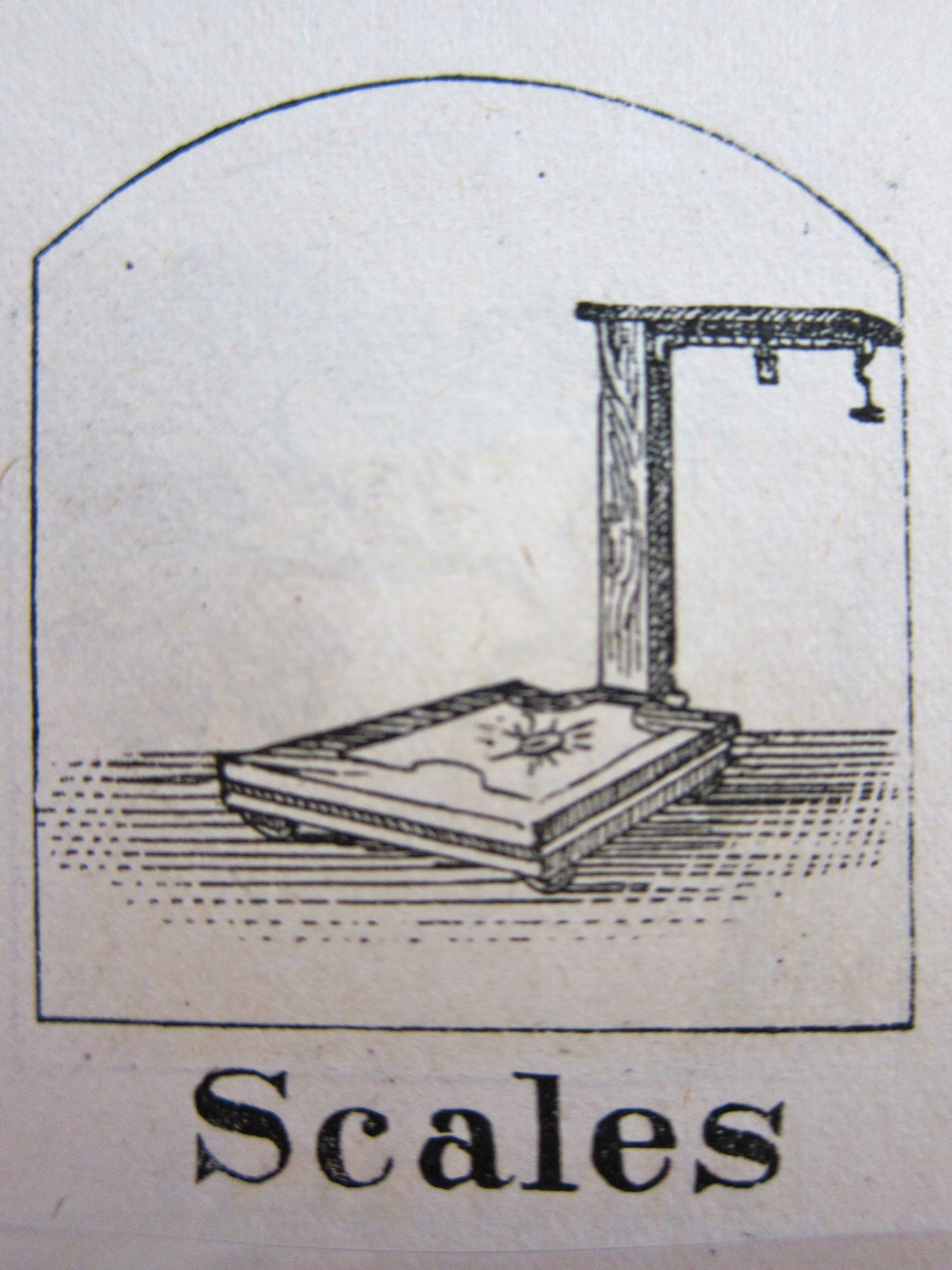
Went to the store & was weighed  148 lbs

called at the factory to see Edwin work and he came to

tea  Mr Whitwell called while we were gone

Not shy, Evelina stepped on the scale at the company store.  Fully clothed in the voluminous fashion of the day, she weighed 148 pounds. Given that her dress was full-skirted and worn over a chemise, undersleeves and petticoats, and that she wore a bonnet and most likely kept her hose and shoes on, her actual weight was probably several pounds less than she reported.  She likely weighed closer to 140.

Evelina missed a visit from Reverend Whitwell today, as she was out and about with young female company.  Two nieces, Lavinia Gilmore and Rachel Gilmore Pool, came over with Rachel’s sister-in-law, Augusta Pool.  They were ages 19, 21, and 22, respectively. They visited the store, shopped, perhaps, and watched their aunt get weighed. Perhaps they got weighed themselves. It might have been a lively time as they chatted and moved back and forth.

From the store the group traipsed to the shovel factory to watch Evelina’s nephew and Lavinia and Rachel’s brother, Edwin Williams Gilmore, work – an unusual visit to say the least, and one that could only have been accomplished in the company of the boss’s wife. What did the workmen think?

Edwin, nearly 23, would not work at the shovel shop for long. By 1854 he would be manufacturing hinges along with business partners Oakes and Oliver Ames Jr., whom he would eventually buy out. All that was in his future; today he would join his sisters and their friend Augusta for tea at his aunt’s.

July 16, 1851


Shovel Storage_1 Nov 2010

*

1851

July 16th  Wednesday  Mrs H Ames left this morning.  Will stop

a day or two at Mr Hinckleys and then venture

home  Gustavus was to meet her in Boston

Have been to work on my silk muslin dress

Julia has been here cutting the waist and it

is so near done that it will not take long 

to finish it.  Edwin & Oliver went to S. Bridgewater

to get patterns for shovel press & Back strap Machine

Evelina seldom referred to the shovel business in her diary.  The factory, the employees, the machines, the products, the day-long sounds that emanated from the shovel shops right across the street from her home went essentially unmentioned. Despite the fact that six days a week, life in North Easton revolved around O. Ames and Sons, the factory that her husband, father-in-law, and brother-in-law owned, and at which her three sons worked, Evelina was mum about the business.

Instead, she kept her attention on the domestic and social events of her own life, recording the tame goings-on of the household, which was, naturally, her sphere of interest and influence. Her focus begs the question, however, of how much of her record was consciously restricted to the quotidian. Did she hear about events at the shovel shop and choose not to include them, or were business details never discussed at the dinner table?  Were shovels excluded from pillow talk at day’s end? Or was she so familiar with the many facets of the shovel business that she took them for granted, dismissed them and looked solely at her own concerns? Was she disinterested or discrete?

That aside, shovel-making slipped into Evelina’s record today.  Her middle son, Oliver (3), and his cousin, Edwin Williams Gilmore, headed to South Bridgewater to fetch patterns and a back-strap machine for the shovel factory. The patterns were probably “dies used in a drop hammer/press that give the curved shape to the previously flat, partially formed blade.”**  The back strap was an object that facilitated the process of attaching the handle to the blade. Oliver and Edwin must have used a wagon to tote the goods back to North Easton.

* Ames shovels, Stonehill College Archives, with thanks to Nicole Casper, CRM, Director of Archives and Historical Collections

** Per Gregory Galer, PhD.

March 23, 1851

Bible

1851

March 23 Sunday.  Have been to church to day and 

stoped at noon to hear the bible class

with Alsons wife & others, got some subscriptions

for the blinds.  Mother came home with

us from church to make a visit.

Orinthia & myself read to Mother a story in 

The Boston Museum a long one but not worth

much Edwin called and Fred & Helen

A beautiful day it has been

Not only was Helen home from school for a visit, but her older brother Fred was back, too, from Philips Exeter Academy where he was preparing for college. How pleasant for Oliver Jr and Sarah Lothrop Ames to have their two children home, however briefly. Helen and Fred stopped in to say hello, as did another cousin on the Gilmore side, Edwin Williams Gilmore. Plus, Evelina’s aged mother, Hannah Gilmore, returned from church with the Oakes Ames family to “make a visit” of a few days. The old house was busy toward the end of the day, and tea this evening must have been especially sociable.

Earlier in the day, at the intermission between services, Evelina popped into a Sunday School class – perhaps for adults? She also did a little fund-raising for the church, or for a charity with which the church was affiliated.  She and others raised some “subscriptions for the blinds” (which does not mean they were ordering new window treatment!)  They were hoping to help the sightless.

Although Evelina was both devout and charitable, she was not sanctimonious. In her diary, she never mentions reading the Bible. She loved reading, and made note of various novels, stories and articles, such as today’s story that “was not worth Much.” But the Bible itself went unnamed.  If she did read chapter and verse from time to time, which seems likely, she simply never said so.  Perhaps reading from it may have been as automatic as looking something up in the dictionary might be for us.  She didn’t feel the need to remark on it.