October 9, 1851

IMG_1057

Thursday Oct 9th  Jane has been sick to day went to bed directly

after washing the breakfast dishes and I had to get

dinner  After dinner she was much better and was

able to […do] the dishes  This afternoon I have passed

in Olivers with Miss S. Orr.  Mrs Witherell & Mitchell

Mr Ames & William there to tea Have trimmed

Susans bonnet with dark ribbon


Jane McHanna was sick.  The domestic team at the Oakes Ames house was barely operational, what with Evelina herself still feeling the effects of a mean case of nettlerash. But between them, the two women, servant and mistress, managed to make meals appear on the dinner table in a timely fashion. Did the men of the house appreciate the extra effort going on behind the kitchen door?

Tea was a special event today, served next door at Oliver, Jr. and Sarah Lothrop Ames’s. Present were five of Old Oliver’s six surviving children: Sarah Witherell, Harriett Mitchell, Oakes Ames, William Leonard Ames, and the host, Oliver Ames, Jr. William was visiting, if not from New Jersey, then from his current way station on his journey to Minnesota. Harriett, too, held visitor status;  she and her children were about to return to her husband in Pennsylvania. Only Sarah Witherell, Oakes, and Oliver Jr. lived in North Easton and saw one another regularly.

Missing from the group was Horatio Ames, who lived down in Connecticut. No one’s favorite sibling, some – Oakes, particularly – may even have appreciated his absence. Interesting that Old Oliver himself isn’t mentioned as being present.

Another guest who was also there at this rare gathering of the clan was Miss Susan Orr, a long-time family friend (or relative?) who had known the group when they were children. She could remember Oakes Ames as a baby. Susan had been staying with Sarah Witherell and Old Oliver for about ten days. Meanwhile, a different Susan, only nine-years-old, got her bonnet trimmed with a new ribbon.

 

October 6, 1851

OLYMPUS DIGITAL CAMERA

*

Monday Oct 6th  Went down to Dr Swans before 7 or 8 Oclock

so that I might find him at home and he has given

me some powders  When I came back found the

dishes washed and put away  Jane has been remarkable

smart  I have finished my striped french print

and have worn it this afternoon  Mr Brown

commenced school again to day  Passed the evening

at Mr Holmes with Susan


Evelina sought help today from Dr. Caleb Swan, who gave her “some powders” for her nettlerash. She would have mixed a dosage with water and swallowed it.  What was the actual medicine that she ingested? Did it contain the laudanum that was often dispensed to women in that era? Whatever it was, it seemed to make Evelina feel a bit better.

Jane McHanna, the Ames’s servant, washed the breakfast dishes for Evelina while she was at the doctor’s. Jane usually did the cooking and Evelina typically did the washing up, but in this case Jane must have recognized how sick Evelina was.  Evelina was grateful for the assistance and praised Jane for being “remarkable smart.”

The day progressed well afterwards. Little Susie returned to school where Eratus Brown was her teacher. Did she miss her old teacher, Orinthia Foss? Evelina sewed and finished making a “striped french print” dress. Stripes were in fashion that fall, as the illustration above from Godey’s Lady’s Book shows. The illustration also shows that distortion of the female figure for advertising purposes was every bit as popular in 1851 as it is in 2014. The length of the woman’s legs in the drawing is improbable, unless she is standing on stilts under that full skirt. Look at her tiny foot sticking out from the hem!

Evelina even felt well enough to go out in the evening with her daughter.  They went over to the Holmes’s where they probably visited with Harriet Holmes, the neighbor who had been so ill earlier in the summer. The Holmeses had a daughter, Mary, who was about Susie’s age.


Fashion plate from Godey’s Lady’s Magazine, September 1851

October 4, 1851

Pick

Oct 4th Sat.  Preserved 25 pounds of peaches and 16 lbs

barbaries & about 23 lbs Apples with them.  Have

been about sick all day  Expect I have taken

the nettlerash from Susan have been troubled

with it three or four days.  Called this afternoon

at Augustus find them quite comfortably settled

Harriet trimmed my Bonnet with the ribbon I

wore last fall  Charles Mitchell came to see Mrs Mitchell


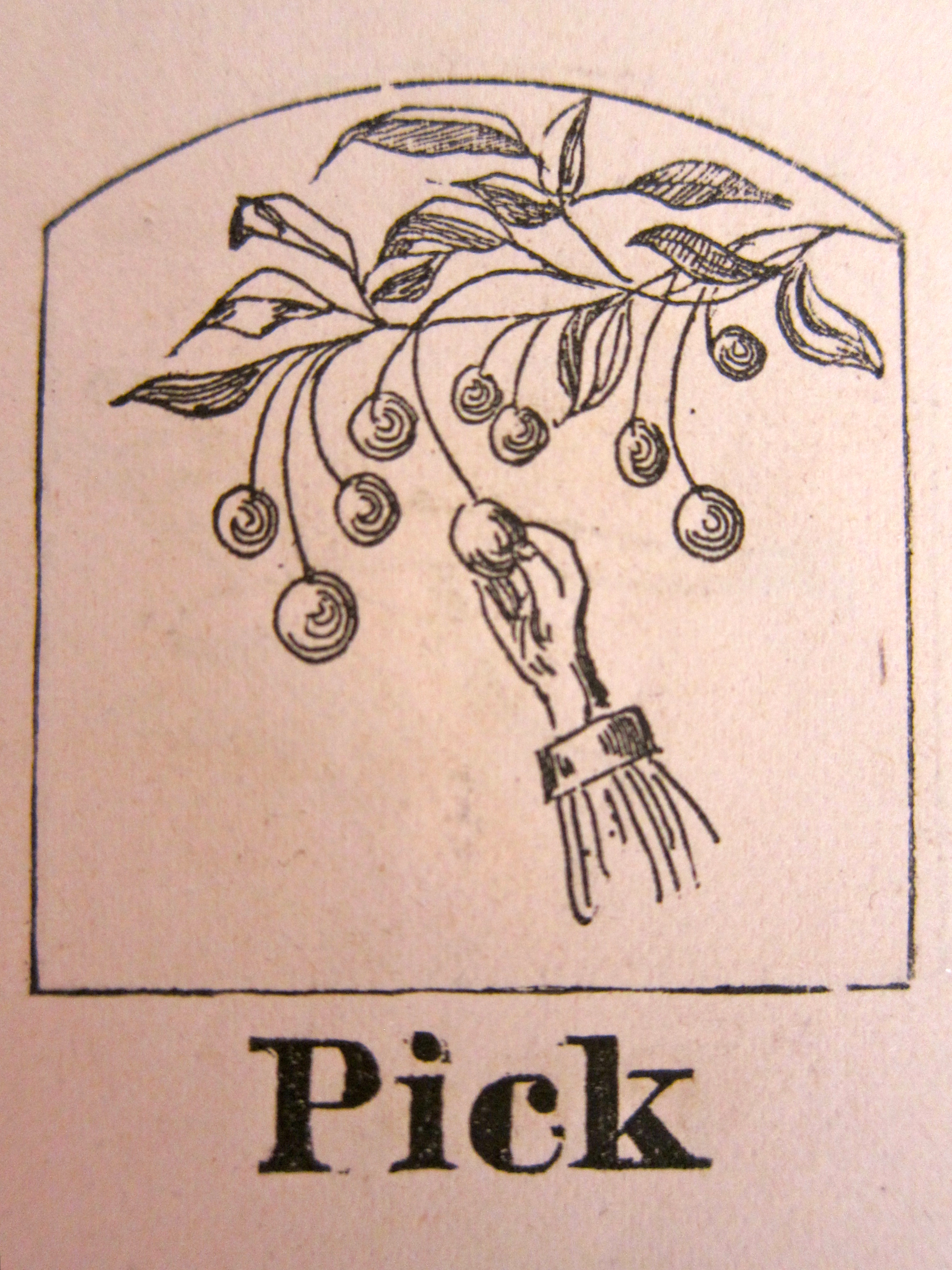
Evelina hadn’t felt very well for several days and began to feel even worse today. She believed she had “taken the nettlerash from Susan,” meaning that she now had hives, just as her daughter had had a week earlier. It made her feel “about sick” yet she stayed upright and worked in the kitchen most of the day. The fruit they had picked or gathered from friends and family wouldn’t keep, so the cooking had to get done.

In the kitchen, Evelina, probably with significant help from Jane McHanna, put up 64 pounds of fruit. She didn’t make jam, which would have consisted of cooked fruit pulp, nor did she make jelly, which would have been made from fruit juice.  She made preserves, which in this instance were pared peaches and apples, the latter mixed with barberries, that were placed whole or in chunks in sugar – lots of sugar – and then boiled down. And because “ingredients in […] loaf sugar are not always very clean,”* most cookbooks of the day strongly urged that the sugar be clarified.

Mrs. Cornelius, in her 1846 The Young Housekeeper’s Friend,* noted that “[t]he chief art in making nice preserves, and such as will keep, consists in the proper preparation of the syrup.  All sugars are better for being clarified.”* Mary Tyler Peabody Mann, more than ten years later in her cookbook, Christianity in the Kitchen, agreed with the necessity of clarifying the sugar The process was labor intensive; even with the help of Jane McHanna, Evelina would have had hours of work if she followed Mrs. Mann’s “receipt”:

“Put half a pint of water to every pound of sugar.  Stir in the white of an egg for every five pounds of sugar, and let it boil; when it rises, put in half a teacup of water and let it boil again, and repeat this process two or three times.  Set the kettle aside for fifteen minutes, then take the scum from the top.  Pout off the syrup; wash the kettle, and put in the fruit you wish to preserve.”**

After sitting at the kitchen table paring the fruit, or standing over the stove clarifying the sugar, or placing the fruit into the stoneware or glass jars, Evelina needed a break. She took a walk to the village to see her nephew Augustus and his family. Even if she wasn’t feeling well, the fresh air must have felt good after the heat and bustle of the kitchen.


Mary Hooker Cornelius, The Young Housekeeper’s Friend, 1846

** Mary Peabody Mann, Christianity in the Kitchen, 1858

October 3, 1851

OLYMPUS DIGITAL CAMERA

Mint and sage from the garden

Oct 3d Friday  Quilted most of the forenoon with Ellen

this afternoon have sewed some on my dresses

and paired some peaches that I had of Mr

Clarke and laid them down in sugar.  Cut

my sage and mint  Ellen has finished the

quilt and has it bound and the sitting

room in order  She will leave in the 

morning has been here nearly eight weeks

Putting the garden to bed continued to be one of Evelina’s chief occupations; today she cut her “sage and mint” and hung them somewhere to dry. The aroma of the newly cut herbs would have sweetened the air in the house. She also sewed, of course, and was pleased that the new quilt was finished. Ellen the servant bound the piece today, tidied up the sitting room and put away the quilt frame. Whose bed was that quilt to go on? Evelina never indicated for whom she was making it.

After midday dinner, Evelina moved to the kitchen for an afternoon of preserving fruit. She “paired” some peaches and then “laid them down in sugar.” She wasn’t kidding about the sugar if she used the proportions suggested in the various cooking books of the day. According to Lydia Maria Child, author of The American Frugal Housewife, “A pound of sugar to a pound of fruit is the rule for all preserves. The sugar should be melted over a fire moderate enough not to scorch it. When melted, it should be skimmed clean, and the fruit dropped in to simmer till it is soft.” The peaches would have been stored in stoneware or glass jars.

Ellen, a servant whose last name we never learned, was planning to leave in the morning.  She had joined the Ames household back the middle of August “to assist some about the house and help me sew.”  Given the absence of any complaints from Evelina, Ellen apparently had done her job well. Why she was leaving we don’t know, but servants often came and went as their personal circumstances – and the circumstances of their employers – changed. Evelina would hire someone new.


June 11, 1851

images

June [11]  Wednesday  Mended

Oakes Angiers coat put on new

buttons  Then made the button holes in 

the waist of Mrs Sarah Ames dress. Cooked

a calfs head for dinner  This afternoon

about three Mrs Witherell, Mitchell & Miss

Eaton & self went to call on Mrs Whitwell.

Called at Mr Wm Reeds  Mrs Reed was from

home.  Called at Dr Swans.  Bridget here.

A[u]ugustus gone to Boston.


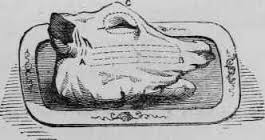
Evelina’s activities today were quintessentially nineteenth-century.  She mended her son’s coat, made button holes for her sister-in-law, rode out in the carriage with her other sisters-in-law to call on the parson’s wife, and served a calf’s head for dinner.

Perhaps there is a reader out there who has been served calf’s head, or cooked it.  Most 19th century cook books carried a “receipt” for it, right next to recipes for calf’s feet, sheep’s head, and roasted sweetbreads.  Calf’s head could be roasted or boiled; the recipe below from Mary Peabody Mann’s 1858 Christianity in the Kitchen opts for the latter.  What follows is not for the squeamish:

To Dress a Calf’s Head

Soak the head for ten minutes in lukewarm water, powder it well with rosin, dip it into a large quantity of scalding water, and holding it by the ear, scrape off the hair with the back of a knife.  When clean, take out the eyes, cut out the tongue, remove the jawbone with teeth, saw lengthwise through the skull without injuring the brains, which must be carefully taken out, and put for a few hours into lukewarm water, to disgorge, [that is, to rinse out the blood.]

Make a stock by putting into the brazing pan two or three carrots and onions, six cloves, a pint of cream, a bouquet of parsley, thyme, and bay-leaves, and after stirring this together for twenty minutes over the fire, add a pint of water.  When this is warm, mix a quarter of a pound of flour with a gallon of water, slice a lemon, add a quarter of a pound of salt, and lay the calf’s head into the stock.  Let it be entirely covered, else the uncovered part will have a dark look, and simmer it gently till it is tender.


April 2, 1851

Ham

1851 Wednesday

April 2nd  Jane & myself have been taking care of a hog

that was killed yesterday.  Have the lard tried

sausages made  fat back & hams salted and the whole

hog already for cooking.  This afternoon Jane ironed

seven fine bosom shirts.  This evening have been reading

being to[o] much fatigued to work.  Augustus went to 

Boston

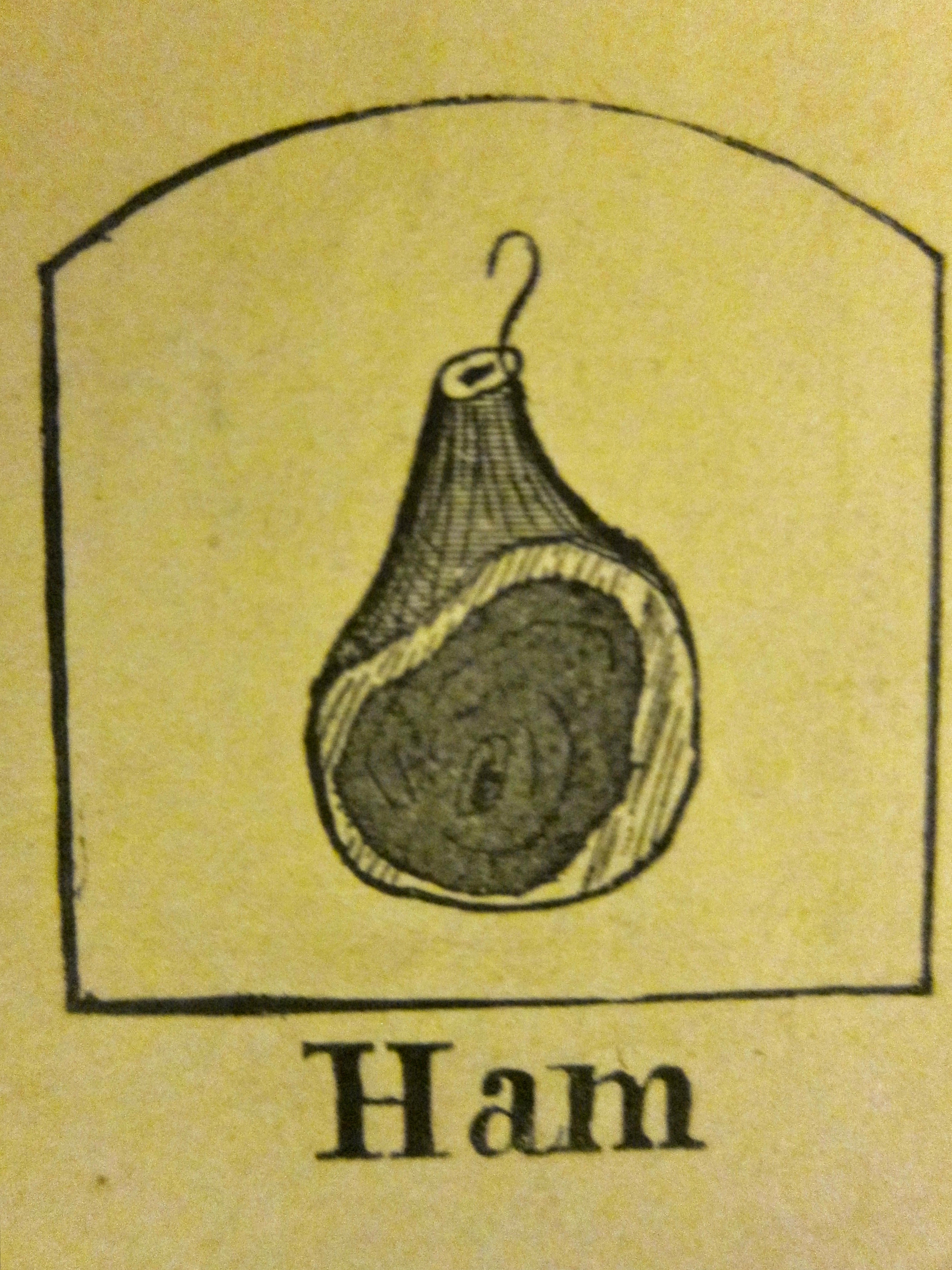
It was a busy day in the Ames kitchen as Evelina and her servant, Jane McHanna, set about preserving one of the pigs that Evelina’s father-in-law, Old Oliver, had slaughtered the day before.  He sold some of the pork, but held back at least one of the animals for his own household.  Evelina and Jane had a long day’s work processing the animal, which had weighed about 300 pounds when slaughtered.

As the women broke the animal down into workable pieces, they “tried the lard,” which meant that they boiled much of the pork fat in water on the top of the stove, taking care to avoid the spattering as the fat popped and the water drew down. The resulting lard was cooled and stored, probably in stoneware jars, for future household use.

Also to be cooked in the future were the big hams, ribs, hocks and more.  The large hams were salted and hung in a safe place like the cellar or a smokehouse until ready to be baked or boiled and eaten, while smaller pieces like the ham hocks would have gone into glass jars or stoneware. Everything got prepared, even sausages, which was a process unto itself, what with grinding the meat, mixing in the herbs and spices, and packing the mixture into the intestinal casing.

In addition to all this, Jane found both time and energy to iron “seven fine bosom shirts.” The cookstove, which had been heated for trying the lard, must have been hot enough to heat up the flatirons.  Perhaps not wanting to waste that good energy, Jane set up the table to iron.

Those two women must have slept well this night.


January 21, 1851

Potato

Jan 21  Tuesday.  This morning commenced working on

Susans sack but had some things to do about house so

that I could not accomplish much.  Mrs. Holmes called

to get some potatoes for Miss Eaton  says she (Miss E) is

failing and the Dr had told her that he could not help

her  Mr Robinson came this afternoon to varnish the

chimney pieces & spilled the varnish over my carpet

which prevented me from going to have Susans doll

dressed

Harriet Holmes, a neighbor, came to the Ames house to fetch potatoes for the ailing Miss Eaton, the same Miss Eaton on whom Evelina and Sarah Ames called during the cold spell earlier in the month. The spinster lived with Harriet and Bradford Holmes, their children, Harriet’s mother and a shovel worker named Oliver Eaton – a relative, possibly.  Mr. Holmes was a teamster who probably worked with Old Oliver’s oxen. Many folks who lived in North Easton were connected to the shovel works in some way.

The potatoes that Evelina gave away would have been grown either by Old Oliver or by Alson Gilmore, Evelina’s brother, who owned the Gilmore family farm.  Potatoes were common fare at the dinner table, and particularly a favorite for winter use.  The Irish called them “pratties.” The challenge for a housewife lay in how to serve potatoes: mashed, roasted, and boiled were familiar variations, then and today.  Sarah Josepha Hale underscored the dietary importance of potatoes in her book, The Good Housekeeper.  “To boil Potatoes in the best manner, is a very great perfection in cookery,” she said.

In the Ames sitting room, hapless Mr. Robinson had to contend with a displeased housewife after he spilled varnish on the carpet.  He was already in Evelina’s bad graces from having taken too long to paint around the fireplaces. How do you suppose Evelina got the varnish cleaned up?

January 9, 1851

images

/51

Jan 9th Thursday

This morning after cleaning my room & doing

my usual mornings work, finished my collars & the

book Mr Whitwell brought.  Cut Susan a sack out of

her plaid cloak.  Prepared some mince pie meat ready

for baking & this evening have been writing in this book.

Had to take the foregoing from memory.  Mr Ames, ague in his face

and come home from the office very early.  Has been

troubled with it several days.  Unpleasant this afternoon

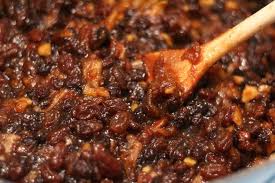
Oakes Ames still had his head cold and came home early from work, something almost unheard of.  He was always on the go. Evelina, meanwhile, worked in the cook room preparing mince meat, a lengthy process that calls for a lot of chopping of meat and suet, not to mention the “stoning” of raisins.

Sarah Josepha Hale, intrepid editor of Godey’s Lady’s Book, had nothing nice to say about mince meat pies. In her book, The Good Housekeeper (1841), she urged American housewives to serve mincemeat only on special occasions:

“The custom of eating mince pies at Christmas, like that of plumb puddings, was too firmly rooted for the ‘Pilgrim fathers’ to abolish; so it would be vain for me to attempt it.  At Thanksgiving, too, they are considered indispensable; but I may be allowed to hope that during the remainder of the year, this rich, expensive and exceedingly unhealthy diet will be used very sparingly by all who wish to enjoy sound sleep or pleasant dreams.”

Evelina was a regular reader of  Godey’s Lady’s Book, but she paid scant attention to Mrs. Hale’s admonishment against mince meat pies.  She served them often; they were a familiar presence at the Ames dinner table.  Considering  the large family to be fed, including three physically active sons between ages 17 and 21, and the ready availability of meat and suet from the oxen provided by her father-in-law, it’s small wonder that Evelina turned to a dish that was hearty and filling.   Mincemeat was a standard in many farming families.