March 25, 1851

438px-HardTimesComeAgainNoMore1854

/51

March 25  Worked on Olivers shirt this forenoon

In the morning read to Mother awhile

Mrs J Porter spent the day with Mrs Witherell

I called to see her.  Her youngest boy was with

her between three & four years.  Her oldest daughter

15 & her other son 13 years.  Has lost four children

Abby & Malvina were here to tea.  Pleasant

Augustus went to Boston.  I received a letter from Louisa

J. Mower  Oliver went this morning to New Jersey.  Helen to school

A quiet weekday in Easton, punctuated by departures.  Augustus Gilmore went into Boston, perhaps on errands for the new boot factory. Helen Ames returned to school and her father left for New Jersey on shovel business. Pleasant weather facilitated everyone’s travels.

Sarah Witherell had a visitor today, a Mrs. J. Porter, who brought three children with her. Evelina, who “called to see her,” noted that Mrs. Porter had borne four other children who had died, a sorrow Evelina would have been especially sympathetic to, having lost a child of her own. So had Sarah Witherell. Surely there was a tinge of loss hovering on the edges of this modest gathering, “frail forms fainting round the door,” as Stephen Foster’s classic ballad* from 1854 would soon suggest.

In the United States in 1851, average life expectancy was less than 50 years old. No small variable in that number was the high rate of infant mortality. The expectation that an infant might not survive was so prevalent that some parents didn’t name their children until after the child had lived through its first twelve months.  It wasn’t unusual for census records to show entries for two- or six- or nine-month old babies described as “Infant Not Named.”  Children and young adults died, too, from diseases that we have since held at bay, but babies were especially vulnerable.

*Hard Times Come Again No More

March 24, 1851

canton-ma-landscaping

/51

March 24 Monday  It was so unpleasant this morning

that Jane could not put her clothes out but

about noon it cleared up and she has got

them all dry  I have cut out a shirt for Oliver 

of fine unbleached cloth and have sewed

some of it & mended Mr Ames coat & vest

He went to Canton this afternoon.  Mr Whitwell

called.  Mrs Witherell passed an [illegible] this evening

Perhaps wearing one of his new shirts, or at least wearing a mended one, Oakes Ames traveled to neighboring Canton today.  Named for Canton, China, because some imaginative citizen believed the Chinese city to be its geographical twin on the opposite side of the world, the Massachusetts city had manufacturing interests much like Easton. Since before the American Revolution, the Kinsley family had operated an ironworks there. Like the shovel works, the Kinsley business had started small and grown well. Initially, it produced farm implements and was entirely family-run. It had a forge, a large rolling mill and the capability of producing steel.

In 1851, Lyman Kinsley was its sole operator; by 1858, the company would be owned by the Ameses. Oliver Ames Jr. would become its first Ames president, with others to follow (Frederick Lothrop Ames would be next, and after him, his son Oliver.) Frank Morton Ames would be its General Manager. Perhaps Oakes’s visit to Canton today, although certainly having something to do with getting steel for shovels, was also quietly prompted by some foreknowledge that the Ameses were interested in acquiring this complementary business.

Once the Ames owned it, the Kinsley Iron and Machine Company would eventually develop to produce wheels and axles for railroad cars, another product that would fit nicely with Ames business interests.

March 23, 1851

Bible

1851

March 23 Sunday.  Have been to church to day and 

stoped at noon to hear the bible class

with Alsons wife & others, got some subscriptions

for the blinds.  Mother came home with

us from church to make a visit.

Orinthia & myself read to Mother a story in 

The Boston Museum a long one but not worth

much Edwin called and Fred & Helen

A beautiful day it has been

Not only was Helen home from school for a visit, but her older brother Fred was back, too, from Philips Exeter Academy where he was preparing for college. How pleasant for Oliver Jr and Sarah Lothrop Ames to have their two children home, however briefly. Helen and Fred stopped in to say hello, as did another cousin on the Gilmore side, Edwin Williams Gilmore. Plus, Evelina’s aged mother, Hannah Gilmore, returned from church with the Oakes Ames family to “make a visit” of a few days. The old house was busy toward the end of the day, and tea this evening must have been especially sociable.

Earlier in the day, at the intermission between services, Evelina popped into a Sunday School class – perhaps for adults? She also did a little fund-raising for the church, or for a charity with which the church was affiliated.  She and others raised some “subscriptions for the blinds” (which does not mean they were ordering new window treatment!)  They were hoping to help the sightless.

Although Evelina was both devout and charitable, she was not sanctimonious. In her diary, she never mentions reading the Bible. She loved reading, and made note of various novels, stories and articles, such as today’s story that “was not worth Much.” But the Bible itself went unnamed.  If she did read chapter and verse from time to time, which seems likely, she simply never said so.  Perhaps reading from it may have been as automatic as looking something up in the dictionary might be for us.  She didn’t feel the need to remark on it.

March 22, 1851

images-1

1851

March 22 Sat. Early this morning Mrs S Ames & Helen

called.  Helen likes her school & room mates

This forenoon I have been busy but cannot

tell of much that I have accomplished.

In the afternoon I put a new bosom into a

shirt for Mr Ames & Orinthia finished the 

fifth shirt that she has made since

she has been here.  A[u]gustus dined here

Sarah Lothrop Ames brought her daughter Helen over this morning for a visit, so Evelina could see and hear for herself that Helen was happy at boarding school.  Was Sarah Ames’s motive in bringing Helen by the house prompted by unalloyed familial affection, or did she also wish to show that she and her husband had been right to send Helen away? Did she want to share with Evelina some of the challenges – and gratifications – of raising a daughter?

Sarah herself had grown up as one of ten children, of whom she was the only girl.  It seems probable that Sarah had been doted on as a child. Now, as a mother of her own, she may have replicated – almost automatically – the singular attention with which she had been raised, and focused it on Helen.

More. Shirts. Orinthia Foss, by boarding at the Ames house in the middle of shirt-making March madness, had no easy escape from the chore.  And once she was pressed into service, the production of shirts sped up.  Did Orinthia mind all the sewing?  Did she wish she could get outside into the spring air to explore the town?    A dutiful young woman from the upcountry of Maine, she may have marveled at finding herself in North Easton and appreciated its novelty.  Orinthia seemed to look up to Evelina as her guide, a role Evelina fell into happily, enjoying, in her turn, the novelty of being looked up to.

March 21, 1851

OLYMPUS DIGITAL CAMERA

SPRING, from Godey’s Lady’s Magazine, April, 1851

1851

March 21 Friday  Have heat the oven twice to day

baked 15 mince pies, 2 loaves bread & 

two sheets cup cake & ginger snaps  got the 

last oven full in about twelve.

This afternoon have been looking over my

accounts and mending stockings A[u]gustus dined

here.  Helen came to night in the stage

Pleasant weather but sloppy.

Vernal Equinox, at last.  The first day of spring was mild, with the earth tilting in the right direction. If the ground hadn’t been “sloppy” and she hadn’t been tied to the oven, Evelina might have gone outside to inspect her flower beds to see if any bulbs were peeking up through the disappearing snow.

Evelina, and probably Sarah Witherell, too, baked today.  Evelina made her patented host of mince meat pies to be served over the next week or two. Brown bread, cake and ginger snaps also had a turn in the capacious brick oven, no doubt filling the house with some wonderful aromas.  Pleasant day outside, pleasant day inside.

Nephew Augustus Gilmore, still bookkeeping next door, continued to dine with the family at midday, perhaps walking back from the office or counting house at noon with Oakes.  Niece Helen Ames arrived home via stagecoach from her boarding school in New Bedford for a weekend visit, although “weekend” was not a term most people in town would have used.  The shovel shop ran six days a week, after all, so Saturday had no special connotation for most citizens of North Easton.

March 20, 1851

photo

Shirt bosoms

/51

March 20 This morning at 1/2 past seven commenced 

a fine bleach shirt for one of my sons

and finished it about ten Oclock this evening

Made the whole but stiching the bosom

Mrs Witherell brought the 8th bosom that

she has stiched for me this forenoon and 

sat with me two hours  William left this 

morning.  Clothes dried and ironed.  Cloudy & snowy

A[u]gustus here to dine

Today Old Oliver wrote in his daily journal:

“it is a snowing moderately this morning  William left here this morni[n]g for New Jersey.  It did not snow long but it was cloudy all day wind north west but it thawed some.”

William went back to the family-financed foundry in New Jersey for a final time before making the momentous change of striking west.  He wanted to put distance between himself and the shovel operations in Easton.  With his older brothers Oakes and Oliver Jr. managing the family business, his only chance at success was to find his own niche somewhere beyond their reach. At age 38, he was about to begin a very different life.

As William rode off, Evelina, naturally, was wielding needle and thread.  After so many days of sewing shirts, she was adept enough to sew one entirely in a single day, beginning just after breakfast and finishing up right before bed.  Having her kind sister-in-law Sarah Witherell to sew with for part of the day was a pleasant diversion.  That Sarah contributed so many “bosoms” (detachable shirt fronts also known as dickies, false-fronts, and, in the 20th century, tux fronts) suggests that some of the shirts might have been destined for the men in her care, her father Old Oliver and her son, George Oliver Witherell.

March 19, 1851

Slaves

1851

March 19 Wednesday  This morning commenced another

shirt that was cut out last fall & the

sleeves finished & the body nearly ready for the

bosom. Made the bosom & collar and finished

it all off this evening. Mr Ames went to

Boston this morning The snow is not deep but

much banked Augustus here to breakfast & dinner

Orinthia finished the shirt that she worked on yesterday

The last days of winter in Easton appeared calm, with the final snowfall (they hoped) on the ground, nephew Augustus still pulling up a chair to the Ames dinner table, and Evelina and Orinthia sitting near the windows, sewing more men’s shirts. But all wasn’t well in the nation. Since the passage of the Fugitive Slave Act the previous fall, discord over the issue of slavery had increased.  In Boston, where Oakes Ames went today, passions ran high among abolitionists.

What did Oakes and Evelina think of the debate? The Ames men admired Daniel Webster, but the famous Whig senator had helped engineer the political compromise that led to the slave act and been roundly denounced for what many in Massachusetts saw as a sell-out. In the interest of preserving national unity, Webster urged his constituents to obey the federal law. If the story that historian William Chaffin tells is true, Oakes Ames disobeyed it. Writes Chaffin:

“Rev L. B. Bates was once here as Methodist minister.  He says that one night not long after the passage of the infamous Fugitive Slave Law a poor slave called him up at midnight for food and help. Rev. Bates fed him and then took him to Oakes Ames who gave him money and sent him on his way rejoicing.”

Lewis Bates was certainly a respected minister in North Easton, but he wasn’t appointed until 1859, so the timing in his recollection of Oakes Ames assisting a runaway slave close on the heels of the passage of the Fugitive Slave Act doesn’t jibe. Either Bates got it wrong in the telling or, because he was writing the story many decades later, Chaffin got it wrong in the remembering. The whole tale may be apocryphal, but two ministers believed it to be true. Helping a slave would have been in keeping with Oakes’s generous spirit.

March 18, 1851

imgres

1851

March 18th Tuesday  A very bad north East snow

and Orinthia did not keep school and we both

sit down to sewing quite early.  She to work

on a coarse shirt for Oakes Angier and I have

made a collar and finished the shirt that

I commenced yesterday  Wm Called for the 

first time since he came here.  A[u]gustus dined 

& spent the night

More snow, enough to call off school and prevent nephew Augustus Gilmore from departing to his lodgings at Mr. Wrightman’s.  Did it fall on any little crocuses in Evelina’s flower beds? Wasn’t it getting to be springtime?

Augustus, a man with a robust figure and evident appetite, continued to spend time with the Ames family, often joining them at dinner. Did he pay for his board, or did Evelina and Oakes give him free meals?  Evelina began to track his meals by underlining those occasions in her diary.  Why? Did she begrudge her nephew’s presence in the dining room, or did her tracking of his meals have some other purpose?

William Leonard Ames, youngest living son of Old Oliver, had been visiting in North Easton for ten days, yet today was the first time he called on Evelina and Oakes.  His avoidance of their parlor spoke loudly of the animosity between William and Oakes.  His pronounced delay in paying a call on his oldest brother might well have been his only way to retaliate for the financial distress that Oakes had caused him in the closing of the family ironworks in New Jersey, an operation that had been in William’s care.  For a deeply researched account of the particulars of the rift between the two brothers, in which the blame seems to lie more with Oakes, see Greg Galer’s thesis, Forging Ahead.  

March 17, 1851

images-1

*

March 17  Monday  A very cloudy windy morning  Jane could

not put her clothes out.  Orinthia washed the dishes

& I made the beds &c. Commenced working on a

fine unbleached shirt that was cut out

last Nov & partly finished.  It is all done but

[…] putting in the sleeves & making Collar and 

binding  Cut out some receipts for my scrap 

book from the Ploughman  A[u]gustus here to dine

The Massachusetts Ploughman was an agricultural newspaper published in Boston that provided reading material for a number of Ameses.  It was probably subscribed to by Old Oliver, who maintained an interest in farming that he couldn’t seem to pass on to any of his children. Although the Ames shovel business had helped turn once-rural North Easton into a productive, if small, industrial village, agriculture still ruled the show as the “largest single sector of the economy even in the highly commercial states of Massachusetts and Connecticut.”** Most people still farmed, raised livestock, worried about bringing in the hay, and looked for guidance from experts such as those behind the Ploughman masthead.  Evelina turned to the paper for recipes.

It may have been St. Patrick’s Day, but no celebrating would have gone on in the Ames compound.  At the factory, however, things might have been different. Thirteen years from this date, in the middle of the Civil War and less than a year after Old Oliver’s death, Oliver Jr. would note in his diary that on “St Patricks day did not run Engines in Shop.”  Was that also true in 1851, or did Old Oliver’s animosity toward the Irish preclude such an indulgence?

* A late-19th century copy of the Massachusetts Ploughman after it merged with the New England Journal of Agriculture.

** Jack Larkin, The Reshaping of Everyday Life, 1790-1840, 

March 16, 1851

OLYMPUS DIGITAL CAMERA

March 16th Sunday.  Went to meeting all day.  Oakes Angier

did not go. There were but a very few present

as it was very windy & cloudy commenced raining about

noon. Spent the intermission at Mr. Whitwells.

I liked both sermons, particularly in the afternoon.

Orinthia staid at home in the afternoon having

a bad cold This Evening wrote a letter to Louisa

J Mower & read the papers

Most of the Ames family attended church today. The crummy weather couldn’t keep them at at home, although it affected the travel of others in the congregation. Evelina continued to admire Reverend Whitwell and listened carefully to his sermons. She enjoyed the company of his wife Eliza, with whom she spent today’s intermission between services. Orinthia Foss, meanwhile, went back to the house at noon with a cold. Did she catch it yesterday when the ladies were out making calls?

After church on Sunday was usually a quiet time. The Ameses followed the old Puritan practice of not working on the Sabbath. Sewing was included in that stricture, meaning that Sunday was the one day Evelina gave her thimble a rest. She usually filled what we would call “down time” by writing letters or reading. On this afternoon, she wrote a letter to Louisa Mower in Maine, perhaps bringing Louisa up to date on Orinthia’s stay in Easton and her new teaching responsibilities.

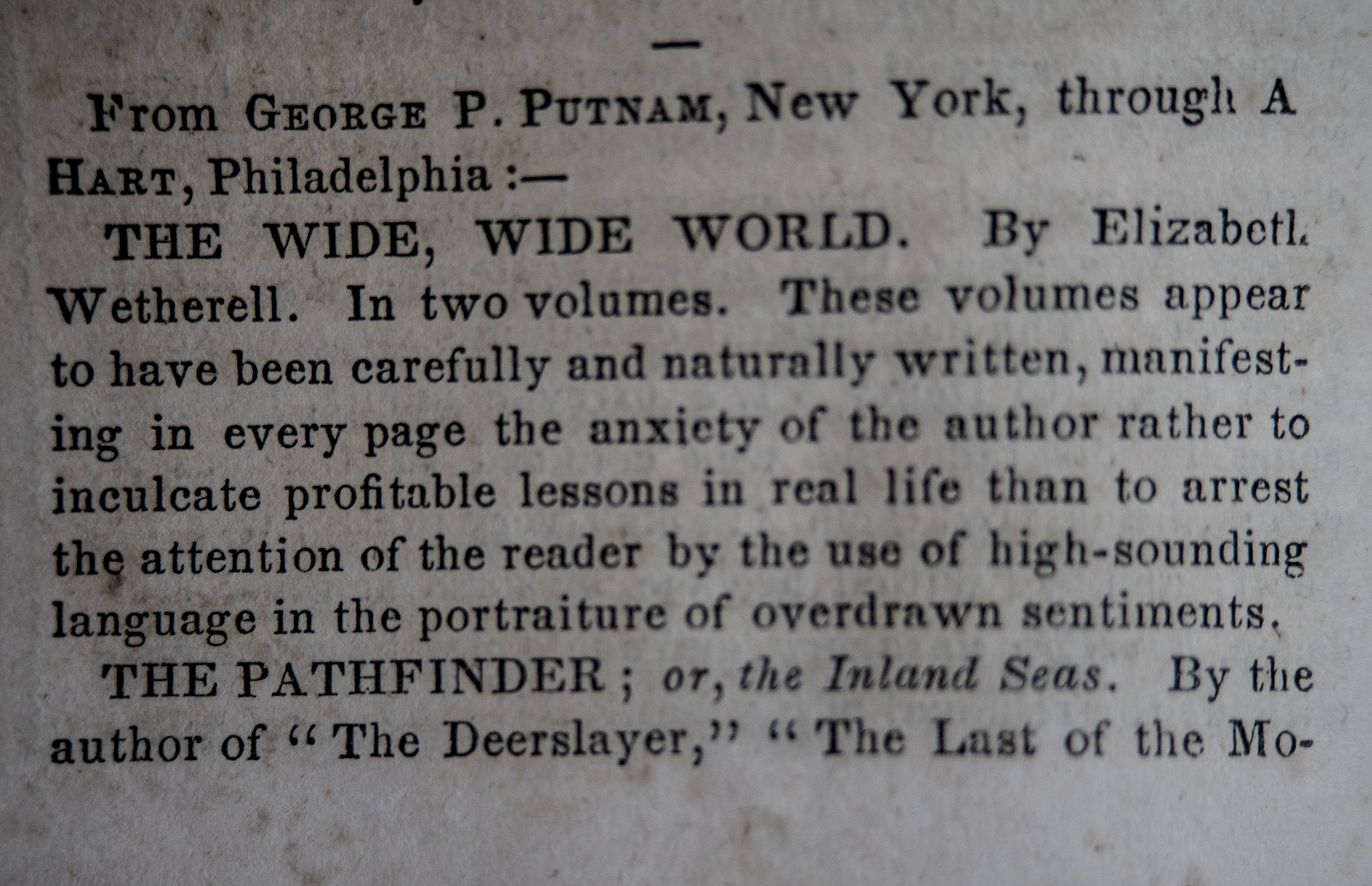
As for reading, Evelina and Oakes either subscribed to or bought directly (in Boston) various periodicals and newspapers.  One of her favorites was Godey’s Ladys Magazine, a popular women’s monthly published in Philadelphia. If Evelina looked through the March issue today, in the section entitled “Editors Book Table,” she may have read notices for two books just published by George Putnam in New York. The first was The Wide, Wide World by Elizabeth Wetherell (pen name for Susan Warner), a Christian-themed novel that would be a big bestseller and a mainstay of 19th century fiction for decades. The short review described the book as “carefully and naturally written, manifesting in every page the anxiety of the author […] to inculcate profitable lessons in real life.” Both Evelina and her daughter would read it.

James Fenimore Cooper’s The Pathfinder was next in the list of new books and promised more adventure than The Wide, Wide World. Evelina never mentioned reading any of Cooper’s books but perhaps her sons, who also loved to read, enjoyed the Leather Stocking Tales.