March 2, 1851

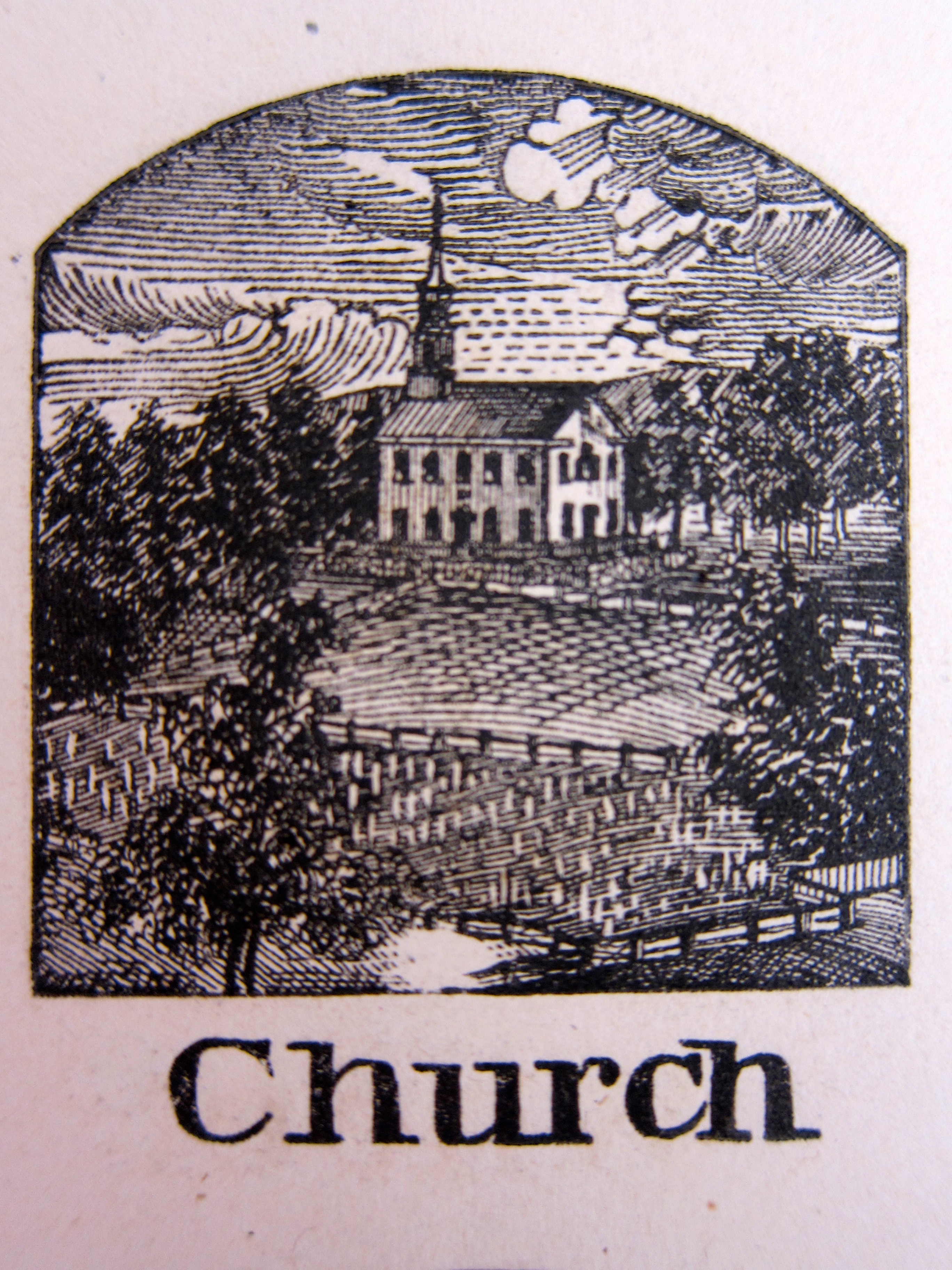
Church

March 2nd  Sunday.  Have been to meeting all day.  Mr Whitwell read

notes for Mr Guilds family  His text in the morning was

I would not live alway  It was an excellent sermon.

In the afternoon his sermon was for the male part

of the congregation.  The good man of the house.

An excellent sermon for my dirty boys if they

would only profit by it.  This evening commenced

reading Woman’s Friendship.  Rather pleasant but cold

Evelina went back to church today for the first time in three weeks.  She had been absent since February 10, the week that she hosted a Unitarian Sewing Circle meeting to which no one came.  To her diary she cited a bad cough as reason for her absence.   On this Sunday, she had finally recovered from that cold.  She had also, evidently, regained her dignity.  Back to church she went and sat right down in the family pew.

Her attention was focused on Reverend Whitwell and his thoughtful words.  She wouldn’t live “alway,” and in the meanwhile she had to work on her sons to become better people.  What did she think of her sons to describe them as “dirty boys?” What did Mr. Whitwell mean, “the good man of the house?”  Did her own good man of the house, Oakes, pay attention to this sermon?

Oakes Ames was actually known for sleeping in church, according to town historian, Reverend William Chaffin.  Chaffin charitably suggested that “Mr. Ames was so hardened with business affairs that he invariably went to sleep in church during the sermon.”  Chaffin also remembered that Oakes Ames stayed awake during his own maiden sermon in North Easton.  Used to seeing Oakes with his eyes closed, someone in the congregation that day chided him about it, to which Oakes replied with typical bonhomie, “Well, I knew Mr. Chaffin was here as a candidate for settlement, and I had to keep awake the first Sunday to see if his preaching was safe enough to sleep under.”
 

March 1, 1851

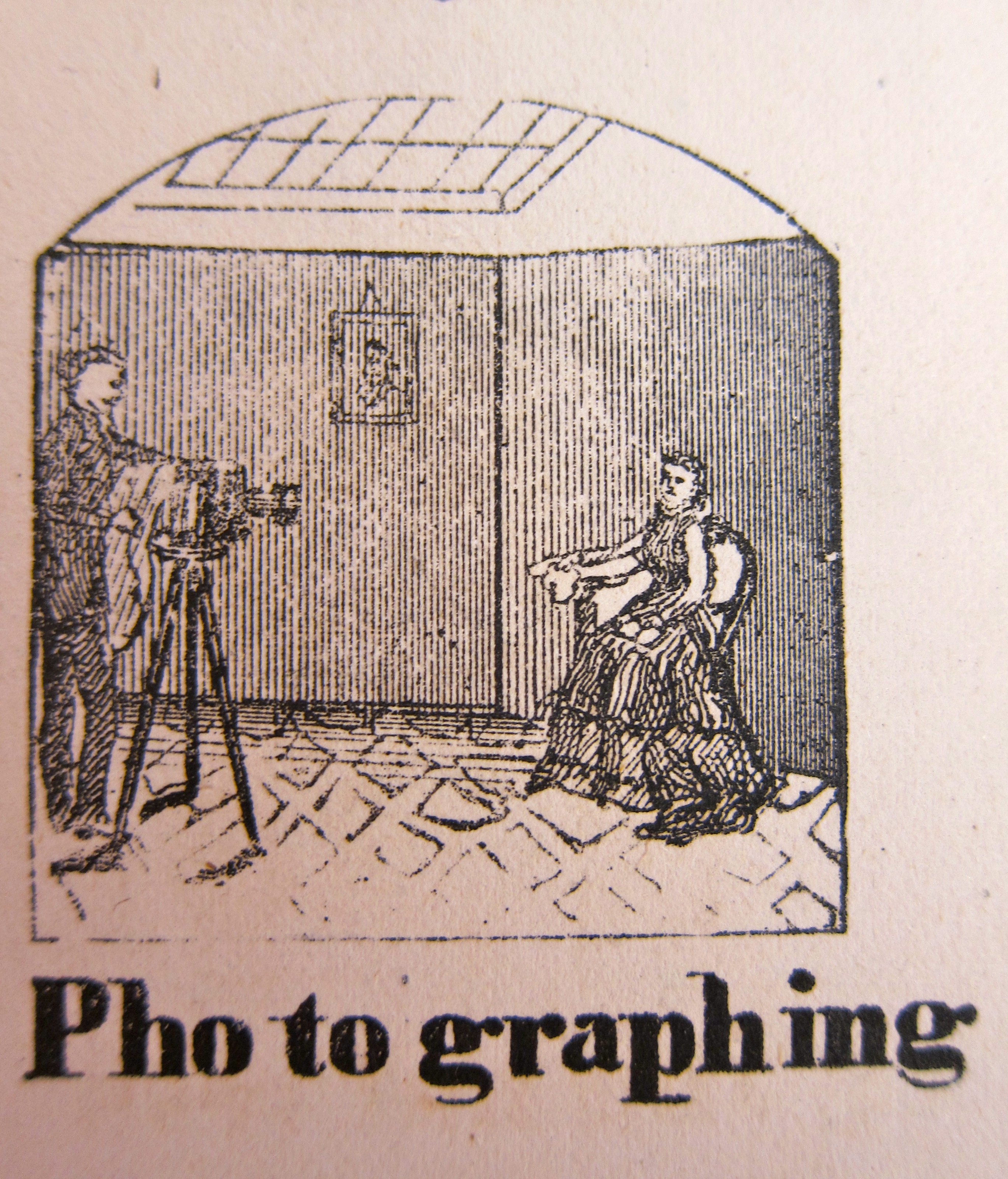
Photographing

March 1st  Saturday  This forenoon put a bosom into an old

shirt of Mr Ames.  After dinner worked on shirt

bosoms, carried them into Olivers and staid two

hours and then went to meet Orinthia at the

Daguerretype saloon.  Called at the store and on Abby

Torrey  On my return called on Miss Eaton found her

more comfortable than I have seen her for some time

Mrs. Holmes mother has been sick for a week.  Very 

pleasant.  Augustus not here

Only a dozen years after a Frenchman named Louis Daguerre reproduced an image of a Paris street onto a piece of treated glass, the new medium of photography had become so popular and successful that someone in the small town of North Easton, Massachusetts had seen fit to set up a “saloon” to take pictures.  What a novelty for the townspeople.

After a day of rather pedestrian sewing, Evelina Ames, housewife, went to the daguerreotype studio to meet Orinthia Foss, schoolteacher (and boarder at the Ames’s,) to have their likenesses taken. What a lark for them to go pose for the camera.  Whose idea was it? Did they pose together?  Did they pose alone?  Or did only one of them have an image taken? How long did she or they have to hold still?  Who ran the shop? Where are those photographs today?  What good friends Evelina and Orinthia are getting to be.

A stop at the company store and a visit with her niece, Abby Torrey, were next on the agenda for Evelina’s afternoon. Now that it was March, the daylight began to last a little longer, allowing more time for errands before heading home. One last stop at the house of Bradford and Harriet Holmes was in order. There, two invalids, Miss Eaton and Mrs. Wright, were being “watched,” or looked after by various friends and relatives, in a manner resembling today’s hospice care. Miss Eaton, of indeterminate age, had been in poor health for several months, probably with consumption.  Sixty year old Mrs. Wright, mother to Harriet Holmes, had also taken ill.  She was suffering from pleurisy and was not expected to recover. Spring might be on its way, but not for these two women.

February 28, 1851

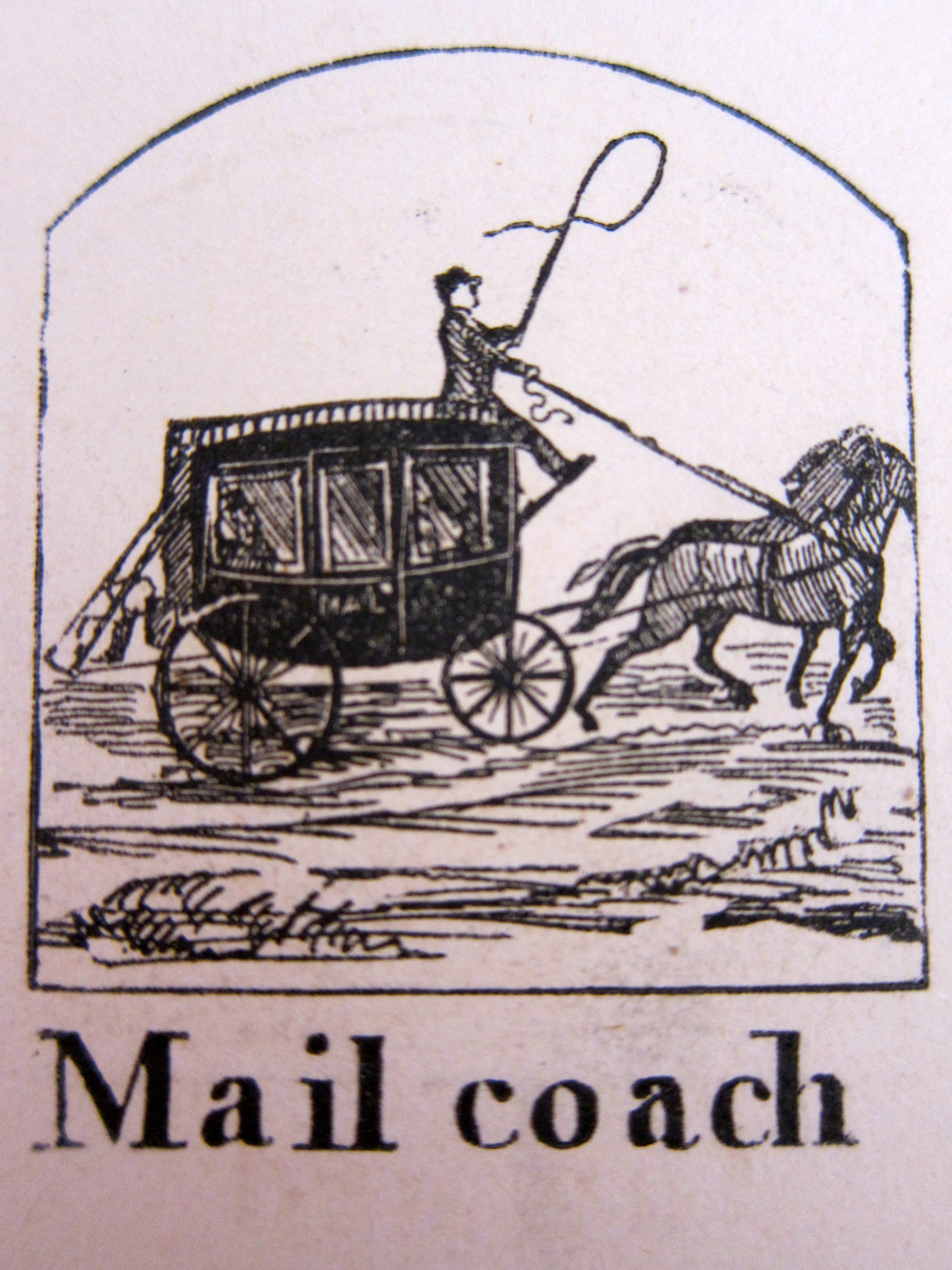
Mailcoach

Feb 28  Friday  After doing my usual chores about house I

carried my work into the other part of the house

and staid until dinner time  Worked on shirt

bosoms & carried two in for Mrs Witherell to stich

This afternoon wrote a long letter to Cousin

Harriet Ames which took me most of the 

afternoon to write   Orinthia & myself spent

the evening in the other part of the house  Cloudy

Augustus not here

Cousin Harriet Ames was a spinster who lived in Burlington, Vermont with her widowed mother.  She was the daughter of Old Oliver’s older brother, John Ames.  Thus she was a niece of Old Oliver and first cousin to Oakes, Oliver Jr., Sarah Witherell and the rest of that generation of siblings.  Moving down one more generation, she was a first cousin once-removed to Oakes Angier, Oliver (3), Frank Morton and Susan.

It’s likely that Evelina wasn’t the only Ames to correspond with Cousin Harriet; her sisters-in-law Sarah Ames and Sarah Witherell probably wrote and received  letters from Burlington as well.  All three ladies would have corresponded by mail with distant friends and relatives.  It was the way.  Writing letters was how people kept up with one another.  There was no telephone, and there certainly was nothing that resembled today’s digital and instantaneous communication.  Telegraphs were only just coming on the scene; telegraph offices and wires would soon dot the countryside and lead the way west.  Big wooden poles would be dug into the ground by men wielding – what else – shovels.  In a decade or so hence, Oakes and Oliver Jr. would maintain an active communication by telegraph once Oakes went to Congress and both men became involved with the building of the Union Pacific.

But they would all still write letters. Evelina wrote certain people regularly: Cousin Harriet in Vermont, Louisa Mower in Maine, and another friend named Pauline Dean. She must have been pleased when the mail coach came in, bringing letters to the little post office in North Easton, and taking them out to friends far away.

February 27, 1851

Coal scuttle

1851

Feb 27 Thursday  Cannot say much for my work to day

Orinthia cleaned the sitting room for me while I

was making the fire in the furnace.  had a good 

deal of trouble with it  Augustus made quite a

long call this morning talking over matters & things

Have finished putting in the bosom & wris[t]bands to 

the old shirt that I commenced Tuesday & mended one

for Mr Ames

It sounds as if Evelina’s normal routine was challenged today.  First, she had to struggle with the coal furnace, or stove, probably stoking it and trying to make it catch and hold.   She was certainly familiar with “making” fires, but coal was not her strong suit.  She had spent most of her life burning wood, and she didn’t manage the new furnace well.

Second, her nephew Augustus came to call in the morning at a time of day when she was likely to still be working about the house.  He was full of conversation about “matters & things,” probably filling her in on his move to Easton,  his decision to leave teaching, and his hopes for the new boot and shoe factory he was setting up in the Lothrop Building. Evelina, fond aunt that she was, was no doubt interested in what Augustus had to relate, but the housewife in her was perhaps worried about not getting through her choring or not finishing the last of the ironing or not getting to the necessary mending while Augustus made his long visit.  Happily, Orinthia Foss was around to help with some of the basic sweeping and dusting.

In the afternoon, her housewifely pace seemed to settle down and she was able to pick up her sewing.  She reworked an old shirt belonging to her husband, replacing the most worn areas with new pieces.  A shirt that today we might throw out or put into the rag bag, she saved.  No wonder Reverend Chaffin accused her of being “very economical.”  She was, with no apologies.  No apologies from her husband, either.

February 26, 1851

exps42325_TH1443683D45C

Feb 26  Wednesday.  Have been baking  Heat the oven twice

made 18 mince pies.  Cake brown bread & ginger snaps

Mr Whitwell called & brought home some books.

I called to see Miss Eaton this afternoon she has failed

very much since I saw her nearly two weeks since.  Mrs. 

Wright is sick with the pleurisy & lung fever, both have watches

Abby & Malvina spent this evening here   The boys have

all gone to the meeting house to a sing  Pleasant & mild

A[u]gustus here to dine

Eighteen mincemeat pies! Hard to fathom a domestic pantry, pie safe or cold shelf  that could hold 18 mince meat pies all at once, let alone an oven that would bake even half that number at one time.  Cake, cookies, and bread, too.

The brown bread that Evelina baked today was a staple of the New England kitchen, and was made from some combination of Indian (corn) meal and rye.  While other geographic areas of the United States, like the south, the mid-Atlantic and the expanding west, had turned to wheat as their preferred grain for baking bread, Yankee housewives, “who valued and esteemed brown bread as the food of their Puritan ancestors,*” held to the familiar cornmeal and rye.  So it was in Evelina’s kitchen.

According to Sarah Josepha Hale, who published The Good Housekeeper in 1841, brown bread was “an excellent article of diet for the dyspeptic and the costive.”   Mary Peabody Mann, in Christianity in the Kitchen pronounced brown bread to be “a nutritive bread, though inferior in this respect to wheat,” and agreed that it produced “a laxative effect upon the system.”  Lydia Maria Child, author of The American Frugal Housewife, liked brown bread for its economy and tradition.  She advised that it “be put into a very hot oven, and baked three or four hours.”

After she got away from the cook room, Evelina was visited by Reverend Whitwell who either borrowed some books from her or lent some to her – the passage is unclear. Both of their homes must have housed a collection of books, and borrowing and sharing was common.  A decade or so earlier, Easton had boasted of two or three lending libraries but these institutions had pretty well ceased to operate.  Other, better organized libraries would be formed later that century, but in 1851, if someone wanted a book to read, he or she borrowed it from a friend or bought the publication.

In the neighborhood, Miss Eaton was still failing and now, under the same roof,  Mrs. Wright, mother of Harriet Holmes, was believed to be dying, also.  Neighbors were helping Mrs. Holmes with the care and feeding of the two invalids.

*Judith Sumner, American Household Botany, 2004, p. 48

February 25, 1851

Helen Angier Ames

Helen Angier Ames

1851

Feb 25  Tuesday  This morning Helen left home for school

at Dorchester.  She felt so bad when she left

that I did not go in to see her.  Her Father & Mother

went with her and returned to night, they went into

Boston and stoped an hour or two.  Mr Jennings

& Crommet called this evening to see Orinthia

I have been to work on a bosom of shirt putting

a new one into an old shirt of Oakes Angiers.  Very windy.

A[u]gustus here

Under some duress, the teenaged Helen Ames was taken to boarding school today, clearly not wishing to go.  Her parents insisted and accompanied her to see her settled.  Their stop in the city on the way home might have been a lift of spirits for a mother and father who had just driven away from a disconsolate child.

The children of both Oakes and Oliver Jr. each went away to school for a portion of their education.  Oakes and Evelina’s boys had already gone and returned home; Susan still had her boarding school ahead of her.  Oliver Jr. and Sarah’s two children, Fred and Helen, were at this stage both away at school.  Oliver Jr. and Sarah were empty-nesters, to use a term they wouldn’t have recognized.  They might have recognized the emotion, however.  Strange to think of them in their separate house, just the two of them now, quiet, (although Sarah’s younger brother, Cyrus Lothrop, sometimes lived with them) while right next door in the old homestead lived a whole commotion of relatives.

Schooling seemed to be the theme of the day.  A Mr. Jennings and a Mr. Crommet called to see Orinthia Foss, presumably on matters of her employment as a schoolteacher. Does any reader out there know either of these names?

His wife and son still living elsewhere – Bridgewater, perhaps – while he set up their rented lodgings in North Easton, Augustus Gilmore was staying temporarily with his aunt Evelina and her family.  He would soon bring Hannah, who was expecting, and little Eddie to town.

February 24, 1851

School

Feb 24th Monday.  This morning Orinthia commenced a

private school at the school house had twenty

scholars.  Was choring about house all the forenoon

This afternoon made over a valance for

Franks bed and did some mending.

Martin Guild was burried at two Oclock.  None

of us attended the funeral  Helen & Sarah Ames

called a few moments this evening.  Heavy rain.

Looks like little Susie was back in school today, this time under the tutelage of Orinthia Foss, the new teacher.  Not only would Susie see Miss Foss in the school room every day, but also at home for breakfast, dinner, and tea. During her tenure in Easton, Orinthia would take turns boarding with different families in town beginning with the Oakes Ameses. The exact location of the schoolhouse where she taught is undetermined, but it may have been located right in the heart of the village, at the Rockery.*

As usual, Evelina spent this busy Monday doing housework, or “choring,” as she called it, in the morning, or “forenoon,” while Jane McHanna labored with the weekly washing. What do you suppose was served for midday dinner on Mondays, when the women of the house were preoccupied with everything except cooking?  Perhaps the family ate one of those mincemeat pies that had been prepared days in advance and kept very cold somewhere. Yankee housewives were known to keep some baked goods frozen for months, either by placing them on shelves in an ice house, or simply by storing them in unheated spaces not far from the kitchen. A risky practice, one might think, especially with the varied temperatures and rainy weather that has characterized this particular February.

Also as usual, Evelina turned in the afternoon to her mending and sewing. She refurbished a valance for Frank Morton’s bed.  Although his brothers Oakes Angier and Oliver (3) shared a bedroom, Frank had a space, if not a room, to himself.  A valance was an essential component of his bedstead, naturally offering some warmth and privacy that might otherwise be lacking.

* Information from Frank Mennino, Curator of the Easton Historical Society.  Thank you, Frank.

February 23, 1851

Map of Maine, 1850

Map of Maine, 1850

1851

Feb 23  Sunday  Have not been to church to day on account

of my cough, although it is a great deal better.

Orinthia staid at home too, having a bad cold and 

being a good deal fatigued.  We have had a nice 

quiet time talking over Maine affairs.  She spent

Thursday night at Mr Mowers.  Have written a long

letter to Louise J. Mower to day.  Mr Whitwell exchanged

with Mr Bradford of Bridgewater.  It is a lovely day.

This was the second Sunday in a row that Evelina missed going to meeting.   She stayed behind ostensibly to keep the new boarder company and to nurse the lingering cough that she admitted to herself was much better.  Was she still avoiding certain people at church, or had she gotten past the Sewing Circle incident?  Whatever her reasoning, she had a pleasant visit with young Orinthia Foss, the new schoolteacher.

Orinthia seems to have hailed from the state of Maine, where the Ames family had vital business connections.  The wooden handles of the Ames shovels came from Maine, where good wood like ash was still plentiful. Massachusetts, on the other hand, in 1850, was fairly well devoid of decent stands of hardwood after two centuries of settlement and development.  Wood from Maine was a critical resource for the Ames enterprise and over the years, one or other of the Ames men made a periodic trip north to examine the supply and cultivate the connections. Oliver Jr., for instance, made a trip to Wayne, Maine, near Augusta, in the mid-1860s.

On her journey to North Easton, Orinthia Foss spent a night with the Warren Mower family in Greene, Maine, a town near today’s Lewiston-Auburn area. Quite wooded, and close to the Androscoggin River as well.   Mrs. Warren Mower was the former Louisa Jane Gilmore born in Leeds, Maine, in 1820. Was she a relative, perhaps? Evelina’s eldest brother, John Gilmore, lived in Leeds, having moved there from Easton in the 1840s.  What was the connection? Whether or not they were related, Evelina and Louisa were clearly friends who corresponded regularly.

February 22, 1851

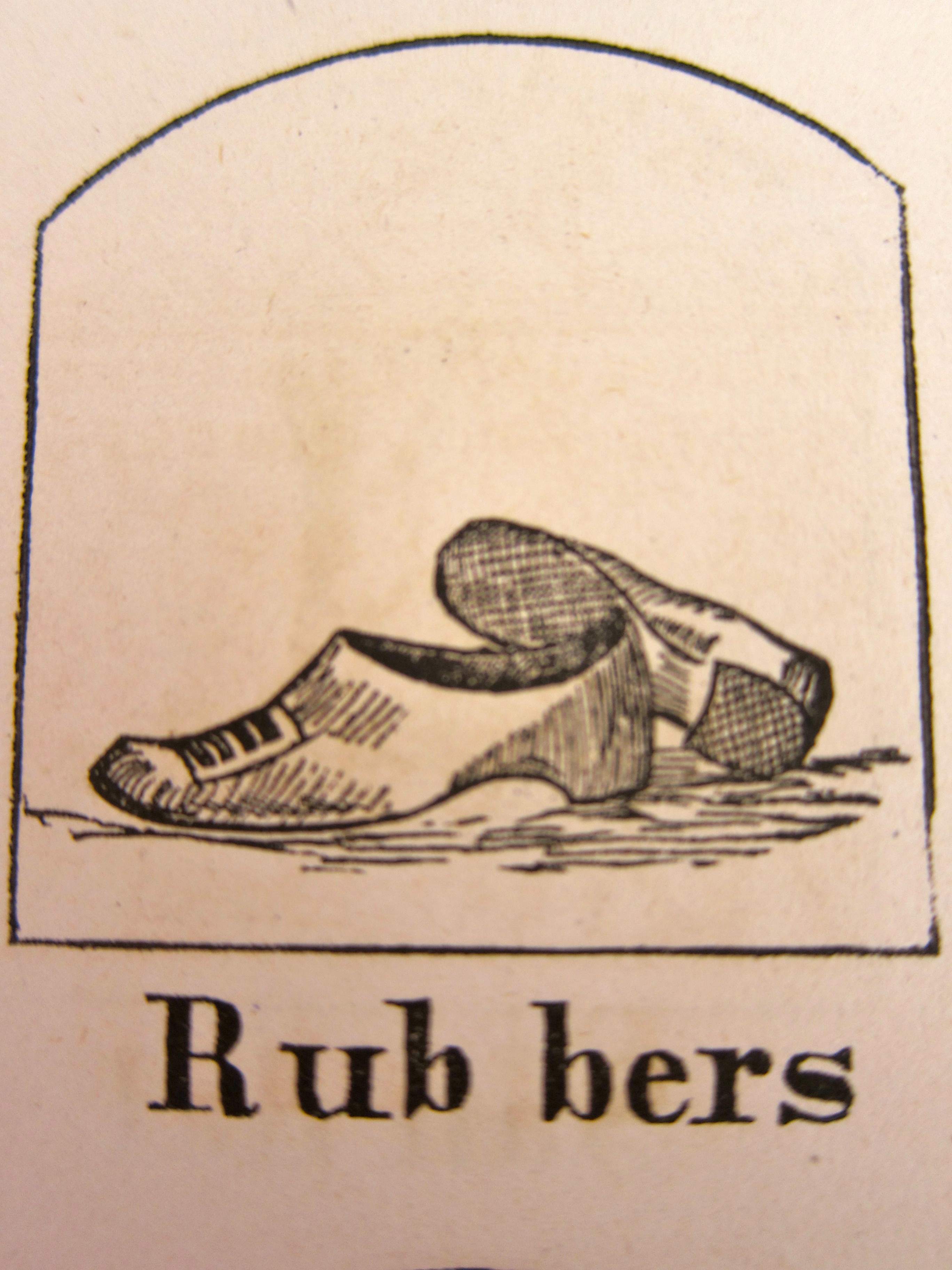
Rubbers

Feb 22nd  Saturday  This morning sat down to sewing

quite early to work on Susans apron.  Mr Torrey called 

to see about Augustus having his tenement.  Augustus

has engaged Mr Wrightmans house for the present.

Lavinia & myself passed this afternoon at Mr Torreys.

Called at the store, met Mrs. Peckham & Miss

Georgianna Wheaton there  Miss Foss came to night.  Mr

Ames has been to Boston brought Susan Rubbers.

Cleared off pleasant to night

In his journal today, Old Oliver noted that “It’s pretty muddy now,” which explains why Oakes Ames returned from Boston with overshoes, known as rubbers, for his daughter.  Probably everyone in the household donned rubbers during this late winter wetness.

Evelina negotiated the streets just fine, it seems, as she and her niece traveled the short distance to the center of town to call at the company store and at her brother-in-law’s house.  Their mutual nephew, Augustus Gilmore, had decided not to rent from Col. Torrey and would be settling his family instead at a Mr. Wrightman’s house.  And at the end of the day, a new person entered the domestic scene.  Miss Orinthia Foss, the new schoolteacher, arrived from Maine.

February 22 is a date that people acknowledged in 1851 in a manner similar to the way people do in 2014, because it’s George Washington’s birthday.  In this year of Evelina’s diary, President Washington had only been dead for a little over fifty years.  People were alive who could still remember him; Old Oliver was one of them.  Old Oliver was born in 1779, while the Revolutionary War was being fought.  He was two years old when the British surrendered at Yorktown, and eight years old when representatives of the new states assembled in Philadelphia to write a constitution.  George Washington was elected to head that convention and became the country’s first president in 1789, when Old Oliver turned ten.  When Washington died in 1799, beloved and mourned, Old Oliver was a twenty-year old bachelor just making his way in the world.  Much about that world would change over Old Oliver’s lifetime, but the reverence that citizens of the United States felt for their first leader would hold strong.

February 21, 1851

Bed

1851  Feb 21  Friday  It stormed so hard & so dark that Mr & Mrs

Whitwell spent last night with us & returned

home about 8 Oclock this morning  Lavinia &

myself have been sitting quietly sewing.

Susan is all engaged making Labels for the shop

has cut quite steady all day.  Helen brought her work in, and staid two

or three hours but I could not prevail on her to stop to tea

Bridget has hired a bed & bedstead

The family business, O Ames and Sons (as it had been known since 1844 when Old Oliver handed over two-thirds of the reins to his sons Oakes and Oliver Jr.) was just that: a family business.  The Ames men all had rolls to play in its operation, from manufacturing to sales to management.  On this day in 1851, it appears that an Ames female had a roll to play, too.  Little eight-year old Susie Ames spent the day making labels for the shop.  Presumably, this meant she was cutting out printed labels to be affixed to individual shovels.  Did she sit at a table in the kitchen or the dining room, paper and scissors in hand?  Was she paid for this effort, or was this just a rainy day game for her?  Who thought this up?

While Susie wielded scissors, the women wielded needles, of course.  Evelina and her niece, Lavinia Gilmore, kept each other company as they sewed and were joined for a few hours by Helen Ames from next door.  Although Lavinia, aged 19, lived in the country and Helen, aged 14, lived in town, the two young women, distantly related by marriage, were friends.

Lavinia was in town visiting her aunt Evelina.  Last night, Mr. and Mrs. Whitwell stayed over, unable to return home because of bad weather.  A new servant, Bridget, had just ordered a bed and bedstead for herself. In a two-family house already filled with ten people, not including servants, where did everybody sleep? People surely doubled up; Oakes Angier and Oliver (3), for instance, shared a bedroom and probably a bed. Although this practice, too, was disappearing, many houses of the period still kept beds in their parlors; apparently the Ames did this, so perhaps that was where the Whitwells spent the night.

The difference between a bed and a bedstead was simply that the former included only the mattress and linens (also known as bedding), while the latter was the frame on which to put the mattress.  This verbal distinction was beginning to disappear at the time, but it was still useful in an era when some people – servants, particularly – only had bedding on which to sleep.  A mattress could be rolled up and moved around, a wooden frame could not.  Bridget showed hope or confidence in her place in the household when she ordered a bedstead as well as a bed.