April 22, 1851


images

1851

Tuesday April 22d  This morning it is quite pleasant & I went

to the store & got the print for Susans dress

that I returned last week have made the 

skirt & cut the sleeves called into the other part

of the house awhile & have staid three or four

hours in Olivers, she is quite sick so that

she does not sit up at all.  Mary Middleton buried

in Canton 17 carriages went to the grave

A[u]gustus went to New York last night with Henry Gilmore

Evelina spent several hours today in the bed chamber of Sarah Lothrop Ames, who was so sick in bed that she did “not sit up at all.”  That kind of illness was worrisome, especially as Sarah had been sick for several days and wasn’t getting better.

Sewing wasn’t forgotten amid her concern for her sister-in-law.  Evelina picked out some printed cloth for a new dress for Susie, the same print or dress at the company store that she had rejected previously.  She began cutting and sewing and had the skirt finished and the sleeves underway while otherwise occupied with checking in on both sisters-in-law. She was speedy with the needle.

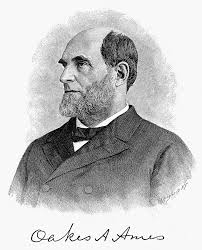
Meanwhile, a local woman named Mary Middleton was buried in Canton.  Evelina was quite impressed at the number of carriages that followed the casket to the cemetery.  Miss or Mrs. Middleton must have been a personage of some importance, or someone with countless relatives. Evelina could have no way of knowing that when her own husband Oakes would die in 1873, a crowd of 3,000 people would attend his funeral. How many carriages would he draw to his service?


April 21, 1851


Doctor

1851

Monday April 21st  I have ripped my blue & orange

Delaine dress & washed & ironed it ready to make over

It was quite pleasant this morning & Jane got her

clothes all dried but this afternoon & evening it storms

again. Frank has been unwell for a few days

with his throat & headache.  Dr Swan called & I paid

him 50 cts.  Mrs S Ames sick and had the Doctor

Frank helped me set out some rhubarb roots

A sunny morning sent Evelina out of doors and into her garden, which must have been muddy after all the recent rain. With the help of son Frank Morton, she put in some rhubarb.  Nearby, Jane McHanna hung the Monday wash and managed to get it dry before more wet weather arrived in the afternoon.

Frank had been unwell, as had Sarah Lothrop Ames next door and each had a call from a doctor. In those days, doctors would typically call on patients in their homes. Physicians kept offices, of course (usually in their own homes,) but generally treated people by traveling to them rather than the other way around. This practice was commonplace well into the 20th century.

Dr. Caleb Swan was Evelina’s physician of choice.  Besides being generally considered quite competent, Swan was “suave, genial and agreeable.”*  His bedside manner must have been calm and attentive. He had studied at Harvard and then apprenticed under a practicing physician, apprenticeships being standard training regimen at that time. A popular man in town, he was involved occasionally with local and state politics.  “Intensely opposed to the Know Nothing” party, he was a “pronounced anti-slavery man.”* He had a large family, and four of his sons became physicians like him.

Elsewhere in the world of shovels, Old Oliver oversaw work on a shop they kept in Bridgewater, where men were “sleighting the roof.”  Slate was the preferred roof material for owners who were concerned with the possibility of fire.

*William Chaffin, History of Easton, 1886


April 20, 1851

Lobster

1851

April 20  Sunday  Another severe storm it snows some

but most of the day it has rained in torrents

Not one of the family have been to church.

The children have been pretty wide awake for 

the sabbath and made not a little noise.  Harriet

& Anna were here to supper  had Lobster.

Rec d a letter from Pauline this morning.

The weather this April just wouldn’t quit.  The prospect of all the Ameses trapped indoors yet again by “another severe storm,” is dreary.  Surely Evelina missed being able to get to church. Oakes could escape to his office, at least, but Evelina was in the house with many family members. The little children coped, however. After their train trip, Frank, John and Anna Mitchell seemed delighted with the relative freedom and novelty of visiting their relatives. They romped and played, making “not a little noise.”

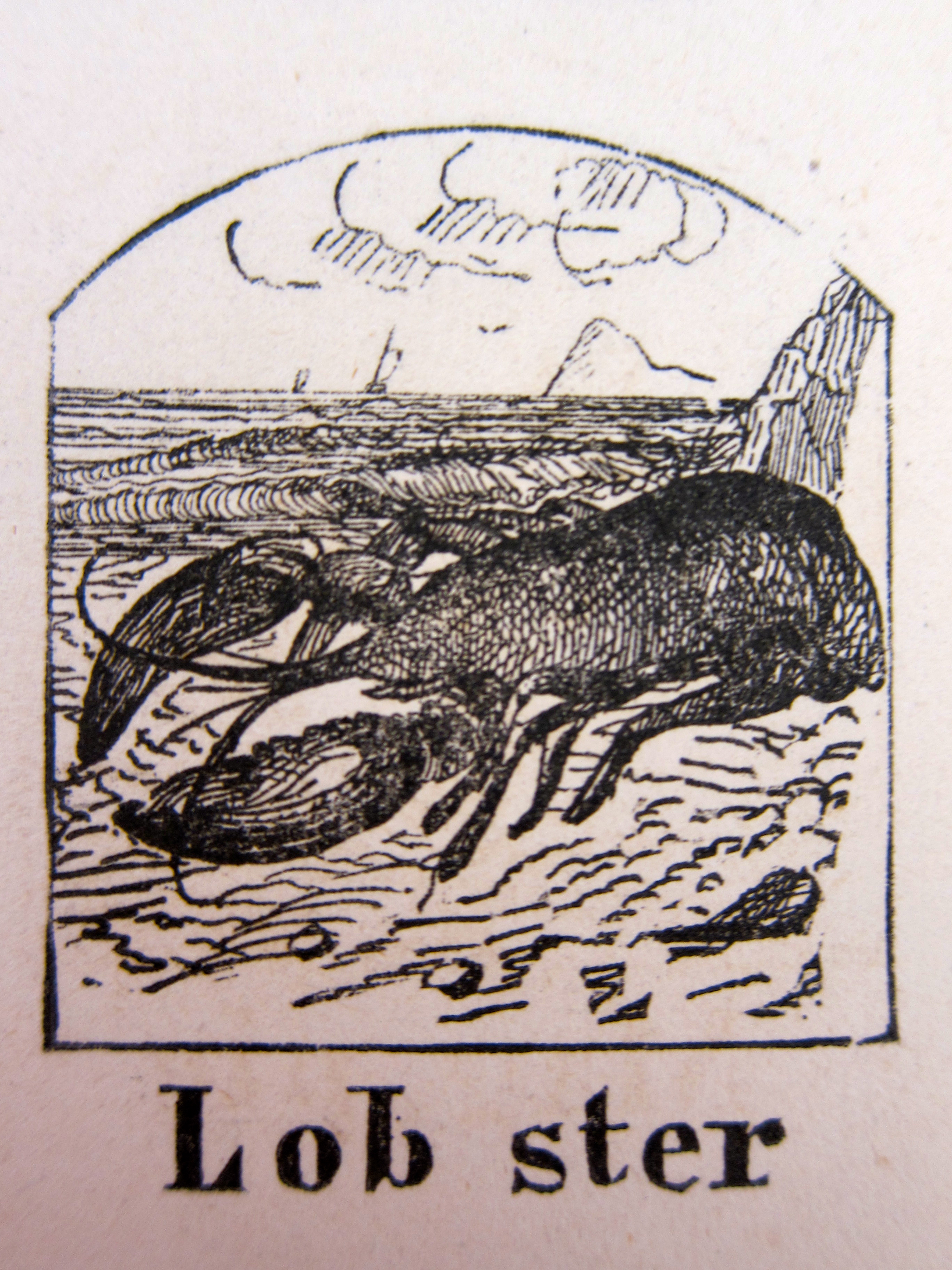
Lobster was served for supper, a change of pace from more usual fare of beef, bread and pie. Until very recently, lobster had been considered a dish fit only for the lower classes, a sure sign of poverty. It was so cheap that it was often served in prisons. In the novel Little Women, Amy March was embarrassed when a handsome young man bumped into her on the omnibus while she was carrying one in her basket.  Only at mid-century did the crustacean’s “vulgar size and brilliancy”* begin to appeal to the more affluent. Whether Evelina served it because it was beginning to be fashionable to do so or because it was still a very economical meal is hard to say.  Certainly, it was easy enough to obtain. Oakes probably picked it up the day before while in Boston.

The indefatigable Sarah Josepha Hale offered a recipe for stewing lobster that included the direction: “If you have no gravy, use more butter.” She also suggested that lobster could be eaten cold, “with a dressing of vinegar, mustard, sweet oil, and a little salt and cayenne. The meat of the lobster must be minced very fine; and care must be taken to eat but a little of this dish.”**


*Louisa May Alcott, Little Women, 1868-1869

** Sarah Josepha Hale, The Good Housekeeper, 1841


April 19, 1851


rail_travel_leslies

*

1851

April 19  Harriet and her children came from Pittsburgh this

morning, came by the way of Stonington to Mansfield

and got someone to bring them.  It s too bad we did

not send for them, but Father thought the storm

might prevent their coming  Called in to see them this

afternoon.  Harriet does not look near as well

as she did before she went.  Augustus went to Boston

& Mr Ames  Tolerably pleasant


The youngest offspring of Old Oliver and Susannah Ames came back to town today.  Harriett (Ames) Mitchell, all of 31 years old, traveled by rail from Pittsburgh to Easton, finding her own way from the station in nearby Mansfield. (The railroad had not yet been built to North Easton.) In tow were her three children, Frank Ames Mitchell, John Ames Mitchell, and Anna Mitchell, aged 9, 6, and not quite 4, respectively. Given the rigors of traveling a long distance on a train with small children, it’s little wonder that Harriett did “not look near as well as she did before she went.”

Weather and travel conditions aside, the question is why Harriett returned home and left her husband, Asa Mitchell, behind. We know only a little about Asa Mitchell. He was a member of the well-regarded Mitchell family of Bridgewater. A coal dealer, he had recently moved west from Cambridge to Pittsburgh, Erie or someplace in Pennsylvania.  His employment seemed unsettled, and perhaps was driven by the vagaries of the coal industry.

Asa and Harriett had been married for eleven years and, like any of the Ames marriages, we can only conjecture what their relationship was like. We do know that Harriett and their children spent many months away from Asa, eventually staying in a house in Bridgewater that Old Oliver obtained for her. Asa spent some time there, too, but by 1867 he was an inmate at the Taunton Insane Asylum, where his expenses were met by Oliver Jr. We don’t know what his mental illness was; it may have been as debilitating as senility, as sudden as brain trauma or as complicated – and untreatable then – as schizophrenia or bipolar disease.  His condition would erase him from Harriett’s life and, by extension, the lives of his children. He died in June, 1877 in Taunton.

So on this cloudy day, with the “wind north east and cold,” and an uncertain future in front of her, Harriett brought her children home and was made welcome. She and her older sister Sarah Witherell were close and, no doubt, were glad to see each other.

* Leslie’s, 1878

April 18, 1851

aclk

U.S. Three Cent George Washington stamp, 1851

1851

April 18  Friday  I have made up the bed new in the 

parlour chamber and got the room in pretty

good order have not got to clean it this spring

I have been choring about house most all 

day about four Oclock  went into

the other part of the house & took the stockings

with me to mend  Not at all pleasant

Spring was the season for choring, choring, choring. Until she went to sit and mend stockings with Sarah Witherell, Evelina worked around the house all day.  The bad weather of the past several days continued.

The Ameses kept a bed in their parlor.  This seems strange to us, but it was customary at the time, or had been.  The practice was waning, as bigger, Victorian houses became the style and the older Colonial and Federal floor plans were abandoned.  Once upon a time, however, a downstairs parlor served multiple purposes.  We know it as the spot in the house where more formal visitors were welcomed. In the 18th and into the 19th century, the parlor was also where the master and mistress of the house might sleep, while children went upstairs to colder quarters. As the family became more affluent and rooms got reconfigured, the bed in the parlor accommodated overnight guests.  Several weeks back, in fact, inclement weather had forced William and Eliza Whitwell to stay over; they may have stayed in the very parlor that Evelina put “in pretty good order” today. Same with Evelina’s mother when she came to visit.

Many Ameses celebrated their birthdays in the month of April.  Today was another family birthday, that of John Ames 2d, the youngest son of Old Oliver and Susannah, who was born on this date in 1817. He was never in robust health, never married and succumbed to lung disease at age 27.  Before his death, however, he served as the very first postmaster of North Easton, then a new outpost between two larger post offices elsewhere in Easton proper. According to historian William Chaffin, young John Ames’s “office” consisted of “a large box with a cover […] set upon a post” with “mail (at least newspapers and heavy mail)” that was “put into and taken from this box by the drivers of the passing mail-coaches.”  This newest post office was needed for the increasing amount of mail coming in and out of the shovel factory.  With his health too poor to work in the factory itself, at least John had a role in managing the post.

April 17, 1851

imgres-1


1851

April 17th Thursday.  Julia has been here to finish

my Foulard Silk it does very well now & looks

very well indeed after washing It has taken

her two days to cut & make the waist baste

the sleeves & sew on the skirt She is very

slow. Orinthia did not keep school yesterday

or to day on account of the storm It has been

a driving storm to day but not as bad as yesterday

The storm that took down Minot’s Light still raged today.  Safely indoors, Evelina and Orinthia tended to sewing, joined by dressmaker Julia Mahoney, who finally finished the alterations on a silk dress for Evelina. Foulard silk was a popular, lightweight fabric – good for the coming warm weather – that typically featured a small print pattern. Used today for scarves, it could and can be hard to sew because it’s so thin.

Julia took longer to complete the outfit than Evelina thought she should, yet as Julia was probably paid by the piece and not by the hour, Evelina’s annoyance wasn’t based on monetary concerns. Perhaps her exasperation at the dressmaker’s deliberate pace stemmed from her own seasoned agility with needle and thread; perhaps she thought she could do the work faster. But Julia may still have been more skilled in the finer needlework required for high-end ladies’ dresses.  Certainly the end result proved pleasing.

According to Godey’s Lady’s Magazine, “One might as well be out of the world as out of the fashion”.  While North Easton, Massachusetts would never be in the running as a fashion center, some of its citizens cared about style and appearance.  Evelina and her sisters-in-law did. They followed the fashions, via various periodicals and on trips into Boston, and dressed themselves as modishly as they could. As Evelina’s grandson Winthrop Ames later pointed out, “Every season there was a great remaking of old garments to bring them up to date.”

The remaking of garments didn’t preclude the production of entirely new dresses, either.  But older clothes were made and remade to last as long as possible.


April 16, 1851

Lighthouse

1851

April 16th Wednesday  Robinson had papered the 

bedroom to day but has not done it well at all.  I have

finished the carpet and put it down and 

got the room in order and it looks like another

place.  It stormed very hard last night and 

a high wind, and to day we are having the

hardest storm that I ever recollect.  Rains very

fast & wind high.  Augustus not here.

Light house on Minots rock blown down

Today’s foul weather made history. Like Evelina, Old Oliver reported it in his journal as remarkable. [T]he water is quite high I never knew the wind blow so hard for so long a time together”  It was a hard storm indeed, hard enough to take down the new lighthouse off of Cohasset, Massachusetts:
“[E]asterly winds began blowing around April 8, 1851. […] The storm increased in fury and, by the 16th, was causing considerable damage ashore. At Minots Ledge, the two assistant keepers kept the bell ringing and the lamps burning, but just before midnight on the 16th they cast a bottle adrift containing a message for the outside world in case they failed to survive. The high tide at midnight sent wave after wave through the upper framework of the weakened structure.

What actually happened then will never be known. Probably about 11 p.m. the central support snapped off completely, leaving the top-heavy 30-ton lantern tower held only by the outside piling. Then just before 1 a.m. on April 17, 1851, the great Minots Ledge Lighthouse finally slid over toward the sea. One by one the eight iron pilings broke until only three remained. The keepers, probably realizing that the end was near, began pounding furiously on the lighthouse bell. This was heard by residents of the Glades. With the tower bent over, the remaining supports now gave way and the great tower plunged into the ocean.

The body of Joseph Antoine was washed ashore later at Nantasket.  Joseph Wilson managed to reach Gull Rock, probably mistaking it for the mainland. Here he apparently died of exhaustion and exposure.”


* http://www.uscg.mil/history/weblighthouses/LHMA.asp

April 15, 1851

images-1


1851

April 15 Tuesday  Oakes A 22 years old. This morning

tore the paper off the dark bedroom & had it cleared

ready for the paper.  Have been working about 

the house most of the day.  Cut of[f] the breadths of

the carpet for the bedroom and have partly 

made it.  Moved the stove from my chamber

& cleaned the dark bedroom chamber.  It is 

quite stormy & windy.  Cut two coarse shirts.


Oakes Angier Ames, eldest son of Evelina and Oakes Ames, was born on this date in 1829, when Evelina was 19 and Oakes was 25. The couple had been married for about a year-and-a-half and were already settled into their own quarters within the Ames family homestead. On this, his 22nd birthday, and as yet unmarried, Oakes Angier was still living in the house in which he had been born.

Oldest of all 24 grandchildren of Old Oliver and Susannah Ames, Oakes Angier grew up amid multiple siblings and cousins, among whom he retained primogeniture in an uncontested patriarchal hierarchy. His mother called him Oakes Angier; everyone else seemed to call him just plain “Oakes.” He was marked from birth to run the family business.

Although Oakes Angier had attended school locally and away, at Fruithill and Leicester academies, he left behind no indication that he longed to further his studies. After graduation, he went straight to work at the shovel factory. There, one 19th century historian noted,  “with a view to making himself master of the process of manufacturing shovels, he spent from three to six months in each of the various departments of the factory.”*

Reverend William Chaffin, Unitarian minister and town historian, knew Oakes Angier and his family well. He described Oakes Angier as “shrewd, conservative [and] sound in judgment.”* Although in their later years Oakes Angier shared the responsibility for O. Ames & Sons with his brother Oliver (3) and cousin Fred Ames, Chaffin makes a point of noting that to the shovel shop employees, Oakes Angier was the man who embodied management.  It was Oakes Angier who was on the ground overseeing the daily operations during the company’s most ambitious years, Oakes Angier who was “one of the superintendents who superintends.” He ran the place.

The same historian who wrote of Oakes Angier mastering the process of shovel manufacturing also described him as someone who stayed focused on his immediate responsibilities and did not, like his brothers, cousin and father, diversify his pursuits.  As the 19th c. historian saw it, Oakes Angier gave “his whole time to the demands of his business, and yield[ed] to no temptation to embarrass himself […] by the complications and annoyances which beset the paths of the politician, and of the projector of enterprises outside of his legitimate occupation.”* In other words, Oakes Angier learned to avoid both politics and risky investments.

On this particular birthday, Oakes Angier was on the cusp of adulthood, preparing to leave the nest. He spent many free evenings squiring different young women to and from the dances and sings that were available in the neighborhood, seemingly ready to find a young woman to settle down with. He and his brothers were what some parents would have described as eligible young men.


William Thomas Davis, ed., The New England States, Vol. I, 1897.


April 14, 1851

Coffin

1851

April 14 Monday  Julia Mahoney has been here to day

to work on my foulard silk It is bad to 

work on and she has not succeeded very well

but is coming again to finish it. Jane has

done the washing and her clothes dry

Orinthia has finished the shirt for Oliver that

was cut out March 31st Weather Pleasant

Mrs Witherell Mrs G Ames & Mrs S Ames called evening

In his journal today, Old Oliver noted that his son, Horatio Ames, was visiting. Although Horatio would have been, literally, under the same roof as Evelina and Oakes, Evelina didn’t mention his visit. She might not have seen him, of course, although she must have known he was in town and probably staying in the other part of the house.  Horatio, like their brother William, was on poor terms with Oakes and it appears that neither wanted to encounter the other.

Another heartfelt topic that found no tongue today was the anniversary of the birth of Henry Gilmore Ames, the son of Evelina and Oakes who did not survive childhood.  Henry would have been twelve years old today, but died at age two-and-a-half of an unrecorded cause.

In the future – 1876 in fact – family graves would be disinterred from their original locations and moved to a dedicated family cemetery behind the new Unitarian church on Main Street. Oakes Angier would oversee the relocation; among the graves moved would be the small one for Henry.  At the time, Oliver (3) made a few observations about the relocation, including one of the little brother they had lost: “Bro Henry was moved to day and his hair was as perfect as when he was buried. His hair was smooth and parted.”  Oliver (3) also noted that his father’s coffin was so heavy that it took seven men to lift it from its original resting place.

If Evelina remembered today’s date, she indicated nothing.  She was busy with overseeing laundry day (not that Jane McHanna needed any direction on what needed to be done,) as well as Orinthia Foss’s completion of one last men’s shirt, and Julia Mahoney’s sewing on her silk dress.  Many needles at work.


April 13, 1851

200px-First_Unitarian_Church_in_1886

*

1851

April 13th Sunday.  Have been to church all day Frank

staid at home in the morning Mrs G Ames went

with us to meeting all day and liked Mr Whitwell

I staid at noon with Mother most of the time

Called at Mr Whitwells with Louisa Howard

Mrs Dr Deans & Mrs H Pool. Mrs Whitwell

has no help now & is not very well. rather cold

On this cold spring day, the Ames family, minus Frank Morton, went to church with Almira Ames, widow of Oakes’s cousin George Ames.  Perhaps Almira joined Evelina and her mother during the midday intermission when many women were welcomed into the parsonage by Eliza Whitwell, wife of the minister. Eliza was under the weather but still was under a social obligation to open her house to fellow Unitarians who could not get home and back during the pause between the morning and afternoon services.

Mrs. Dr. Deans, otherwise known as Hannah (Wheaton) Deans, wife of Dr. Samuel Deans, was also present at the Whitwell’s.  The “Dr.” title in front of her name didn’t mean that Hannah was a physician; far from it. It meant that she was married to a physician.  She was a daughter of old Daniel Wheaton who lived out on the Bay Road.

Evelina often admired Rev. Whitwell’s sermons but seldom related their content. In these tumultuous months following the enactment of the Fugitive Slave Law, did Mr. Whitwell ever speak about slavery or abolition? We know that other Unitarian ministers were quite vocal about abolishing slavery.  On this same Sunday in Philadelphia, three hundred miles to the south, Rev. William H. Furness gave a discourse on the Fugitive Slave Law, speaking from the pulpit with all the authority that his robed position could give him.  A graduate of Harvard and friend of Ralph Waldo Emerson, Furness was, like William Whitwell, an accomplished theologian.  He was also a passionate abolitionist; was Reverend Whitwell?


*First Unitarian Church of Philadelphia, ca. 1886