October 29, 1851

1157676_l

*

Wednesday Oct 29.  I have been what I call puttering

about house most all day and have accomplished

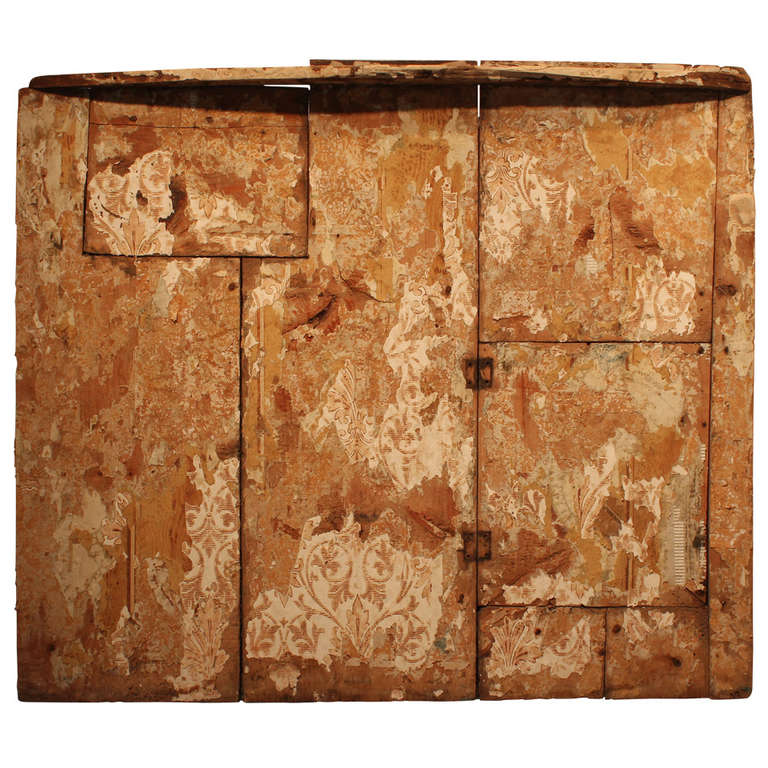
but very little.  papered the fireboard and pasted

the loose places in Franks chamber  Mr Scott

has painted the sitting room & closet

Mrs Hubbel & Ames came from New York this morning

H O A Orr came for Susan this afternoon  Mr

Walton is there. Mrs Holmes and Abby called

Mr Ames came home from Boston to night

Many comings and goings in North Easton today, under a cloudy sky.  Almira Ames, widow of George, an Ames cousin, arrived from New York with a Mrs. Hubbel in tow. They came for a visit with the obliging Sarah Witherell and Old Oliver Ames in the other part of the house.

Susan Orr, meanwhile, who had been staying with Sarah Witherell and her father for almost a month, was picked up this afternoon by her brother, Hector Oakes Orr. Susan, age 53, and Hector, age 51, were first cousins of Sarah Witherell and her siblings on the Angier side of the family.  Susan and Hector were two of five children of Susanna Angier Ames’s sister, Mary and her husband, Dr. Hector Orr, of Bridgewater. Their shared grandparents were Oakes and Susanna (Howard) Angier.

Evelina’s niece on the Gilmore side, Abigail Williams Torrey, paid a call with Harriet Holmes (the neighbor who had been so ill back in August). A Mr. Walton floated somewhere in the picture; Evelina’s inclusion of his name is a bit vague. And chugging along in the background of the various calls was Mr. Scott painting the woodwork in the sitting room. Evelina concentrated on papering a fireboard when she wasn’t attending to the influx of visitors. For readers who don’t have fireplaces, a fireboard was a piece of wood, textile or ironwork fitted to the opening of a fireplace for periods when the fireplace wasn’t being used.  Fireboards made from wood, most common in the countryside, were often decorated with wallpaper or painting.


* 19th century papered fireboard, Pennsylvania, courtesy of 1stdibs.com.


October 28, 1851

fig7

*

Tuesday Oct 28.  Have been assisting Mr Scott about papering

again to day and have painted over some things

and places about the house. Finished papering the

sitting room and little entry just after dinner

Hannah called with Eddy a few moments

Mr Ames is still in Boston passed last

night there.  I spent the evening in the other

part of the house.


Yesterday’s unseasonable snow storm departed and left behind “a fair day**”  Evelina seemed not to notice the difference, focused as she was on the repapering and repainting of the downstairs of her part of the house. She was helping with the actual papering. Her husband, Oakes, was away in Boston, so her only responsibility was making sure that meals were on the table for sons Oakes Angier and Frank Morton and daughter Susan Eveline, a task she typically delegated to her servants.

Hannah Lincoln Gilmore, who was married to Evelina’s nephew, Alson “Augustus” Gilmore, paid a call with her older son Eddy. Edward Alger Gilmore was a toddler who had fidgeted more than once in his great-aunt’s parlor. He was only two years old, and probably couldn’t yet pronounce his name.

Eddy’s middle name came from his maternal grandmother, Rachel Howard Alger (1802-1823), the first wife of Alson Gilmore and mother of Hannah’s husband, Augustus.  Rachel died less than a year after Augustus was born; Augustus couldn’t have remembered her, but he clearly wished to honor her by naming his own first-born after her. The Alger family was settled in Bridgewater, Taunton, and Easton, all descendants of a Thomas Alger in the 17th century. Both Evelina and Sarah Lothrop Ames were among the hundreds of descendants in the Thomas Alger line.


* Illustration in “Scientific American”, ca. 1880, of machine production of wallpaper, New York, Courtesy of National Park Service, http://www.cr.nps.gov/history/online_books/tpsd/wallpaper.

** Oliver Ames Journal, courtesy of Stonehill College Archives


October 27, 1851

winter_snowfall-t2

Monday Oct 27th  Mr Scott came this morning about nine

It being very stormy he could not get here before

Mr Smiley came just before and worked about

three hours.  After dinner went to Mansfield.

I have been helping Mr Scott paper the sitting

room  Have been busy all day about the 

papering.  Mr Ames went to Boston this afternoon

was also gone Thurs & Friday of last week


Snow! At least that’s what Old Oliver reported in his journal: “this morning the ground was coverd with snow and it snowd about all the forenoon, and was cold. wind north west + blowd hard, at night the fields are coverd with snow 2 or 3 inches deep – there has bin 1 ¼ inches of rain this time”  Evelina only reported that the weather was “stormy.”

Not only did the weather interfere with the travel of the workmen; it also surely challenged servant Jane McHanna as she attempted to wash and dry the weekly laundry. Yet it didn’t seem to prevent Oakes Ames from heading to Boston in the afternoon.  He had been there often of late.  Indoors, Mr. Scott continued to put up new wallpaper in the downstairs.  The redecorating and attendant removal of much of the furniture had been going for a week.

It was the 300th day of the year.

October 26, 1851

1421516038_22078acff3

*

Sunday Oct 26.  John Ames from Springfield is here at

fathers came last night.  We have all been

to meeting  Mr Whitwell preached two

excellent sermons.  Went at intermission

into Mr John R Howards with Mother and several

others  The first time I have called since

they moved.  It has rained since eleven this

morning, quite hard.

For the first time since September 21, Evelina attended church; even the “hard” rain couldn’t keep her away. She surely was pleased to be back in the family pew, head tilted up to listen to Reverend Whitwell’s “excellent” sermons, happy to visit with friends and acquaintances at intermission. The opportunity to congregate at church was central to Evelina’s social life, and she was quick to catch up.  Her visit at intermission with John and Caroline Howard was her first visit to their new home.

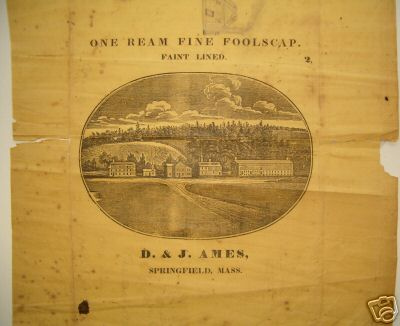
A cousin from Springfield, John Ames, was visiting in the other part of the house. There were several relatives named John Ames with close ties to Old Oliver, including his father and a brother. This John Ames was, most likely, a nephew of Old Oliver, the son of Old Oliver’s much older brother David. His dates were 1800-1890. He was famous for certain inventions pertaining to the manufacture of paper and with a brother, also named David, ran the Ames Paper Company in Springfield. According to one 20th century historian, “[f]rom the outset the firm, which became known as D. and J. Ames, prospered wonderfully, making money rapidly and growing until it was one of the largest and most powerful in the country.”**

A life-long bachelor, John Ames lived with a sister, Mary, and the two managed the family farm well into their old age. Oliver Jr. writes of visiting them in Springfield in 1871. The families stayed in touch.Yet Old Oliver made no mention of his nephew’s visit.  Instead, in his journal, he noted only that “it was cloudy all day to day + raind some in the day time + in the evening + night ther was considerable.” He was more interested in the rain which, given the fact that rain meant more water and more water meant more power for the factory, was perhaps understandable.

Image courtesy Benjamin L. Clark, Massachusetts Book Trade

**Lyman Horace Weeks, The History of Paper-manufacturing in the United States, 1690-1916, New York, 1916, p. 125

October 25, 1851

WHEATLAN-h

*

1851

Sat Oct 25th  Mr Scott & Holbrook have been to work

all day papering the parlour and they have got

it papered only from the little entry door

around to that corner of the mantlepiece.

Mr Smiley worked here about two hours to day

put on the border in the parlour as far as it [was]

papered and some paint on top of the closet

shelves.  I have trimmed the paper and &c.


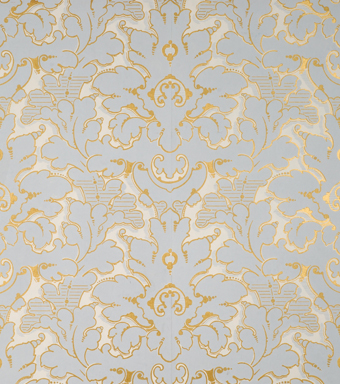
The wallpaper in the illustration above is an example of a mid-19th century pattern that might have been available in Boston, where Evelina purchased her new paper for the parlor. Two men, Mr. Scott and Mr. Holbrook, did some papering today, but not fast enough to suit Evelina. She was so eager to have the paper up that she helped by trimming some of it herself.  What did the workmen think about that? Mr. Smiley, who only seemed to work a few hours at a time, applied a border to what paper had been put up and painted a few shelves.

Oakes Ames was probably absent today, as Saturday was his usual day to be in Boston taking orders for shovels. Sons Oakes Angier and Frank Morton would have been at the factory across the street, honing their skills in the manufacture of shovels. Little Susie was probably at school.


*Example of mid-19th century wallpaper, courtesy of adelphiapaperhanging.com

October 24, 1851

pantry-shelves-vintage-650-225x300

*

Friday Oct 24th  Jane & Bridget have cleaned the buttery

and I have had some paint put on the 

shelves  Mr Smiley worked here about three

hours, he went to Mansfield and came here 

about two Oclock.  Scott & Holbrook have finished

the first coat to the sitting room & parlour

I have been about house most of the day.  Sit awhile

with Susan Orr.  Capt Isaac Lothrops wife buried this P. M.

Much cleaning was going on at the Ames’s house in tandem with major redecorating. Evelina the housewife was impelled to tidy everything up before and after various workmen came through to scrape, dismantle, build, paint and/or paper the downstairs rooms. Her servants, Jane McHanna and Bridget O’Neil, scurried around with her, clearing shelves so that the men could follow and do their work.

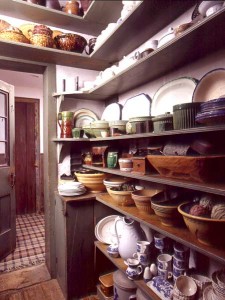
The buttery that Evelina mentions was, in fact, a shelved area off her kitchen that served pretty much as a pantry.  She had food storage “down cellar”, of course, but the buttery, being close by and on the same floor as the kitchen, would have been more accessible for daily use.  She would have stored everyday items like coffee or tea there, for instance. If the Ameses had kept dairy cows, milk would have been poured into pans there, to be skimmed for cream.  Yet the term buttery derives not from its use for dairy products, but from an archaic British term for the room where large caskets of wine, known as butts, were stored. (One butt was the equivalent of two hogsheads or four barrels of wine.) There was no storing caskets of wine at the Ames’s.

Oakes Ames was away during yesterday and today’s disruption, though sons Oakes Angier and Frank Morton and daughter Susan Eveline were home and had to sidestep the disarray. Oakes was away on shovel business, most likely.  No one from Evelina’s household appeared to attend the funeral of Isaac Lothrop’s wife.


* 19th century pantry, courtesy of http://www.oldhouseonline.com, photo by Gross & Delaney


October 23, 1851

Brush

Thursday Oct 23rd   Mr Smiley Scot & Holbrook came

to paint to day.  Mr Smiley whitewashed

the parlour & sitting room & painted two

windows in the sitting room  has been to work

all day  Hannah & Eddy called this morning

Augustus & wife & self have been to the funeral

of aunt Alger this afternoon  Have passed

the evening in Olivers  Bridget ONeal came this

morning

Contractors filled the old house again today to paint and continue the refurbishment of the downstairs.  The parlor, where company met, and the sitting room, where Evelina sewed, were both being redecorated. We don’t know who Mr. Smiley and Mr. Scott were, but we believe that Mr. Holbrook’s first name was Randall; of the three men, Mr. Scott and Mr. Holbrook would continue off and on to paint various rooms at the Ames’s from this date until June, 1852.

New to this bustle of repainting was Bridget O’Neil, a servant who only arrived in the morning. She was probably taking the place of the recently departed Ellen. She was also the same Bridget who had worked for the family earlier in the year.  Where had she gone in the interim?

On a sad note, Evelina attended a funeral today for a Gilmore relative, an aunt in the Alger family. She went with her nephew and his wife, Hannah.  Later, she went next door to visit with Sarah Lothrop Ames.  Those post-tea evenings were beginning to take place after dark . Very soon tea itself would be served after the sun had gone down.  Daylight and warmth would diminish.  As Old Oliver noted in his journal , “this was a fair day wind north west and grew cold towards night.”

October 22, 1851

Child

1851 Wedns Oct 22d  have been taking care of Hannahs

babe to day  He has been pretty good

but would not be turned off at all have

had to hold him most of the time

George Randall came about eleven

to scrape the walls has got the paper

from the parlour and part of the sitting

room  It has been raining most all day

have written to Louisa J Mower


Evelina made good on her promise to watch Hannah Lincoln Gilmore’s baby son while Hannah went into Boston.  Little William Lincoln Gilmore was only three months old, still nursing and not yet able to sit up. No wonder he “would not be turned off at all.”  Had Evelina forgotten what it was to care for an infant? She “had to hold him” most of the time, probably walking around with Willie in her arms, or rocking him in one of her rocking chairs – except that the furniture was in disarray from the redecorating. She couldn’t take him outside, either, as the day was cold and rainy.

A local man, George Randall, came to scrape wallpaper, a task that Evelina had, evidently, finally given up on. She had spent much of the last two days scraping and was ready now to pay someone to finish the job she had started. Mr. Randall was able to complete the scraping in the parlor and start it in the sitting room.

When Evelina was able to lay young Willie down, or perhaps after Hannah returned and picked him up – happy baby – she sat to write a letter to her friend in Maine, Louisa J. Mower. She may have written a thank you note for the cheese and butter that arrived a few days back.

October 21, 1851

scraping-wallpaper-renovation-14163480

Tues Oct 21st  Have been scraping off the paper again

to day and getting ready for the painters

Have been to work some on the sleeves

of my cashmere have sewed part of the 

trimming on.  Hannah called to ask

me to take care of her babe for her to go

to Boston tomorrow  Was in the other part

of the house part of the afternoon 

The house continued to be in some upheaval this morning as Evelina scraped more wallpaper off of the parlor walls in order to get “ready for the painters.” Her arms and hands must have ached with the effort. Soon enough she broke away from that task and turned to her sewing, probably with relief. For some time she had been working on a new wool dress and today sewed some trim on.  Did she add fringe, or piping, or lace? Or did she add the ribbon she’d been looking for lately?

The bad weather from the weekend had disappeared. According to Old Oliver’s daily chronicle “there was a large fog this morning + after it went of[f] it was verry warm wind brisk from south west Mr Arnold came here to day to sleight the shop at great pond.”

Hannah Lincoln Gilmore, wife of Evelina’s nephew Alson “Augustus” Gilmore, came by to ask her aunt to babysit the next day. Evelina, always a friend to younger women, agreed to watch Hannah’s infant son. It’s worth noting that in order to ask that favor, Hannah had to walk over from the village to physically appear at Evelina’s house. That, or she could have written a note and asked someone to deliver it.  There was no phoning, no texting, no emailing, no instant messaging. Instead, there was a knock on the door and a face-to-face request. That’s how it was done in 1851.

Evelina wound up the day with a visit to Sarah Witherell and her houseguest, Susan Orr, in the other part of the house.


October 20, 1851

Cheese

Monday 20th  Susan washed the dishes again this

morning and I took up the parlour carpet and cleared

the room  Mr Healy has taken out the door

where the closet used to be and getting it ready for

the masons  I have been to work getting of[f] the 

paper and to night feel quite lame.  Mr Smiley

has varnished the chairs that he painted last week

Received 6 cheeses and a tub of butter from Mrs Mower

The calendar may have said it was October, but the domestic commotion at the Ames’s suggested spring cleaning.  In order to redecorate, Evelina pulled up the carpet (which had been laid down in pieces), emptied the parlor of furniture, and spent the better part of the day scraping off the old wallpaper. A local carpenter, Henry R. Healy, was also in the house, removing a closet door and preparing a wall for masonry. Were they putting in a new fireplace?  A coal stove would be more likely. Further, another worker, Mr. Smiley, finished varnishing some chairs.  All this went on over and around the usual Monday washing of clothes by servant Jane McHanna.

Scraping wallpaper off of horsehair plaster is hard work and by night time, Evelina was smarting from the day’s exertion. She couldn’t have been unhappy, though. Much had been accomplished and, moreover, her housewifely self must have been pleased to add “6 cheeses and a tub of butter” to the larder.  Louisa J. Mower, a friend from Maine, sent the dairy items to her.  As gifts? As a purchase?

It was a day of accomplishment for Evelina.