May 11, 1852

Abbott H. Thayer, Angel, 1887, oil Smithsonian American Art Museum Gift of John Gellatly

Abbott H. Thayer, Angel, 1887, oil
Smithsonian American Art Museum
Gift of John Gellatly

Tuesday May 11th  George died this morning about eleven

Has not spoken so that we could understand

since yesterday noon.  died at last very easy

without a struggle or groan.  Mrs S Ames & self

laid him out,  His mother has slept but about

two hours for two days and nights. Have trimmed

my straw bonnet. Miss Copeland sewed it over  Spent

about two hours in Olivers this afternoon.  Helen has a 

blister on her arm  The gardener set out some rose plants.

Prairie Rose Baltimore bell and Fraxinella sent

from Boston

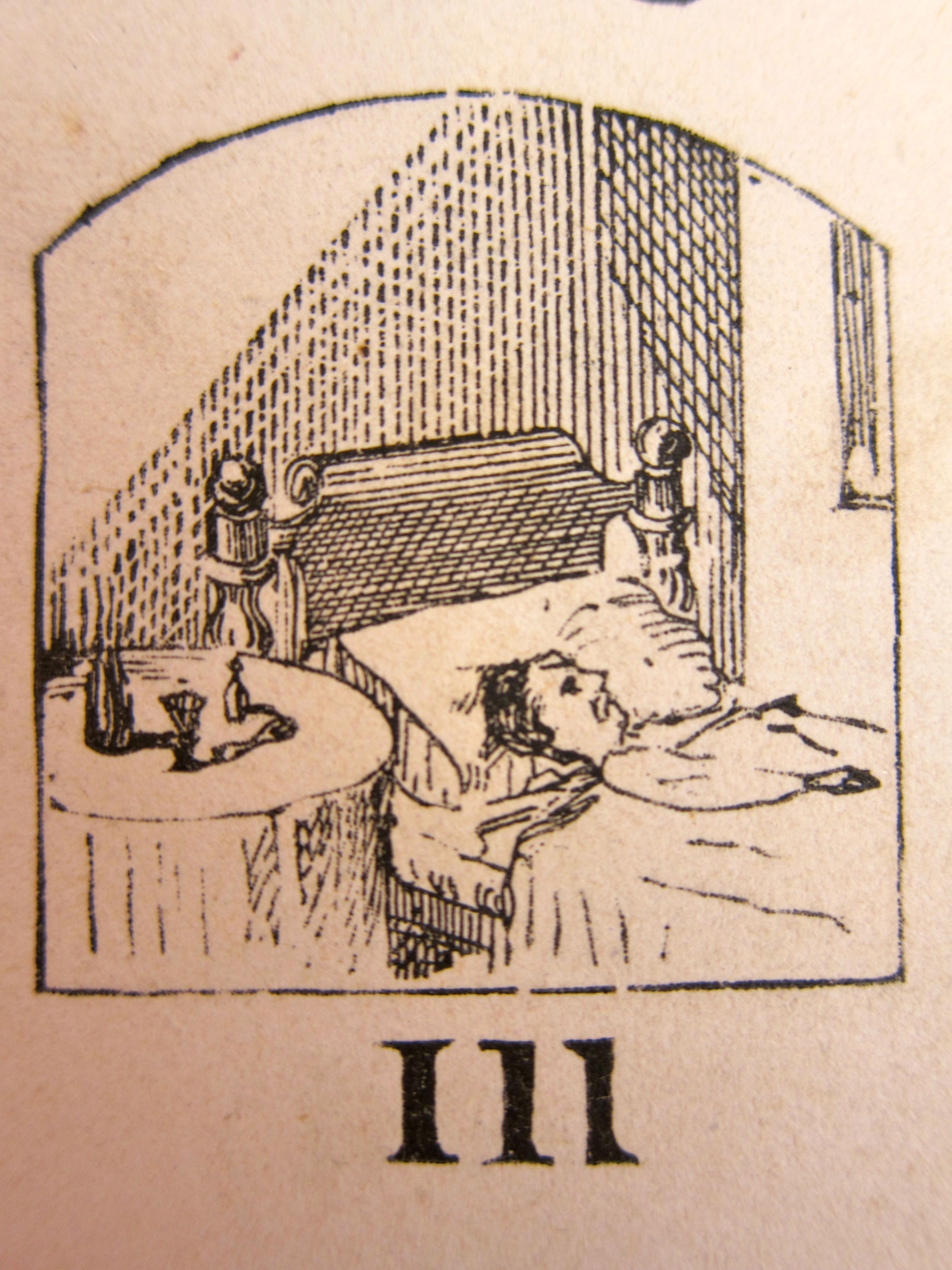
George Oliver Witherell, aged fourteen, died on this day from rheumatic fever.  He had been suffering for many days, but “died at the last very easy.”  His Aunt Evelina had been with him for much of the illness, spelling his exhausted mother, Sarah Ames Witherell. She and her other sister-in-law, Sarah Lothrop Ames (who had her own sick child at home), laid out the corpse.

The family must have expected George’s death by this stage of his illness; certainly the attending physician had already predicted it. But anticipation is not the same as actuality, and the death of the young man would have hit everyone hard. Evelina dwelt in her diary on George’s last few minutes, but then added a few mundane notes about her summer bonnet, her niece Helen’s continued battle with an unnamed infection, and some new additions to the flower garden. She might have wished to move on to less painful concerns.

George’s grandfather, Old Oliver, noted his grandson’s death succinctly: “George Witherell dyed to day about eleven O clock.” Oliver rarely included personal items in his daily record; that he wrote of George’s death is a sign of regard, however minimal we might consider it. His grief would have been real.

Of Sarah Ames Witherell’s feelings, we’re told nothing, and must imagine her utter exhaustion and complete sorrow.

May 10, 1852

Doctor

Monday May 10th  Do not feel very well to day.  Slept in

the light bedroom so as to assist Sarah in taking

care of George.  He knows everyone but otherwise 

is not conscious and since noon does not notice

all all.  The Dr has given up all hopes of him

I planted most of my flower seeds this

afternoon felt sorry to do so but it is getting late

The women in the Ames compound were becoming exhausted with tending to two very sick young people, George Oliver Witherell and Helen Angier Ames.  It was George, however, who had entered a dangerous phase. He had been suffering from rheumatic fever for many days and was now unconscious. His doctor had finally “given up all hopes of him.” How terrified the family must have been; no doubt prayers were being lifted in the hope that George might yet recover.

Evelina broke away from her nephew’s bedside to work in her garden. She “felt sorry to do so,” but the seeds needed to be planted. To wait too long would be to lose the best timing for the flowers. She might have felt relieved to kneel down in the soil and push little seeds into place, each seed a hopeful gesture in the face of helplessness.


May 9, 1852

wetsheet


Sunday May 9th  Our own family all went to meeting

& Oliver  George is much worse and we fear

will never be any better is very much out of his

head  Helen is quite sick with her face

had the Dr  Went into Mrs John Howards

at noon & carried her some flower seeds.

Mr & Mrs Swain made a long call this afternoon 

after they left I went to sit with George to assist

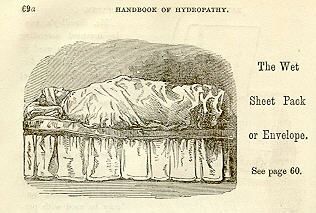
Sarah  They are laying a wet sheet once an hour


George Witherell was getting sicker and sicker. Perhaps to lower his temperature and reduce the involuntary spasms in his limbs and face, his family and physician were “laying a wet sheet once an hour.” They wrapped his body in a cold, wet sheet, and covered him with wool blankets to make him sweat. Everyone was trying to bring down his fever, soothe his nervous system and help him sleep. It was a desperate measure, but in the absence of effective medicines, it was the only option.

A wet-sheet wrap is a form of hydrotherapy, a controversial treatment meant to quiet a violent or agitated person. Opponents of this form of hydrotherapy feel that it’s been misused in certain psychiatric institutions, some patients attesting to being tied up for ten to twelve hours in icy sheets, an application that seems more punitive than restorative. Yet others in the medical profession, such as alternative care-givers in our modern age, tout wet-sheets – if applied properly – as a healthful therapy that induces sleep and calms the nervous system. Its effectiveness seems tied to the intention of the person applying the therapy and the nature of the illness of the person being wrapped.

Helen Angier Ames next door was also “quite sick.”  No wet sheets for her, but she was having her swollen face attended to. It sounds as if she might have had a bad abscess, also a dangerous condition in the era before antibiotics. Dr. Swan, if it was he who was attending the Ameses, was being kept busy.  His little gig would have been pulling up to the Ames compound at all hours of the day and night. Few in the family were getting any rest.  Evelina left the house briefly, to take some flower seeds to Caroline Howard, but returned home to help her sister-in-law.


May 8, 1852

Ill

1852

Saturday May 8th  Mrs Witherell has finished working

my Delaine sleeves and I have put them in

and have finished the dress which I think

is about time.  I sit with George for Mrs Witherell

to lay down this afternoon  He is very sick and 

suffers very much.  Mr Manly brought me some

more plants & I paid him 1,58 cts.  Oliver &

Brown returned this morning

George Witherell, fourteen years old,  was ill with rheumatic fever. In the age before antibiotics, the “rheumatics,” as Evelina called it, was a serious illness. It was a complication of strep throat, which George must have had three or four weeks earlier. Its symptoms, many of which George manifested, were fever; a flat rash; involuntary twitching in the hands, feet and face; painful, tender and swollen joints; chest pain; palpitations and fatigue. As Evelina noted, George suffered a great deal, for rheumatic fever was extremely uncomfortable and unsettling. It was also often fatal.

Sarah Ames Witherell had been nursing her son for several days now.  She took a rest in the afternoon and let Evelina sit with George.  All the family was helping, although George wasn’t the only sick child. Helen Angier Ames next door was down, too, with a somewhat mysterious ailment in her face. Family members were worried about both young people.

Despite the concern everyone must have been feeling, normal routines in this season of planting had to be adhered to. Old Oliver reported that “we began to plow the hill back of the shovel shop pond to day.”


May 7, 1852

il_340x270.517720740_i0s3

Polyanthus

Friday May 7th  Was in the garden to work a short

time transplanted some pinks but worked on

Olivers clothes most of the time.  Mr Brown &

Oliver rode to Mr Copelands and got me a polyanthus

and to the furnace in the afternoon to Canton 

and Sharon.  Mrs S Ames returned from Boston to

night & Helen with her  Helens face is very

swollen has not been to school for a week


With her middle son Oliver home from Brown, Evelina had a great deal of mending to tend to. She might have preferred to be in her flower garden, but she only had a short window in which to repair her son’s shirts, hose, and coats. Oliver, meanwhile, rode out with his college roommate, Mr. Brown. They roamed from Easton to Canton and Sharon and in the process picked up a polyanthus, or primrose, for Evelina. They got the latter from a Mr. Copeland, who was perhaps Josiah Copeland, an elderly resident of Easton who lived with his wife and unmarried daughter.

George Witherell continued to be ill in the other part of the house, but he wasn’t the only family member who was ailing.  Helen Angier Ames had to come home from boarding school because of a swollen face. Perhaps she had an infection – an abcess of some sort – or perhaps she was having an allergic reaction to an insect bite or other allergen. Whatever was ailing her, she hadn’t attended class for a week, and her mother had to fetch her home.


May 6, 1852

images-1

Queen of the Prairie

1852 May

Thursday 6th Worked in the garden a short time and

about nine went to the shovel shops with Hannah

and her sister  They spent the afternoon here and

Augusta.  Edwin came to tea  Mr Brown,

Olivers room mate, came to night.  We ladies rode

to Mr Clapps, bought Queen of the Prairie for 37 cts

Warm sunshine sent Evelina outdoors for much of the day. She gardened after breakfast, then broke away at nine a.m. to go over to the shovel shops with her niece, Hannah Lincoln Gilmore, and Hannah’s sister, Sarah Lincoln. What were the ladies doing at the factory? Evelina wouldn’t have gone there on her own volition.

The Lincoln sisters, originally from Hingham, spent much of the day with Evelina.  They were joined by Augusta Pool Gilmore, whose husband Edwin Williams Gilmore later came to tea. “We ladies” traveled to the home of Lucius Clapp, another fine gardener with plants to sell, where Evelina purchased a Filipendula rubra, or Queen of the Prairie. Clapp was a well-respected citizen of Stoughton, described by a contemporary historian as “one of the representative farmers of this progressive age.” *

Oliver (3), meanwhile, was briefly home from Brown University.  His roommate, a Mr. Brown, came to North Easton for a visit. It was a full table at tea time.

D. Hamilton Hurd, History of Norfolk County, Massachusetts, pp. 424-425


May 5, 1852

Thread

Wednesday May 5th  Worked about house & got my sleeves for Delaine ready

for Mrs Witherell to work  The sewing circle met

at Mrs Nahum Pools.  Mrs S Ames gone to Boston

George quite sick with the rheumatics Augusta gone

to N Bridgewater and so poor I should have had to

go alone.  Preferred to stay at home  Mr Peckham +

family all at Mr Swains.  called to see them & after they

left Mr & Mrs Swain went with me to Edwins garden got

two Gladiolus bulbs.  A beautiful pleasant day

The Sewing Circle met today at the home of Nahum and Lidia Pool, but Evelina didn’t attend. Her usual companions from the village were otherwise occupied, and “poor” she didn’t want to go by herself. She stayed home, or at least she stayed in North Easton. She parcelled out some sewing to her sister-in-law, Sarah Witherell, to work on, and headed out. Perhaps Sarah sat and sewed near her son George, who was “quite sick.”

The day was beautiful, and Evelina seemed to be in fine spirits despite missing the sewing circle, or perhaps because of missing it. She went to see John and Ann Swain and there encountered the Peckham family, who had moved away from North Easton the previous year. They must have been back for a visit.  When they left, Evelina and the Swains went up to the garden of Edwin Manley and bought two Gladiolus bulbs.

May 4, 1852


IMG_0159

Trellis on the door of the home of Oakes and Evelina Ames and extended family, ca. 1860


Tuesday May 4th  Mr Healy & Morse commenced the trellis

for our front door  We had quite a consultation how it should

be made  I[t] was very cold & windy this morning & I fear I

have taken cold in being out so long  Have mended Olivers

sack and cut the pattern and have done some other mending

Augusta made a long call. It is really very pleasant to have

her so near.  Mrs S Ames went to Boston

The trellis that Evelina refers to today could very well be the modest trellis that graces one of the doors in the above photograph. The doorway facing the street in the approximate middle of the photograph was the door that Evelina, Oakes, and their family used for their own. The doorway on the far left, facing the yard, was likely the entry that Old Oliver and his daughter, Sarah Witherell, used. The house on the far right was a separate dwelling that belonged to Oliver Ames Jr. and his wife, Sarah Lothrop Ames.

None of these buildings is still standing. The one on the far right was torn down in 1863 and replaced by a larger, more formal house that is still extant today, with lovely gardens and a well-kept air.  The house in the center, halved on the interior to accommodate the two households of Evelina and Sarah Witherell, was torn down in the 1950s, at the behest of Oakes Angier Ames’s eldest son, Hobart Ames. The site has since been reclaimed by trees and undergrowth.

The trellis was meant to add a fashionable air to Oakes’s and Evelina’s side of the house. Evelina was trying to bring the simple, old Federal dwelling into the Victorian age, inside and out. She had a particular vision for her home, and she worked hard to realize it. Small wonder that the construction required “quite a consultation.”


May 3, 1852

frontispiece_of_edward_shaw's_'the_modern_architect'_(1854)-141D753C60C6EA2D682

The Modern Architect”*

1852

May 3d Monday Our cook room being painted  Jane

had to wash in the bathing room.  Susan washed

the dishes and I did the rest that was done

about the work which was not much.  Rode

to Mr J Howards to get Rural Architect for Mr

Healy called at Mr Clarks and got some Gladiolus

bulbs and at Jason Howards to see their garden

afternoon planted some sweet peas & lilly seed

Oliver came home to night from Providence


More planting, this time of sweet peas and lilies, went on this afternoon. Gardening was preferable to choring on any given day, but it was probably especially true on this Monday. The kitchen, or “cook room” as Evelina called it, was being painted, making the usual chores more difficult. Servant Jane McHanna had to wash the weekly laundry in the bath tub. Evelina must have been pleased to be outdoors in the sunshine, viewing other gardens and planting flowers in her own. She also would have been pleased to greet her son, Oliver (3), home from college on a break.

At some point during the day, Evelina rode south to John and Caroline Howard’s to borrow a book written by Richard Upjohn, a prominent architect. “Upjohn’s Rural Architecture: Designs, working drawings and specifications for a wooden church, and other rural structures” was a popular new publication featuring home designs in the latest styles. Upjohn, who became the first president of the American Institute of Architects, favored Italianate and Gothic style cottages. His book appealed to the up-and-coming middle class as well as to the wealthy. Evelina borrowed it to show her carpenter, Henry Healey. She had something in mind for Healey to build.


*Frontispiece from “The Modern Architect,” by Edward Shaw, 1854


May 2, 1852

IMG_0157 (1)

Frontispiece, Breck’s Book of Flowers, 1851

Sunday May 2d

1852 Have been to church and at noon went

into Mrs Howards with Mother & Henrietta

After meeting went with Oakes A & Mrs

S Ames to call on Mrs Perkins at Mr Kimballs

also called at Mr Nahum Williams

Mrs Kimball has her garden laid out quite

prettily but the walls are too narrow I think

Evelina was almost as interested in other people’s gardens as she was in her own. After church, she and her son, Oakes Angier Ames, and sister-in-law,  Sarah Lothrop Ames, made a few calls around the neighborhood. The day “was cloudy + fair by turns,”* and as they visited, Evelina was able to see what others were doing in their yards.

The group stopped at the home of John and Lusannah Kimball, whose garden Evelina judged to be pretty, certainly, but “too narrow.” Perhaps Mrs.Kimball was building a perennial border, as opposed to the central bed configuration that Evelina used. Taste in gardening design was changing, with the latest ideal illustrated in Joseph Breck’s popular new book on flowers. Was this the look that Evelina was aiming to achieve in her yard?

The whole family seemed to be out and about, at least for the ride to and from the meeting house. The usual group, representing all three Ames households, was in attendance.  It would be the last Sunday ever for this particular ensemble.  In only two weeks, the Ameses would be back at church for a funeral for one of their own.

*Oliver Ames, Journal, Stonehill College Archives, Arnold Tofias Collection